
- Release Year: 1999
- Platforms: Macintosh, Windows 16-bit, Windows
- Publisher: Humongous Entertainment, Inc.
- Genre: Compilation
Description
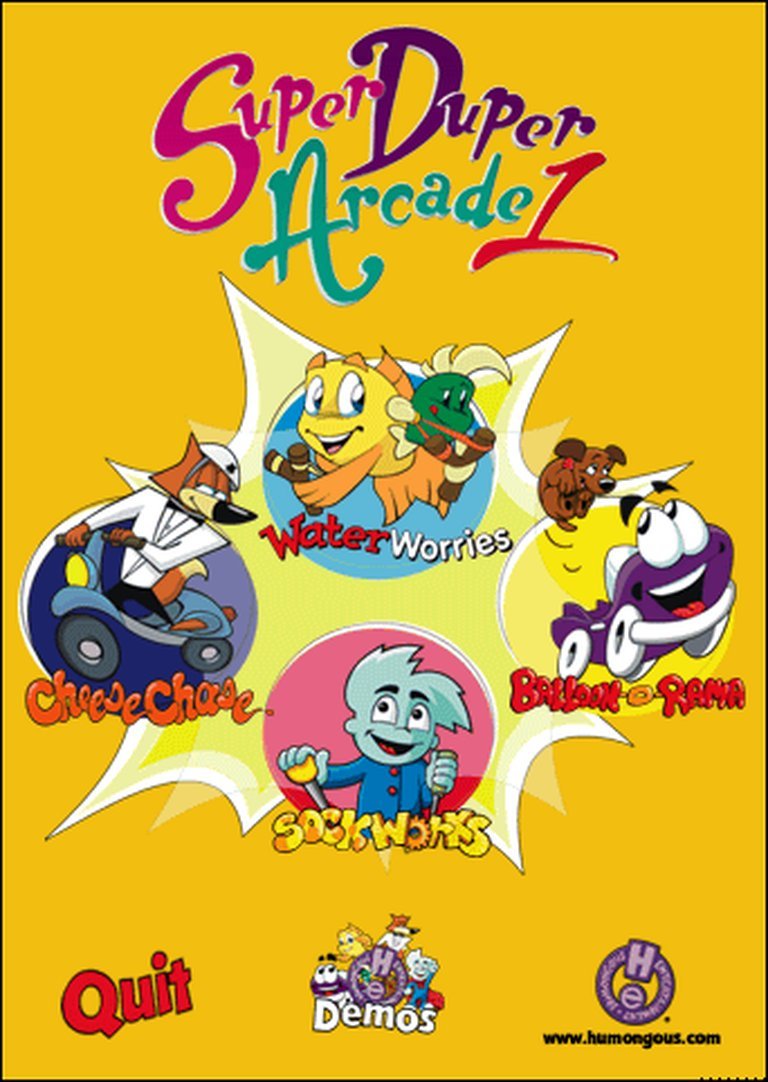
Super Duper Arcade 1 is a 1999 compilation disc published by Humongous Entertainment, bundling four arcade-style games from the Junior series: Putt-Putt and Pep’s Balloon-o-Rama, Freddi Fish and Luther’s Water Worries, Pajama Sam’s SockWorks, and Spy Fox in Cheese Chase. Designed for young players, this collection features colorful, intuitive gameplay with beloved characters in diverse, whimsical settings, offering a variety of engaging activities suitable for children and families.
Super Duper Arcade 1: A Time Capsule of Humongous Joy
Introduction: The Arcade Cabinet of Childhood
In the bustling era of late-1990s PC gaming, a peculiar and delightful artifact emerged from the creative workshops of Humongous Entertainment: Super Duper Arcade 1. This 1999 compilation is not a traditional arcade port, nor a straightforward collection of minigames. It is, instead, a thoughtful and playful bridge—a deliberate attempt to translate the beloved characters and whimsical sensibilities of Humongous’s flagship Junior Adventure series (Putt-Putt, Freddi Fish, Pajama Sam, Spy Fox) into the fast-paced, score-attack language of the arcade. For a generation of children, this disc was a portal to a safe, vibrant, and challenging arcade where the only violence was a balloon popping or a sock finding its bin. This review argues that Super Duper Arcade 1 is a significant historical document, capturing a specific moment where “edutainment” evolved beyond pure learning into pure, unadulterated fun, leveraging established intellectual property to create a compilation that stands on its own as a masterclass in accessible, character-driven game design. Its legacy is twofold: as a cherished piece of childhood nostalgia and as a testament to Humongous Entertainment’s versatile design philosophy.
Development History & Context: Humongous Pivots to Play
To understand Super Duper Arcade 1, one must understand its creator. Humongous Entertainment, founded by Ron Gilbert and Shelley Day in 1992, had already cemented its reputation with the Putt-Putt, Freddi Fish, Pajama Sam, and Spy Fox adventure series. These “Junior Adventures” were point-and-click narratives built for ages 3-8, emphasizing exploration, puzzle-solving, and non-violent conflict resolution. They were powered by a proprietary engine, a spiritual successor to LucasArts’ SCUMM, tailored for simple interfaces and vibrant hand-drawn art (a shift from the pixel art of the earliest titles).
By the late 1990s, the market for children’s software was maturing. While adventure games remained popular, there was a growing appetite for more immediate, replayable gratification—the essence of arcade gameplay. Humongous responded not with entirely new IPs, but by mining their existing, wildly successful franchises. The “Junior Arcade” series was born, with titles like Putt-Putt and Pep’s Balloon-o-Rama (1996) and Spy Fox in Cheese Chase (1998) appearing as standalone releases. Super Duper Arcade 1 (and its sibling, Super Duper Arcade 2, released simultaneously) was the logical culmination: a value-packed CD-ROM compiling four of these arcade spinoffs onto one disc. Technologically, it was a product of the CD-ROM boom, where 650MB of space allowed for bundling. The games themselves, while simpler than their adventure cousins, still utilized Humongous’s signature high-quality animation and sound, a stark contrast to the often-chintzy production values of contemporaneous kids’ arcade bundles. This compilation was a strategic move to extend the lifecycle and revenue of their core franchises, offering fans a new way to interact with their favorite characters.
Narrative & Thematic Deep Dive: Character Over Plot
Super Duper Arcade 1 presents a fascinating case study in narrative minimalism. These are not story-driven games; they are premise-driven. Each title establishes a utterly simple, context-free scenario that serves purely as a flimsy scaffolding for gameplay. There is no exposition, no cutscenes, no dialogue trees. The “narrative” is implied through character selection and thematic consistency with the parent series.
- Putt-Putt and Pep’s Balloon-o-Rama: The premise is pure conceit. Putt-Putt, the friendly purple convertible, and his dog Pep are in a “Balloon-o-Rama.” The why is irrelevant. The theme is cheerful, celebratory chaos.
- Freddi Fish and Luther’s Water Worries: Freddi Fish, the intrepid junior detective, and her laid-back friend Luther are engaged in… target practice? The game involves shooting “worm-doodles” (as described by secondary sources) at targets. It’s a bizarre departure from Freddi’s usual sleuthing, but it maintains her determined personality—she’s still aiming to succeed.
- Pajama Sam’s SockWorks: Here, the premise aligns perfectly with the character. Pajama Sam, the imaginative boy who conquers his fear of the dark, is faced with the mundane yet monumental childhood task: sorting laundry. The theme is domestic order and logical categorization, a quiet, cerebral challenge.
- Spy Fox in Cheese Chase: The most thematically resonant. Spy Fox, the suave, gadget-wielding secret agent fox (a clear parody of James Bond), is on an obstacle course. The “Cheese Chase” name evokes a spy mission where the MacGuffin is dairy-based. It’s a perfect, silly translation of spy tropes into a simple runner/avoider game.
The underlying theme unifying all four is “Playful Mastery.” There is no villain to defeat (except perhaps the clock or the high score), no world to save. The goal is self-improvement, pattern recognition, and mechanical skill. This stripped-down approach is a thematic statement in itself: the joy of these characters is in their presence and the pure satisfaction of gameplay, unburdened by narrative. It’s a pure distillation of the “game” part of “video game,” wrapped in the comforting skins of Childhood Icons.
Gameplay Mechanics & Systems: Four Flavors of Arcade Simplicity
The compilation is a quartet of distinct, pure arcade loops, each focusing on a different core skill.
-
Putt-Putt and Pep’s Balloon-o-Rama: A vertical shooter-lite. Players control Putt-Putt moving left/right at the bottom, with Pep independently popping balloons that drift down. The core loop is pattern recognition and split-second timing. Popping specific colored balloons (like those tied to paint buckets) can change Putt-Putt’s color, a fun callback to the customization in the adventure games. The challenge escalates with denser balloon patterns and faster speeds. It’s a test of reflexes and spatial awareness, wrapped in cheerful, popping sound effects.
-
Freddi Fish and Luther’s Water Worries: A static shooting gallery. Freddi is fixed in place, with targets (the worm-doodles) appearing on screen. Players aim and shoot, likely with a cursor. The mechanics involve timing and accuracy, though secondary sources suggest a target-practice purity. It’s the most straightforward of the set, focusing purely on hand-eye coordination without movement.
-
Pajama Sam’s SockWorks: The outlier and, by many accounts, the most clever. This is a physics-based sorting puzzle disguised as an arcade game. Socks of different colors/patterns fall from the top, and the player must guide them into similarly colored bins using a paddle or deflector. The “arcade” element comes from the time limit and the increasing speed and complexity of sock patterns. It requires strategic planning and quick decision-making, engaging the logical brain more than the reflexive one. This title best exemplifies Humongous’s “edutainment” roots hiding within an arcade format.
-
Spy Fox in Cheese Chase: The most dynamic. Described as an “obstacle course” game, it likely has Spy Fox automatically running or scrolling, with the player performing jumps, dodges, or gadget uses to navigate hazards. The core loop is reaction-based platforming or avoidance. The spy theme allows for whimsical hazards (lasers, rolling cheese wheels, enemy agents) that fit the franchise’s parody tone.
UI & Innovation: The UI across all games is intentionally minimal, with large, clear icons and bright colors suitable for young children or low-resolution displays. There are no complex HUDs; score and time are simple readouts. The “innovation” lies not in radical mechanics but in thematic fidelity. Each game feels unmistakably like a Putt-Putt, Freddi Fish, Pajama Sam, or Spy Fox experience, despite the genre shift. The sound effects, character grunts, and visual cues are pulled directly from the adventure games’ asset libraries, creating an immediate sense of familiarity. The flaw, however, is a lack of cohesion between the games; there’s no overarching meta-game, high-score table persistence between titles, or shared aesthetic menu. It’s four distinct games packaged together, which, while honest, feels less like a curated “arcade” and more like a bundle.
World-Building, Art & Sound: The Humongous Signature
The atmosphere of Super Duper Arcade 1 is 100% Humongous Entertainment. This is the late-90s peak of their hand-drawn animation style: soft, rounded character designs, lush and colorful backgrounds, and an overwhelming sense of friendly, safe whimsy.
- Visual Direction: Each game retains the unique art identity of its series. Balloon-o-Rama is set against a bright blue sky with fluffy clouds. Water Worries has an underwater, bubbly aesthetic. SockWorks is a domestic interior—laundry room or bedroom. Cheese Chase is a spy-fi obstacle course with sleek, gadget-filled environments. The sprite work is detailed and expressive, with Putt-Putt’s smile, Freddi’s determined look, Sam’s sleepy eyes, and Spy Fox’s cool confidence all readable even in small arcade-scale sprites. The color palettes are vibrant and primary, designed to captivate a child’s eye.
- Sound Design: The audio is a masterclass in character. The music for each game is a catchy, looping midi track that matches the theme—upbeat and jazzy for Spy Fox, playful and staccato for Pajama Sam, etc. More importantly, the voice clips are iconic. Putt-Putt’s “Honk-honk!” and Pep’s doggy sounds, Freddi’s “Golly gee!”, Sam’s mumbled “I’m not scared!”, and Spy Fox’s smooth “Got it!” are all present, triggered by in-game actions. This auditory branding is powerful, immediately anchoring each arcade game in its broader narrative universe. The sound effects for actions—balloon pops, sock plops, cheese clatters—are satisfying and clear, providing crucial gameplay feedback.
Together, these elements create a world that is instantly recognizable and reassuring to fans. There is no disconnect between the adventure games and these arcade entries; they feel like different doors in the same playful, optimistic universe. This cohesion is the compilation’s greatest artistic strength.
Reception & Legacy: A Niche Darling and a Preservation Puzzle
Super Duper Arcade 1 existed in a quiet corner of the market. Critical reception was sparse but positive; the sole cited critic review from FamilyPC Magazine awarded it 86%, noting, “The entire Humongous cast… cheer kids through hundreds of levels in this bundle… young testers appreciated the company.” This sums up its appeal: it was a crowd-pleaser for its target demographic, with little critical analysis beyond that.
Commercially, its success is tied to the massive popularity of the Humongous brand. It was a staple of “triple treat” and “fun pack” bundles (like Humongous Entertainment Triple Treat), often found at educational software retailers or as value-packs in big-box stores. For parents seeking non-violent, high-quality games for their children, a Humongous compilation was a trusted purchase.
Its legacy is complex:
1. Historical Significance: It represents the apex of the “franchise arcade spin-off” model for children’s software in the 90s. It showed that established characters could support diverse gameplay genres without losing their identity.
2. Preservation and Obscurity: For years, it was a typical “orphan” product of a defunct studio (Humongous shuttered in 2005, assets later acquired by Tommo). Its preservation was taken up by the retro gaming community, specifically through ScummVM support. As noted on Macintosh Garden, both Super Duper Arcade 1 and 2 are preserved and playable on modern systems (including Apple Silicon Macs) via this emulator. This has cemented its status as a preserved piece of software history, accessible to enthusiasts.
3. The Name Confusion: A major complication in discussing this game is the 2024/2025 Steam release titled Super Duper Arcade by “Super Duper Vibes.” This is a completely unrelated, modern indie compilation of original retro-style arcade games (with titles like Space Intruders and Boom Bots). The name collision creates perpetual confusion in searches and discussions. The historical Super Duper Arcade 1 is the 1999 Humongous product, and the Steam version is a spiritual successor in name only. This highlights the challenges of preserving and categorizing video game history when titles are not unique.
4. Influence: Its direct influence is subtle but present in modern “party pack” style games for families and children (think Mario Party minigames or Jackbox). The model of taking a colorful IP and distilling it into simple, replayable skill-based challenges is now standard. Humongous’s own later bundles and the continued success of their re-released adventure games on Steam (2014) show the enduring value of their catalog, of which the Arcade compilations are a key part.
Conclusion: A Definitively “Super Duper” Artifact
Super Duper Arcade 1 is not a groundbreaking masterpiece that altered the course of game design. It does not have a tragic story or a cult following that analyzes its mechanics for decades. Instead, it is something more valuable: a perfectly executed artifact of a specific time, place, and philosophy.
It is the sound of a dial-up modem connecting to a world of friendly foxes and fish. It is the smell of a new CD-ROM, promising hours of contained joy. It is the pure, uncynical understanding that for a child, controlling a beloved character—even to pop balloons or sort socks—is a form of magic.
Its thesis is simple: fun is universal, characters are powerful, and accessibility is paramount. The gameplay loops are tight, the presentation is polished, and the charm is overwhelming. It fails only in its lack of ambition beyond its premise, but that premise is so joyfully realized that such a failure feels like a virtue.
Verdict: 8/10 – A Preserved Classic. As a piece of history, it is essential for understanding the breadth of Humongous Entertainment’s output and the late-90s children’s software boom. As a game, it remains a delightful, if brief, experience for its intended audience (and for nostalgic adults). It is a super duper time capsule, and thanks to the preservation efforts of the community, it remains a playable one. Its place in history is secure: not as a titan, but as a happy, humming piece of the machinery that brought video games into the homes and hearts of a generation with a simple, unwavering promise of a good time.