
- Release Year: 2003
- Platforms: Windows
- Publisher: NStorm, Inc.
- Developer: NStorm, Inc.
- Genre: Action, Sports
- Perspective: 1st-person
- Game Mode: Hotseat, Single-player
- Gameplay: Bowling, Character selection, Control schemes, Lane selection
- Setting: Christmas, Fantasy
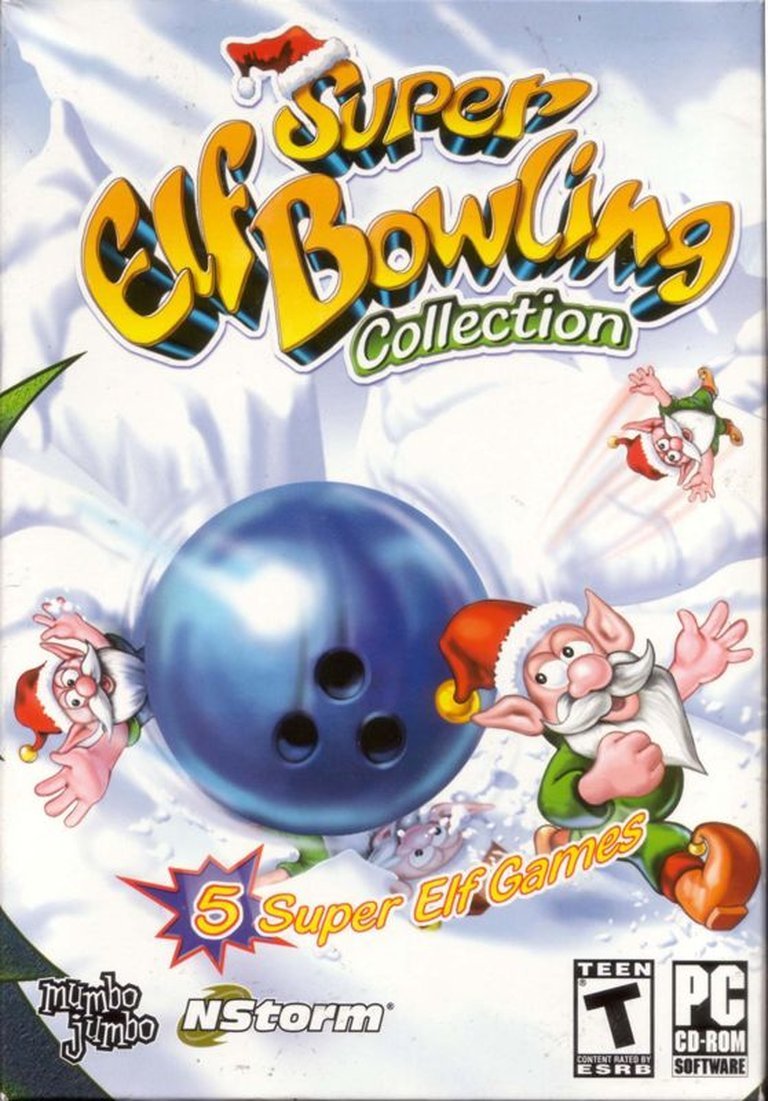
Description
Super Elf Bowling is a comedic, first-person sports game that parodies traditional bowling by replacing pins with mischievous elves. Players can choose from various holiday-themed lanes such as the Candy Factory, Ice Alley, or Toy Factory, select characters like Santa or custom bowlers with varying skills, and use control methods including mouse-based throws or slingshot mechanics. The objective is to achieve a maximum score of 300 by knocking down elves in two throws per frame, with options for single-player or multiplayer modes, and the shareware version limits play to Santa at the Candy Factory lane in Super Elf Bowling style.
Gameplay Videos
Super Elf Bowling Reviews & Reception
retro-replay.com : Super Elf Bowling delivers holiday cheer all year long.
Super Elf Bowling: A Yuletide Menagerie of Mayhem and Miscalculation
Introduction: The Strikes and Spares of a Viral Phenomenon
In the crowded pantheon of Christmas video games—a genre often derided for its saccharine sentiment and mechanical simplicity—Super Elf Bowling stands apart not through excellence, but through a bizarre and enduring legacy of cynicism, viral fame, and corporate metamorphosis. Released in November 2003 by NStorm, Inc., this title represents the fourth main entry and a technical overhaul of the Elf Bowling series that began as a $70,000 advergame and exploded into one of the earliest examples of a digitally viral casual game. Its thesis is as blunt as a bowling ball to the face: festive cheer is a facade for labor exploitation, and the only thing more satisfying than a strike is watching a cartoon elf get crushed by a runaway sphere. Yet, Super Elf Bowling is a paradox. It is a game that perfected a shallow, timeless core loop while simultaneously signaling the beginning of the franchise’s creative and ethical descent into cynical cash-grabbing. This review will argue that Super Elf Bowling is a pivotal but deeply flawed artifact—a moment where anovelty peaked technically while narratively and morally wilting under the weight of its own commercial ambitions, ultimately becoming a cautionary tale about the lifecycle of internet-born intellectual property.
Development History & Context: From Email Spam to Sharewarewall
To understand Super Elf Bowling, one must first trace the peculiar origins of its parent series. The entire franchise was birthed not from a passionate creative vision, but as a pragmatic marketing tool. In the late 1990s, the Dallas-based web design company NVision Design operated a small in-house games division called NStorm, Inc. (often mischaracterized as the “email marketing division”). The goal was simple: create lightweight, shareable freeware games that would serve as brilliant business cards. If someone enjoyed Frogapult or Good Willie Hunting, they might remember NVision when needing web services.
The original Elf Bowling (1999), conceived by Dan Ferguson and Mike Bielinski, was the breakout hit. Its genius lay in its form: a ~1MB standalone Windows executable. In the dial-up era, this could be emailed effortlessly, bypassing nascent web banners with a 23% click-through rate. The premise was deliberately, nihilistically funny: on Christmas Eve, Santa’s elves go on strike, and his response is to use them as human (elf?) pins. This dark holiday satire, wrapped in crude vector graphics and simple timing-based mechanics, became a monster. By December 1999, it was reportedly being played “900 times per second,” a staggering metric for the time. However, its success spawned a classic internet panic. Chain emails claimed ElfBowl.exe was a virus or spyware set to activate on Christmas Day, fueled by the game’s brief network connection—actually a benign server ping for download tracking. Symantec and others debunked it, but the stigma lingered, ironically amplifying its notoriety.
The business landscape shifted rapidly. NVision/NStorm was acquired by the aggressively expanding Vectrix Business Solutions in December 1999. Vectrix, a dot-com era roll-up, saw NStorm’s “viral process” as a patentable asset. But the dot-com bubble’s burst in 2000-2001 doomed Vectrix, which filed for Chapter 11 bankruptcy in July 2001. NStorm’s assets, including the Elf Bowling trademark, were auctioned off. The original founders (Bielinski and Ferguson), now at Kewlbox, tried to buy back their creation but were outbid at the last minute by Commotion Interactive, led by Matthew Lichtenwalter. This shady handoff, detailed in the fantastic investigative work of the Bad Game Hall of Fame, sowed the seeds of acrimony that would define the series’ later history. Commotion, lacking the original developers’ spirit, transformed the freeware advergame into a payware franchise.
Super Elf Bowling (2003) is the first fruit of this new, monetized model. Developed under Commotion’s NStorm banner, it was a graphical and mechanical overhaul, but crucially, it was sold as shareware. The full game was locked behind a paywall, with the demo offering only Candy Factory lane, Santa as the bowler, and one control scheme. This marked the complete reversal of the original’s free distribution ethos, pivoting to a retail-style model that would later be exploited for low-quality console ports.
Technological Constraints & Innovation: The original’s vector-based graphics were a technical necessity for a 1MB file. Super Elf Bowling moved to low-poly 3D (using software rendering or early 3D accelerators), allowing for varied lanes and character models but looking primitive even for 2003. Its innovation was in variety: six thematic lanes, five playable characters with different “skill” stats (affecting ball weight and control), and three distinct control schemes. This was a significant expansion from the original’s single, static lane and pure timing-click mechanic. However, the underlying physics engine remained absurdly simple—pin action was negligible, and the “sidestepping elf” randomizer from the first game ensured a perfect 300 was impossible, a design choice that framed the game as a score-attack novelty rather than a simulation.
Narrative & Thematic Deep Dive: The Class War at the North Pole
The narrative of Super Elf Bowling and the series at large is a masterclass in sustained, lowbrow anti-Christmas satire. The core premise, established in the 1999 original, is a labor dispute: Santa’s elves, overworked and underappreciated, go on strike. Santa’s solution is not negotiation, but brutal, bowling-based discipline. The elves are literally positioned as pins (10 per frame) and subjected to violent, comedic abuse. This is not subtle humor. It’s a recurring, gleeful celebration of petit-bourgeois authoritarianism disguised as holiday fun.
Character & World: The world is a consistently toxic North Pole. Santa is a scowling, bullying jock. The elves are a motley crew of snarking, flatulent, pants-dropping malcontents. Key characters include:
* Santa Claus: The player avatar. He is silent, vengeful, and physically imposing.
* Mrs. Kringle: A playable character in Super Elf Bowling with “precision” stats, her presence adds a layer of spousal complicity to Santa’s tyranny.
* Dingle Kringle: Santa’s ne’er-do-well brother, first introduced in Elf Bowling 2 as a shuffleboard opponent. In Super Elf Bowling, he’s a playable bowler with “power” stats, embodying familial rivalry and incompetence.
* Elliot Elf: The series’ primary running gag. His proclivity for explosive flatulence not only triggers collective elf mockery but, in Elf Bowling 6: Air Biscuits, becomes the primary propulsion mechanic. He represents the scapegoated, physically-expressive working class.
* Elly Fay Elf & Custom Bowler: Offer more stat variation, allowing players to project themselves into the hierarchy.
The dialogue is non-existent in-game (elves communicate through animated thought bubbles and sounds), but the Bad Game Hall of Fame review documents the extensive manual and splash screen text that fleshes out this world. Elves in Paradise (2002) reveals post-strike consequences: the elves won higher wages and a cruise, but Santa’s wager with Dingle involves implied sexual favors from Mrs. Claus—a crass escalation. Super Elf Bowling itself strips this back to pure sport, but the lore is that this is a sanctioned, ongoingdisciplinary event.
Thematic Underpinnings: The series operates on several unspoken, cynical themes:
1. Labor Exploitation as Spectacle: The elves’ strike is not a plot to be resolved, but a permanent state justifying their subjugation. Their misery is the entertainment.
2. Anti-Family Sentiment: Santa is a tyrant, Mrs. Claus is complicit (or a participant), and Dingle is a parasitic failure. The “family” of the North Pole is a dysfunctional corporation.
3. Toilet Humor as Emancipation: The elves’ only power is juvenile rebellion—mooning, farting, holding insult signs (“SANTA SUX!”). Their physicality is their only outlet against the crushing weight of Santa’s ball.
4. The Commodification of Christmas: Every sequel adds more branded lanes (Candy Factory, Cruise Ship), product tie-ins (CDNow, TechTV), and ultimately, a direct-to-video movie. The holiday itself is a marketing vehicle, and the series embodies that sentiment with terrifying accuracy.
Super Elf Bowling doesn’t advance this narrative; it aestheticizes it. The 3D lanes (Toy Factory, Cruise Ship, Rooftop) turn the North Pole into a theme park of exploitation. The “Candy Factory” lane, with its giant gumdrops that alter ball physics, makes the labor (making toys/candy) part of the playground where Santa exercises dominance.
Gameplay Mechanics & Systems: Precision in Pointlessness
At its heart, Super Elf Bowling is a ten-pin bowling game where the pins are sentient, taunting elves. The core loop is identical to traditional bowling: 10 frames, two balls per frame (unless you get a strike), aiming to knock down all 10 elves. The scoring is standard: strikes (10 + next two balls) and spares (10 + next ball), with a theoretical maximum of 300. However, as in the original, the elf in the 1-pin position has a random chance to sidestep the ball, rendering a perfect 300 statistically impossible—a clever (if petty) design choice that encourages replayability for perfectionists.
Control Schemes & Systems: Super Elf Bowling’s primary innovation is offering three distinct control methods:
1. Classic / Elf Bowling Mode: The exact control scheme from the original. A lateral arrow moves back and forth at the foot of the lane. The player clicks to stop it, setting left/center/right direction. Power is fixed. This is pure timing and memorization.
2. Super Elf Bowling Mode: This is the titular “upgrade.” The player uses the mouse to position the ball at the foul line, then clicks and drags backwards to set power and angle (like a golf swing), releasing to throw. This adds a layer of skill and physicality absent from the original.
3. Slingshot Mode: A rubber band stretches across the lane. The player clicks and drags the ball back against the band, then releases. This offers yet another tactile feel and power curve.
Character & Lane Selection: The game introduces RPG-lite elements. Six bowlers are available:
* Santa: Balanced.
* Mrs. Kringle: High precision, lower power.
* Dingle Kringle: High power, low precision.
* Elly Fay Elf & Elliot Elf: Variations on balanced and power/quirky stats.
* Custom Bowler: Player-named, with adjustable stats.
Each character’s “skill level” subtly affects the ball’s weight, its curve in the Super mode, and its resistance to gutter-hooking. This encourages experimentation: a power build for easy strikes, a precision build for picking up tricky spares. The six lanes (Ice Alley, Toy Factory, Candy Factory, Cruise Ship, Rooftop, Hockey Rink) are largely aesthetic, though some (like Candy Factory) have minor interactive elements (bouncing candy). They serve to refresh the visual palate and reinforce the theme.
UI & Presentation: The interface is clean. Lane select, bowler select, and control scheme are all on the main menu. During gameplay, a simple scorecard is displayed. The 3D visuals, while dated, provide a sense of depth the original lacked. The elf animations are more fluid and varied—dancing, covering their ears, reacting to near-misses. The sound design is repetitive but effective: Santa’s hearty “Ho ho ho!” on a strike, the elves’ collective “Whoa!” and “Is that all you got?” taunts, and the satisfying crunch of impact.
The Shareware Shackle: A critical, anti-player system is the shareware limitation. Only Candy Factory lane, Santa, and Super Elf Bowling mode are available. To unlock the game’s full promise—all lanes, characters, and modes—requires purchasing the full version. This transforms the game from a complete toy into a teaser. In the context of a series that began as free viral marketing, this paywall felt like a profound betrayal to its early adopters and established a predatory pattern later exploited by the infamous GBA/DS ports.
Flaws & Limitations: The game is ingeniously simple but shallow. There is no spin control in any mode (except the vague “curve” stat). Pin action physics are minimal; pins scatter but rarely create strategic chain reactions. The “skill” stats have a subtle, almost negligible impact on high-level play. The game’s challenge comes from the sheer, mindless fun of repetition and the desire to hear the next elf insult. Its “depth” is in attaining the elusive strike/spare, not in strategic complexity.
World-Building, Art & Sound: From Vectors to Vaporware Vulgarity
The Aesthetic Evolution: The original Elf Bowling used simple, clean 2D vector graphics. The elves were smooth, monochromatic (often green or red) shapes with minimal detail. This style had a charming, almost MS Paint authenticity. Super Elf Bowling transitions to textured, low-polygon 3D models. The elves are now fully rendered, with silly hats, beards, and expressive faces. The lanes are immersive 3D environments: the Ice Alley has reflective ice and snow piles; the Toy Factory has conveyor belts and giant stuffed animals; the Cruise Ship sways gently. This was a significant leap, making the world feel more “lived-in” and grotesque.
However, this 3D upgrade came at a cost. The game runs at a low frame rate and uses a limited color palette, giving it a muddy, Windows 98-era look. The charm is less “endearing crudeness” and more “barely functional.” The animations, while more numerous, can be stiff. The transition from the vector-based clarity to polygon-based mess is symbolic of the series’ broader shift: from clever, lightweight joke to bloated, commercially-motivated product.
Sound as Satire: The audio suite is small but iconic. The soundtrack is limited to a few repetitive, jingle-bell-esque loops that are inoffensive but forgettable. The genius is in the sound effects:
* The clack-clack-clack of the ball rolling.
* The sproing of the slingshot.
* The varied, squeaky elf screams upon impact.
* Santa’s celebratory “HO HO HO!” and disappointed “DARN!”
* The elf taunts: “Is that all you got?”, “Santa Sux!”, and Elliot’s signature fart sound.
These sounds are the primary carriers of the game’s humor and personality. They are cheap, repetitive, and immensely satisfying in the moment. The Bad Game Hall of Fame review poignantly notes how later ports, especially the GBA/DS versions, lost many of these audio cues and animations, gutting the game’s soul.
Atmosphere & Tone: The atmosphere is one of perpetual, participatory cruelty. The settings are Christmas-themed but warped: a factory, a slippery alley, a dangerous rooftop. The color schemes are garish (candy-cane stripes, neon toy colors). The tone never wavers from comedic violence. There is no warmth, only the cold satisfaction of a perfect strike achieved through brute force. This deliberate lack of traditional holiday spirit is its defining—and for many, its only—artistic statement.
Reception & Legacy: A Franchise Forged in Fire, Frozen in Shovelware
Super Elf Bowling’s immediate reception is difficult to gauge. As a shareware title in 2003, it didn’t attract major critical attention. Within the niche of viral casual game fans, it was likely seen as a competent, fuller-featured sequel. Its significance is retrospective: it represents the peak of the series’ technical ambition and the formalization of its paywall business model.
The Tarnished Legacy: Ports, Profits, and Pettiness: The true testament to Super Elf Bowling’s legacy is the catastrophic reception of its indirect successors. The compilation Elf Bowling 1 & 2 (2005) for GBA and DS, developed by Black Lantern Studios and published by Ignition Entertainment, is one of the most infamous critical disasters in handheld history. Metacritic scores of 12/100 (DS) and similarly abysmal GBA reviews (IGN: 1/10, GameSpot: “god awful”) eviscerated it. The Bad Game Hall of Fame’s autopsy is brutal: missing story screens, truncated animations, broken physics (splits impossible, collision detection non-existent), and a severe graphical downgrade that lost the vector charm for flat, jagged sprites. This wasn’t just a bad port; it was an act of profound negligence. The fact that these were paid releases of free games, years later, made the offense worse.
This disaster triggered a Wikipedia edit war. Matthew Lichtenwalter of Commotion Interactive (the rights holder) anonymously edited the article to state the GBA/DS ports were “unauthorized and without permission” and “extremely poor copies.” This claim is dubious—no lawsuits were filed, and the games were officially listed on publisher sites. It likely reflects post-hoc rationalization for a shoddy product or a business dispute. Meanwhile, original creator Dan Ferguson also self-edited the article, highlighting his own role. This petty digital feud over a series of elf-bowling games encapsulates the entire franchise’s tragicomic descent: from viral, grassroots joy to corporate squabbles over a degraded brand.
The Franchise’s Death by a Thousand Cuts: Post-Super Elf Bowling, the series hemorrhaged creativity:
* Elf Bowling: Bocce Style (2004): Replaced bowling with bocce ball.
* Elf Bowling 6: Air Biscuits (2005): Elf-launching via flatulence.
* Elf Bowling 7⅐: The Last Insult (2007): Returned to bowling with power-ups and a story mode—too little, too late.
* Elf Bowling: Hawaiian Vacation (2008): Same engine, tropical setting. The last gasp.
* Elf Bowling the Movie: The Great North Pole Elf Strike (2007): A CGI film so reviled (IMDb 1.8) it killed planned sequels.
The final planned title, Elf Bowling: Collector’s Edition for DS (by Detn8 Games), was canceled. The rights have changed hands multiple times, with MumboJumbo briefly involved. Today, the series is abandonware, preserved through fan sites and archives like My Abandonware. Its modern availability is a ghost of its former self.
Cultural Impact: Its legacy is bifurcated:
1. The Viral Blueprint: Elf Bowling (1999) is a cornerstone of pre-social media internet culture. It demonstrated the power of lightweight, shareable executable games as marketing. The malware hoax itself is a case study in early internet panic and the importance of digital literacy.
2. The cautionary tale: The series is a textbook example of how to mismanage a viral hit. The shift from free to paid, the lazy and exploitative console ports, the extension into irrelevant spin-offs and a terrible movie—all illustrate the death of a novelty through over-commercialization and a fundamental misunderstanding of what made the original appealing (its free, cruel simplicity). The Bad Game Hall of Fame’s verdict that Elf Bowling 1&2 was a product “made for absolutely no one” applies to the entire post-2003 franchise.
Conclusion: A Perfectly Imperfect Frame
Super Elf Bowling is a game that cannot be evaluated in a vacuum. It is the apex of the Elf Bowling series’ mechanical evolution—a 3D, feature-rich bowling game with surprising (if shallow) customization. As a standalone piece of software from 2003, it is a fun, juvenile, and effective holiday distraction. Its controls are functional, its humor consistent, and its replayability reasonable for a score-attack title.
However, its place in history is defined by context. It is the bridge between the series’ anarchic, freewheeling beginnings and its cynical, monetized decline. It introduced the paywall that would later enable the atrocious GBA/DS ports. It perfected a loop so simple that any subsequent deviation (bocce, air biscuits) felt like creative bankruptcy. Its narrative of Santa bowling striking elves remains its strongest, most coherent asset—a darkly comic, sustained bit of world-building that the expanding franchise only muddied.
Ultimately, Super Elf Bowling is a 7/10 game with a 3/10 legacy. It is a competent, niche product that inadvertently paved the way for its own franchise’s ruin. It represents a moment when a piece of internet ephemera was recognized as a “brand” and subjected to the full, ugly cycle of commercialization: acquisition, sequels, platform expansion, and merchandise. The joy of the original—the swift, email-forwardable chuckle—was methodically extracted and replaced with the chore of unlocking content and the ignominy of being sold on a bargain bin cartridge.
In the museum of video game history, Super Elf Bowling does not belong in the “Great Games” wing, nor does it deserve the “Worst Games” hall of infamy solely on its own merits. It belongs in a special exhibit: “The Curious Life and Gruesome Death of a Viral Advergame.” It is a testament to the fact that a game can be both culturally significant and fundamentally shallow, both a brilliant marketing ploy and a creative dead end. The ultimate irony is that a game about the crushing of labor for sport became itself a product crushed by the capitalist forces it satirized. For that, it earns not a perfect strike, but a memorable, cautionary gutter ball.