
- Release Year: 2001
- Platforms: Windows
- Publisher: Planet Intermedia, SYBEX-Verlag GmbH
- Genre: Puzzle
- Game Mode: Single-player
- Gameplay: quiz, trivia
Description
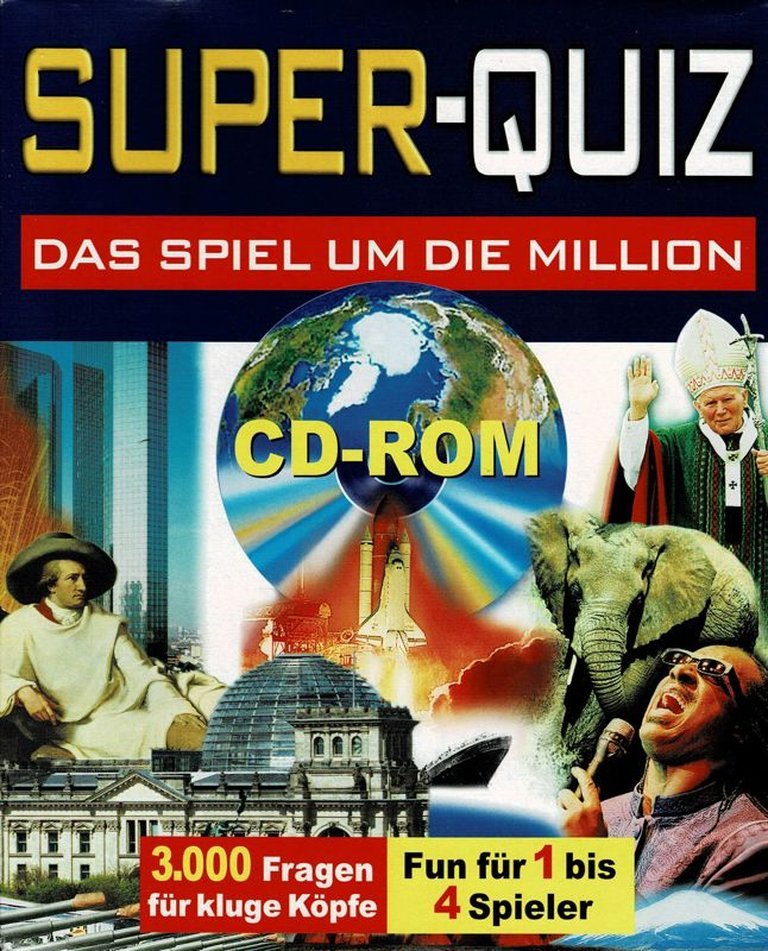
Super-Quiz: Das Spiel um die Million is a German quiz game released in 2001 for Windows, featuring 3,000 questions across eight categories, including Nature, Sports, History, Culture, Media, Science, Geography, and Entertainment. Players can compete solo against the computer or in multiplayer rounds with up to four participants, answering randomly generated questions with eight possible answers each. The goal is to be the first to accumulate one million points, blending trivia challenges with a game show-style format.
Super-Quiz: Das Spiel um die Million – A Deep Dive into Germany’s Forgotten Trivia Gem
Introduction: The Million-Euro Question
In the early 2000s, the quiz game genre was experiencing a renaissance, fueled by the global success of television shows like Who Wants to Be a Millionaire? and Jeopardy!. Germany, never one to shy away from a good trivia challenge, saw the release of Super-Quiz: Das Spiel um die Million (2001), a digital adaptation of the board game Das Super-Quiz um Millionen. Developed by Planet Intermedia and published by SYBEX-Verlag GmbH, this Windows-based quiz game promised players the thrill of high-stakes trivia, pitting them against a computer or friends in a race to accumulate a virtual fortune.
Yet, despite its ambitious premise and the cultural zeitgeist it rode, Super-Quiz remains an obscure footnote in gaming history. This review seeks to resurrect its legacy, examining its design, mechanics, and the broader context of its existence. Was it a pioneering digital quiz experience, or merely a forgettable cash-in on a fleeting trend? Let’s dissect it piece by piece.
Development History & Context: Riding the Trivia Wave
The Studio & Vision
Super-Quiz: Das Spiel um die Million was developed by Planet Intermedia, a German studio that primarily focused on educational and casual games. The publisher, SYBEX-Verlag GmbH, was known for its software and book publications, particularly in the fields of IT and business. Their collaboration on this title was likely an attempt to capitalize on the burgeoning quiz game market, which was exploding thanks to the success of Who Wants to Be a Millionaire? (1998–).
The game’s digital iteration was closely tied to its board game counterpart, Das Super-Quiz um Millionen, designed by Michael Rüttinger and published by Noris Spiele. The board game, released in 2001, featured 5,500 questions across multiple categories, a far cry from the digital version’s 3,000. This discrepancy suggests that the video game was either a scaled-down adaptation or a separate project inspired by the same concept.
Technological Constraints & Era
Released in 2001, Super-Quiz was a product of its time. The minimum system requirements—Windows 95, a Pentium CPU, and 32 MB of RAM—reflect the modest hardware of the late ’90s and early 2000s. The game was distributed on CD-ROM, a standard medium for PC games at the time, and relied on mouse input, eschewing more complex control schemes.
The early 2000s were a transitional period for gaming. While 3D graphics were becoming the norm, many casual and educational games still relied on 2D interfaces and simple mechanics. Super-Quiz fit squarely into this category, offering a no-frills, functional experience rather than a visually stunning one.
The Gaming Landscape of 2001
The year 2001 was dominated by groundbreaking titles like Halo: Combat Evolved, Grand Theft Auto III, and Silent Hill 2. In this environment, a text-heavy quiz game was never going to be a blockbuster, but it didn’t need to be. The market for casual and family-friendly games was growing, particularly in Europe, where board game adaptations and trivia titles found niche audiences.
Super-Quiz competed with other quiz games of the era, such as:
– Jackpot: Das Quiz um die Million! (2001) – A direct competitor with a similar premise.
– Million Dollar Quest (2010) – A later, more polished take on the millionaire quiz formula.
– Trivial Pursuit (various digital adaptations) – The quintessential quiz game franchise.
Unlike these, Super-Quiz lacked the brand recognition of Trivial Pursuit or the television tie-in of Who Wants to Be a Millionaire?. It was a standalone product, relying purely on its gameplay merits to attract players.
Narrative & Thematic Deep Dive: The Illusion of a Million
The Premise: A Game Show Without the Show
Super-Quiz is, at its core, a pure gameplay experience. There is no overarching narrative, no characters to speak of, and no real “story” beyond the abstract goal of winning a million virtual dollars. This is not a criticism but an observation of its minimalist design philosophy.
The game’s thematic foundation is rooted in the game show aesthetic of the late ’90s and early 2000s. The idea of answering questions to climb a monetary ladder was a cultural phenomenon, and Super-Quiz sought to replicate that tension in a digital format. However, unlike its television counterparts, it lacked:
– A charismatic host (no digital Regina or Chris Tarrant).
– Dramatic music and lighting (the stakes felt lower without the production value).
– Audience interaction (no lifelines, no “ask the audience” mechanics).
Instead, it relied on raw trivia challenge, making it a purist’s quiz game—stripped of fluff, focused solely on the questions.
Categories & Question Design
The game’s 3,000 questions are divided into eight categories:
1. Nature (e.g., biology, ecology)
2. Sports (e.g., football, Olympics)
3. History (e.g., world events, wars)
4. Culture (e.g., art, literature)
5. Media (e.g., films, television)
6. Science (e.g., physics, chemistry)
7. Geography (e.g., countries, capitals)
8. Entertainment (e.g., music, celebrities)
The randomized selection of categories and stakes ensured that no two games played the same way. However, the eight-answer multiple-choice format (as opposed to the standard four) was an interesting deviation from most quiz games. This increased difficulty, as players had to sift through more options, some of which were likely plausible but incorrect.
Themes: Knowledge as Currency
The game’s central theme is the commodification of knowledge. In Super-Quiz, intellect is directly tied to financial reward, mirroring the capitalist undertones of game shows like Who Wants to Be a Millionaire?. The million-dollar prize is purely symbolic—there’s no real money at stake—but the psychological thrill of accumulation remains.
This theme is reinforced by the progression system:
– Correct answers move you forward on a virtual money ladder.
– Incorrect answers penalize you, forcing a step back.
– The first to one million wins.
The lack of a narrative wrapper (e.g., a story about why you’re answering these questions) makes the experience purely mechanical, but also universally accessible. There’s no barrier to entry beyond general knowledge.
Gameplay Mechanics & Systems: The Quiz Engine
Core Gameplay Loop
Super-Quiz follows a simple but effective loop:
1. Select a category (or let the game choose randomly).
2. Answer a question from eight possible choices.
3. Advance on the money ladder if correct, retreat if wrong.
4. Repeat until someone reaches one million.
The game can be played:
– Solo against the AI (a passive opponent that answers questions at a fixed difficulty).
– Multiplayer (up to 4 players)—likely the intended way to play, given the board game’s social nature.
Question Difficulty & Randomization
The randomized stakes and categories ensure unpredictability, but the difficulty scaling is unclear. The game does not explicitly state whether questions grow harder as you progress, but given the million-dollar endpoint, it’s reasonable to assume that later questions are more challenging.
The eight-answer format is the game’s most distinctive (and potentially frustrating) mechanic. Most quiz games use four answers, making educated guesses easier. Here, the increased options force players to:
– Read carefully (some answers are nearly identical).
– Rely more on pure knowledge (guessing is less effective).
– Take longer per question (which may slow down the pace).
UI & Presentation: Functional but Uninspired
The game’s user interface is utilitarian:
– Text-heavy screens dominate, with questions and answers displayed in a basic font.
– No voice acting—questions are presented as static text.
– Minimal animations—likely just a progress bar or money counter.
This lack of polish is understandable given the technological limitations of 2001, but it also means the game lacks the excitement of its television counterparts. There’s no:
– Dramatic “Final Answer” moment.
– Tension-building music.
– Visual feedback beyond a simple “correct/incorrect” prompt.
Multiplayer: The Intended Experience
The multiplayer mode (2–4 players) is where Super-Quiz shines. The competitive trivia format works best when played with friends or family, replicating the social dynamics of a board game. However, the lack of online play (a rarity in 2001) means it was local-only, limiting its longevity.
Flaws & Missed Opportunities
While Super-Quiz is competent, it suffers from several design oversights:
1. No Lifelines – Unlike Who Wants to Be a Millionaire?, there are no “50:50” or “Ask the Audience” mechanics, making it less forgiving.
2. No Question Database Expansion – The 3,000 questions were fixed; there was no way to add new ones, limiting replayability.
3. No Visual or Audio Feedback – A simple “ding” for correct answers would have added immersion.
4. No Progression Beyond the Million – Once you win, there’s no incentive to replay unless you enjoy the questions themselves.
World-Building, Art & Sound: The Aesthetic of a Quiz Game
Visual Design: Minimalism Over Spectacle
Super-Quiz is not a visually impressive game. Its art style can be described as:
– Functional – The UI is clean but bland, prioritizing readability over aesthetics.
– Early 2000s PC Game Aesthetic – Think Windows 95-era design, with basic menus and static backgrounds.
– No Character or Environmental Art – Unlike modern quiz games (e.g., Jackbox), there are no avatars, no animated hosts, no themed stages.
The box art (available on MobyGames) suggests a generic game show vibe, with gold and blue accents evoking wealth and intellect. However, the in-game experience is far more spartan.
Sound Design: Silence Speaks Volumes
The game’s audio design is almost nonexistent:
– No background music – Just silence or ambient PC hum.
– No voice acting – Questions are text-only.
– Minimal sound effects – Likely just a correct/incorrect chime.
This lack of audio feedback makes the game feel sterile. Even a simple MIDI track would have added atmosphere.
Atmosphere: The Loneliness of the Trivia Champion
Playing Super-Quiz solo feels isolating. There’s no sense of occasion, no build-up to the million-dollar question. The absence of a host or audience removes the game show spectacle, leaving only the cold, hard questions.
In multiplayer, the atmosphere improves dramatically, as human interaction replaces the missing audio-visual flair. The competitive banter and shared groans over tough questions make it feel like a real quiz night.
Reception & Legacy: The Forgotten Contender
Critical & Commercial Reception
Super-Quiz: Das Spiel um die Million lacks documented reviews on MobyGames, Metacritic, or other major aggregators. This suggests:
– Limited marketing – It may have been a budget release with little promotional push.
– Niche appeal – Quiz games were not mainstream in 2001 outside of licensed titles.
– Overshadowed by competitors – Games like Trivial Pursuit and Who Wants to Be a Millionaire? dominated the space.
Given its obscurity, it’s likely that Super-Quiz sold modestly at best, appealing primarily to:
– German-speaking audiences (the game was Germany-exclusive).
– Board game fans looking for a digital adaptation.
– Casual gamers who enjoyed trivia but didn’t seek high-production-value experiences.
Legacy: A Footnote in Quiz Game History
Super-Quiz did not spawn sequels or imitators, and its influence on later games is negligible. However, it represents:
– An early attempt at digital quiz gaming before the Jackbox Party Pack era.
– A bridge between board games and video games, showing how traditional game mechanics could transition to digital.
– A time capsule of early 2000s PC gaming, reflecting the limitations and simplicity of the era.
Its biggest legacy may be as a curiosity—a game that few remember, but one that captured a moment when quiz shows ruled pop culture.
Conclusion: A Million-Dollar Idea with a Thousand-Dollar Execution
Super-Quiz: Das Spiel um die Million is not a bad game, but it is a forgettable one. It succeeds in its core objective—delivering a functional, challenging quiz experience—but fails to elevate the formula in any meaningful way.
Strengths:
✅ Large question database (3,000 questions) – Ensures variety.
✅ Eight-answer format – Adds difficulty and forces careful reading.
✅ Multiplayer support (2–4 players) – The best way to experience it.
✅ Simple, accessible mechanics – Easy to pick up and play.
Weaknesses:
❌ No narrative or presentation flair – Feels sterile and mechanical.
❌ No lifelines or assistance mechanics – Less forgiving than competitors.
❌ No replayability incentives – Once you’ve seen the questions, there’s little reason to return.
❌ Dated, barebones UI – No visual or audio polish.
Final Verdict: 6/10 – A Competent but Unremarkable Trivia Game
Super-Quiz is a product of its time—a serviceable quiz game that does the job but doesn’t excel. It’s not a must-play, but it’s an interesting artifact for:
– Retro gaming enthusiasts curious about early 2000s PC games.
– Trivia buffs who want a no-frills challenge.
– Board game fans who enjoy digital adaptations of tabletop classics.
In the grand tapestry of gaming history, Super-Quiz is a minor thread—not a masterpiece, but a small, functional stitch in the evolution of quiz games. It may not have won the million, but it earned its place in the archive.
Would I recommend it today? Only to die-hard trivia fans or collectors of obscure German PC games. For everyone else, modern alternatives (Jackbox, QuizUp, or even Who Wants to Be a Millionaire? mobile games) offer far more polish and replayability.
But for what it was—a simple, earnest quiz game from 2001—it delivers exactly what it promises. And sometimes, that’s enough.
Final Score: ★★★☆☆ (3/5) – A Decent but Dated Trivia Challenge