
- Release Year: 1998
- Platforms: Windows
- Developer: Josh Bender
- Genre: Action
- Perspective: 3rd-person (Other)
- Game Mode: Single-player
- Gameplay: Breakout, Gun, Paddle, Pong, Spider
Description
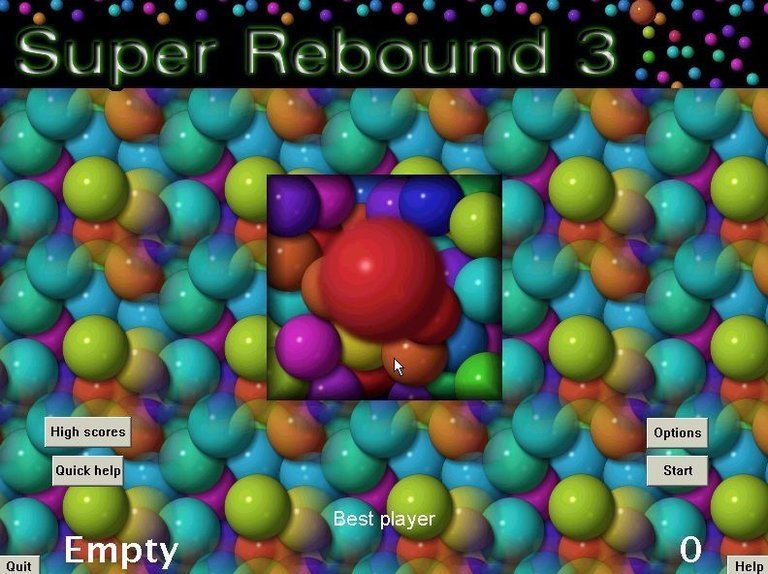
Super Rebound 3 is a single-player Breakout clone developed by Josh Bender and released as freeware for Windows in 1998. Players control a paddle with the mouse, using SHIFT to fire a gun vertically and CTRL to randomize the ball’s angle, across two modes: beginner where balls don’t reset on bottom hits, and expert where they do. Instead of destroying all bricks, levels are cleared by defeating a giant spider that patrols the top screen, requiring fifteen hits while avoiding its retaliatory shots.
Super Rebound 3: Review
Introduction: A Phantom of the Freeware Scene
In the vast, uncatalogued archives of late-1990s PC gaming, there exists a shadowland of shareware and freeware titles—games that flickered briefly on bulletin board systems, personal websites, and nascent download hubs before receding into digital obscurity. Super Rebound 3 (1998) is a perfect specimen from this era: a game with no commercial footprint, no critical reception, and a player count so low it is measured in single digits on aggregation sites. Yet, within its modest 2-megabyte executable, crafted by a lone developer using a constrained authoring tool, lies a fascinating case study in genre hybridization. This review posits that Super Rebound 3 is not merely another Breakout clone, but a curious, flawed, and conceptually ambitious artifact that attempted to fuse the zen-like paddle physics of bat-and-ball games with the direct action of a shooter, all while operating under the severe technical and creative limitations of the 1990s freeware ecosystem. Its legacy is not one of influence, but of pure, unadulterated idea—a testament to what a single developer could imagine within a rigid framework.
Development History & Context: The One-Man Studio and the Klik & Play Revolution
The development history of Super Rebound 3 is almost entirely absent from the historical record, a common fate for freeware projects of its time. The sole credited creator is Josh Bender, a developer with a small portfolio of similar-sounding titles (Dr Goo series, ET’s Turbo Pig Bash) also hosted on preservation sites like Kliktopia. This context is crucial: Bender was not an indie auteur in the modern sense but part of a grassroots community of hobbyist developers empowered by accessible game-creation tools.
According to Kliktopia, the game was “Made using The Games Factory,” Clickteam’s 1997 successor to the wildly popular Klik & Play. This tool allowed non-programmers to create games via a visual, event-based interface, but it came with significant constraints: fixed screen resolutions, limited color palettes (often 256 colors), and predefined physics and input models. The fact that Super Rebound 3 was built for Windows 95/98 and requires only a Pentium 133 MHz and 32MB RAM speaks to its era-specific optimization for low-end home PCs. Its release window is ambiguously dated “1997-2021” on Kliktopia, but the Internet Archive lists a specific upload date of November 15, 1999, while MobyGames and MyAbandonware cite 1998. This minor discrepancy is emblematic of the chaotic distribution of freeware—a game could be “released” the moment a developer finished it and uploaded it to a GeoCities page, with no formal launch, marketing, or version control.
Bender’s vision, as inferred from the mechanics, was to take the pure, abstract challenge of Breakout—a game about angle, timing, and destruction—and layer upon it a secondary objective and a direct threat. The gaming landscape of 1998 was dominated by 3D accelerators (Half-Life, Unreal), but the 2D freeware scene remained vital, producing experimental takes on classics. Super Rebound 3 fits squarely into this tradition: a homage that seeks not to replicate but to augment a classic formula, using the only tools available to a solo developer.
Narrative & Thematic Deep Dive: The Absence of Story and the Metaphor of the Spider
To speak of “narrative” or “thematic depth” in Super Rebound 3 is to confront a void. The game provides no backstory, no character motivation, and no textual context. The “plot,” such as it is, is reduced to a single, relentless instruction: destroy the giant spider. This is not a narrative climax but a mechanical one—the spider is the win condition.
However, within this stark minimalism, one can analyze the implied mythology. The setting is a pure, grid-like arena of bricks—a sterile, digital colosseum. The player’s paddle is an anonymous, floating shield. The antagonist is a “giant spider that patrols the top of the screen.” Spiders in gaming and cultural symbolism often represent chaotic, creeping threat, a predator that weaves traps. Here, the spider is stationary yet actively offensive, shooting projectiles downward. This inverts the typical Breakout dynamic where the bricks are passive obstacles. The spider is a conscious entity that must be aggressed against, transforming the player from a mere destructor into a hunter.
The theme, then, is one of targeted annihilation versus area denial. The core tension of standard Breakout is between clearing the field and conserving balls. Super Rebound 3 deliberately decouples these: bricks are secondary, a mere obstacle to be cleared from the line of fire between paddle and spider. The true skill lies in weathering the spider’s return fire while landing fifteen precise hits with either the bouncing ball or the paddle-mounted gun. This creates a bizarre, almost asymmetrical combat scenario. The game’s philosophy is not “destroy everything” but “assassinate the boss,” a progenitor of later “bullet-hell boss rush” mechanics, albeit in a painfully primitive form. The lack of narrative justification only heightens this abstract, almost ritualistic confrontation.
Gameplay Mechanics & Systems: A Clumsy but Innovative Synthesis
The core gameplay loop of Super Rebound 3 is where its hybrid identity is either its genius or its fatal flaw, depending on perspective.
Core Control & Physics:
* Paddle: Controlled directly by the mouse, moving freely within unoccupied screen areas. This is a significant departure from the constrained, axis-locked movement of classic Pong or Breakout, offering precision but also potential for erratic motion.
* Ball: Standard physics apply—it bounces off walls, the paddle, and bricks. The critical innovation is the CTRL key, which forces a “veering off at a random angle.” The game’s own documentation (from Caiman.us) explicitly states this is “useful when balls get stuck,” acknowledging a common flaw in bat-and-ball games where a ball enters a repeating, unbreakable loop between two bricks or along a wall. This is a pragmatic, if inelegant, player-accessible fix for a physics-system limitation.
* Gun (SHIFT): The game’s most defining and divisive feature. Pressing SHIFT fires a projectile vertically upward from the paddle. This allows direct, player-directed damage to the spider, bypassing the ball’s unpredictable trajectory. It introduces a second, parallel damage-dealing system.
The Dual-Win Condition & Enemy Design:
The level is not cleared by brick destruction, but by reducing the spider’s 15-hit health pool. The spider “does shoot back,” and a hit on the paddle costs a life. This creates a fundamental shift in priority:
1. Primary Threat: The spider’s projectiles. The player must dodge these while positioning for attacks.
2. Primary Objective: Hit the spider 15 times.
3. Secondary Objective: Clear bricks that obstruct the path between the paddle and the spider. Bricks become terrain to be manipulated, not the main goal.
This design introduces profound strategic questions: Do you use the ball exclusively, risking its unpredictable path? Do you spam the gun, exposing yourself while stationary? Do you clear a direct vertical channel first, at the cost of time and exposure? The spider’s stationary nature makes it a static target, but its fire makes the space above the paddle hazardous.
Modes & Difficulty:
* Beginner: Ball hits bottom of screen → no life lost. This turns the ball into a pure, risk-free tool for hitting the spider or clearing bricks, drastically reducing challenge.
* Expert: Ball hits bottom → life lost. This is the intended mode, where ball management becomes a critical survival skill on top of the shooting/dodging calculus.
Flaws and Frictions:
The sources repeatedly mention the ball getting “stuck.” The CTRL-key fix is an admission of imperfect collision detection or level design. Furthermore, the gun’s vertical-only fire limits tactical options; it cannot shoot diagonally to hit the spider if the paddle is off-center. The paddle’s free movement may also lead to accidental self-collisions. The system is a house of cards built on a base (Breakout physics) not designed for active enemy combat, resulting in a kludgy but functional experience.
World-Building, Art & Sound: The Aesthetics of Constraint
Given its creation in The Games Factory and its 1998 release window, we can definitively reconstruct its aesthetic profile, even with no surviving screenshots showing clear details (the MobyGames thumbnails are too small for analysis).
- Visual Direction: The game employs a fixed/flip-screen perspective, meaning one static screen per level. The graphics are almost certainly 256-color VGA or early SVGA, with low-resolution sprites. The “giant spider” is likely a simple multi-color bitmap sprite, as are the bricks and paddle. The background is probably a flat, solid color or a simple tiled pattern, a staple of the tool. The “atmosphere” is one of digital minimalism—a sterile, grid-based arena. There is no attempt at realism, immersive world-building, or even a distinct artistic style; it is pure, functional interface.
- Sound Design: The source material is silent on this front. Given the era and tool, sound would have been limited to digital PCM samples, likely 8-bit or 16-bit, played via the PC speaker or early Sound Blaster-compatible sound cards. Expect simple, repetitive “blip” sounds for ball hits, a “pew” for the gun, and a crude noise for the spider’s shots. No musical score is implied; the focus would be on auditory feedback for mechanics.
- Contribution to Experience: The art and sound exist solely to serve the mechanics. They are not immersive but informational. Their extreme simplicity, born of technical constraint, actually reinforces the game’s abstract, almost mathematical nature. There is no “world” to get lost in—only a problem space. This aligns perfectly with the “pure game” ethos of its Breakout ancestry, even as the narrative metaphor of the spider hints at a world that is never visually realized.
Reception & Legacy: The Sound of One Hand Clapping
Super Rebound 3 exists in a state of near-total critical and commercial nullity.
- At Launch (1998-1999): As freeware distributed from a personal site (firstpop.com, per SharewareJunkies), its “reception” was limited to whatever downloads occurred from obscure links and compilations. The Internet Archive’s 2016 upload includes a publisher’s blurb calling it “the arcade classic back and better than ever! with a wide variety of power-ups and monsters to battle with.” This is either developer hyperbole or a later marketing addition—the original MobyGames description mentions no power-ups, only the gun and the spider. This discrepancy suggests either different versions or pure promotional fiction. There is no evidence of it being reviewed in any contemporaneous print or online magazine.
- Post-Release & Modern Rediscovery: Its presence on MobyGames (added 2017) and sites like MyAbandonware and Kliktopia marks it as a preserved artifact of the freeware scene, but one of extreme obscurity. The MobyGames entry stats are damning: “Moby Score: n/a” (no aggregated critic score) and “Collected By: 1 players”. It is, for all intents and purposes, a ghost title. The ResetEra thread about magazine review scores contains not a single mention of Super Rebound 3, confirming it never breached the consciousness of professional or even dedicated enthusiast press.
- Influence: It is safe to state there is zero detectable influence on subsequent game design. Its mechanics—a Breakout game with a boss and a direct-fire gun—were not novel even in 1998 (Arkanoid had power-ups; other hybrid clones existed). Its obscurity and freeware status prevented any commercial or critical ripple effect. Its only lineage is nominal: it sits in the “Rebound” series list on MobyGames, connecting it nominally to Atari’s 1974 Rebound (a two-player volleyball Pong variant) and to the long string of Breakout-inspired titles, but this is a taxonomic connection, not one of direct inspiration or legacy.
- Historical Value: Its value lies purely in documentation. It is a data point illustrating the creative experiments happening in the late-90s freeware scene, where developers used tools like The Games Factory to twist classic genres. It shows an attempt to solve Breakout‘s passive nature by injecting active combat, a design curiosity that, while flawed and forgotten, speaks to a persistent desire to evolve simple templates.
Conclusion: A Curious, Flawed Gem of the Freeware Underground
Super Rebound 3 is not a lost masterpiece. It is not a cult classic. By any conventional metric of game evaluation—graphical fidelity, narrative engagement, polish, influence, even raw fun—it falters. Its mechanics are burdened by the physics of its progenitor, its presentation is minimal to the point of invisibility, and its obscurity is almost total.
Yet, as a historical artifact, it is remarkably fascinating. It represents a specific, vanishing moment: the lone hobbyist developer, armed with a click-tool and a modest idea, attempting to fuse two discrete gameplay loops (paddle deflection and direct shooter action) into a coherent whole. The core tension it creates—managing a chaotic ball while aiming a gun at a shooting boss amidst a brick field—is a genuinely intriguing design problem, even if the execution is clunky and the tools were inadequate.
Its definitive verdict in video game history is that of a curio. It is a footnote in the lineage of Breakout clones, a testament to the experimental spirit of the pre-YouTube freeware era, and a stark reminder of how many ambitious, small-scale projects vanish without a trace. It lives on only because of the dedicated archival efforts of sites like MobyGames, Kliktopia, and the Internet Archive. To play it today is not to enjoy a classic, but to engage in a act of digital archaeology—to witness a solitary developer’s attempt, however imperfect, to remix a classic formula and, in doing so, to glimpse the vast, quiet ocean of forgotten creativity upon which today’s gaming industry floats. It earns not stars, but a respectful nod for its audacious, if poorly-executed, hybrid vision.