
- Release Year: 1989
- Platforms: DOS, Macintosh, Windows 16-bit, Windows
- Publisher: Learning Co., Inc., The
- Developer: Learning Co., Inc., The, Sculptured Software, Inc.
- Genre: Action, Educational
- Perspective: Side view
- Game Mode: Single-player
- Gameplay: logic, Math, Puzzle elements
- Setting: School
- Average Score: 89/100
Description
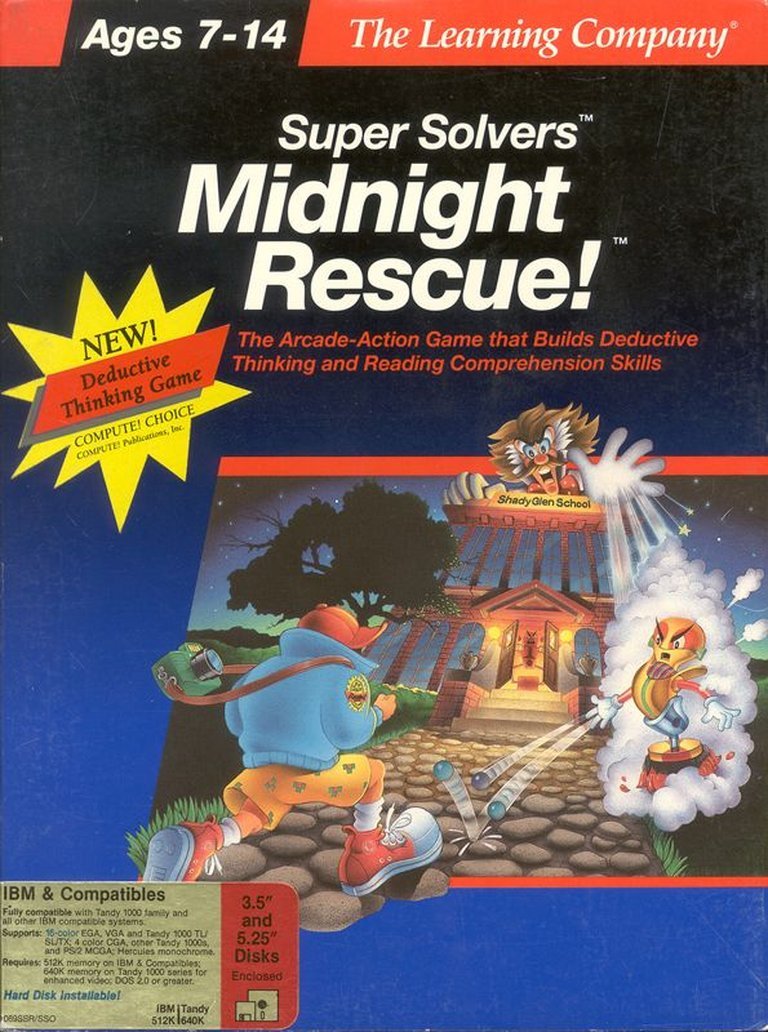
In ‘Super Solvers: Midnight Rescue!’, the Master of Mischief has devised a sinister plan to make Shady Glen School vanish using disappearing paint and robotized paintbrushes. As the player, you must navigate the school, solve puzzles, and outsmart robots to uncover clues and identify the disguised Master of Mischief before midnight. Armed with a camera to photograph and analyze dangerous robots, you’ll explore the school’s halls, avoiding obstacles and deciphering hints to thwart the villain’s scheme in this action-packed educational adventure.
Gameplay Videos
Super Solvers: Midnight Rescue! Free Download
Super Solvers: Midnight Rescue! Guides & Walkthroughs
Super Solvers: Midnight Rescue! Reviews & Reception
classicreload.com : This game wasn’t just about winning—it was about thinking. Every puzzle encouraged players to read carefully, analyze clues, and make logical decisions.
myabandonware.com (89.4/100): Midnight Rescue is definitely a masterpiece of its kind, and a must have. Two thumbs up!
Super Solvers: Midnight Rescue! – A Masterclass in Edutainment
Introduction
In the late 1980s, the educational gaming landscape was a wild frontier, populated by well-meaning but often clunky attempts to merge learning with play. Amid this terrain, Super Solvers: Midnight Rescue! (1989) emerged as a beacon of innovation—a game that didn’t just teach but thrilled, wrapping reading comprehension and critical thinking in a cloak of suspense, mystery, and just a hint of horror. Developed by The Learning Company and Sculptured Software, Midnight Rescue! wasn’t merely an edutainment title; it was a survival experience, a race against time in a haunted school where failure meant erasure—literally.
For a generation of children, this game was more than a tool—it was an adventure. It was the first title in the Super Solvers series, a franchise that would redefine how educational software could engage young minds. But Midnight Rescue! stands apart, not just for its pedagogical prowess, but for its atmosphere. It was Resident Evil before Resident Evil, a horror-lite experience where the stakes were high, the robots were relentless, and the clock was always ticking.
This review will dissect Midnight Rescue! with the precision of a Super Solver analyzing clues: its development, its narrative depth, its gameplay mechanics, its haunting world, its reception, and its enduring legacy. We’ll explore why, decades later, it remains a touchstone of edutainment—and why, for many, it was the game that made reading cool.
Development History & Context
The Birth of a Genre-Blender
The late 1980s were a pivotal era for educational software. Companies like The Learning Company, founded in 1980 by Ann McCormick and Teri Perl, were pioneering the concept of “edutainment”—games that could teach without feeling like homework. Prior to Midnight Rescue!, The Learning Company had already made waves with titles like Reader Rabbit (1983), which introduced young children to literacy through playful, low-stakes activities. But Midnight Rescue! represented a bold evolution: it wasn’t just about learning to read—it was about using reading to solve a high-stakes mystery.
The game was developed in collaboration with Sculptured Software, a Utah-based studio known for its work on licensed titles and educational games. The partnership was strategic: The Learning Company brought its pedagogical expertise, while Sculptured Software provided the technical and creative muscle to craft an engaging, interactive world.
The Vision: Learning Through Adventure
The core vision behind Midnight Rescue! was to create a game that required reading—not as a chore, but as a necessity for survival. Lead designer Mary Schenck Balcer and lead writer Gary Schenck (who were married at the time) sought to craft a narrative where players weren’t just passively absorbing information but actively using it to outsmart an antagonist.
The game’s premise—stopping the Master of Mischief, Morty Maxwell, from painting Shady Glen School invisible by midnight—was deliberately designed to be urgent. The ticking clock wasn’t just a gameplay mechanic; it was a narrative device that mirrored the pressure of real-world problem-solving. The team wanted players to feel the same rush of adrenaline that comes with solving a mystery under duress.
Technological Constraints and Innovations
Midnight Rescue! was developed for MS-DOS and Macintosh, platforms that, in 1989, were far from the multimedia powerhouses of today. The game had to run on 8088/8086 processors with 512KB of RAM, and it supported CGA and EGA graphics—meaning a palette of just 4 or 16 colors, respectively.
Despite these limitations, the team crafted a visually distinct world. The side-scrolling perspective, inspired by action-platformers like Super Mario Bros. (1985), gave the game a dynamic feel, while the school’s layout—with its two floors, classrooms, and auditorium—was designed to be intuitive yet labyrinthine enough to encourage exploration.
Sound was another challenge. The game relied on the IBM PC speaker, which could only produce basic beeps and tones. Yet, the developers leveraged classical music to set the mood: Paul Dukas’ The Sorcerer’s Apprentice played in the hallways, evoking a sense of magical mischief, while Edvard Grieg’s In the Hall of the Mountain King accompanied room exploration, its crescendo building tension as the player raced against time.
The Educational Framework
The game’s educational content was meticulously curated. The team included an advisory panel of educators and psychologists, including Ph.D.s in child development and literacy, to ensure the reading passages and questions aligned with grades 3–5 standards.
The game featured:
– Over 200 reading selections, including diary entries, letters, newspaper articles, and excerpts from classic literature (e.g., Doctor Doolittle, Winnie the Pooh).
– More than 400 comprehension questions, with randomized selections to ensure replayability.
– On-screen definitions and pronunciations for over 500 words, reinforcing vocabulary in context.
The questions weren’t just about recall; they required inference, analysis, and deduction—skills that mirrored the higher-order thinking emphasized in modern literacy education.
The Gaming Landscape of 1989
When Midnight Rescue! launched, the gaming world was dominated by arcade ports, platformers, and early RPGs. Educational games were often relegated to a niche, seen as “boring” or “babyish” by kids who craved the excitement of Ninja Gaiden or Mega Man 2.
Yet Midnight Rescue! defied expectations. It wasn’t just educational—it was tense. The robots weren’t cute; they were menacing. The school wasn’t bright and cheerful; it was dimly lit and eerie. The game’s horror-lite aesthetic was accidental but brilliant, tapping into the same primal fear that made Scooby-Doo so compelling: the idea of a familiar place (a school) becoming haunted after dark.
In many ways, Midnight Rescue! was ahead of its time. It anticipated the “serious games” movement of the 2000s, where games like Portal and The Witness would blend challenge with learning. But in 1989, it was a revelation—a game that proved education and entertainment weren’t mutually exclusive.
Narrative & Thematic Deep Dive
The Plot: A Race Against Erasure
Midnight Rescue! drops players into Shady Glen School at night, a place that should be empty but is instead teeming with robotic paintbrushes and the looming threat of invisibility. The antagonist, Morty Maxwell (a.k.a. the Master of Mischief), has devised a plan to erase the school using disappearing paint, and he’s hidden himself inside one of five robots: Buffo, Lectro, Pogo, Rollo, and Turbo.
The player assumes the role of the Super Solver, an unnamed protagonist tasked with:
1. Exploring the school to find clues hidden in envelopes.
2. Reading passages and answering questions to unlock hints about Morty’s disguise.
3. Photographing robots to gather evidence.
4. Deducing Morty’s location before midnight.
The narrative is simple but effective. It’s a detective story with a sci-fi twist, and the stakes are personal: if the player fails, they don’t just lose—they’re erased, painted invisible alongside the school.
Themes: Fear, Logic, and the Power of Reading
At its core, Midnight Rescue! is a game about overcoming fear through knowledge. The school at night is a liminal space, a place that’s familiar by day but terrifying by night. The robots aren’t just obstacles; they’re embodiments of chaos, disrupting the order of the school. Morty Maxwell, with his mischievous grin and love of pranks, is a trickster figure, a villain who thrives on disorder.
But the game’s genius lies in how it weapons reading. In most games, text is incidental—dialogue, lore, instructions. In Midnight Rescue!, text is the key to survival. Every clue is hidden in a passage, every answer unlocks a piece of the puzzle. The game teaches players that words have power—that careful reading isn’t just academic, it’s strategic.
The game also explores themes of:
– Deductive Reasoning: Players must cross-reference clues, eliminate possibilities, and make informed guesses.
– Time Management: The ticking clock forces players to prioritize—do they read another passage or hunt for a robot?
– Persistence: Failure isn’t punitive; it’s a learning opportunity. The game encourages players to try again, armed with new knowledge.
Characters: The Robots and the Master of Mischief
The robots in Midnight Rescue! are more than just enemies—they’re personalities. Each has a distinct design, attack pattern, and role in Morty’s scheme:
| Robot | Description | Attack Method |
|---|---|---|
| Buffo | A tall, yellow robot with round brush legs. | Throws banana peels. |
| Lectro | A green, wheeled robot with dual brushes. | Zaps with electricity. |
| Pogo | A blue, skirt-clad robot that bounces erratically. | Deploys miscellaneous weapons. |
| Rollo | A red paint roller with a menacing grimace. | Rolls swiftly, attacks with peels. |
| Turbo | A gray, floating spray can. | Charges rapidly with armaments. |
Morty Maxwell, the Master of Mischief, is the game’s puppet master. Though he’s only seen at the end of a successful round, his presence is felt throughout the school. Players find diary entries he’s written, taunting notes he’s left, and reports detailing his schemes. He’s a lovable villain, a mischief-maker who delights in chaos but isn’t truly evil—just playful in the most destructive way possible.
Dialogue and Writing: A Hidden Depth
The writing in Midnight Rescue! is deceptively sophisticated. The passages aren’t just filler; they’re mini-stories, each with its own tone and purpose. Some are humorous, like Morty’s report on showing hyenas a Marx Brothers movie. Others are eerie, like diary entries describing strange occurrences in the school.
The game also includes excerpts from classic literature, introducing players to works like Doctor Doolittle and Winnie the Pooh in a context that feels relevant to the mystery. This wasn’t just about teaching reading—it was about fostering a love of stories.
The comprehension questions are equally well-crafted. They’re not just about recall (“What color was the robot?”); they require inference (“Why did the character feel scared?”) and analysis (“What does this passage suggest about Morty’s plan?”).
The Horror Element: Why It Worked
Midnight Rescue! wasn’t intentionally horror, but its atmosphere made it feel like one. The dimly lit school, the sudden appearances of robots, the ticking clock, and the threat of erasure combined to create a tense, immersive experience.
For many players, the game was scary—but in a good way. It was the kind of fear that comes from exploration and discovery, not jump scares. It was Scooby-Doo meets Resident Evil, a game where the real horror wasn’t the monsters but the unknown.
This accidental horror element made the game memorable. Decades later, players recall the eerie music, the creepy robots, and the sense of urgency that made every session feel like a life-or-death mission.
Gameplay Mechanics & Systems
Core Gameplay Loop: The Anatomy of a Rescue
Midnight Rescue! is structured around a time-limited mystery that unfolds in real-time. Each round follows this loop:
- Exploration: Navigate Shady Glen School’s two floors, searching for blue envelopes containing reading passages.
- Reading & Comprehension: Open an envelope, read the passage, and answer a multiple-choice question to unlock a clue.
- Robot Encounters: Avoid or photograph robots that appear suddenly, each with unique attack patterns.
- Clue Collection: Use the notebook to track clues about Morty’s disguise (e.g., “wearing a hat,” “holding a rubber nose”).
- Deduction: Compare clues to robot photographs to eliminate suspects.
- Final Accusation: Before midnight, guess which robot is Morty. Correct guess = victory; wrong guess = erasure.
This loop is brilliant because it integrates learning seamlessly into the gameplay. Players aren’t just practicing reading—they’re using it to solve a puzzle.
Combat and Avoidance: The Camera as a Weapon
Midnight Rescue! isn’t a traditional action game, but it has combat-like mechanics. The player’s primary tool is the camera, which serves multiple purposes:
– Defense: Taking a photo of a robot scares it away, preventing attacks.
– Intel Gathering: Photos reveal robot characteristics (e.g., items held, clothing), which are crucial for deduction.
– Resource Management: The player has limited film (initially 10 shots), forcing strategic use.
Robots attack in different ways:
– Buffo throws banana peels, causing the player to slip and lose time.
– Lectro zaps with electricity, draining film.
– Pogo bounces unpredictably, making it hard to photograph.
– Rollo rolls quickly, requiring precise timing.
– Turbo charges aggressively, forcing evasion.
The risk-reward of photographing robots is a masterstroke. Players must decide: Do I risk losing time/film to gather intel, or do I flee?
Character Progression: The Rank System
Midnight Rescue! features a progressive difficulty system tied to the player’s lifetime score. As players accumulate points, they rank up, unlocking harder challenges:
| Rank | Points Required | Difficulty Changes |
|---|---|---|
| Trainee | 0 | Basic gameplay, 1 photo per robot required. |
| Junior | 5,000 | Slightly faster robots, more complex readings. |
| Senior | 30,000 | 2 photos per robot required, some dummy clues. |
| Pro | 60,000 | Robots move faster, readings are longer. |
| Expert | 120,000 | 4 photos per robot required, no hints, harder questions. |
| Master | 200,000 | Maximum difficulty, all clues must be carefully analyzed. |
| All-Star | 300,000 | Near-impossible robot speeds, minimal time to read. |
| Champion | 500,000 | The ultimate challenge—only for the most dedicated Super Solvers. |
This system ensures long-term engagement. Players aren’t just repeating the same game; they’re mastering it, with each rank introducing new layers of challenge.
UI and UX: Simplicity with Depth
The game’s user interface is a model of clarity and efficiency. Given the technological constraints of 1989, the UI had to be intuitive and unobtrusive.
Key UI elements:
– Notebook: A clue-tracking system where players record robot characteristics.
– Film Counter: Shows remaining photos (a critical resource).
– Timer: A real-time clock counting down to midnight.
– Map: A basic layout of the school, though players had to memorize routes.
The controls were keyboard-only (no mouse support in the original DOS version), with:
– Arrow keys for movement.
– Spacebar to take photos.
– Enter to read notes or access the notebook.
– Esc for the menu.
This simplicity made the game accessible to young players while still offering depth in strategy.
Innovative Systems: What Worked (and What Didn’t)
What Worked:
1. Seamless Integration of Learning: The game never feels like a “quiz disguised as a game.” Reading is essential to progress.
2. Dynamic Clue System: Clues are randomized, ensuring replayability.
3. Risk-Reward Mechanics: The trade-off between gathering intel and conserving resources adds tension.
4. Progressive Difficulty: The rank system keeps players engaged long-term.
What Didn’t:
1. Limited Visual Feedback: The CGA/EGA graphics could make it hard to distinguish robot details.
2. Repetitive Music: While atmospheric, the classical loops could become grating over time.
3. No Save Feature: In the original version, players had to complete a round in one sitting—no saving mid-game.
4. Robot Spawning: Some players found the random robot appearances frustrating, especially in later ranks.
Despite these flaws, the game’s strengths far outweighed its weaknesses, making it a landmark in edutainment.
World-Building, Art & Sound
The School as a Character: Shady Glen’s Haunting Charm
Shady Glen School isn’t just a setting—it’s a character. The two-floor layout, with its classrooms, auditorium, library, and principal’s office, feels lived-in and mysterious. The side-scrolling perspective gives the school a cinematic quality, as if the player is moving through a film noir set.
Key locations:
– Hallways: Dimly lit, with flickering lights (implied by the music and atmosphere).
– Classrooms: Each has a distinct theme (e.g., science lab, music room).
– Auditorium: A central hub, often where critical clues are hidden.
– Principal’s Office: A high-stakes area, where Morty’s final hiding spot might be.
The school’s design encourages exploration but also strategy. Players learn to memorize routes, anticipate robot spawns, and prioritize clue locations.
Visual Design: Making the Most of Limited Palettes
Given the CGA/EGA constraints, the art team had to be creative. The game uses:
– High-contrast colors to distinguish robots and clues.
– Simple but expressive sprites—the robots, while blocky, have distinct silhouettes.
– Environmental details (e.g., posters, desks) to make the school feel real.
The 1995 CD-ROM version enhanced the visuals with higher-resolution graphics and smoother animations, but the original’s charm lies in its retro aesthetic.
Sound Design: Classical Tension
The game’s soundtrack is one of its most iconic features. The use of classical music wasn’t just a cost-saving measure (no original score needed)—it was a stroke of genius.
- “The Sorcerer’s Apprentice” (Paul Dukas): Plays in the hallways, evoking magic and mischief.
- “In the Hall of the Mountain King” (Edvard Grieg): Plays in rooms, with its crescendo building tension.
The sound effects are minimal but effective:
– Camera flash when taking a photo.
– Robot attack sounds (e.g., zaps, squirts).
– Timer beeps as midnight approaches.
The lack of voice acting in the original is notable—players had to read everything, reinforcing the game’s educational goals.
Atmosphere: Why It Felt Like a Horror Game
Midnight Rescue! wasn’t marketed as horror, but its atmosphere made it feel like one. The combination of:
– A familiar place (school) turned eerie.
– Robots that appear suddenly.
– A ticking clock.
– The threat of erasure.
created a unique blend of tension and excitement. For many players, it was their first “scary” game—one that was thrilling but not traumatizing.
Reception & Legacy
Critical Reception: A Game Ahead of Its Time
Upon release, Midnight Rescue! received positive reviews from both educators and gamers.
- Home of the Underdogs awarded it the Top Dog Award, praising its balance of education and entertainment.
- MacUser called it a “simple but entertaining mystery game” that effectively taught reading comprehension.
- Retro Spirit later awarded it the “Golden DOS Spirit” for its nostalgic appeal and educational value.
The game’s MobyGames score (7.5/10) reflects its enduring popularity, with players rating it 4/5 decades later.
Commercial Success and Bundles
Midnight Rescue! was a commercial hit, leading to:
– A 1995 CD-ROM re-release with enhanced graphics and voice acting.
– Inclusion in bundle packages like “Super Solvers Super Learning Collection!” (with OutNumbered! and Spellbound!).
– A merged release with Spellbound! as “Super Solvers Reading Ages 9–12”.
The game’s success helped establish The Learning Company as a leader in edutainment, paving the way for future titles like Treasure Mountain! and Gizmos & Gadgets!.
Cultural Impact: The Game That Made Reading Cool
Midnight Rescue! left a lasting impression on its players. For many, it was:
– Their first “serious” game—one that required strategy and thought.
– A gateway to reading, introducing them to classic literature in a fun context.
– A nostalgic touchstone, evoking memories of school computer labs and after-school gaming sessions.
The game’s horror-lite aesthetic also made it memorable. Decades later, players recall the eerie music, the creepy robots, and the sense of urgency that made every playthrough feel like a mission.
Influence on Future Games
Midnight Rescue! influenced subsequent edutainment titles by proving that:
– Learning games could be tense and exciting.
– Reading comprehension could be a gameplay mechanic.
– Educational software didn’t have to be “babyish.”
Its deductive reasoning mechanics can be seen in later games like:
– Nancy Drew series (1998–present).
– Professor Layton series (2007–present).
– The Witness (2016), which also uses environmental clues for puzzle-solving.
Preservation and Modern Playability
Today, Midnight Rescue! is preserved through:
– Emulation (e.g., DOSBox, Internet Archive).
– Abandonware sites (e.g., My Abandonware, ClassicReload).
– Retro gaming communities that celebrate its legacy.
While there’s no modern remake, the game’s spirit lives on in titles that blend education and adventure.
Conclusion: A Timeless Masterpiece of Edutainment
Super Solvers: Midnight Rescue! is more than a game—it’s a cultural artifact, a proof of concept that education and entertainment can coexist seamlessly. It was ahead of its time in 1989, and its legacy endures today.
Final Verdict: 9/10 – A Landmark in Edutainment
Strengths:
✅ Seamless integration of reading and gameplay.
✅ Tense, atmospheric experience that feels like a horror-lite adventure.
✅ Replayable thanks to randomized clues and progressive difficulty.
✅ Educational without being preachy—teaches critical thinking and deduction.
Weaknesses:
❌ Limited graphics/sound by modern standards (though charming in retrospect).
❌ No save feature in the original (a frustration for young players).
❌ Repetitive music could become grating.
Legacy:
🏆 One of the first successful “edutainment” games.
🏆 Influenced future mystery and puzzle games.
🏆 Remembered fondly by a generation of players.
Midnight Rescue! wasn’t just a game—it was an experience. It turned reading into a survival skill, school into a battleground, and learning into an adventure. For that, it deserves its place in gaming history as a true masterpiece.
Final Thought:
If you ever played Midnight Rescue! as a child, you remember the thrill of the chase, the satisfaction of solving the mystery, and the horror of the ticking clock. It wasn’t just a game—it was a rite of passage, a proof that knowledge is power.
And if you’ve never played it? Find an emulator. Experience it. Understand why, for so many, it was the game that made reading cool.