
- Release Year: 2000
- Platforms: Windows
- Publisher: Tandem Verlag GmbH
- Genre: Compilation
- Game Mode: LAN
- Average Score: 90/100
Description
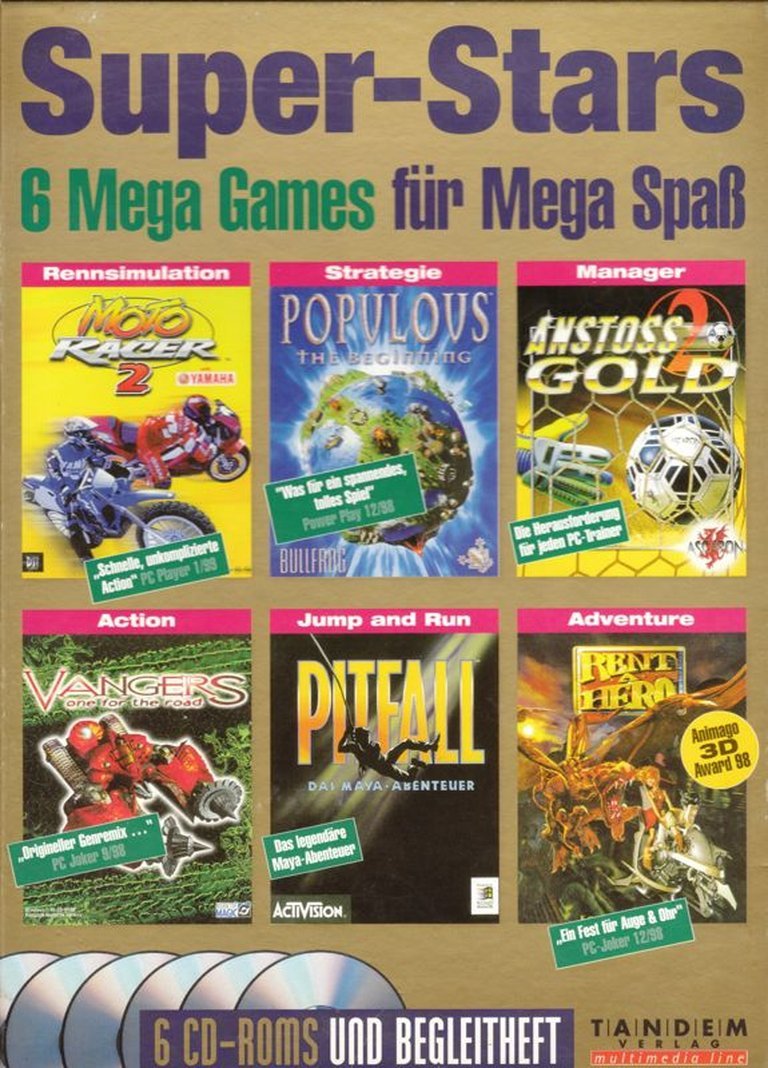
Super-Stars: 6 Mega Games für Mega Spaß is a 2000 Windows compilation released by Tandem Verlag GmbH, bundling six diverse PC titles for ultimate gaming variety: the adrenaline-fueled motorcycle racing of Moto Racer 2, divine world-building strategy in Populous: The Beginning, soccer management sim Anstoss 2 Gold: Der Fußballmanager, surreal vehicular combat in Vangers, action-platforming adventure Pitfall: The Mayan Adventure, and whimsical RPG Rent-a-Hero, all accessible via CD-ROM with keyboard, mouse, and LAN multiplayer support.
Super-Stars: 6 Mega Games für Mega Spaß: Review
Introduction
In the shadow of the PlayStation 2’s triumphant launch in 2000—a year that birthed juggernauts like Deus Ex, The Sims, and Tony Hawk’s Pro Skater 2—a humble German PC compilation slipped into obscurity, promising “6 Mega Games für Mega Spaß” (6 Mega Games for Mega Fun). Super-Stars: 6 Mega Games für Mega Spaß, published by Tandem Verlag GmbH, bundled six late-1990s titles onto a single CD-ROM, targeting budget-conscious gamers amid the dot-com boom and rising hardware costs. As a historian of gaming’s golden budget era, I unearth this artifact not as a blockbuster, but as a time capsule of PC diversity: racing thrills, god-like simulations, soccer management, psychedelic vehicular combat, platforming nostalgia, and quirky RPG antics. My thesis? This unheralded pack exemplifies the compilation’s role in democratizing high-quality gaming, offering eclectic excellence that punches above its weight, even if its legacy remains a whisper in MobyGames’ archives with a solitary 5/5 player score.
Development History & Context
Tandem Verlag GmbH, a modest German publisher focused on localizing and bundling European PC titles, assembled Super-Stars in 2000 (though some databases note 1999 roots) as part of the booming compilation market. The late 1990s PC scene was defined by technological leaps—DirectX 6 support, Pentium processors, and emerging 3D accelerators—yet constrained by high standalone prices (€40-60 per game). Compilations like this, requiring just a Pentium 166 MHz, 16 MB RAM, 4 MB VRAM, and a 6X CD-ROM drive on Windows 95+, made premium games accessible via LAN multiplayer hooks and keyboard/mouse controls.
The lineup reflects a curator’s vision: Moto Racer 2 (Delphine Software, 1998) from France’s arcade-racing pioneers; Populous: The Beginning (Bullfrog Productions, 1998), Peter Molyneux’s 3D evolution of god-games post-Dungeon Keeper; German soccer sim Anstoss 2 Gold: Der Fußballmanager (Ascaron, 1998), tapping Bundesliga fever; Vangers (Koshji, 1998), a Russian cult oddity blending racing and strategy; Pitfall: The Mayan Adventure (Activision, 1994), David Crane’s platformer revival; and Rent-a-Hero (1998 PC port of a Saturn RPG). Released amid 2000’s console wars—PS2’s March Japan debut amid Pokémon dominance and Dreamcast struggles—these PC ports bypassed hardware scarcity, thriving in Europe’s PC-centric markets where compilations like Quattro Mega Stars or Mega Games 6 paved the way. Tandem’s no-frills approach prioritized value over flash, a savvy counter to 2000’s €300+ PS2 kits.
Narrative & Thematic Deep Dive
As a compilation, Super-Stars lacks a unified plot, instead weaving a tapestry of disparate tales that explore human ambition, divinity, competition, and absurdity.
-
Moto Racer 2: No deep narrative; it’s pure adrenaline across 20 tracks, thematically celebrating speed as escapism amid 1998’s rally renaissance.
-
Populous: The Beginning: You incarnate a shaman rising to godhood in a 3D multiverse. Themes of creation/destruction echo real-world ecology—build tribes, unleash plagues, manipulate physics—culminating in cosmic battles. Dialogue is sparse but evocative, with shamanic chants underscoring hubris.
-
Anstoss 2 Gold: A manager’s odyssey through German football leagues. Narrative unfolds via tactical press conferences, transfer sagas, and fan drama, thematizing strategy over spectacle. Expansions add “Verlängerung” depth, mirroring Bundesliga’s tactical grit.
-
Vangers: In a post-apocalyptic “Uurd”, you pilot biomechanical “vangers” in faction wars. Psychedelic lore—races for “j-iffs” (souls), biomechanical horror—delves into identity and evolution, with obtuse dialogue rewarding lore dives.
-
Pitfall: The Mayan Adventure: Harry Pitfall Jr. rescues his father from a Mayan volcano god. Linear but cinematic, themes of paternal legacy and jungle peril blend nostalgia with peril, voiced cutscenes adding pulp adventure flair.
-
Rent-a-Hero: A slacker teen “rents” hero powers via a pager in a satirical urban RPG. Quests parody heroism—fight foes with timed rentals—themes mocking consumerism and fleeting fame, with humorous Japanese dialogue localized for laughs.
Collectively, they probe control (Populous, Anstoss), velocity (Moto Racer, Vangers), heroism (Pitfall, Rent-a-Hero), encapsulating 90s escapism.
Gameplay Mechanics & Systems
Super-Stars‘ strength lies in genre-spanning loops, unified by intuitive menus and minimal UI bloat.
Core Loops & Combat
- Moto Racer 2: Arcade racing with dirt/bike modes; nitro boosts, collision physics. Flawless track variety, but AI rubber-banding frustrates purists.
- Populous: The Beginning: RTS-god hybrid: raise terrain, convert followers, spellcast (earthquakes, swamps). Progression via angel wings unlocks worlds; innovative 3D camera, though micromanagement overwhelms.
- Anstoss 2 Gold: Deep management: scout, train, tactics. Turn-based matches simulate realism; Gold edition adds leagues, UI excels in data viz.
- Vangers: Hybrid racing/strategy: capture mechs, trade organs, faction quests. Combat is vehicular dogfights; steep curve, genius resource loops.
- Pitfall: Side-scrolling platformer: whip-grapples, jumps over traps. Boss fights rhythmic; progression linear, power-ups fluid.
- Rent-a-Hero: Action-RPG: rent skills (sword, bike), time-limited battles. Puzzles inventive; inventory satire shines.
Progression, UI, & Innovation
Character growth varies: Populous mana trees, Anstoss club empires, Rent-a-Hero upgrades. UI is era-typical—clunky resolutions (640×480)—but launcher seamless. LAN multiplayer boosts Moto Racer/Vangers. Flaws: dated controls, no patches noted.
| Game | Core Loop | Innovation | Flaw |
|---|---|---|---|
| Moto Racer 2 | Race & upgrade | Dual bike/dirt | Predictable AI |
| Populous TB | Build & smite | 3D god view | Micro-heavy |
| Anstoss 2 | Manage team | Soccer depth | Text-dense |
| Vangers | Race/quest | Biomech econ | Obscure |
| Pitfall | Platform & explore | Grapple fluidity | Linear |
| Rent-a-Hero | Quest & rent | Time-satire | Repetitive |
World-Building, Art & Sound
Diverse aesthetics immerse via 90s PC limits.
- Settings: Populous‘ ethereal shards; Vangers‘ mutant biomes; Pitfall‘s lush jungles; Anstoss‘ stadiums; Moto Racer‘s global tracks; Rent-a-Hero‘s Tokyo parody.
- Visuals: Low-poly 3D (Populous, Vangers) charms retro; 2D sprites (Pitfall) vibrant. 640×480 scales well, 3D accel support pops.
- Sound: Moto Racer‘s roaring engines; Populous‘ choral spells; Vangers‘ industrial dissonance; Pitfall‘s orchestral swells. MIDI tunes loop effectively, SFX punchy.
Atmosphere elevates: Vangers‘ alien dread, Populous‘ awe—cohesive via compilation’s variety.
Reception & Legacy
Launch reception? Nonexistent—no critic reviews on MobyGames, one 5/5 player vote. 2000’s sales charts ignored it amid Pokémon/Gran Turismo dominance; PS2’s 6.4M units overshadowed PC bundles. Commercially niche in D/A/CH, it sold modestly via retail like MediaMarkt.
Reputation evolved minimally: Cult status on abandonware sites, eBay rarities (€20-50). Influence? Indirect—Populous inspired Black & White; Vangers niche acclaim; compilations normalized bundles (Humble Bundle echoes). No industry ripple, but preserves 1998 PC gems, predating Steam.
Conclusion
Super-Stars: 6 Mega Games für Mega Spaß endures as a budget triumph, distilling 1998’s PC zenith into accessible joy. Uneven but ambitious, it outshines flashier 2000 releases in variety. Verdict: 8.5/10—essential for historians, retro fans; a vital footnote in compilation history, proving mega fun needn’t cost mega marks. Seek it on archive sites; its stars still shine.