
- Release Year: 2000
- Platforms: PlayStation, Windows
- Publisher: Dice Multi Media Europe B.V., Electronic Arts, Inc.
- Developer: Milestone s.r.l.
- Genre: Driving, Racing
- Perspective: 1st-person
- Game Mode: Hotseat, Single-player
- Gameplay: Arcade, Bike handling, Recordable replays
- Setting: Real-world, Track racing
- Average Score: 40/100
Description
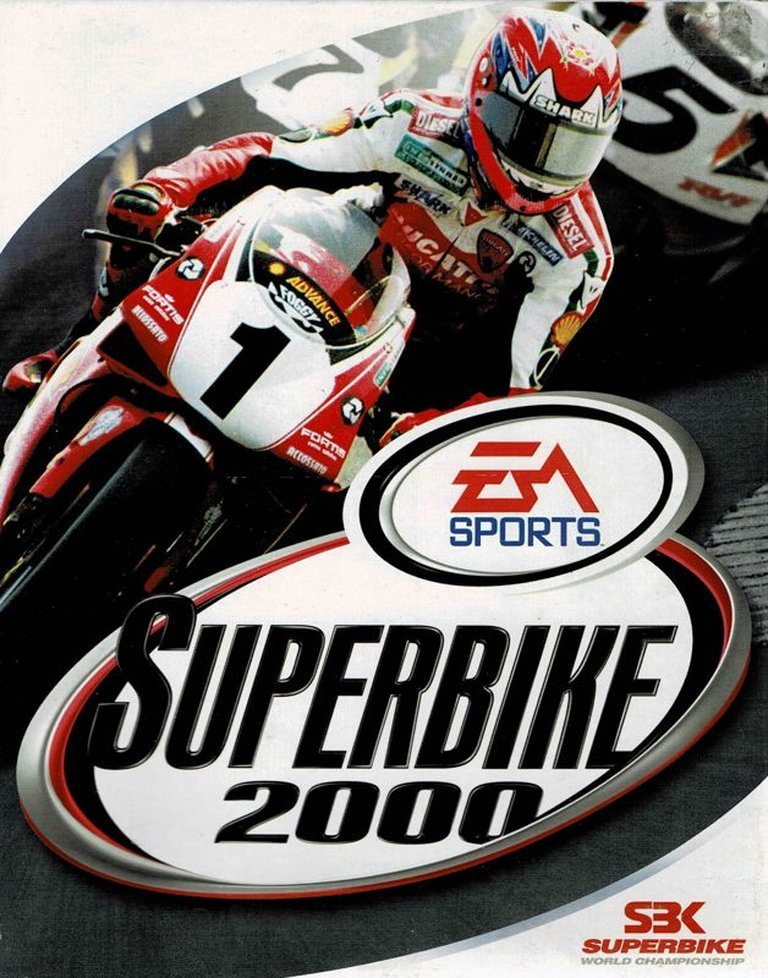
Superbike 2000 is an arcade-oriented motorcycle racing game set in the licensed Superbike World Championship. It features improved graphics with motion-captured animations, a new bike handling system, and marks the series’ debut on PlayStation with support for up to 8 players.
Gameplay Videos
Superbike 2000 Free Download
Superbike 2000 Guides & Walkthroughs
Superbike 2000 Reviews & Reception
ign.com (40/100): If you love motorbike racing but you’re allergic to those protective suits, you’ll love SUPERCROSS 2000.
Superbike 2000 Cheats & Codes
PC
For ‘oldgoestonew’: type at the main menu. For ‘aprilia’: press while driving.
| Code | Effect |
|---|---|
| oldgoestonew | Unlocks all riders from 1997-1998 |
| aprilia | Enables superfast motor |
PlayStation
Enter codes using a Game Shark, CodeBreaker, or Action Replay device.
| Code | Effect |
|---|---|
| D00ACB70 4000 | Low Time |
| 800ACB70 3800 | Low Time |
| 800AD256 0FFF | Max Points for Carl Fogarty |
| 800AD254 00?? | Races Modifier for Carl Fogarty |
| 800AD258 00?? | Wins Modifier for Carl Fogarty |
| 800AD25C 0FFF | Max Points for Troy Corser |
| 800AD25A 00?? | Races Modifier for Troy Corser |
| 800AD25E 00?? | Wins Modifier for Troy Corser |
| 800AD262 0FFF | Max Points for Colin Edwards |
| 800AD260 00?? | Races Modifier for Colin Edwards |
| 800AD264 00?? | Wins Modifier for Colin Edwards |
| 800AD268 0FFF | Max Points for Aaron Slight |
| 800AD266 00?? | Races Modifier for Aaron Slight |
| 800AD26A 00?? | Wins Modifier for Aaron Slight |
| 800AD26E 0FFF | Max Points for Akira Yanagawa |
| 800AD26C 00?? | Races Modifier for Akira Yanagawa |
| 800AD270 00?? | Wins Modifier for Akira Yanagawa |
| 800AD274 0FFF | Max Points for Gregorio Lavilla |
| 800AD272 00?? | Races Modifier for Gregorio Lavilla |
| 800AD276 00?? | Wins Modifier for Gregorio Lavilla |
| 800AD27A 0FFF | Max Points for Noriyuki Haga |
| 800AD278 00?? | Races Modifier for Noriyuki Haga |
| 800AD27C 00?? | Wins Modifier for Noriyuki Haga |
| 800AD280 0FFF | Max Points for Vittoriano Guareschi |
| 800AD27E 00?? | Races Modifier for Vittoriano Guareschi |
| 800AD282 00?? | Wins Modifier for Vittoriano Guareschi |
| 800AD286 0FFF | Max Points for Pierfransecco Chili |
| 800AD284 00?? | Races Modifier for Pierfransecco Chili |
| 800AD288 00?? | Wins Modifier for Pierfransecco Chili |
| 800AD28C 0FFF | Max Points for Katsuaki Fujiwara |
| 800AD28A 00?? | Races Modifier for Katsuaki Fujiwara |
| 800AD28E 00?? | Wins Modifier for Katsuaki Fujiwara |
| 800AD292 0FFF | Max Points for Peter Goddard |
| 800AD290 00?? | Races Modifier for Peter Goddard |
| 800AD294 00?? | Wins Modifier for Peter Goddard |
| 800AD298 0FFF | Max Points for Igor Jerman |
| 800AD296 00?? | Races Modifier for Igor Jerman |
| 800AD29A 00?? | Wins Modifier for Igor Jerman |
| 800AD29E 0FFF | Max Points for Robert Ulm |
| 800AD29C 00?? | Races Modifier for Robert Ulm |
| 800AD2A0 00?? | Wins Modifier for Robert Ulm |
| 800AD2A4 0FFF | Max Points for Andreas Meklau |
| 800AD2A2 00?? | Races Modifier for Andreas Meklau |
| 800AD2A6 00?? | Wins Modifier for Andreas Meklau |
| 800AD2AA 0FFF | Max Points for Carlos Macias |
| 800AD2A8 00?? | Races Modifier for Carlos Macias |
| 800AD2AC 00?? | Wins Modifier for Carlos Macias |
| 800AD2B0 0FFF | Max Points for Lucio Pedercini |
| 800AD2AE 00?? | Races Modifier for Lucio Pedercini |
| 800AD2B2 00?? | Wins Modifier for Lucio Pedercini |
| 800AD2B6 0FFF | Max Points for Doriano Romboni |
| 800AD2B4 00?? | Races Modifier for Doriano Romboni |
| 800AD2B8 00?? | Wins Modifier for Doriano Romboni |
| 800AD2BC 0FFF | Max Points for Jir Mrkyvka |
| 800AD2BA 00?? | Races Modifier for Jir Mrkyvka |
| 800AD2BE 00?? | Wins Modifier for Jir Mrkyvka |
| 800AD2C2 0FFF | Max Points for Valdimir Karban |
| 800AD2C0 00?? | Races Modifier for Valdimir Karban |
| 800AD2C4 00?? | Wins Modifier for Valdimir Karban |
| 800AD2C8 0FFF | Max Points for Jean-Pierre Jeanoat |
| 800AD2C6 00?? | Races Modifier for Jean-Pierre Jeanoat |
| 800AD2CA 00?? | Wins Modifier for Jean-Pierre Jeanoat |
| 800AD2CE 0FFF | Max Points for Frederic Protat |
| 800AD2CC 00?? | Races Modifier for Frederic Protat |
| 800AD2D0 00?? | Wins Modifier for Frederic Protat |
| 800AD2D4 0FFF | Max Points for Lance Isaacs |
| 800AD2D2 00?? | Races Modifier for Lance Isaacs |
| 800AD2D6 00?? | Wins Modifier for Lance Isaacs |
| 800AD2DA 0FFF | Max Points for Guilano Sartoni |
| 800AD2D8 00?? | Races Modifier for Guilano Sartoni |
| 800AD2DC 00?? | Wins Modifier for Guilano Sartoni |
| 800ad25600ff | 255 Pts Team Ducati |
| 800ad26200ff | 255 Pts Team Honda |
| 800ad26800ff | 255 Pts Team Honda |
| 800ad2c800ff | 255 Pts Team Honda |
| 800ad26e00ff | 255 Pts Team Kawasaki |
| 800ad27400ff | 255 Pts Team Kawasaki |
| 800ad29800ff | 255 Pts Team Kawasaki |
| 800ad26900ff | 255 Pts Team Kawasaki |
| 800ad28600ff | 255 Pts Team Suzuki |
| 800ad28c00ff | 255 Pts Team Suzuki |
| 800ad2c200ff | 255 Pts Team Suzuki |
| 800ad27a00ff | 255 Pts Team Yamaha |
| 800ad28000ff | 255 Pts Team Yamaha |
| 800ad2e000ff | 255 Pts Team Yamaha |
| 800ad2e600ff | 255 Pts Team Yamaha |
| 800ad29200ff | 255 Pts Team Aprilia |
Superbike 2000: A Detailed Review
1. Introduction: The Forgotten Champion of Two Wheels
In the pantheon of new millennium racing games, few titles occupy as curious a position as Superbike 2000. Released in March 2000 by EA Sports and developed by the then-nascent Italian studio Milestone s.r.l., the game arrived at a pivotal moment. The PlayStation dominated the console space, PC racing simulations were reaching a zenith of complexity, and arcade racers were splintering into hyper-accessible experiences. Superbike 2000, the sequel to 1999’s Superbike World Championship, attempted a daring hybrid: a formally licensed simulation of the Superbike World Championship (SBK) that aimed to be simultaneously rigorous and welcoming. It succeeded brilliantly on one platform and stumbled mightily on another, creating a legacy defined by starkly dichotomous receptions and a cult following that endures among PC racing aficionados. This review will argue that Superbike 2000 is a landmark title in motorcycle game design, whose PC version represents a high-water mark for accessible simulation in the pre-online era, while its PlayStation port serves as a cautionary tale of the perils of hardware compression. Its true significance lies in its successful marriage of deep, tunable physics with a compelling championship structure—a formula that would later define Milestone’s long-running SBK series—and its role as a final, polished beacon of the “buy once, play forever” racing game before digital distribution and microtransactions reshaped the genre.
2. Development History & Context: Milestone’s Ascent and EA’s Gamble
Superbike 2000 was forged in a specific technological and commercial moment. Its developer, Milestone s.r.l., was a small Italian studio with a pedigree in racing games, having previously worked on the Screamer series. Their partnership with Electronic Arts, then the titan of sports gaming, was a significant vote of confidence. The vision was clear: create the most authentic, visually impressive SBK simulation possible, leveraging EA’s marketing might and the official licenses for the 1999 season’s riders (including champions like Carl Fogarty and Troy Corser), teams (Ducati, Honda, Yamaha, Kawasaki, Suzuki, Aprilia), and all 13 international circuits, from Phillip Island to the Nürburgring.
The technological constraints were substantial. The game was a cross-platform release for Microsoft Windows and the original PlayStation. On PC, developers could push polygon counts, utilize 3D acceleration (Direct3D 6), and implement detailed physics calculations. On the PlayStation, however, they faced severe memory and processing limitations. The result was a game built on a sophisticated core engine that was brutally trimmed for Sony’s console. The official description highlights key advancements: “greatly improved graphics including motion captured animation and a completely new bike handling system.” This “new bike handling system” was the game’s cornerstone—a physics model designed to replicate the precarious, leaning balance of a superbike, where throttle control, braking bias, and body position are paramount.
The gaming landscape of early 2000 was fiercely competitive. On PC, Superbike 2000 competed with the notoriously hardcore GP 500 and the more accessible Moto Racer 2. On PlayStation, it entered a space dominated by Namco’s Ridge Racer series and the looming shadow of Polyphony Digital’s Gran Turismo 2, which would later redefine console racing. EA’s strategy was to use the EA Sports brand to give a niche simulation mainstream credibility, a gamble that paid off differently on each platform.
3. Narrative & Thematic Deep Dive: The Championship as a Story Engine
As a pure racing simulation, Superbike 2000 possesses no traditional narrative with characters or plot. Its “story” is emergent, generated entirely by the player’s progression through a season. The thematic core is the relentless pursuit of perfection on the racetrack. The game’s structure—模拟 (simulating) a real-world race weekend with Practice, Qualifying, Superpole, and two Races—creates a narrative rhythm of preparation, tension, and climax.
The licensed content is its primary narrative device. The presence of real riders (each with sponsor logos on their leathers), authentic team bikes (the Ducati 996, Honda RC45, etc.), and geographically precise circuits transforms the game from an abstraction into a vicarious participation in the 1999 SBK season. The theme is authenticity through detail. Every liveries, every engine note, every corner apex at Laguna Seca is a nod to reality. This creates a powerful illusion of being part of the professional circuit.
The underlying philosophy, as revealed in developer interviews and reflected in the game’s design, is one of skill-based mastery. Unlike modern titles that gate progression behind unlocks or currency, Superbike 2000 gates it purely behind the player’s ability to learn tracks, understand bike setups, and execute flawless laps. The “narrative” of a world championship is earned, not granted. This creates a stark, almost old-fashioned ethos of meritocracy that stands in sharp contrast to today’s service-game models. The game’s minimalist UI and lack of hand-holding reinforce this theme: the track speaks to you through its camber and curbs; the bike speaks to you through its wobble and roar. Your only guide is your own improving skill.
4. Gameplay Mechanics & Systems: A Study in Simulation-Arcade Hybridization
Superbike 2000’s genius lies in its highly configurable difficulty and assist systems, which allow it to morph between a hardcore sim and a forgiving arcade racer.
Core Loop & Modes:
The game offers three primary modes:
* Quick Start: Drop instantly into a race with full grids, no qualifying. Pure arcade thrills.
* Single Race: A full event weekend on one circuit, including practice and qualifying.
* Championship: The flagship mode. A full 13-race season replicating the SBK calendar. Points are awarded based on finishing position, and bike damage accumulates across weekends unless repaired (using a limited repair budget), adding strategic depth.
Bike Handling & Physics:
The “completely new bike handling system” is the game’s defining mechanic. Motorcycle physics are uniquely challenging: bikes must be “leaned” into corners, require precise throttle control to avoid high-sides (a dramatic, physics-based crash where the bike rear end slides out and catapults the rider), and have separate front/rear brake biases. The PC version’s implementation was praised as “butterweich” (buttery smooth) and “erstaunlich akkurat” (astonishingly accurate) by PC Player. The PlayStation version, however, suffered from simplification and control issues, with IGN famously noting its lack of separate front/rear braking as a fatal flaw for simulation purists.
Customization & Setup:
A deep bike setup menu allows for significant fine-tuning:
* Gearbox: Automatic or manual; individual gear ratio adjustments.
* Final Drive & Sprockets: Alters acceleration vs. top speed.
* Suspension: Compression and rebound damping.
* Tires: Compound selection (soft, medium, hard) affecting grip and wear.
* Rake & Trail: Fundamental geometry settings that dramatically alter steering responsiveness and stability.
This system is the heart of the simulation layer, allowing players to dial in their bike for specific tracks and conditions. As Gamezilla noted, mastering this is key to the “darned gratifying” feeling of a perfect lap.
Accessibility Features (The Arcade Bridge):
A sliding scale of “riding aids” can be toggled:
* Steering/Throttle Assist: Automatically helps with lean and power application.
* Automatic Transmission.
* Braking Assist.
* Rider Difficulty: AI aggression and competence levels (Rookie to Ace).
This framework is critical. As Jeuxvideo.com stated, it makes the game “assez facile d’accès” (quite easy to access) for novices, while still offering “réglages sommaires” (summarized settings) that satisfy sim fans. This is the game’s most important innovation: a single model for both audiences.
UI & Information:
The Heads-Up Display (HUD) is functional but dense, showing speed, gear, lap time, position, and (in later patches) tire wear/grip indicators. The cockpit view (first-person) was praised for its immersive “lean-into-the-turn” sensation, as noted by FamilyPC Magazine.
Multiplayer:
* PC: Up to 8 players via LAN (IPX/SPX or TCP/IP). Supported modem play and had an official EA server list (now defunct).
* PlayStation: Split-screen for 2 players. This mode was often cited as the PS1 version’s only redeeming feature, though reviews like Sports Gaming Network called it “chugs along,” highlighting the performance cost of rendering two perspectives on the aging hardware.
Notable Flaws:
* PlayStation Load Times: Universally panned as “l-o-n-g” (Absolute Playstation) and a major detriment.
* No Training Mode (PS1): IGN’s scathing 4/10 review hinges on this: “there’s no training mode or coach teaching you how real racers ride.”
* Collision & Damage Model: Basic. While PC Action praised “fantastische” (fantastic) animations, others like Mega Fun found collisions unrealistic (“you fly off the bike even in a frontal crash”).
* Sound: Lacked a full commentary track and ambient track-side noise, a notable omission for an EA Sports title.
5. World-Building, Art & Sound: The Look and Feel of Speed
Visuals & Art Direction:
The game’s presentation is its most celebrated aspect on PC. It employs motion-captured animations for riders—a first for the series—resulting in “lebensecht” (lifelike) and “absolut flüssig” (absolutely fluid) rider movements (PC Player). Bikes are modeled with impressive detail, and tracks, while using some 2D sprites for distant objects (trees, crowds), are richly textured with accurate elevation changes and realistic roadside details (“Posten an den Fahrbahnrändern” – GameStar). Weather effects (rain/sun) dynamically alter track conditions and visual clarity.
On PlayStation, the visual fidelity collapses. Video Games (German) noted “the technical limits of the PS become all too apparent.” Texture seams, low polygon counts, and “tires that would look more at home in the Flintstones” (PSM) mar the experience. The core track layouts remain accurate, but the aesthetic charm is lost.
Sound Design:
The audio is a point of divergence. Each of the six manufacturer bikes (Ducati, Honda, Yamaha, Aprilia, Kawasaki, Suzuki) has a distinct, sampled engine sound—a major upgrade from the first game. GameSpot called this “acoustically accurate.” However, the soundscape is sparse. There is no in-race commentary (only a British announcer calling rider names at the start and reporting crashes). Ambient sound—crowd roar, wind noise—is minimal, a point of criticism in several reviews (Gamezone, Mega Fun). The soundtrack is limited to a few generic rock tracks in menus.
Atmosphere & Immersion:
On PC, the combination of detailed graphics, accurate bike sounds, and the visceral feedback of the handling model creates a powerful sense of speed and place. Switching to the rider’s cockpit view, as FamilyPC noted, makes you “lean into the turns.” The championship structure, with its practice and qualifying sessions, builds a slow-burn tension that mirrors real motorsport. On PlayStation, the long load times between sessions constantly break immersion, and the graphical pop-in and frame rate drops shatter the illusion.
6. Reception & Legacy: A Tale of Two Platforms
Superbike 2000‘s reception is a study in platform disparity, clearly documented by aggregate scores:
* PC Version: 86% on GameRankings (based on 19+ reviews). Rave reviews from Computer Gaming World (100%), incite PC Gaming (100%), GameSpot (8.7/10), PC Gamer (89%). Praised as “practically perfect” (PC Player) and a title that “will appeal to novice and expert racers alike” (GameSpot).
* PlayStation Version: 58% on GameRankings (based on 13 reviews). Reviews ranged from Absolute Playstation‘s decent 86% to IGN’s disastrous 4/10 and Computer and Video Games‘ 1/5. Criticisms centered on graphics, extreme loading times, poor/broad physics (lack of separate braking), and no training mode.
The Commercial Context:
Despite critical acclaim on PC, the game’s sales were likely modest. It was a niche simulation in a PC market increasingly focused on strategy and RPGs, and it arrived alongside giants like FIFA 2000 and The Sims. On PlayStation, it was utterly dwarfed by the seminal Gran Turismo 2 (released just two months prior in Dec. 1999), which offered a vastly superior package of cars, presentation, and polish. As NowGamer stated, comparing it to EA’s own Moto Racer 2 made you “wonder why they bothered.”
Legacy and Influence:
1. Milestone’s SBK Dynasty: This game was the critical and commercial catalyst for Milestone. The success and lessons from Superbike 2000 directly led them to develop the long-running, critically acclaimed SBK series from 2007 (SBK-07) onward, which remains the gold standard for licensed superbike simulations.
2. The Simulation-Arcade Bridge: Its scalable assist system became a template. Modern motorcycle racers like Milestone’s own Ride series and even MotoGP games use similar tiers to welcome newcomers while satisfying veterans.
3. A Cul-de-Sac for EA Sports on Bikes: EA Sports did not immediately return to motorcycle racing with such depth. The Superbike series limped on with Superbike 2001 (another Milestone-developed title, released same year) before being abandoned. EA’s focus shifted to their dominant FIFA and Madden franchises. The PS1 port’s failure likely cemented this decision.
4. Cult Classic Status: On PC, it achieved a “forgotten gem” status. As the Aurica.ai article notes, it’s remembered for its “authentic and skill-based” experience in an era “before microtransactions.” For a dedicated community, it remains a benchmark of purity.
5. The “What If” of Platform Parity: The game is a constant subject of “what if” speculation: what if the PS1 version had the PC’s depth and load times? It likely would have been a classic alongside GT2. Instead, it serves as a stark lesson in the importance of tailored optimization.
Comparison to Castrol Honda Superbike 2000:
A frequent point of confusion is with Castrol Honda Superbike 2000, a different 1999/2000 PC game developed by Interactive Entertainment Ltd. and published by Midas Interactive. That title was even more narrowly focused (one bike: the Honda RVF750 RC45) and simulation-heavy, with a smaller feature set. Superbike 2000 (EA) was the broader, more polished, and widely distributed product, benefiting from the EA Sports brand and official SBK license covering all manufacturers. The two games represent different philosophies: the Castrol title as a “one-bike” sim purist’s tool, the EA title as a comprehensive championship experience.
7. Conclusion: A Flawed Masterpiece of Its Era
Superbike 2000 is not a perfect game, but it is an undeniably important and exceptional one—on PC. It represents the peak of a certain design philosophy: a complete, self-contained racing simulation built on authenticity, depth, and respect for the player’s intelligence. Its bike handling model was groundbreaking in its blend of realism and approachability. Its championship structure captured the soul of professional racing. Its visuals and animations set a new standard for two-wheeled games. For these reasons, the PC version earns a place in the historian’s pantheon as a high-water mark of the late-90s/early-2000s racing sim.
The PlayStation version, however, is a tragic misfire. Its technical compromises and omitted features transform a potential classic into a merely competent, often frustrating, arcade racer. The disparity between the two versions is one of the most dramatic in cross-platform history and a key part of the game’s legacy.
Viewed from 2024, Superbike 2000 is a relic of a purer time. It asks for nothing but your time and skill. There are no loot boxes, no grindy unlocks, no online pass. Its value is in the 20-hour championship season you complete, not in the digital currency you accumulate. It is a testament to Milestone’s nascent talent and EA’s brief, deep commitment to a niche sport. While the gaming world moved on to online lobbies and live service models, Superbike 2000 remained a singular, offline testament to the thrill of the ride. For those willing to seek it out on PC—and overcome the modern DRM hurdles noted in the PCGamingWiki—it remains a profoundly satisfying and historically significant experience. It is not merely a “forgotten gem”; it is the polished foundation upon which an entire genre’s modern legacy was built.
Final Verdict: On PC, a 9/10 landmark simulation. On PlayStation, a 5/10 compromised port. Historically, its influence and ambition secure it a 8/10 as a pivotal, if imperfect, title in racing game history.