
- Release Year: 2010
- Platforms: Macintosh, Windows, Xbox 360, Xbox One
- Publisher: Square Enix Co., Ltd., Square Enix Limited, Virtual Programming Ltd.
- Developer: Gas Powered Games Corp.
- Genre: Strategy, Tactics
- Perspective: Top-down
- Game Mode: LAN, Online PVP, Single-player
- Gameplay: Base building, Prototype units, Real-time strategy, Research Tree, Resource Management, Unit upgrades
- Setting: Futuristic, Sci-fi
- Average Score: 77/100
Description
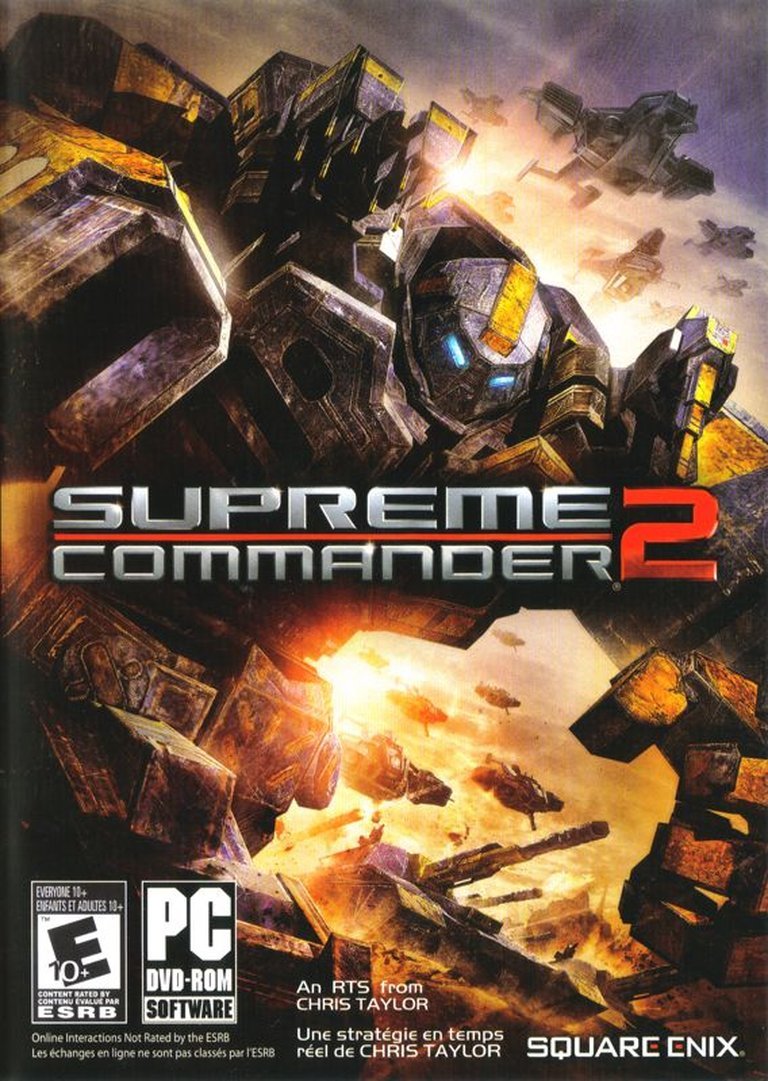
Supreme Commander 2 is a real-time strategy game set 25 years after the events of its predecessor, continuing the Infinite War across the galaxy. Players take control of one of three factions—the Cybran Nation, the Illuminates, or the United Earth Federation—and lead their armies in a single-player campaign or multiplayer battles. The game features a vast array of units, strategic resource management, and the ability to upgrade structures and units with advanced technologies.
Gameplay Videos
Where to Buy Supreme Commander 2
Supreme Commander 2 Free Download
Supreme Commander 2 Cracks & Fixes
Supreme Commander 2 Patches & Updates
Supreme Commander 2 Mods
Supreme Commander 2 Guides & Walkthroughs
Supreme Commander 2 Reviews & Reception
metacritic.com (77/100): Challenging, refined and exciting, this is the new RTS benchmark.
gamespot.com : This slick and fun strategy sequel bridges the gap between complexity and accessibility.
steambase.io (88/100): Supreme Commander 2 has earned a Player Score of 88 / 100.
ign.com (84/100): Leaner and more user friendly, there’s a lot to like about Gas Powered Games’ sequel.
imdb.com (60/100): Great game with one of the greatest graphics I have ever seen in any strategy game.
Supreme Commander 2 Cheats & Codes
PC
Enable cheat mode by editing the Game.prefs file. Add ‘debug = { enable_debug_facilities = true }’ above ‘options_overrides’, then set ‘CheatsEnabled = true’ under ‘options = {‘. Save and start a new game.
| Code | Effect |
|---|---|
| Alt+A | Shuts down the enemy AI for the rest of the match |
| Alt+Delete | Deletes all selected units instantly without explosion or nuclear effects |
| Alt+F2 | Launches the Create Unit Interface to create the selected unit at the cursor |
| Alt+N | Prevents all units and players from getting damaged |
| Alt+T | Teleports all selected units to the cursor |
| Ctrl+Alt+B | Gives all players 99,999 mass, energy, and research points |
| Ctrl+Alt+Z | Toggles fog of war |
| Ctrl+Shift+C | Copies selected units to the clipboard |
| Ctrl+Shift+R | Gives all players all research |
| Ctrl+Shift+V | Creates units from the clipboard |
| Ctrl+K | Destroys the selected unit |
| Ctrl+N | Renames the selected unit |
| Alt+Left Mouse Button | Changes perspective to enemy |
| Z | Opens the console window for command input |
Supreme Commander 2: An Exhaustive Postmortem of Strategy’s Most Divisive Sequel
Introduction: The Weight of War Eternal
When Supreme Commander 2 launched in 2010, it inherited a legacy forged in the crucible of high expectations. Its 2007 predecessor had redefined real-time strategy (RTS) with its Total Annihilation-inspired planetary warfare, a sophisticated economy, and the revolutionary “strategic zoom.” Yet developer Gas Powered Games, helmed by visionary Chris Taylor, faced a conundrum: evolve the formula for broader appeal or deepen the complexity that made the original a cult classic. This review interrogates whether Supreme Commander 2 successfully bridged accessibility and depth—or became a casualty in the Infinite War between old-school strategy purists and a shifting gaming landscape.
Development History & Context: A Studio Under Siege
The Visionary’s Dilemma
Chris Taylor’s pedigree (Total Annihilation, Dungeon Siege) positioned him as a godfather of RTS innovation. Yet Supreme Commander’s steep learning curve and hardware demands alienated mainstream audiences. The sequel aimed to “democratize the sandbox,” per Taylor, with a focus on faster pacing and intuitive systems—a response to the late-2000s market favoring approachable titles post-2008 financial crash.
Technological Constraints & Platform Ambitions
To reach consoles (Xbox 360) and lower-end PCs, the Forge Engine underwent significant optimization. Maps were scaled down (from 81km² in SupCom to 25km²), unit caps reduced, and textures simplified—a necessary sacrifice for multiplatform parity. The partnership with publisher Square Enix further influenced this shift, targeting RPG fans unfamiliar with RTS conventions. This compromise drew ire: as critic Tom Francis noted, SupCom 2 “solved accessibility issues… for players who didn’t want them solved” (1UP).
The 2010 Strategy Landscape
Launching against StarCraft II: Wings of Liberty, SupCom 2 faced brutal competition. The RTS genre was bifurcating: Blizzard’s tight macro/micro balance versus relic-dominant titans like Company of Heroes. Gas Powered Games bet on spectacle and speed, stripping back economy management to court console players—a gamble that fractured its core audience.
Narrative & Thematic Deep Dive: Idealism’s Collateral Damage
Campaign Structure & Character Arcs
The single-player campaign unfolds across three intertwined perspectives:
– UEF’s Dominic Maddox: A defector torn between duty and family (his Illuminate wife), embodying the game’s theme of loyalty vs. ideology.
– Illuminate’s Thalia Kael: A revolutionary manipulated into terrorism, her arc deconstructing “righteous war” tropes.
– Cybran’s Ivan Brackman: A clone-son of Dr. Brackman, confronting paternal legacy and ethical autonomy.
Thematic Complexity
SupCom 2 replaces the original’s macro-scale geopolitics with intimate moral quandaries. Maddox’s refusal to bomb New Cathedral mirrors real-world dilemmas of military ethics, while Thalia’s realization—”I’m the monster”—echoes the cycle of violence. The villain, proto-Cybran William Gauge (voiced with Shakespearean flair by Jason Douglas), serves as a chaotic-neutral force, quoting Oppenheimer as he nukes cities: “I am become death, the destroyer of worlds” (TV Tropes). Yet the storytelling falters in pacing; missions often prioritize spectacle over narrative cohesion, undercutting emotional beats.
Dialogue & Worldbuilding
The script leans into dark humor (Cybran units quip “Insert motivational quip here“) amid apocalyptic stakes—a tonal clash. While MobyGames’ reviews praised the “emotional stakes,” critics like Eurogamer noted the plot’s “B-movie schizophrenia” (73% average score).
Gameplay Mechanics & Systems: Streamlined Warfare
Resource Management: From Calculus to Algebra
The original’s continuous “flow economy” (mass/energy trickling in/out) was replaced by stored resource pools. Buildings/units now deduct costs upfront, removing the tension of deficit management. Hardcore fans lamented the loss of strategic depth, while newcomers appreciated reduced cognitive load.
The Research Tree: Tech as Progression
Replacing tech tiers, a faction-agnostic research system lets players unlock upgrades (e.g., shield generators, unit variants) via points earned passively or by destroying enemies. This introduces RPG-like customization but homogenizes faction identity—until late-game Experimentals.
- UEF: Powerhouse units (King Kriptor mech) and artillery dominance.
- Cybran: Stealth, speed, and the Cybranasaurus Rex (genetically-engineered T-Rex mech).
- Illuminate: Hover units and teleportation tactics.
Experimental Units: Spectacle Over Stamina
Iconic units like the Fatboy II (UEF’s mobile base) and Kraken (Cybran’s submersible death-squid) deliver cinematic heft but lack their predecessors’ strategic weight. With lower costs and faster build times, Experimentals flood battles earlier, trading enduring impact for immediate fireworks.
Interface & Multiplayer Refinements
The radial command wheel (consoles) and smart group assignments improved accessibility. Multiplayer, however, suffered from pared-down maps and a fleeting meta; post-launch patches (e.g., October 2010’s resource tweaks) salvaged balance but couldn’t reignite competitive interest after StarCraft II’s dominance.
World-Building, Art & Sound: Aesthetics in Flux
Visual Design: Identity Crisis?
SupCom 2’s factions retain distinct silhouettes but lose visual grit. The UEF’s utilitarian tanks and baroque artillery contrast the Illuminate’s crystalline hovercraft (“Crystal Spires and Togas,” per TV Tropes)—yet texture quality and lighting feel cartoony next to SupCom’s dieselpunk solemnity. Environments, though diverse (jungle, ice, volcanic), lack the original’s epic scale.
Sound Design & Score
Jeremy Soule’s soundtrack blends militaristic brass with ethereal choirs, evoking grandeur despite narrative intimacy. Unit barks—Cybrans’ mechanical rasps, UEF’s stoic reports—anchor faction personalities. Yet the post-processing muffles explosions, diminishing battlefield chaos.
Performance & Tech
Optimized for DX9, the game ran smoothly on modest hardware—a necessity for Xbox parity—but sacrificed the original’s awe-inspiring 1,000-unit battles for stable framerates.
Reception & Legacy: The Infinite War of Opinions
Critical Divide
MobyGames’ aggregated 73% critic score reflects polarized responses. IGN (8.4/10) praised the “user-friendly makeover,” while 4Players.de lambasted the “Massenmarkt-taugliche Schrumpfkur” (“mass-market-friendly downsizing”). PC Gamer UK’s later reappraisal—90% post-patches—highlighted unrealized potential.
Commercial Performance & Player Backlash
Sales underperformed (Square Enix never released figures), attributed to franchise fans’ exodus. Steam reviews remain “Mixed,” mourning lost depth. Yet the 2016 Steam re-release found a niche audience, appreciating its brisk pace for casual sessions.
Industry Influence
SupCom 2‘s research system inspired successors like Planetary Annihilation: Titans, while its console port lessons informed Halo Wars 2. Yet its true legacy lies as a cautionary tale: balancing accessibility with depth remains RTS’s Gordian Knot.
Conclusion: Between Ambition and Compromise
Supreme Commander 2 is a paradox: a game that streamlined itself into obsolescence for its core base while failing to captivate mainstream strategy players. Its narrative daring and mechanical refinements deserve recognition, but the erosion of scale, economy depth, and faction asymmetry left a void no amount of Cybranasaurus Rexes could fill. For historians, it epitomizes early 2010s AAA pivot trauma—sandblasting a masterpiece’s edges to fit console controllers and sales charts. Yet beneath the concessions lies a solid, if unremarkable, RTS—one that whispers what could’ve been had Gas Powered Games weathered the Infinite War on their own terms.
Final Verdict: A flawed but fascinating relic; the memory of Total Annihilation’s lineage, preserved in amber.