
- Release Year: 2015
- Platforms: Windows
- Publisher: Big Fish Games, Inc
- Developer: Elephant Games AR LLC
- Genre: Adventure
- Perspective: 1st-person
- Game Mode: Single-player
- Gameplay: Hidden object, Mini-games, Point and select
- Setting: Detective, Fantasy, Mystery
- Average Score: 100/100
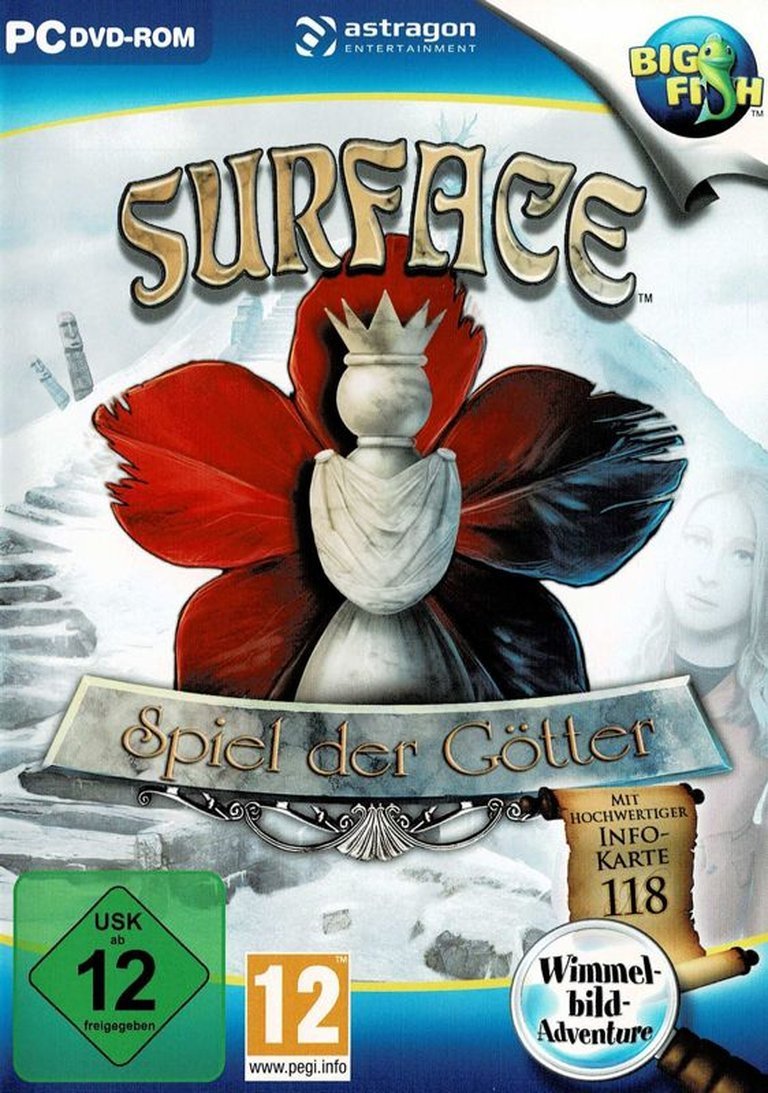
Description
Surface: Game of Gods is a hidden object puzzle adventure game set in a fantasy mystery world. Players are drawn into a perilous scenario when a paid research study invitation from friends turns sinister: two companions vanish, and a third is abducted by a mysterious figure. Forced to participate in a lethal board game where each move risks death, players must solve intricate puzzles, uncover hidden objects, and navigate a surreal narrative to save their friends and escape alive. Developed by Elephant Games, the title blends detective gameplay with supernatural elements, challenging players to survive the gods’ deadly game.
Gameplay Videos
Where to Buy Surface: Game of Gods
PC
Surface: Game of Gods Cracks & Fixes
Surface: Game of Gods Guides & Walkthroughs
Surface: Game of Gods Reviews & Reception
niklasnotes.com (100/100): Surface: Game of Gods Collector’s Edition has earned a Player Score of 100 / 100.
steambase.io (100/100): Surface: Game of Gods Collector’s Edition has earned a Player Score of 100 / 100.
Surface: Game of Gods: An Odyssey of Missed Potential and Mythical Conventions
Introduction
When Elephant Games launched Surface: Game of Gods in 2015, it arrived as the sixth entry in their once-groundbreaking Surface series—a franchise that had pioneered narrative ambition in the Hidden Object Puzzle Adventure (HOPA) genre. Promising a Jumanji-inspired descent into a divine board game with life-or-death stakes, the game beckoned players to “roll the dice” in a race against cosmic forces. Yet, beneath its tantalizing premise lies a paradox: a game that embodies both the creative zenith and creative stagnation of mid-2010s casual adventure design. This review argues that while Game of Gods delivers a mechanically competent HOPA experience, its failure to leverage its mythic framework or innovate beyond genre tropes renders it a fascinating relic of a genre in transition.
Development History & Context
Developed by Elephant Games—a studio synonymous with HOPA staples like Mystery Trackers and Grim Tales—Surface: Game of Gods emerged during a pivotal era for casual gaming. By 2015, the genre faced saturation, with studios like Mad Head Games and Eipix pushing boundaries in storytelling and production value. Elephant Games, once a trailblazer, now risked irrelevance by relying on formulaic design.
Technologically, Game of Gods adhered to the HOPA standard: pre-rendered 2.5D environments, fixed first-person perspectives, and a blend of hidden object scenes (HOS) and logic puzzles. The game was built for modest hardware, targeting the Windows-dominated casual market, with subsequent ports to Mac and iPad underscoring its accessibility. Its Collector’s Edition, featuring bonus chapters and a strategy guide, catered to completionists amid rising competition from free-to-play mobile titles.
Thematically, the Surface series had distinguished itself with surreal settings—dreamscapes, alternate dimensions, floating cities—but Game of Gods leaned into mythological pastiche, a trend popularized by titles like Age of Mythology yet underexplored in HOPA. This shift reflected Elephant Games’ attempt to recapture relevance but also exposed their struggle to balance innovation with genre conventions.
Narrative & Thematic Deep Dive
Game of Gods casts players as an unnamed protagonist drawn into a supernatural board game after their friends—Jim, Kevin, and Maggie—vanish during a research study. Guided by a cryptic Stranger, players navigate realms tied to dice rolls, aiming to rescue their companions and thwart vengeful deities. The setup evokes Jumanji’s lethal playfulness but layers on a mythic backdrop involving cyclical rituals to appease primordial gods—an intriguing concept let down by superficial execution.
Characters & Dialogue
The ensemble lacks depth. Protagonist friends exist as MacGuffins, their personalities reduced to journal entries and fleeting apparitions. The Stranger, positioned as a morally ambiguous guide, teases lore about an ancient organization overseeing the game but reveals little, rendering his role undercooked. Voice acting oscillates between serviceable (the Stranger’s gravelly noir inflection) and campy (gods declaiming with pantomime gravitas), while dialogue favors exposition over nuance.
Themes
The game’s strongest thematic thread—subverting divine power through mortal cunning—is squandered. Players “challenge gods” but engage in boilerplate tasks (e.g., collecting amulets, solving tile puzzles) that rarely feel mythically consequential. Unlike Hades (2020), which reimagines Greek myth through character-driven pathos, Game of Gods treats deities as set dressing. The finale, a showdown against deific entities, culminates in a predictable deus ex machina, betraying its potential for psychological or moral complexity.
Gameplay Mechanics & Systems
Game of Gods adheres to genre scaffolding with minimal deviation:
Core Loop
- Hidden Object Scenes: Standard list-based HOS dominate, with sporadic variations (silhouette matching, environmental interactions). Scenes are well-rendered but lack thematic integration—finding a saber in a foliage-heavy scene feels arbitrary, not mythic.
- Puzzles: Logic puzzles range from rudimentary (sliding tiles) to inventive (replicating a lyre’s melody). A standout involves reforging a key using metallurgy mini-games, though such moments are rare.
- Progression: The “game board” serves as a hub, but dice rolls linearly gate levels, neutralizing any illusion of player agency. Cards collected in-game (e.g., “Release Card”) function as single-use keys, a mechanic with untapped strategic potential.
UI & Innovation
The point-and-click interface is intuitive, though inventory management feels dated. A missed opportunity lies in the “game piece” selection at the start: players choose a token with traits like “animal affinity,” but this never impacts dialogue or puzzles, epitomizing the game’s underdeveloped systems.
Flaws
- Pacing: Early chapters drag with backtracking; late-game puzzles spike in difficulty without narrative payoff.
- Predictability: Veteran HOPA players will foresee solutions (e.g., “combine X with Y” tropes).
- Bonus Content: The Collector’s Edition adds a 30-minute epilogue, but its lore-deepening aspirations clash with rushed storytelling.
World-Building, Art & Sound
Visual Design
Game of Gods adopts a painterly aesthetic, blending surreal landscapes (gothic castles, mist-shrouded forests) with mythological iconography. Yet, these environments feel static—more diorama than lived-in realm. Character models, particularly during close-ups, suffer from stiff animations and uncanny facial distortions, a jarring contrast to the detailed backdrops.
Atmosphere
The game’s tone wavers between eerie and absurd. One moment, players navigate a melancholic cemetery; the next, they befriend a talking skeleton-turned-shopkeeper. This tonal inconsistency undermines dramatic stakes, though dream sequences—such as a trippy descent into a god’s psyche—hint at unrealized ambition.
Sound Design
The orchestral score, laden with choral chants and percussive tension, excels in isolation but overpowers quieter scenes. Sound effects—a dice clatter, a gate creaking—are serviceable, while voice acting’s uneven quality (from the Stranger’s gravitas to Maggie’s shrill panic) further disrupts immersion.
Reception & Legacy
Upon release, Game of Gods garnered muted praise. JayIsGames applauded its “cinematic” appeal and creativity but noted its simplicity, while That Swedish Guy’s Corner lamented its “generic blandness” and squandered potential. Commercial performance mirrored mid-tier HOPA norms, buoyed by loyalists but ignored by broader audiences.
The game’s legacy is twofold:
1. As a Cautionary Tale: It exemplifies the HOPA genre’s mid-2010s stagnation—relying on proven formulas amid rising competition from narrative-driven indies (Firewatch) and myth-rich AAA titles (God of War).
2. As a Time Capsule: Its mashup of board-game mechanics and mythology foreshadowed trends in games like Immortals Fenyx Rising (2020), albeit without their polish.
Elephant Games never revived the Surface series after 2017’s Return to Another World, pivoting instead to safer franchises (Mystery Trackers). Today, Game of Gods lingers as a curio—a bridge between HOPA’s golden age and its decline.
Conclusion
Surface: Game of Gods is neither triumph nor disaster—it is the quintessential B-tier HOPA. Its mythological premise tantalizes but fumbles execution; its puzzles satisfy but rarely surprise. For genre devotees, it offers a fleeting, polished diversion. For critics, it embodies the creative crossroads of a studio—and genre—struggling to evolve. In the pantheon of mythic games, it is a demigod: admirable in aspiration, mortal in legacy. Its dice may roll, but they land with a whisper, not a thunderclap.