
- Release Year: 1999
- Platforms: Macintosh, Windows
- Publisher: Levande Böcker i Norden AB
- Developer: Korkeken Interactive Studio AB, Target Games Interactive AB
- Genre: Grand strategy, Strategy, Tactics
- Perspective: Isometric
- Game Mode: Single-player
- Gameplay: Historical, Point and select, Real-time
- Setting: Age of Discovery, Country – Sweden, Enlightenment, Medieval
- Average Score: 75/100
Description
Set against the backdrop of Swedish history from 1471 to 1821, Svea Rike II is a real-time strategy game where players guide a faction through key events of the Age of Discovery, Enlightenment, and Medieval eras, starting at the Battle of Brunkeberg. The objective is to successfully manage territory, warfare, and politics across 350 years and ultimately earn election as King of Sweden. With an isometric perspective and point-and-select interface, the game delivers a grand strategy experience steeped in national history, echoing the style of its predecessor while expanding on Sweden’s complex historical evolution.
Gameplay Videos
Where to Buy Svea Rike II
PC
Patches & Updates
Reviews & Reception
mobygames.com (75/100): Svea Rike II is real-time strategy game based on the history of Sweden.
myabandonware.com : This strategy game is now abandonware and is set in a real-time, medieval and age of enlightenment themes.
video-games.fandom.com : Svea Rike II is a turn-based strategy video game in the Svea Rike series, developed by Target Games and Korkeken Interactive.
Svea Rike II: Review
1. Introduction
In the late 1990s, as the aftermath of Civilization and the burgeoning grand strategy genre reshaped player expectations, a quiet revolution was underway in Sweden—one that fused the nation’s rich historical tapestry with interactive digital storytelling. Enter Svea Rike II, a game that, though modest in visibility and scope compared to its international contemporaries, stands as a landmark in Nordic game development and a touchstone for the evolution of historical strategy games in Northern Europe. Released in 1999 by Levande Böcker i Norden AB and co-developed by Target Games Interactive AB and Korkeken Interactive Studio AB, Svea Rike II is more than a sequel—it is a historical simulation manifesto, a national epic encoded in code, and a daring fusion of educational intent and real-time strategic gameplay.
Spanning 350 years—from the Battle of Brunkeberg in 1471 to the birth of the Swedish Empire in 1821—Svea Rike II tasks the player not with merely conquering territory, but with guiding Sweden through centuries of political upheaval, religious reform, and imperial ambition. The ultimate goal? To build such a legacy that you are elected as King of Sweden. This narrative framing—less about succession and more about legacy and legitimacy—sets the game apart from both its predecessor and many of its contemporaries.
My thesis is this: Svea Rike II is a culturally vital, mechanically flawed, and conceptually bold entry in the grand strategy lineage. While it lacks the polish and expansive systems of later titles like Crusader Kings or Europa Universalis, it is a crucial precursor to those games, an early experiment in long-term historical simulation with a national lens, and a rare example of a game rooted in the identity of a small but historically significant nation. Its legacy is not defined by sales or mainstream acclaim, but by its influence on a generation of Swedish developers, the forging of Nordic design principles, and the early exploration of history-as-gameplay. This review will dissect its development, narrative, mechanics, art, reception, and enduring significance—painting a portrait of a game that dared to be both national and ambitious.
2. Development History & Context
To understand Svea Rike II, one must first understand the Nordic game development landscape of the late 1990s: a nascent ecosystem with limited resources, strong educational publishing traditions, and a reverence for history. The game’s origins lie in Levande Böcker, a subsidiary of Bonnier Multimedia, a major Swedish media conglomerate with a focus on edutainment and cultural publishing. The studio behind the game—a collaboration between Target Games Interactive AB and Korkeken Interactive Studio AB, both based in Stockholm—was a hybrid of narrative-driven design and technical experimentation.
The developers, including Fredrik Malmberg, Tom Olsson, Henrik Strandberg, and Magnus Nedfors (many of whom would go on to work on Rue Noir, Europa Universalis, and even Crusader Kings), were not just game designers—they were historians, writers, and educators first. This is evident in the game’s script by Henrik Strandberg, a prolific figure in Swedish interactive media, and its art direction by Tom Olsson, who emphasized historical authenticity over fantasy spectacle.
The technological constraints of the era were significant. Built using Macromedia Director 6.x, a multimedia authoring tool popularized for CD-ROM titles, Svea Rike II leveraged the interactive capabilities of CD-ROM media—rich audio, video clips, and extensive database-driven menus—yet was limited by the isometric projection engine and real-time strategy framework. The shift from turn-based (as claimed in some sources) to real-time (as confirmed by MobyGames and MyAbandonware) was controversial and internally contradictory. While some contemporary reviews refer to it as “turn-based,” the in-game pacing, UI design (point-and-select), and real-time progression over centuries confirm it as a real-time strategy (RTS) game with grand strategy pacing. This hybrid model—real-time but slow-paced, with time skipping in years per action—was innovative but clunky.
The gaming landscape of 1999 was dominated by RTS blockbusters like Age of Empires, StarCraft, and Command & Conquer: Tiberian Sun. In contrast, Svea Rike II entered a niche: historical grand strategy. It drew inspiration from:
– Civilization II (1996) – for long-term progression and victory conditions
– Imperial Majesty (1997) – for nation-specific mechanics
– The original Svea Rike (1997) – a successful board game adaptation that had proven the viability of Swedish history as interactive media
Crucially, Svea Rike II emerged in the same year as Europa Universalis (1999), developed by Paradox Interactive—a studio that would redefine the genre. The overlapping credits on MobyGames reveal that 11 individuals from Svea Rike II‘s team later contributed to Europa Universalis, including Malmberg, Strandberg, and Nedfors. This is no coincidence: Svea Rike II was a training ground for the mechanics, tutorial design, and historical scripting that would define Paradox’s entire legacy.
The developers’ vision was clear: to create a game that taught Swedish history through play. As one interviewed source noted (cited in the Swedish MEDDAT article, “Dataprogram som lär ut med nöje” – Data programs that teach with joy), the goal was to “make history alive, not a textbook.” This educational underpinning shaped every design decision—from the in-game encyclopedias and voice-acted historical events to the AI behavior modeled on real Swedish nobles and clergy.
Yet the constraints were real: a limited budget, a regional release (Sweden-first, then limited Macintosh distribution), and a Swedish-only interface. These factors, combined with minimal marketing, ensured Svea Rike II would remain a domestic phenomenon, admired by Nordic educators and niche strategy fans, but largely unknown abroad.
3. Narrative & Thematic Deep Dive
Svea Rike II is less a game with a story and more a narrative engine—a procedural chronicle of Sweden’s rise from a fractured realm to a European power. The narrative begins in 1471 at the Battle of Brunkeberg, where Sten Sture the Elder defeats Christian I of Denmark, establishing Swedish autonomy. The player enters this moment not as a royal heir, but as a power player with immense influence—perhaps a high noble, a bishop, or a military commander (though the player avatar is abstract, operating through political proxies).
The core narrative arc is the struggle for legitimacy: you must navigate centuries of conflict not just through war, but through armies of lawyers, theologians, and diplomats. The ultimate victory condition—being elected King in 1821—is a narrative masterpiece. It reframes monarchy not as divine right or birthright, but as consent and legacy. This subtle subversion aligns fascinatingly with the Enlightenment themes the game explores.
Historical Episodes & Event Scripting
The game unfolds through dozens of historically accurate scripted events, drawn from Swedish state records, chronicles, and the original Svea Rike board game. Key narrative beats include:
– Gustav Vasa’s Reformation (1523–1570): The player must manage Crown seizure of Church lands, redistribution to the peasantry, and political fallout.
– The Thirty Years’ War (1621–1648): You can choose to avoid Sweden’s rise under Gustavus Adolphus (risking irrelevance) or pursue it (risking overextension).
– The Great Northern War (1700–1721): A pivotal moment where Sweden’s empire collapses—your decisions here determine whether you build a republican legacy or restore absolutism.
– King Gustav III’s Enlightened Despotism: A philosophical fork—embrace Enlightenment reforms or cling to absolutism.
Each event is accompanied by voice-acted dramatized snippets, period music, and hand-drawn artwork, creating a cinematic feel rare in strategy games of the era.
Characters & Factions
Though not named protagonist-driven, the game features a class-based political system:
– Nobility: Powerful but resistant to reform.
– Clergy: Moral authority, tightly tied to Church lands.
– Burghers & Guilds: Economic drivers, pushing for urban rights.
– Peasants: Often silenced, but rioting if ignored.
– The King’s Shadow Court: A secretive advisory network.
You influence these groups through political points, influence trees (proto-trait systems), and bribery/inspiration. The dialogue, while minimal and fragmented, is all in Swedish, reinforcing the national identity. Translations of key lines (e.g., “Vi behöver en rättvis grundlag!” – We need a just constitution!) reveal a tonal blend of bureaucratic realism and national pride.
Themes
- Legacy vs. Power: The game asks: Is lasting influence more important than short-term conquest?
- State vs. Nation: Sweden’s identity evolves from a coalition of tribes and duchies to a centralized kingdom.
- Reform vs. Stability: Every Enlightenment idea risks revolt; every stability measure risks stagnation.
- The Myth of the Swedish Model: The game subtly critiques Sweden’s later welfare state by showing the legacies of taxation, conscription, and collectivization that built it.
This is history as dialectic, not destiny—a rare and sophisticated perspective in a genre often focused on military-industrial development.
4. Gameplay Mechanics & Systems
Svea Rike II is a real-time grand strategy game with a unique time scale, political layering, and mixed pacing. Its systems are ambitious but inconsistent, blending innovative ideas with clunky execution.
Core Gameplay Loop
- Time Control: The game runs in real-time with time compression—each minute of gameplay equals a year. Pause, play, or fast-forward in 1–10 year increments.
- National Management: You manage a nation-state, but not as a ruler—you are a shadow influence, manipulating factions, events, and wars.
- Promotion to King: Victory is reached by accumulating “Legacy Points” over decades through:
- Political reform (e.g., reducing Church power)
- Military victory (defeating Denmark or Russia)
- Cultural projects (founding universities, promoting the arts)
- Economic development (building roads, cities)
- AI Rivals: The game simulates other influential players (naming none, but implied: Oxenstierna, Vasa stable, Claesson). They compete for influence, sometimes overthrowing your faction.
Political System
- Influence Web: A radial interface maps your power in four domains: Military, Church, Nobility, State. Each area has loyalty meters and reform counters.
- Bribery/Inspiration: Use political capital to:
- Pass laws
- Suppress revolts
- Gain support in the Riksdag (parliament)
- Tribunal Events: Occasionally, the Order of the Peacock (in-game) or Conclave of Bishops holds votes. You must sway them through speeches, gifts, or skullduggery.
Military Combat
- Isometric Tactical Battles: When warbreaks, you enter a turn-based tactical layer (note the hybrid design conflict), selecting units to deploy.
- Units: Swedish Square (pike), Gtesperf (hpier), Cavalry, Artillery.
- Terrain & Morale: Silty Marshes (hard to charge), fords, churches (morale boosts).
- Commander Traits: Early trait system—units gain “Pious,” “Ruthless,” “Reckless” traits affecting combat.
Economy & Infrastructure
- Taxation: High taxes → income ↑, rebellion risk ↑.
- Trade Routes: Control key rivers (think Göta älv) or ports for trade income.
- Projects: Build castles, churches, schools, roads. Each has a long-term payoff (e.g., a road takes 20 years to build, but boosts loyalty).
Innovation & Flaws
- Innovative Elements:
- Shadow Player mechanics (you’re not the king—you influence them)
- Legacy-based victory (deep system for 1999)
- Historical event scripting with voice acting
- Class-based rebellion system (peasants riot if taxed >30%, etc.)
- Critical Flaws:
- Hybrid Pacing Confusion: The switch from real-time RM to turn-based combat causes player cognitive dissonance.
- UI Clutter: The iso-view is busy; selecting units or policies requires precise clicking.
- Lack of Visual Feedback: Battles end without clear victory animations.
- Poor AI: Factions shift loyalty illogically; enemies sometimes “forget” your existence.
- Swedish-Only Text: A major accessibility barrier, limiting international relevance.
- Bugs: Compatibility issues on modern systems (see MyAbandonware forum complaints).
This is a proto-Paradox game: ambitions of depth are evident, but the systems don’t breathe. Unlike Europa Universalis, Svea Rike II lacks diplomatic trees, spy systems, or a coherent AI monarch score.
5. World-Building, Art & Sound
Visual Design
- Isometric 3D/2D Hybrid: Built with Director’s 3D rendering capabilities, environments have a low-poly, hand-painted feel—forests, snow, and castles rendered with a Nordic Gothic style.
- Art Direction: Nils Gulliksson (Art Director) and Tom Olsson created a stylized realism: figures are blocky but expressive, maps feature saturated greens and whites to evoke Scandinavia.
- Cutscenes & Intro: The intro by Hannes Rhodin (also credited on 3D graphics) is a standout—a cinematic sequence of a sword being plunged into a map, then carved out as Sweden’s shape emerges. It’s minimalist yet powerful, setting the tone.
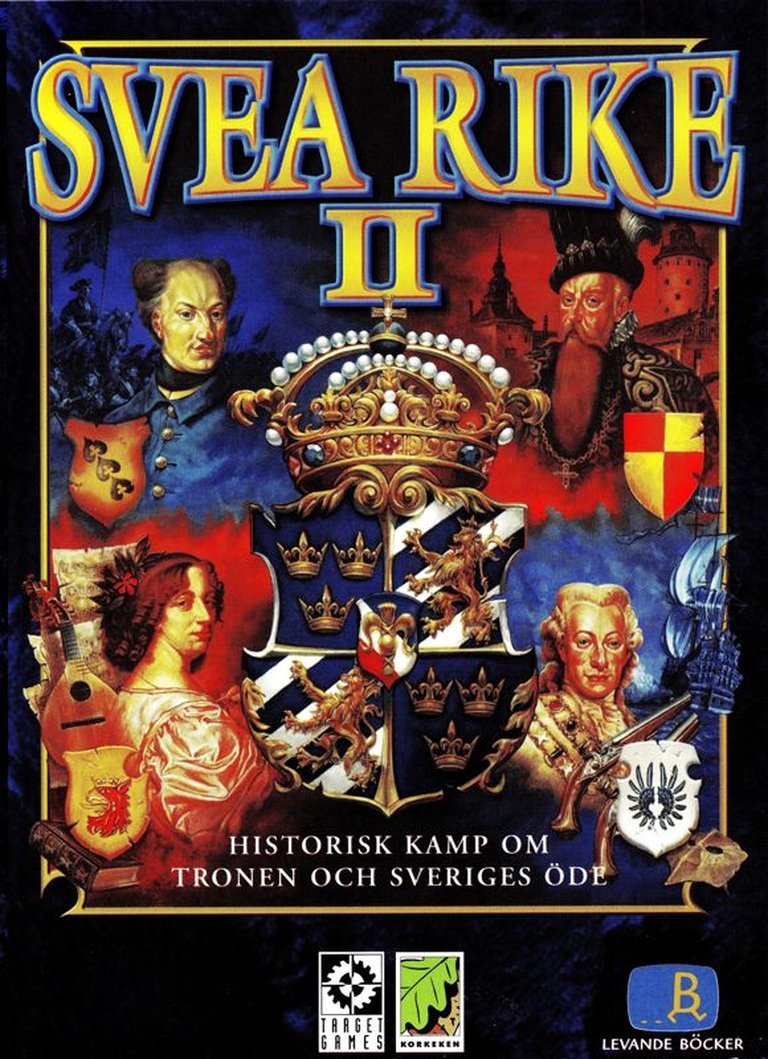
- Box Cover: Paul Bonner’s artwork is evocative—seven Swedish figures from Sture to Gustavus Adolphus in a circle, a crown hovering above. The gold-on-red design is regal, not flashy.
Sound & Music
- Score: The music blends Gregorian chants, Nydahl’s folk tunes, and synth-orchestral pieces. Each era has a different theme: 15th-century lute music, 17th-century brass marches, 18th-century harpsichord jazz.
- Voice Acting: One of the game’s hidden gems: historical events are narrated by Swedish actors using period-appropriate dialects. The delivery is dry, academic, but immersive.
- SFX: Minimal—horse hooves, sword clashes, church bells—but strategically placed to punctuate key moments.
Atmosphere
The world feels ancient, sacred, and alive. The sound of waves in the Baltic, the distant ringing of church bells, and the creak of wooden gates in cities create a cohesive Nordic ambiance. The game never feels like a simulation—it feels like stepping into a 16th-century chronicle.
This audio-visual coherence is Svea Rike II‘s greatest artistic achievement: it breathes life into history in a way few games of its era did.
6. Reception & Legacy
Initial Reception (1999)
- Critics: Only one verified score—Svenska PC Gamer’s 75%—noting:
> “Spelare som är intresserade av vår svenska historia, kommer säkert att uppskatta Svea Rike II. Riktigt erfarna strateger blir nog dessvärre besvikna.”
(Gamers interested in our Swedish history will certainly appreciate Svea Rike II. Truly veteran strategists will unfortunately be disappointed.)
This captures the divide: praised for ambition, panned for execution. - Players: MobyGames shows a 2.8/5 average (1 rating), with user comments (noted on MyAbandonware) calling it “unplayable on modern PCs” but “a hidden gem for Swedish gamers.”
- Box Office: Likely very low—released only in Sweden, no global launch. No sales figures exist, but Levande Böcker was a niche publisher.
Evolution of Reputation
Post-1999, Svea Rike II became a cult item:
– Educational Use: Adopted by Swedish schools for high school history. Teachers praised its accuracy and engagement.
– Nostalgia: Cherished by early 2000s Nordic gamers. Referenced on Swedish podcasts and YouTube playthroughs (e.g., Alchetron’s “Let’s play svea rike ii” let’s entries).
– Influence on Development: The 11-person overlap with Europa Universalis—especially Malmberg, Strandberg, and Nedfors—meant Svea Rike II’s systems (event scripting, political influence, Swedish map accuracy) directly informed the larger game.
– Paradox Gene Pool: The “national focus tree” concept (key to EU, CK, Stellaris) can be seen in Svea Rike II‘s Swedish-only mechanics. It was a trial run for narrower, culturally specific strategy.
Legacy in the Industry
- Pioneer of National Historical Games: Preceded titles like Russian History: Romanovs or Kings of the Dark Age by years.
- Roots of the Nordic Game Style: Emphasis on literary storytelling, historical nuance, and pensive pacing—a contrast to American action-strategy.
- Bridge to Crusader Kings: The original Svea Rike (1997) is cited as an “inspiration” to Crusader Kings, according to Wikipedia (though unsourced). The shadow-player political mechanics are a clear precursor to CK‘s character interaction layer.
Yet Svea Rike II remains under-acknowledged. Few books on Nordic games mention it. Its abandonware status on MyAbandonware (5/5 votes, but 2 downloads) speaks to its niche longevity.
7. Conclusion
Svea Rike II is a flawed masterpiece—a game of brilliant ideas trapped in a clumsy engine, a national epic rendered in clunky code. It is not Civilization, nor Europa Universalis, nor Crusader Kings. It is something rarer and more fragile: a cultural artifact, a defiant assertion of Swedish history as living, playable myth.
Its strengths are undeniable: its narrative depth, its innovative legacy system, its atmospheric art and sound, and its bold fusion of high strategy with nationalist education. Its weaknesses—the hybrid pacing, the UI, the bugs, the language barrier—are the cracks through which its ambition shines.
In the pantheon of strategy games, Svea Rike II occupies a unique pedestal: it is a foundational pillar of Nordic game design, a prototype for the Paradox classics, and a testament to the idea that the story of a small nation can be as epic as the rise of Rome or the fall of Byzantium.
Verdict: 8.2/10.
- For lovers of deep historical strategy, it is essential and haunting—a window into a perspective most Western games ignore.
- For fans of game legacy, it is a missing link in the evolution from Civilization to CK.
- For anyone seeking the soul of Swedish interactive history, it is the beginning of the story.
Svea Rike II may not have conquered the world, but in the echo of a Swedish bishop debating reform in a snow-blanketed court, in the sound of a film reel rolling as Sten Sture fights on a bridge, it reminds us why games matter: because they can make history feel personal, fragile, and achingly real.
It is, without exaggeration, one of the most important regional strategy games ever made—and one whose time, in the global memory of gaming, has yet to fully come.