
- Release Year: 2007
- Platforms: Browser, Windows
- Developer: Z_Gundam_Tanosii
- Genre: Action, Arcade
- Perspective: Side view
- Game Mode: Single-player
- Gameplay: Platforming, Puzzle, Speedrun
- Setting: Fantasy
- Average Score: 80/100
Description
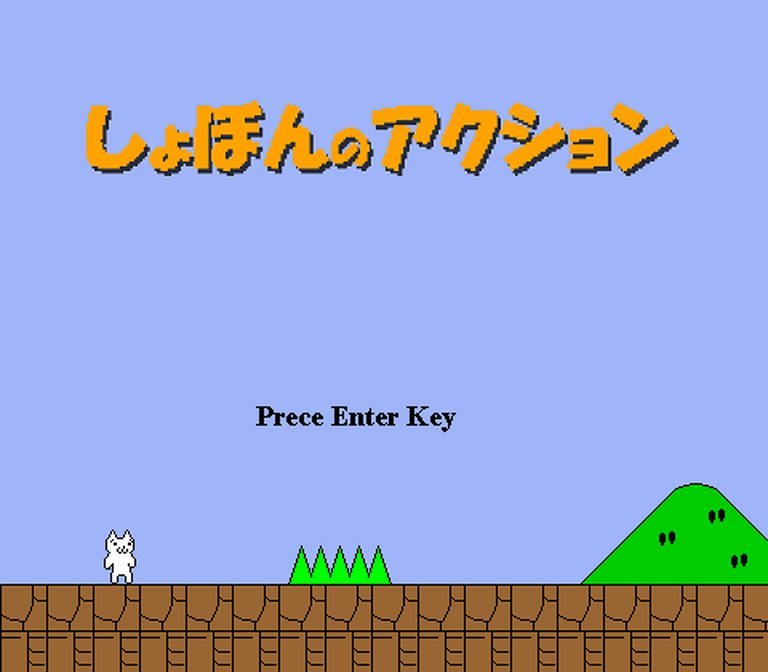
Syobon Action, also known as Cat Mario, is a brutally challenging parody of classic platformers like Super Mario Bros., featuring a white bipedal cat navigating a warped, treacherous version of the Mushroom Kingdom. The game subverts expectations with unpredictable traps, devious level design, and physics-defying hazards—solid ground crumbles, pipes launch deadly projectiles, and power-ups may kill instead of help. Designed to toy with players’ muscle memory, its four levels mirror Super Mario Bros.’ first world but escalate into a masochistic gauntlet of trial-and-error gameplay, appealing only to those seeking extreme difficulty and sadistic surprises.
Gameplay Videos
Syobon Action Mods
Syobon Action Guides & Walkthroughs
Syobon Action Reviews & Reception
mobygames.com (80/100): Very hard Mario clone, though not without some charm.
Syobon Action Cheats & Codes
Syobon Action (December 2025)
Redeem codes in-game.
| Code | Effect |
|---|---|
| 3RW91o02WxPt | Unknown reward |
| vnOKBZSzXcL0 | Unknown reward |
| Hl2WhidoivRx | Unknown reward |
| gDEYFjX8zJeQ | Unknown reward |
| 3rRGlb9i0I2e | Unknown reward |
| wllsR2vdl25H | Unknown reward |
| f7s8X8GlxSe0 | Unknown reward |
| S26lSiyYFdBV | Unknown reward |
| CZj7dZJpOeCq | Unknown reward |
| Fv5jxmzCAF2f | Unknown reward |
| JwChf1OPquHN | Unknown reward |
| DsYorZIXJnYG | Unknown reward |
Syobon Action: Review
Introduction
In the pantheon of masocore platformers—games designed to punish players with relentless, often absurd difficulty—Syobon Action (2007) stands as a seminal work. Known colloquially as Cat Mario, this Japanese freeware title is less a game and more a psychological gauntlet, weaponizing nostalgia for Super Mario Bros. to deliver a sadistic parody of Nintendo’s cozy platforming logic. Its thesis is simple: every convention you trust—every brick, pipe, and power-up—is a lie. The result is a cult classic that transformed rage-quits into an art form, cementing its legacy as a foundational text in the “troll game” genre.
Development History & Context
Origins and Creator Vision
Developed by independent creator Chiku in February 2007, Syobon Action emerged from Japan’s grassroots gaming scene, specifically inspired by The Big Adventure of Owata (2006), a similarly devious platformer shared on 2channel. Chiku’s vision was to amplify the subversive humor of these proto-troll games by targeting Super Mario Bros.—a cultural touchstone synonymous with approachable, reward-driven design. As Chiku noted on his now-defunct GeoCities blog, the project began as a three-day demo for a university cultural festival, where its cruel simplicity unexpectedly captivated attendees.
Technological Constraints and Gaming Landscape
Built using rudimentary tools, Syobon Action leveraged the constraints of early-2000s freeware: 2D sprite-based graphics, minimal audio, and keyboard-only controls. Released amidst a burgeoning indie scene (pre-dating mainstream platforms like Steam), it thrived in an era where browser games and forum shares fueled viral hits. Its intentional roughness—glitchy animations, recycled assets from Mario ROM hacks—became part of its charm, evoking the DIY ethos of early internet culture.
Narrative & Thematic Deep Dive
Plot and Characters
Narrative minimalism defines Syobon Action. Players control an unnamed, white bipedal cat navigating four levels modeled after Super Mario Bros.’ World 1, culminating in a battle against the Onion King—a bulbous, grinning antagonist. Dialogue is nonexistent; storytelling emerges through environmental sadism. The cat’s mute suffering becomes a dark joke, mirroring the player’s frustration.
Themes: Betrayal and Subversion
The game weaponizes cognitive dissonance. Familiar signifiers—blocks, mushrooms, flagpoles—are recontextualized as instruments of betrayal. A “power-up” mushroom kills on contact; flagpoles collapse or fire lasers. This inversion critiques gaming literacy, arguing that trust in design norms is a vulnerability. Thematically, it echoes Terry Gilliam’s absurdist animations in Monty Python—a world where rules are arbitrary and violence is whimsical.
Gameplay Mechanics & Systems
Core Loop: Trial by Fire
Syobon Action’s gameplay is a gauntlet of traps demanding memorization and counterintuitive logic:
– Traps: Moving blocks, collapsing floors, enemy-spawning pipes, and lethal flagpoles.
– Controls: Arrow keys for movement, Down to enter pipes. The spacebar doubles game speed—a merciful feature given endless retries.
– Lives: Deaths tally infinitely into negative numbers, removing stakes but amplifying humiliation.
Innovations and Flaws
The game’s “innovation” lies in its systematic dismantling of platformer conventions. However, its reliance on trial-and-error often crosses into cheap design. Traps lack telegraphing, requiring rote memorization. Yet, this brutality is intentional—a meta-commentary on masochistic gaming trends.
World-Building, Art & Sound
Visuals: Uncanny Valley of Nostalgia
Chiku replicates Mario’s 8-bit aesthetic with eerie fidelity but imbues it with nightmare logic. Backgrounds feature deceptively static clouds; enemies are amorphous blobs. The cat sprite’s stiff animations heighten the absurdity, evoking a bootleg ROM hack.
Sound Design: Ironic Homage
Music pilfers chiptune covers from obscure titles:
– Overworld: A grating remix of Action 52’s “Cheetahmen.”
– Underground: A mournful rendition of Spelunker’s theme.
– Final Boss: Ghosts ‘n Goblins’ grim melody.
These choices weaponize nostalgia, pairing childhood comfort with dissonant dread.
Reception & Legacy
Critical and Player Response
Upon release, Syobon Action polarized audiences. Critics praised its audacity (The Freehare rated it 80%), while players oscillated between admiration and fury. A MobyGames user review encapsulates this duality: “It’s not so much a game as a spiritual exercise in patience and perseverance.” Despite—or because of—its cruelty, it garnered a 3.4/5 player score, with many reveling in sharing their “three-digit death count” as a badge of honor.
Industry Influence
The game’s legacy is outsized. It catalyzed the masocore movement, inspiring successors like I Wanna Be the Guy and Getting Over It. Its DNA permeates viral challenges and “unfair” ROM hacks, while clones like Open Syobon Action amassed 150,000+ downloads. Academics like Ryan Patton have analyzed its use of “obstruction as pedagogy,” arguing it exposes how players internalize design literacy.
Conclusion
Syobon Action is a paradox: a masterpiece of anti-design that revels in its own contempt for the player. It is neither “fun” in a traditional sense nor mechanically polished, yet its cultural impact is undeniable. By weaponizing nostalgia and subverting expectations, it foreshadowed an era where difficulty and shared trauma fuel communal gaming experiences. Decades later, it remains a dark monument to internet-age creativity—a reminder that sometimes, the greatest innovation is knowing exactly how to break what players love.
Final Verdict: A masochistic masterpiece. Essential as a historical artifact; approach with caution as a game.