
- Release Year: 2004
- Platforms: PlayStation 2, PS Vita, PSP, Windows
- Publisher: KOEI Co., Ltd., Taiwan Koei Entertainment Software, Inc., Tecmo Koei Games Co., Ltd.
- Developer: KOEI Co., Ltd.
- Genre: Role-playing (RPG)
- Perspective: Diagonal-down
- Game Mode: Single-player
- Gameplay: Card Collection, Turn-based combat
- Setting: Ancient, Classical, Japan, Medieval
- Average Score: 72/100
Description
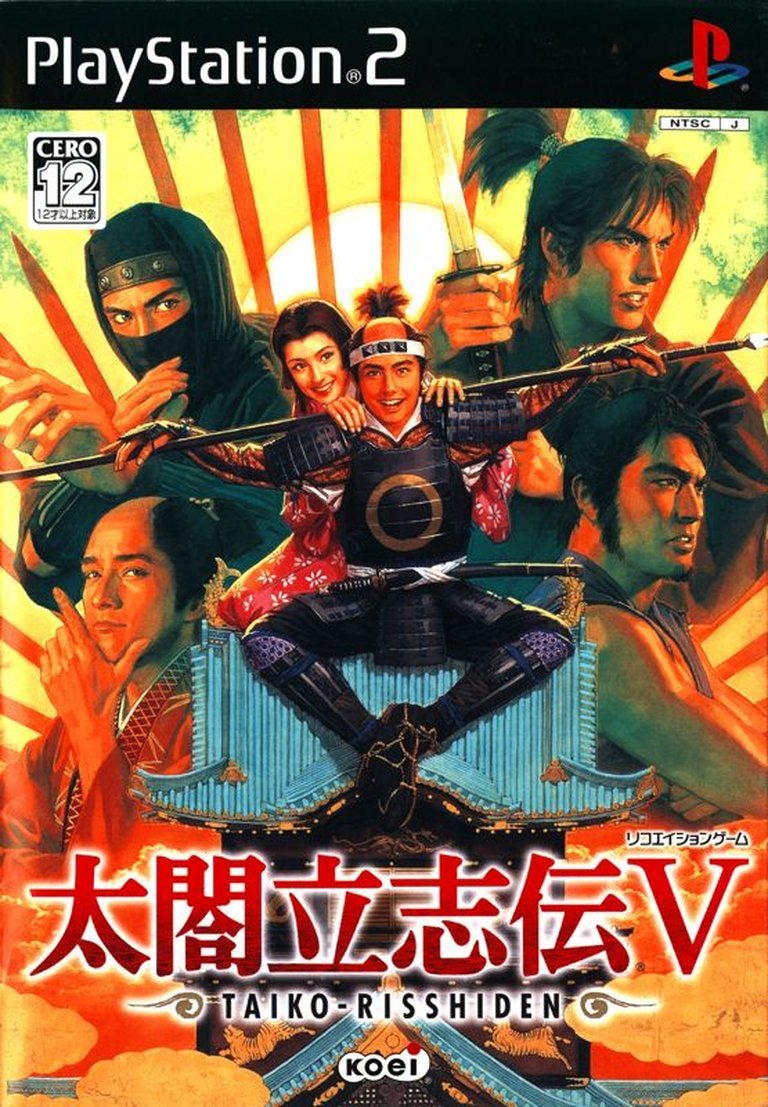
Taiko-Risshiden V is the fifth installment in the Taikō Risshiden series, a historical role-playing game set in feudal Japan. Players can choose from a variety of occupations, including samurai, ninja, merchant, sword master, pirate, doctor, tea master, and blacksmith, each offering unique gameplay experiences. The game features an improved card collection system and an expanded roster of characters, allowing players to immerse themselves in the rich, turn-based strategy and life simulation elements of the era.
Gameplay Videos
Taiko-Risshiden V Patches & Updates
Taiko-Risshiden V Reviews & Reception
opencritic.com (72/100): “Taiko Risshiden V DX” is a fairly qualified reset, which proves that even today, the original “Taiko Risshiden V” can still continue to shine with strong gameplay.
Taiko-Risshiden V Cheats & Codes
PC (v1.0+)
Activate the trainer options in-game as described in the notes.
| Code | Effect |
|---|---|
| Num 1 | Edit Money |
| Num 2 | Edit Stamina |
| Num 0 | Set Game Speed |
Taiko-Risshiden V: A Masterclass in Historical Sandbox RPG Design
Introduction
In the pantheon of Japanese historical strategy RPGs, few series have captured the essence of feudal ambition and personal ascent as vividly as Taiko-Risshiden. The fifth installment, Taiko-Risshiden V, released in 2004, stands as a monumental achievement—a game that not only refined the sandbox RPG formula but also expanded it into a sprawling, immersive simulation of life in Japan’s Momoyama period. Developed by Koei, a studio renowned for its historical strategy games, Taiko-Risshiden V is a testament to the studio’s ability to blend meticulous historical detail with deep, player-driven storytelling.
This review will dissect Taiko-Risshiden V in exhaustive detail, exploring its development history, narrative depth, gameplay mechanics, and lasting legacy. We will argue that Taiko-Risshiden V is not just a high-water mark for the series but a pivotal title in the evolution of historical RPGs, offering a level of player agency and world-building that remains unmatched in the genre.
Development History & Context
The Legacy of Koei and the Taiko-Risshiden Series
Koei, founded in 1978, has long been synonymous with historical strategy games. The studio’s Nobunaga’s Ambition and Romance of the Three Kingdoms series are cornerstones of the genre, but Taiko-Risshiden occupies a unique niche. Unlike its more militaristic siblings, Taiko-Risshiden focuses on the personal journey of its protagonist, drawing inspiration from the life of Toyotomi Hideyoshi, one of Japan’s “Great Unifiers,” who rose from peasantry to become the de facto ruler of Japan.
The series debuted in 1992 on the PC-9801, with subsequent entries refining its blend of RPG mechanics, life simulation, and historical strategy. By the time Taiko-Risshiden V was released in 2004, the series had already established itself as a cult favorite in Japan, though it remained relatively obscure in the West due to its language barrier and niche appeal.
Technological Constraints and Innovations
Taiko-Risshiden V was developed during a transitional period for Koei. The game was released on Windows, PlayStation 2, and later ported to the PSP and PS Vita, each platform presenting its own challenges and opportunities. The PS2 version, in particular, benefited from the console’s robust hardware, allowing for more detailed character portraits and smoother animations.
One of the most significant technological innovations in Taiko-Risshiden V was its shift from the manga-style artwork of previous entries to a gekiga (graphic novel) aesthetic, inspired by Nobunaga’s Ambition. This change was not merely cosmetic; it reflected a broader shift in the game’s tone, emphasizing a more mature, grounded portrayal of feudal Japan.
The Gaming Landscape of 2004
In 2004, the gaming landscape was dominated by action-heavy titles and Western RPGs like World of Warcraft and Fable. Japanese RPGs, while still influential, were beginning to cede ground to more cinematic, fast-paced experiences. Taiko-Risshiden V, with its deliberate pacing and text-heavy gameplay, was a deliberate counterpoint to these trends. It was a game that demanded patience, strategic thinking, and a willingness to engage with its systems—a rarity in an era increasingly defined by instant gratification.
Narrative & Thematic Deep Dive
The Premise: A Tale of Ambition and Ascent
Taiko-Risshiden V is, at its core, a game about ambition. Players assume the role of a character in feudal Japan, with the ultimate goal of achieving greatness—whether through military conquest, economic dominance, or cultural influence. The game’s narrative is not linear but emergent, shaped by the player’s choices and interactions with historical figures.
The game’s title, Taiko-Risshiden, translates to “The Taiko’s Success Story,” referencing Toyotomi Hideyoshi’s title of Taiko (regent). This thematic focus on upward mobility is central to the game’s appeal. Unlike many RPGs, where the protagonist is often a predestined hero, Taiko-Risshiden V allows players to start from humble beginnings and carve their own path to power.
Character Roles and Historical Figures
One of the most compelling aspects of Taiko-Risshiden V is its expansive roster of character roles. While previous entries limited players to three occupations (samurai, ninja, and merchant), Taiko-Risshiden V introduced five new roles: sword master, pirate, doctor, tea master, and blacksmith. This expansion was not merely cosmetic; each role came with its own unique gameplay mechanics, narrative events, and pathways to success.
For example:
– Samurai: Focused on military conquest and loyalty to a lord.
– Ninja: Emphasized stealth, espionage, and covert operations.
– Merchant: Centered on trade, economic dominance, and diplomatic influence.
– Pirate: Allowed for naval combat, smuggling, and overseas trade.
– Doctor: Involved healing, research, and political maneuvering through medical knowledge.
The inclusion of these roles transformed Taiko-Risshiden V into a game about more than just war; it became a simulation of an entire society, where every profession had its own challenges and rewards.
Thematic Depth: Power, Loyalty, and Legacy
Taiko-Risshiden V explores themes of power, loyalty, and legacy with a depth rarely seen in video games. The game’s narrative is not just about achieving success but about the cost of that success. Players must navigate complex relationships with historical figures, balancing loyalty to their lord with personal ambition. Betrayal, political intrigue, and moral dilemmas are common, forcing players to make difficult choices that shape their character’s legacy.
The game’s portrayal of feudal Japan is nuanced, avoiding the romanticized samurai tropes that dominate much of Western media. Instead, it presents a world where power is fragile, alliances are fleeting, and survival often requires compromise. This thematic richness is one of the game’s greatest strengths, elevating it beyond a mere strategy RPG into a meditation on the nature of ambition itself.
Gameplay Mechanics & Systems
Core Gameplay Loop: A Sandbox of Possibilities
Taiko-Risshiden V is a turn-based sandbox RPG, where players navigate a diagonal-down map of feudal Japan, interacting with characters, managing resources, and pursuing their goals. The game’s core loop revolves around three main activities:
1. Exploration: Traveling across Japan to meet historical figures, gather information, and uncover opportunities.
2. Management: Handling finances, training skills, and managing relationships with allies and rivals.
3. Conflict: Engaging in duels, battles, or economic competitions to achieve dominance.
The game’s open-ended structure is its greatest strength. Players are not funneled into a linear narrative but are instead given the freedom to pursue their goals in any way they see fit. This freedom is supported by a robust set of systems that govern everything from combat to trade.
Combat and Mini-Games
Combat in Taiko-Risshiden V is turn-based and tactical, with a focus on positioning, unit composition, and terrain. The game’s battle system is deeply influenced by Koei’s Nobunaga’s Ambition series, but with a greater emphasis on individual duels and small-scale skirmishes.
One of the most innovative aspects of Taiko-Risshiden V is its use of mini-games to simulate various activities. For example:
– Trading: Players engage in a slot machine-style mini-game to determine the success of their trade deals.
– Espionage: Ninja players must complete stealth-based mini-games to gather intelligence.
– Medical Treatment: Doctors must diagnose and treat patients through a series of interactive challenges.
These mini-games are not just gimmicks; they are integral to the game’s mechanics, adding a layer of skill-based interaction to what could otherwise be a purely statistical experience.
Character Progression and Customization
Taiko-Risshiden V features one of the most detailed character progression systems in any RPG. Players can customize their character’s appearance, skills, and abilities, with each choice affecting their gameplay experience. The game’s card collection system, introduced in Taiko-Risshiden IV, was expanded in Taiko-Risshiden V, allowing players to collect and trade cards representing historical figures, items, and events.
The inclusion of female warlords and the ability to manage up to 40 characters simultaneously added unprecedented depth to the game’s character management. Players could now build entire dynasties, with each character contributing to the player’s overall legacy.
UI and Accessibility
While Taiko-Risshiden V is a masterclass in gameplay depth, its UI and accessibility leave something to be desired. The game’s menus are dense, and its systems can be overwhelming for new players. The lack of a comprehensive tutorial or in-game guide means that players must often rely on trial and error—or external resources—to fully grasp the game’s mechanics.
This complexity is both a strength and a weakness. On one hand, it ensures that Taiko-Risshiden V rewards dedicated players with a rich, rewarding experience. On the other hand, it creates a steep learning curve that may deter casual players.
World-Building, Art & Sound
Setting and Atmosphere
Taiko-Risshiden V is set in Japan’s Momoyama period, a time of political upheaval and cultural flourishing. The game’s world is meticulously researched, with historical figures, locations, and events faithfully represented. From the bustling streets of Kyoto to the remote villages of the countryside, the game’s setting is brought to life with a level of detail that is rare in video games.
The game’s gekiga-style artwork is a standout feature, lending the game a mature, cinematic quality. Character portraits are richly detailed, and the game’s environments are rendered with a level of care that reflects Koei’s commitment to historical accuracy.
Sound Design and Music
The game’s soundtrack, composed by Koei’s in-house team, is a masterful blend of traditional Japanese instruments and modern orchestration. Tracks like “Peace Paradise” and “Decisive Battle Emergency” evoke the grandeur and tension of feudal Japan, while more subdued pieces like “The Heart of Wabi Sabi” capture the game’s introspective moments.
The sound design is equally impressive, with ambient noises—such as the rustling of leaves, the clatter of swords, and the murmur of crowds—adding to the game’s immersive atmosphere.
Reception & Legacy
Critical and Commercial Reception
Taiko-Risshiden V was well-received in Japan, where it was praised for its depth, historical accuracy, and innovative gameplay mechanics. However, its niche appeal and language barrier limited its commercial success outside of Japan. Western critics, while acknowledging its strengths, often cited its complexity and lack of accessibility as barriers to entry.
Despite these challenges, Taiko-Risshiden V developed a dedicated fanbase, particularly among players who appreciated its unique blend of RPG and simulation elements. The game’s legacy was further cemented with the release of Taiko-Risshiden V DX in 2022, a remastered version that introduced improved graphics and additional content.
Influence on Subsequent Games
Taiko-Risshiden V has had a profound influence on subsequent Koei titles, particularly the Nobunaga’s Ambition and Romance of the Three Kingdoms series. Its emphasis on player agency, character customization, and emergent storytelling can be seen in later entries in these franchises, as well as in other historical RPGs.
The game’s use of mini-games to simulate various activities has also been adopted by other developers, though few have matched the depth and integration of Taiko-Risshiden V‘s systems.
Conclusion
Taiko-Risshiden V is a game that defies easy categorization. It is at once a historical RPG, a life simulation, and a strategy game—a rare blend of genres that creates an experience unlike any other. Its depth, complexity, and historical fidelity make it a standout title in Koei’s catalog and a pivotal entry in the evolution of historical RPGs.
While its steep learning curve and niche appeal may limit its accessibility, Taiko-Risshiden V rewards dedicated players with an unparalleled sense of agency and immersion. It is a game about ambition, not just in its narrative but in its design—a testament to Koei’s willingness to push the boundaries of what a historical RPG can be.
For those willing to invest the time and effort, Taiko-Risshiden V offers a gaming experience that is as intellectually stimulating as it is emotionally resonant. It is, in every sense of the word, a masterpiece.