
- Release Year: 1999
- Platforms: PlayStation, Windows
- Publisher: Acer Third Wave Software (Beijing) Co., Ltd, Acer TWP Corp, KOEI Co., Ltd.
- Developer: KOEI Co., Ltd.
- Genre: Role-playing, RPG
- Perspective: Top-down
- Game Mode: Single-player
- Setting: Ancient, Classical, Japan, Medieval
Description
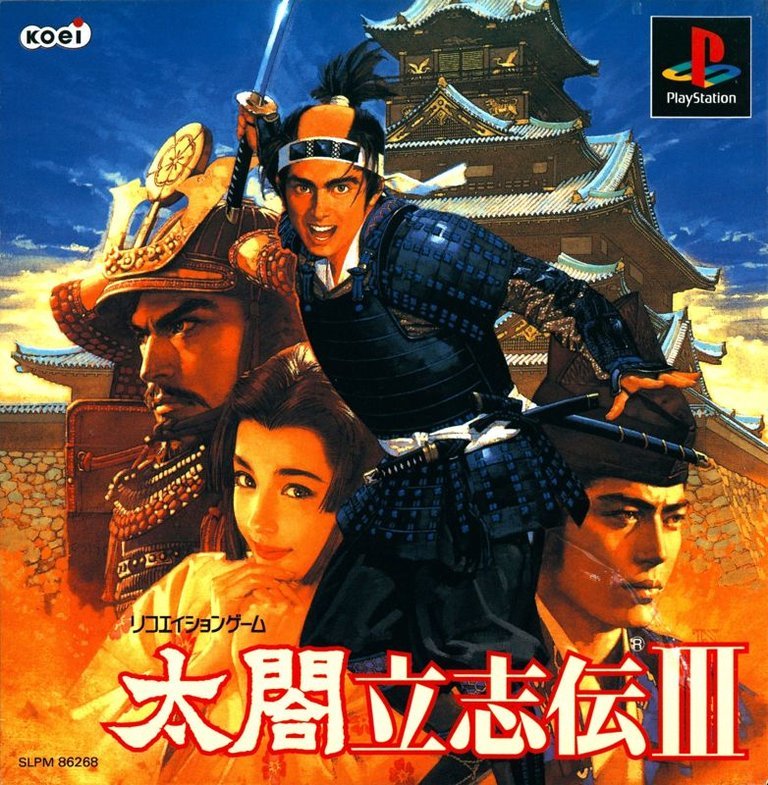
Taikou Risshiden III is a 1999 historical simulation RPG from Koei, set in Japan’s Sengoku period and focusing on the legendary rise of Toyotomi Hideyoshi. As the third entry in the Taikō Risshiden series, it notably restricts players to only two characters (Hideyoshi and a fictional companion) and a linear, preset narrative structure, departing from the more open-ended gameplay of its predecessors and drawing criticism for its lack of freedom and reduced character roster.
Gameplay Videos
Taikou Risshiden III: The Ambitious Misstep in Koei’s Historical Saga
Introduction: A Dynasty in Decline?
In the pantheon of Koei’s historical simulation masterpieces, the Taikō Risshiden series holds a unique and revered position. Unlike the grand strategic sweeps of Nobunaga’s Ambition or the epic military campaigns of Romance of the Three Kingdoms, this franchisezoomse in on the intimate, personal journey of ascension—the “epic of the grand regent,” Toyotomi Hideyoshi, from his humble origins as a foot soldier to the pinnacle of power. For purists and historians alike, the series represented a beloved niche where role-playing elements intertwined with life-simulation to paint a nuanced portrait of the Sengoku period. It is within this context that Taikou Risshiden III, released in 1999 for Windows and PlayStation, emerges not as a triumphant sequel, but as a profound and puzzling contraction. Its thesis, therefore, is not one of innovation, but of inadvertent self-sabotage: Taikou Risshiden III stands as the pivotal, commercially and critically stunted entry that temporarily broke the formula that made the series special, sacrificing its core DNA—player agency and expansive world-building—for a constrained, narrative-driven experience that failed to resonate. This review will dissect how a studio at the height of its creative powers produced a game that is, in almost every metric, the most restricted and least free in the franchise, examining the deadly combination of a misguided design pivot, technical growing pains, and a fundamental misunderstanding of what its audience cherished.
Development History & Context: A Studio at a Crossroads
The late 1990s were a period of intense transition for Koei. The company, under the indelible influence of its legendary general producer Kou Shibusawa (the pseudonym for founder and visionary Yoshiki Okamoto), was riding high on the success of its “Rekoeition” series of historically grounded simulations. The previous entry, Taikō Risshiden II (1995), had refined the series’ blend of adventure and strategy across multiple platforms (PC-98, PlayStation, Saturn). By 1999, the marketplace was shifting rapidly. The PlayStation dominated the console landscape, 3D graphics were becoming the new standard, and Koei itself was diversifying, pouring resources into the burgeoning Dynasty Warriors musou franchise.
Taikou Risshiden III was developed by KOEI Co., Ltd. under the direction of Kazuaki Futamura, with Naoki Takenoya and Shigeto Nakadai handling game design. The team included a significant CG department led by Makiko Kiyoto, indicating a major investment in pre-rendered and real-time 3D visuals—a stark departure from the 2D sprite-based worlds of its predecessors. This move to 3D, while technologically ambitious for Koei at the time, came at a severe cost. The expansion of art assets, programming for 3D models and environments on limited hardware (the PlayStation and contemporary Windows PCs), almost certainly consumed a massive portion of the budget and development timeline.
This context is crucial. In an era where “next-gen” meant polygon counts, Koei may have felt pressure to modernize the series’ aesthetics. However, this technological leap was pursued at the direct expense of the series’ foundational content. The source material is explicit: III is “the most restricted game in the series,” with only two playable characters—the historical Toyotomi Hideyoshi (starting as Kinoshita Tōkichirō) and a single, original fictional protagonist. Furthermore, the “total number of in-game characters is also cut down dramatically.” This points to a development team stretched thin by 3D asset creation, forced to make drastic cuts to NPCs, events, and the sprawling web of historical figures that defined the open-ended “faction system” of earlier games. The vision, as described in the Koei Wiki, of a series designed to “focus on the stepping stones to success” and offer “scenarios and events which are closer to history/popular folklore” was abandoned in favor of a handful of “preset stories.” III represents a moment where Koei’s ambition to visually update the series clashed catastrophically with its core design philosophy, resulting in a game that felt smaller in scope than its 1992 and 1995 predecessors on less powerful hardware.
Narrative & Thematic Deep Dive: A Narrowed Historical Lens
The narrative structure of Taikou Risshiden III is its most radical and fatal deviation. The series traditionally used Hideyoshi’s biography as a spine, but allowed the player to diverge wildly—serving different lords, pursuing non-military careers (merchant, doctor, ninja), and even failing, with the game ending on an alternate history note. III eschews this entirely for a strictly linear, character-specific saga.
Choosing the historical path of Hideyoshi presents a tightly scripted, almost cinematic retelling of his early life and rise under Oda Nobunaga. The game follows a prescribed sequence: the menial laborer Tōkichirō meets the young Nobunaga, impresses him, and is set on a path of military and administrative service. Key historical milestones—the Mino campaign, the betrayal of the Saitō clan, the Battle of Okehazama—are not emergent events based on player stats, but predetermined set-pieces the player must “pass” through. The thematic richness of seeing a peasant navigate the rigid class hierarchy of the Sengoku era through guile, service, and occasional violence is reduced to a series of binary success/failure checks within a narrow corridor.
The introduction of a single fictional protagonist is the game’s most baffling design choice. This character, whose backstory and motivations are not detailed in available sources, exists as a blank-slate alternative to Hideyoshi. However, with the game’s world and events “constrained by preset stories,” this fictional character’s narrative is not an open sandbox but a parallel, equally linear track that presumably intersects with Hideyoshi’s story at key, scripted moments. This negates the entire point of an original avatar—to create your own legend—and instead offers a different, but equally pre-ordained, historical footnote. The vibrant “human drama” of interacting with a massive cast of daimyō, samurai, and townsfolk is gone. The omission of controversial topics like Christian persecution or the Korean invasions, a series staple to maintain a “glamorized” tone according to the Koei Wiki, feels even more jarring here because the player is denied the agency to even approach such themes through divergent play. The narrative becomes a museum diorama: historically accurate in its vignettes, but utterly static and lifeless without the player’s hand to animate it.
Gameplay Mechanics & Systems: The Illusion of Choice
Mechanically, Taikou Risshiden III attempts to fuse first-person adventure gameplay with turn-based strategic elements, a hybrid approach that only half-commits to either genre. The core loop, as described in the PlayStation manual summaries from PSXDataCenter, involves “travel[ing] around the town talking with different people and spending his money in gather new things.” This is the familiar “life sim” aspect: visiting dojos to train stats (martial arts, leadership, charisma), participating in minigames like tea ceremony, managing finances, and resting at inns. However, the “preset stories” choke this loop.
The Faction System is Gutted: The cornerstone of the series—the ability to travel to any castle, serve any clan, and build affinity through tailored actions (bribery for merchants, duels for warriors, missions for samurai)—is either absent or severely neutered. The player is likely shackled to a single predetermined lord or narrative path. The freedom to “juggling their time between building their protagonist and completing these missions,” celebrated in the Koei Wiki overview, is replaced by a series of mandatory, time-sensitive plot objectives. Failure to meet these, as in the first game, likely leads to a game over, but without the mercy of being able to have tried a different path first.
Combat and Progression: When combat occurs, it likely shifts to a tactical, turn-based or isometric view, a carry-over from previous titles. However, with a drastically reduced character roster, the tactical depth is compromised. There are fewer unique commanders with special abilities, fewer unit types to recruit and command. Character progression is tied directly to narrative milestones; you likely gain a new title, residence, or portrait not by amassing a certain amount of gold or fame through open play, but by completing the next scripted chapter. The interface, noted as “Direct control” in MobyGames specs, suggests a more modern, point-and-click adventure feel for town exploration, but this does little to compensate for the lack of meaningful choices within that exploration.
UI and Innovation: The game’s biggest mechanical “innovation”—the presentation of a more focused, story-heavy experience—is also its greatest flaw. It tries to be a visual novel with stat checks and light strategy, but it lacks the branching narratives of a true visual novel and the systemic depth of a true strategy sim. It gets stuck in an unsatisfying middle ground. The inclusion of vibration support on the PlayStation (noted in PSXDataCenter specs) was a minor technical novelty, but it cannot compensate for the profound lack of replayability. With only two characters and preset stories, the game’s longevity is measured in hours, not dozens of playthroughs.
World-Building, Art & Sound: A Pretty, Empty Stage
Visually, Taikou Risshiden III represents Koei’s tentative steps into 3D. Pre-rendered backgrounds and 3D character models (noted as “Cartoon graphics” and “Realistic” in PCGamingWiki and Video Games Museum) would have been a notable leap from the pixel-art sprites of II. The CG production team, led by Makiko Kiyoto and including Mayuko Omori and Daisuke Kojima, was tasked with creating a consistent, three-dimensional world for the Sengoku period. Locations like Nobunaga’s castle, the towns of Gifu or Kyoto, and rural villages would have been constructed with a new sense of scale and depth. The “CG Effects Production” led by Chiho Matsubara suggests attention was paid to atmospheric touches—weather, time of day, environmental animations.
However, this beauty is superficial. The “dramatically cut down” number of in-game characters means these rich environments are hauntingly empty. A bustling castle town in a Koei game should be teeming with recognizable faces—Matsu, Kanbei, Mitsuhide, the tea master Sen no Rikyū. With that roster severely truncated, the world feels like a theme park after hours. The sound design, handled by Tsutomu Hirasawa, Masaaki Honma, and Yasuhiro Misawa, likely continued Koei’s tradition of period-appropriate instrumental music and sparse voice work (if any), but without a robust cast of characters to deliver dialogue, its impact is muted. The atmosphere is one of lonely spectacle. You walk through a beautifully rendered 3D Gifu Castle, but there are few to greet you, few to conspire with, and few to betray you. The historical texture is visual only.
Reception & Legacy: The Black Sheep of the Series
Contemporary reception, as summarized on MobyGames, was unequivocally unfavorable. The description bluntly states that the restrictions—”only contains 2 playable characters,” “gameplay is constrained by preset stories,” “lack[s] freedom,” “total number of in-game characters is cut down dramatically”—”lead to unfavorable reviews.” Players and critics at the time, steeped in the boundless freedom of Taikō Risshiden I & II, saw III not as an evolution but as a profound step backward. The promise of 3D visuals could not mask the loss of the series’ soul: the player’s ability to carve their own unique path through history.
Its legacy is consequently complex. Within the franchise, it is a blip, a cautionary tale. The subsequent entry, Taikō Risshiden IV (2001), famously course-corrected with a vengeance. It expanded the cast to over 750 historical figures, reintroduced deep faction mechanics, and offered multiple story paths based on the protagonist’s chosen career. It was as if Koei publicly acknowledged that III’s experiment had failed. IV and the acclaimed V (2004) are seen as the peaks of the series, direct repudiations of the constraints imposed in III.
In the broader industry context, III is a minor footnote—a example of a major studio misreading its franchise’s core appeal during a transitional hardware generation. It did not influence other games; rather, it is a lesson in what not to do when updating a classic series: do not sacrifice systemic depth for graphical fidelity. Its only lasting impact is to make the richness of IV and V feel even more remarkable by contrast. The fact that it was re-released in a “Koei Teiban Series” budget version in 2002 and had Chinese localizations by Acer TWP speaks to Koei’s commitment to the brand in Asian markets, but these were likely moves to clear inventory of an underperforming product, not celebrations of a classic.
Conclusion: A Flawed Relic of Misplaced Ambition
Taikou Risshiden III is not a bad game in a vacuum. As a linear, story-focused historical adventure with pleasant 3D visuals and a few minigames, it might have found an audience as a standalone title. But as the third entry in the Taikō Risshiden series, it is an unmitigated disaster of design. It systematically dismantles the very pillars that defined the franchise: the multitude of playable roles, the vast roster of historical figures to befriend or fight, the open-ended “faction” system that allowed for infinite replayability, and the sense that your choices could genuinely rewrite history.
The development team’s focus on 3D presentation was a expensive gamble that bankrupted the game’s content. The result is a stunningly beautiful, hauntingly empty playfield where the grand drama of the Sengoku period is reduced to a few scripted scenes. Its historical “accuracy” is preserved only in the broadest strokes of Hideyoshi’s biography, stripped of the human chaos and player agency that makes history compelling in Koei’s best works.
Final Verdict: Taikou Risshiden III earns a ★☆☆☆☆ rating as a failure of its own lineage. It is a fascinating museum piece—a tangible artifact of a wrong turn in game development history. For completionists and historians of Koei, it is a required, if painful, study. For anyone seeking the true spirit of the Taikō Risshiden series—the joy of rising from nothing through wit, war, and diplomacy in a living, breathing world—it is an experience to be skipped. Its rightful place in video game history is not as a classic, but as a stark monument to the perils of prioritizing style over substance, and a crucial lesson that the heart of a simulation beats not in its graphics, but in the glorious, chaotic freedom of its systems. The series’ triumphant redemption in IV and V only underscores how fundamentally III misunderstood its own purpose.