
- Release Year: 2015
- Platforms: PlayStation 3, PlayStation 4, Windows
- Publisher: Bandai Namco Entertainment America Inc., Bandai Namco Entertainment Inc.
- Genre: Compilation, Licensed
- Game Mode: Single-player
- Average Score: 92/100
Description
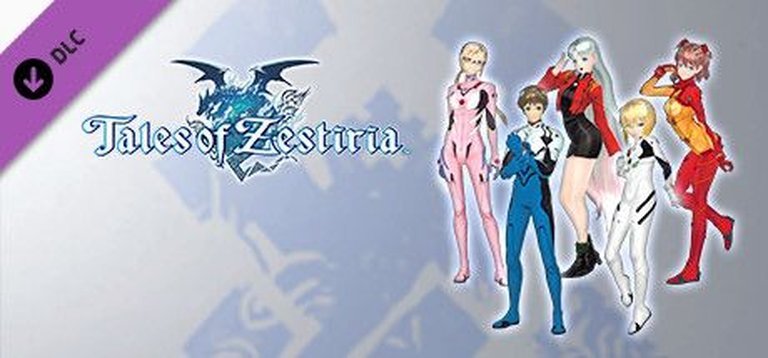
Tales of Zestiria: Evangelion Costume Set is a downloadable content pack for the RPG Tales of Zestiria, featuring costumes inspired by the iconic anime Neon Genesis Evangelion. This set allows players to dress the game’s main characters—Sorey, Alisha, Lailah, Edna, and Rose—in outfits modeled after the Evangelion series, blending the fantasy world of Zestiria with the sci-fi aesthetic of Evangelion. Released in 2015 for Windows, PlayStation 3, and PlayStation 4, the DLC is a fan-service addition that enhances the visual customization options for players familiar with both franchises.
Gameplay Videos
Where to Buy Tales of Zestiria: Evangelion Costume Set
PC
Tales of Zestiria: Evangelion Costume Set Guides & Walkthroughs
Tales of Zestiria: Evangelion Costume Set Reviews & Reception
store.steampowered.com (88/100): Oh my god, Evangelion costumes! The legendary anime license is featured in Tales of Zestiria for the delightment of all its fans!
store.playstation.com (96/100): Average rating 4.82 stars out of five stars from 142 ratings
Tales of Zestiria: Evangelion Costume Set – A Deep Dive into a Niche but Beloved DLC
Introduction: The Intersection of Two Iconic Franchises
The Tales of Zestiria: Evangelion Costume Set is a fascinating artifact of mid-2010s gaming—a microcosm of the industry’s growing embrace of cross-promotional DLC, the enduring appeal of Neon Genesis Evangelion, and the Tales series’ penchant for fan service. Released in November 2015 alongside the Western localization of Tales of Zestiria, this DLC pack allows players to dress the game’s protagonists in outfits inspired by the Rebuild of Evangelion films, blending the high-fantasy aesthetic of Zestiria with the sci-fi iconography of Evangelion.
At its core, this is not a standalone game but a compilation of cosmetic add-ons, yet its existence speaks volumes about the gaming landscape of its era. It reflects the rise of downloadable content as a revenue stream, the globalization of anime licensing, and the ways in which developers cater to niche audiences. While superficially a simple costume pack, the Evangelion Costume Set is a cultural touchstone for fans of both franchises, offering a meta-textual dialogue between two beloved properties.
This review will dissect the DLC’s development context, its thematic and aesthetic contributions, its reception, and its legacy within the broader Tales series and gaming history.
Development History & Context: The Rise of Anime Crossover DLC
The Tales Series and Its Love for Costumes
The Tales franchise, developed by Bandai Namco, has long been known for its deep combat systems, character-driven narratives, and—perhaps most notably—its extensive post-launch costume DLC. Since the Tales of Graces era (2009–2012), the series has embraced downloadable outfits as both a revenue model and a fan-service mechanism. These costumes often range from school uniforms to swimwear, but the Evangelion collaboration marked one of the first major licensed anime crossovers in the series.
Tales of Zestiria itself was a critical and commercial success in Japan, though its Western reception was more mixed due to its linear structure and divisive protagonist, Sorey. The game’s DLC strategy was aggressive, with over a dozen costume packs released across PS3, PS4, and PC. The Evangelion Costume Set was among the most anticipated, given Evangelion’s global popularity.
Licensing and Localization Challenges
One of the most intriguing aspects of this DLC is its successful Western release. Historically, anime-licensed content in Japanese games often faced localization hurdles due to regional licensing restrictions. For example, Tales of Graces f’s Code Geass costumes never made it to the West, and Ao no Exorcist (Blue Exorcist) DLC for Zestiria remained Japan-exclusive.
The Evangelion Costume Set’s arrival in North America and Europe was thus a minor miracle, likely facilitated by Evangelion’s resurgent popularity thanks to the Rebuild films (2007–2021) and its status as a cultural phenomenon. The costumes are specifically based on the Rebuild designs, not the original 1995 series, which may have simplified licensing negotiations.
Technical Constraints and Design Philosophy
From a technical standpoint, the costumes are straightforward reskins. The Tales series has always used a modular character model system, allowing for easy swapping of outfits without altering underlying animations. The Evangelion costumes retain the original character silhouettes but overlay them with iconic Evangelion aesthetics:
– Sorey dons Shinji Ikari’s plugsuit (the black and green bodysuit from Evangelion 2.0).
– Alisha wears Mari Makinami’s pink plugsuit and glasses.
– Lailah is styled after Misato Katsuragi’s casual military attire.
– Edna gets Rei Ayanami’s classic blue plugsuit.
– Rose is outfitted as Asuka Shikinami Langley’s red plugsuit.
The designs are faithful to the Rebuild films, though some fans noted that the plugsuits’ form-fitting nature clashed with Zestiria’s medieval fantasy setting—a deliberate meta joke, as the DLC’s Steam description gleefully exclaims, “Oh my god, Evangelion costumes!”
Narrative & Thematic Deep Dive: A Meta-Commentary on Fan Service
The Absence of Narrative Integration
Unlike some Tales DLC that includes additional skits or story content (e.g., Idolmaster costumes in Zestiria triggering unique dialogue), the Evangelion Costume Set is purely cosmetic. There are no new cutscenes, no Evangelion-themed quests, and no lore explanations for why Sorey is suddenly wearing a plugsuit in a world of seraphim and hellions.
This lack of integration is both a strength and a weakness. On one hand, it allows players to engage with the content without narrative friction. On the other, it underscores the DLC’s nature as pure fan service—a celebration of Evangelion’s iconography rather than a meaningful crossover.
Thematic Dissonance as a Feature
The juxtaposition of Evangelion’s dystopian mecha aesthetic with Zestiria’s high-fantasy world is jarring, and that’s arguably the point. The Tales series has a history of self-aware humor, and the Evangelion costumes can be read as a playful nod to the absurdity of crossover culture. Imagine Shinji Ikari, the perpetually anxious Evangelion protagonist, in the role of Sorey, the idealistic “Shepherd of Light.” The cognitive dissonance is amusing, especially for fans of both franchises.
Character Parallels and Meta-Interpretations
While the DLC doesn’t explicitly draw comparisons between the characters, fans have speculated on thematic parallels:
– Sorey/Shinji: Both are reluctant heroes burdened by destiny, though Sorey is far more optimistic.
– Alisha/Mari: Mari is a free-spirited, enigmatic figure, much like Alisha’s role as a warrior with hidden depths.
– Rose/Asuka: Rose’s fiery, independent personality aligns well with Asuka’s tsundere demeanor.
These connections are entirely fan-driven, but they highlight how crossover content can invite reinterpretations of existing characters.
Gameplay Mechanics & Systems: Cosmetic-Only, But Well-Implemented
How the Costumes Work
The Evangelion Costume Set is a straightforward DLC pack:
1. Purchase and download the set.
2. Access the “DLC” menu in Tales of Zestiria.
3. Select the desired costume for each character.
4. Equip via the in-game outfit menu.
The costumes do not affect stats, abilities, or gameplay in any way. They are purely visual, though they do appear in cutscenes, which adds a layer of immersion (or surrealism, depending on one’s perspective).
UI and Accessibility
The DLC integrates seamlessly into Zestiria’s existing menu systems. Bandai Namco’s experience with costume DLC ensures that the process is intuitive, though the Steam version’s initial rollout was delayed, leading to fan frustration (as seen in the Steam community discussions).
The Broader DLC Ecosystem in Zestiria
The Evangelion Costume Set was part of a larger DLC strategy for Zestiria, which included:
– School Costume Set (generic anime school uniforms)
– Idolmaster Costume Set (another major anime crossover)
– Swimwear Sets (fan-service staple)
– God Eater Costume Set (another Bandai Namco property)
The Evangelion set stood out due to its high-profile licensing, but it followed the same design philosophy: cosmetic-only, high-replay-value content for completionists and fans.
World-Building, Art & Sound: A Clash of Aesthetics
Visual Design: Plugsuits in a Fantasy World
The Evangelion costumes are meticulously designed, with attention to fabric textures, color accuracy, and even small details like Rei’s choker or Asuka’s hair clips. However, their inclusion in Zestiria’s world is intentionally anachronistic.
- Sorey’s plugsuit looks particularly odd in battle, as the tight-fitting bodysuit contrasts with the game’s medieval armor and robes.
- Alisha’s Mari outfit is the most “normal” of the bunch, as it resembles a stylized military uniform that could plausibly exist in Zestiria’s world.
- Rose’s Asuka plugsuit is the most jarring, given her role as a hardened mercenary—seeing her in a skin-tight red bodysuit is pure fanservice.
The costumes do not alter the game’s art style but instead superimpose Evangelion’s aesthetic onto it, creating a fascinating visual collision.
Sound Design: No New Voice Lines or Music
Unlike some Tales DLC that includes new voice clips (e.g., characters reacting to their outfits), the Evangelion Costume Set does not add any audio content. The characters retain their original voice lines, which means Sorey still sounds like Sorey, even when dressed as Shinji. This further emphasizes the DLC’s nature as a visual novelty rather than a narrative expansion.
Atmosphere: Breaking the Fourth Wall
The sheer absurdity of seeing Evangelion characters in Zestiria’s world creates a meta-textual experience. It’s as if the game is winking at the player, acknowledging the silliness of the crossover while still delivering it with polish. For fans of both franchises, this dissonance is part of the appeal.
Reception & Legacy: A Niche but Beloved Add-On
Critical Reception: Positive but Limited
The Evangelion Costume Set has no professional critic reviews on platforms like MobyGames, reflecting its status as a minor DLC pack. However, Steam user reviews are overwhelmingly positive (88% approval), with fans praising:
– The faithfulness to the Rebuild designs.
– The humor and novelty of the crossover.
– The attention to detail in the costumes.
Negative reviews (a mere 3 out of 25 on Steam) primarily cite:
– The lack of gameplay impact (a common critique of cosmetic DLC).
– The price point ($9.99 for a costume pack).
Commercial Performance and Fan Demand
The DLC’s release was highly anticipated, as evidenced by Steam community discussions from October 2015, where fans speculated about its arrival. The fact that it made it to the West at all was a victory for localization advocates, given the history of region-locked anime DLC.
Legacy: A Precursor to Modern Crossover Culture
The Evangelion Costume Set is a small but significant piece of gaming history. It represents:
1. The normalization of anime crossovers in RPGs (a trend that has only grown with games like Persona 5’s Shin Megami Tensei DLC or Fire Emblem’s Dragon Quest costumes).
2. The rise of cosmetic DLC as a standard revenue model (now ubiquitous in live-service games).
3. The globalization of niche anime licensing (proving that even Western audiences would pay for Evangelion content).
While not groundbreaking in itself, the DLC is a time capsule of mid-2010s gaming trends.
Conclusion: A Love Letter to Fans, Warts and All
The Tales of Zestiria: Evangelion Costume Set is, at its heart, a celebration of fandom. It doesn’t pretend to be more than what it is—a fun, if superficial, crossover that delights in its own absurdity. For Evangelion fans, it’s a chance to see beloved characters reimagined in a fantasy setting. For Tales fans, it’s another layer of customization in a series known for its depth.
Final Verdict: 7.5/10 – A Niche Delight
– Pros:
– Faithful, detailed costume designs.
– Seamless integration into Zestiria’s systems.
– A fun meta-experience for fans of both franchises.
– Cons:
– Purely cosmetic with no gameplay or narrative impact.
– Somewhat overpriced for what it offers.
– Thematic dissonance may not appeal to all players.
Who Should Buy It?
– Die-hard Tales or Evangelion fans who enjoy crossovers.
– Completionists who want every costume in Zestiria.
– Collectors of niche anime gaming memorabilia.
Who Should Skip It?
– Casual players who don’t care about cosmetics.
– Those expecting new story content (this is not an expansion).
– Budget-conscious gamers (it’s a luxury, not a necessity).
In the grand tapestry of gaming history, the Evangelion Costume Set is a minor thread—but for those who love Tales and Evangelion, it’s a thread worth pulling. It’s a reminder that sometimes, games don’t need to be deep to be meaningful; they just need to make fans smile.
Final Score: ★★★★★★★☆☆☆ (7/10) – A charming, if frivolous, tribute to two iconic franchises.