
- Release Year: 2007
- Platforms: Windows
- Publisher: Akella, CDV Software Entertainment AG, Paradox Interactive AB
- Developer: Quazar Studio
- Genre: Action, Simulation, Space combat
- Perspective: 1st-person Behind view
- Game Mode: Single-player
- Gameplay: Disassembly, Mission-based, Ship Customization, Space combat, Upgrade system, Workshop
- Setting: Futuristic, Sci-fi
- Average Score: 57/100
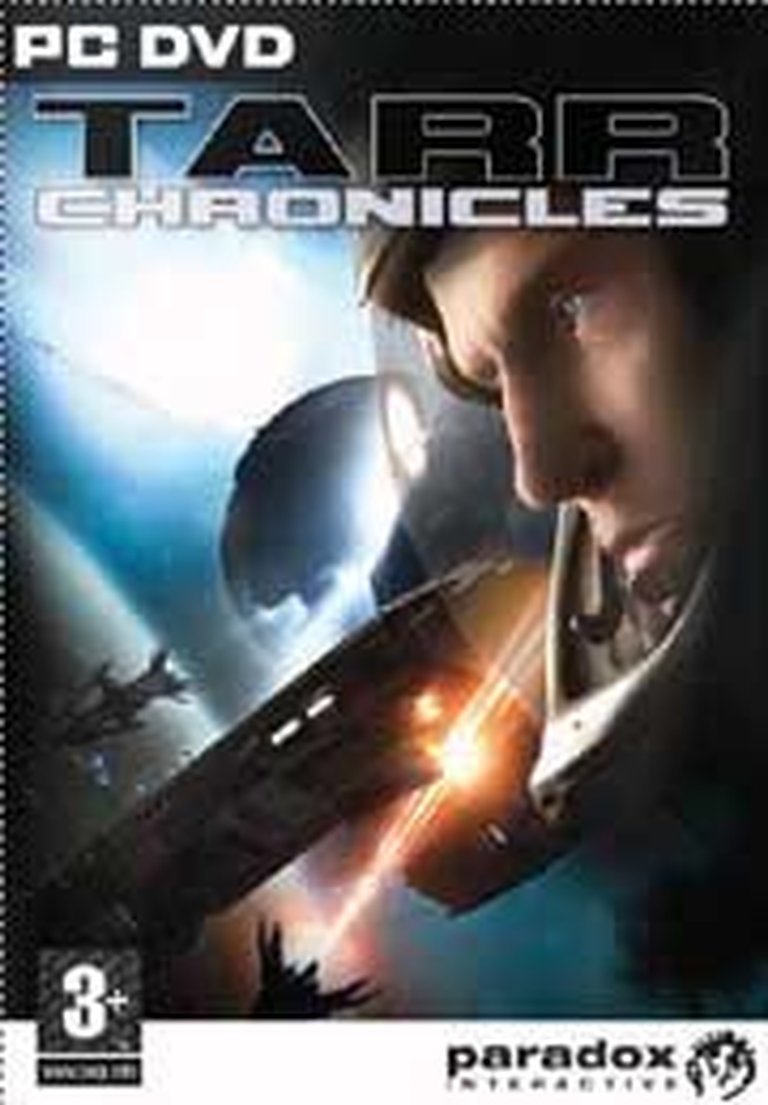
Description
Set in a futuristic sci-fi universe, ‘Tarr Chronicles’ plunges players into a galactic war between humanity and an alien race. As a space pilot on a mission to retrieve a vital artifact, your expedition is ambushed, leading to a catastrophic malfunction during a hyper jump that strands your fleet in unknown territory. The game unfolds through nine action-packed missions featuring intense space combat, where players must navigate treacherous battles alongside AI allies. Key gameplay elements include customizable ship components—such as weapons, shields, and engines—that can be swapped or crafted using resources salvaged from defeated enemies. With intuitive mouse or joystick controls, the game blends strategic customization with fast-paced combat, all while uncovering a narrative conveyed through journal entries and mission dialogues.
Gameplay Videos
Tarr Chronicles Cracks & Fixes
Tarr Chronicles Patches & Updates
Tarr Chronicles Reviews & Reception
metacritic.com (60/100): A thoroughly mediocre space combat game with a good storyline, decent graphics and bad sounds.
gamespot.com (40/100): Tarr Chronicles is the painful combination of incomprehensible and insipid.
ign.com (70/100): Wing Commander and TIE Fighter it ain’t, but this space shooter still manages to deliver the goods.
Tarr Chronicles Cheats & Codes
PC
Enter codes during gameplay. A confirmation message appears in the top left of the HUD when successful.
| Code | Effect |
|---|---|
| nextmission | Automatically complete the mission |
| nextpart | Advance to the following segment in the mission |
| iddqd | Immortality (enter code twice to deactivate) |
| maxrockets | Refill missiles and rockets |
Tarr Chronicles: A Flawed Odyssey Through the Stars
Introduction
In the twilight years of the space combat sim’s golden age, Tarr Chronicles emerged as a flicker of ambition from Russian developer Quazar Studio—a game that promised epic interstellar dogfights, rich customization, and a story of humanity’s last stand against alien terror. Released in 2007, it arrived when the genre was gasping for life, overshadowed by the titanic legacies of Freespace 2 and Wing Commander. This review argues that while Tarr Chronicles ambitiously attempted to revive the spirit of classic space sims, it ultimately succumbed to technical missteps, underbaked design, and a failure to evolve beyond its predecessors. Yet, its overlooked innovations and atmospheric world-building make it a fascinating artifact for historians dissecting the genre’s decline.
Development History & Context
The Studio and Its Vision
Quazar Studio, a relatively obscure developer under the umbrella of Russian publisher Akella, envisioned Tarr Chronicles as a love letter to space sims of the late ’90s. Led by director Timur Lazarenko and lead designer Tatyana Savchenkova, the team sought to marry arcade accessibility with deep systemic complexity. The game’s Russian roots are evident in its bleak, dystopian narrative—a reflection of post-Soviet sci-fi sensibilities—and its reliance on the in-house BRU Engine, which prioritized scalable visuals for mid-2000s hardware.
Technological and Market Constraints
Released in a landscape dominated by console shooters and open-world RPGs, Tarr Chronicles faced an uphill battle. Space sims were already niche, and Quazar’s limited resources led to compromises. The initial release infamously launched with incomplete joystick support, a cardinal sin for the genre’s dedicated fanbase. Patches (notably 1.0.6.0) later addressed this, but the damage was done. Critics at the time compared it unfavorably to contemporaries like Darkstar One (2006), which boasted polished controls and a more dynamic sandbox.
Narrative & Thematic Deep Dive
Plot and Structure
The game casts players as a nameless pilot aboard the battlecruiser Talestra, humanity’s last hope against the predatory De’Khette aliens. After a botched hyperjump strands the fleet in hostile territory, the campaign unfolds across nine missions built around repetitive objectives: escort ships, defend positions, and obliterate waves of foes. The story is conveyed through static journal entries and mission briefings—a stripped-down approach that critics derided as “unintelligible” (GameSpot) and “lacking identification potential” (Game Captain).
Themes and Characterization
Tarr Chronicles leans heavily into existential dread and isolation. The De’Khette are portrayed not as mustache-twirling villains but as a force of cosmic entropy, echoing H.P. Lovecraft’s indifference of the universe. Wingmen like the stoic Commander Voss add nominal personality, but their AI-driven incompetence (a frequent complaint) undermines any emotional investment. Thematically, the game explores sacrifice and the fragility of human civilization, but its execution is hobbled by stilted dialogue and missed opportunities for moral ambiguity.
Gameplay Mechanics & Systems
Core Loop and Combat
At its best, Tarr Chronicles delivers frenetic, large-scale battles reminiscent of Freespace. Players pilot customizable fighters through asteroid fields and derelict fleets, dodging flak and lasers while managing energy between shields, weapons, and thrusters. The controls—optimized for mouse/keyboard but clunky with joysticks—emphasize accessibility, though critics noted a lack of tactical depth. Combat devolves into “circle-strafing” carnage, with AI allies often failing to pull their weight.
Ship Customization: Potential Unfulfilled
The game’s most heralded feature is its modular ship-building system. Between missions, players scavenge components from defeated foes or dismantle existing gear to craft weapons, shields, and thrusters. Each part affects weight, energy consumption, and handling—a system GamingExcellence praised as “the incentive to keep playing.” However, limited variety (only 60 ship types) and unbalanced progression trivialized later challenges. The Workshop, where players could theoretically design custom parts, was hamstrung by grind-heavy resource demands.
UI and Technical Issues
A labyrinthine interface plague’s the pre-mission prep, with nested menus and vague tooltips exacerbating the learning curve. Worse, technical flaws like crashes (noted by eXp.de), texture pop-in, and framerate hitches marred the experience. The 34% score from GameStar Germany underscores how bugs eroded its potential.
World-Building, Art & Sound
Visual Design and Atmosphere
Tarr Chronicles excels in environmental storytelling. Its star systems oscillate between the eerie beauty of nebula-riddled voids and the industrial grime of human outposts. The De’Khette’s biomechanical ships—reminiscent of Warhammer 40K’s Tyranids—contrast sharply with humanity’s utilitarian fighters. Yet, low-resolution textures and repetitive level geometry betray the game’s budget constraints.
Sound Design: A Mixed Bag
Roman Kaverga’s score oscillates between haunting chorales and pulse-pounding combat themes, effectively underscoring the desperation of the narrative. Sound effects, however, are forgettable—generic laser blasts and explosions lack weight. Voice acting, sparse as it is, ranges from passable (wingman chatter) to hilariously stilted (antagonist taunts).
Reception & Legacy
Critical and Commercial Performance
Tarr Chronicles garnered a lukewarm 62% average from critics (per MobyGames), with praise for customization and ambience drowned out by scorn for bugs and repetition. GameSpot’s savage 4/10 review deemed it “incomprehensible and insipid,” while IGN’s more charitable 7/10 called it “solid, if uninspired.” Commercially, it vanished without a trace, failing to crack sales charts.
Influence and Retrospective
While not a genre-redefining work, Tarr Chronicles’ ship-crafting system influenced later titles like Everspace 2 (2021). Its sequel, Dark Horizon (2008), refined the formula but suffered similar obscurity. Today, the game is a cult curio—preserved by abandonware sites and discussed in niche forums as a “what-could-have-been” relic.
Conclusion: A Star That Burned Too Briefly
Tarr Chronicles is a paradox: a game brimming with ideas yet starved of polish. Its customization mechanics and atmospheric world-building hint at greatness, but technical shortcomings, repetitive missions, and a disjointed narrative leave it stranded in mediocrity. For historians, it serves as a poignant case study of the challenges faced by mid-tier studios in the late 2000s—a time when passion projects often collided with harsh market realities. While not essential, it remains a worthy footnote for space-sim devotees willing to forgive its flaws. In the grand chronicle of the genre, Tarr Chronicles is a ghostly whisper, not a battle cry—but echoes of its ambition linger.
Final Verdict:
★✰✰✰✰ – A flawed artifact with fleeting moments of brilliance, best suited for genre archivists and patient nostalgists.