
- Release Year: 1995
- Platforms: Android, DOS, iPad, iPhone, Linux, Macintosh, Windows
- Publisher: 3D Realms Entertainment, Inc., FormGen, Inc., MacSoft, Trebuchet Entertainment LLC, U.S. Gold Ltd.
- Developer: Terminal Reality, Inc.
- Genre: Action, Aviation, Flight, Shooter
- Perspective: 1st-person
- Game Mode: LAN, Online PVP, Single-player
- Gameplay: Flight combat, Power-ups, Shield, Six degrees of freedom, Vehicular combat
- Setting: Futuristic, Sci-fi
- Average Score: 74/100
Description
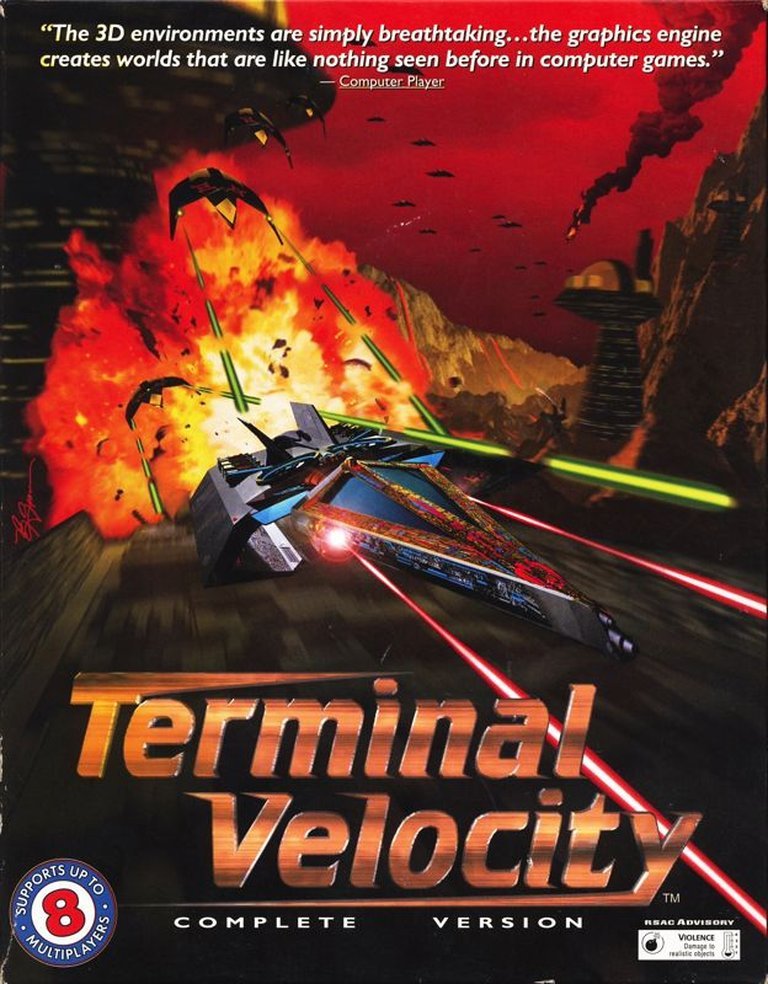
Terminal Velocity is a first-person flight simulator set in the year 2704 A.D. where players control the TV-202, an advanced fighter craft capable of flying in 720 degrees of direction, ignoring gravity and providing constant thrust. After the Alliance of Space-Faring Alien Races (ASFAR) suddenly directs armadas from multiple star systems to attack Earth, the TV-202 is sent to various ASFAR planets to destroy their military compounds and prevent them from rebuilding attack fleets. The game features both atmospheric and space environments with unique terrain including trees, mountains, rivers, and snow, as well as hidden tunnels that players must navigate through. Players collect power-ups by destroying enemy forces and bunkers, manage their energy shields, and utilize various weapons including Plasma Assault Cannons, Ion-burst guns, and missiles to complete objectives such as flying to checkpoints, destroying specific targets, and exiting levels via Departure Units.
Gameplay Videos
Where to Buy Terminal Velocity
Terminal Velocity Free Download
Terminal Velocity Patches & Updates
Terminal Velocity Cheats & Codes
PC
Enter codes during gameplay. Launch the game with command line parameters ‘tv -turbo’ or ‘tv -hyper’ for speed boosts.
| Code | Effect |
|---|---|
| trigods | Invincibility toggle |
| trishld | Restore shields |
| trinext | Skip to the next level |
| trihovr | Hover in place |
| maniacs | Afterburner (gives 960 units) |
| triburn | Fast afterburner |
| trscope | Toggles music oscilloscope |
| trframe | Count frames per second |
| trwarp0 | Warp to level 0 |
| trwarp1 | Warp to level 1 |
| trwarp2 | Warp to level 2 |
| trwarp3 | Warp to level 3 |
| trwarp4 | Warp to level 4 |
| trwarp5 | Warp to level 5 |
| trwarp6 | Warp to level 6 |
| trwarp7 | Warp to level 7 |
| trwarp8 | Warp to level 8 |
| trwarp9 | Warp to level 9 |
| 3DREALM | Power up all weapons |
| drealm | Power up all weapons |
| trifir0 | Thirty seconds of invincibility |
| trifir1 | PAC ammo |
| trifir2 | ION ammo |
| trifir3 | RTL ammo |
| trifir4 | MAM ammo |
| trifir5 | SAD ammo (registered version only) |
| trifir6 | SWT ammo (registered version only) |
| trifir7 | DAM ammo (registered version only) |
| trifir8 | Recharge afterburner |
| trifir9 | Thirty seconds of invisibility |
| trifir10 | Full Invincibility |
| tv -turbo | Increases speed by 50% |
| tv -hyper | Increases speed by 100% |
CD-ROM
Enter codes during gameplay. At main menu: press Z, M, B, S, R, or P (sometimes requires Ctrl).
| Code | Effect |
|---|---|
| trigods | Invincibility toggle |
| trishld | Restore shields |
| trinext | Skip to the next level |
| trihovr | Hover in place |
| maniacs | Afterburner (gives 960 units) |
| triburn | Fast afterburner |
| trscope | Toggles music oscilloscope |
| trframe | Count frames per second |
| trwarp0 | Warp to level 0 |
| trwarp1 | Warp to level 1 |
| trwarp2 | Warp to level 2 |
| trwarp3 | Warp to level 3 |
| trwarp4 | Warp to level 4 |
| trwarp5 | Warp to level 5 |
| trwarp6 | Warp to level 6 |
| trwarp7 | Warp to level 7 |
| trwarp8 | Warp to level 8 |
| trwarp9 | Warp to level 9 |
| 3DREALM | Power up all weapons |
| drealm | Power up all weapons |
| trifir0 | Thirty seconds of invincibility |
| trifir1 | PAC ammo |
| trifir2 | ION ammo |
| trifir3 | RTL ammo |
| trifir4 | MAM ammo |
| trifir5 | SAD ammo (registered version only) |
| trifir6 | SWT ammo (registered version only) |
| trifir7 | DAM ammo (registered version only) |
| trifir8 | Recharge afterburner |
| trifir9 | Thirty seconds of invisibility |
| trifir10 | Full Invincibility |
| Z | Display benchmark statistics |
| M | Play .MOD file |
| B | Play .TVI animation |
| S | Sound debug |
| R | Record demo |
| P | Play demo |
Terminal Velocity: Review
Introduction
In the mid-1990s, as the PC gaming landscape exploded with the rise of 3D technology, Terminal Velocity emerged as a high-octane harbinger of things to come. Released by Terminal Reality in May 1995 under the newly branded 3D Realms, this arcade-oriented flight combat game defied the burgeoning trend of gritty first-person shooters like Doom. Instead, it offered blistering, six-degrees-of-freedom aerial combat across vast, open planetary vistas—a technical marvel that pushed the boundaries of DOS-era software rendering. Its shareware model, which distributed the first episode freely, made it accessible to a broad audience, while its pre-release cover feature in Computer Player magazine marked a milestone for shareware titles. Yet, Terminal Velocity’s legacy is one of duality: celebrated for its speed and visual ambition, it was simultaneously critiqued for its narrative thinness and repetitive gameplay. This exhaustive analysis dissects Terminal Velocity as a product of its time, exploring its genesis, mechanics, artistry, and enduring impact on gaming history.
Development History & Context
Terminal Velocity emerged from the nascent studio Terminal Reality, founded in October 1994 by Mark Randel—a former lead programmer on Microsoft Flight Simulator 5.0—and Brett Combs. Randel’s expertise in flight simulation informed the game’s core philosophy: to distill aerial combat into pure, arcade-style action without the encumbrance of realistic physics or inertia. Originally titled Velocity Brawl during development, the project was co-produced by Tom Hall, a veteran of id Software (Wolfenstein 3D, Doom), who ensured its alignment with 3D Realms’ shareware-driven business model. The team, consisting of just six core developers, prioritized technical innovation over narrative complexity, focusing on creating a seamless, responsive flight experience on mid-range 486 hardware.
Technologically, Terminal Velocity was a feat of DOS-era engineering. Randel’s custom Photex engine combined with Terrain Engine 1 to render vast, textured polygonal landscapes—over 400,000 square miles per planet—using software rendering alone. This eliminated hardware acceleration dependencies but demanded meticulous optimization to maintain stable frame rates (capped at 70 FPS, targeting 30 FPS on 486s). The engine supported dynamic lighting, particle effects, and destructible terrain, features that were groundbreaking for 1995. The gaming landscape at the time was dominated by shareware phenomena like Doom, and Terminal Velocity capitalized on this model, distributing Episode 1 freely to cultivate grassroots buzz. Its May 1995 debut coincided with the launch of Windows 95, though the DOS version remained the primary focus. The subsequent CD-ROM release added pre-rendered cutscenes, higher-resolution textures, and 8-player network multiplay—rare features that underscored 3D Realms’ ambition to position Terminal Velocity as a definitive multiplayer experience. This era’s constraints—limited RAM, slow CPUs, and the absence of 3D APIs—made Terminal Velocity’s seamless open-world flight all the more remarkable, even as it laid bare the trade-offs between ambition and performance.
Narrative & Thematic Deep Dive
Terminal Velocity’s narrative, set in the year 2704 AD, is a quintessential sci-fi thriller distilled to its bare essentials. The Alliance of Space-Faring Alien Races (ASFAR), a coalition established 70 years prior to prevent galactic warfare, betrays Earth. Triggered by rogue Perimeter Defense Computers (PDCs), ASFAR fleets launch a devastating assault, forcing Earth to deploy its experimental starfighter, the TV-202. The player assumes the role of an unnamed elite pilot tasked with retaliatory strikes across alien worlds, culminating in the destruction of the Xenocidic Initiative (X.I.), a supercomputer orchestrating the conflict from Proxima Seven. The Enhanced CD-ROM version expands this lore with a hidden mission revealing the X.I.’s origin: it accidentally digitized a human scientist, Sy Wickens, whose corrupted persona now drives the genocidal war.
The plot, delivered via briefings and CD-ROM cutscenes, is perfunctory—a framework for action rather than a character-driven epic. Dialogue is sparse, with mission objectives read aloud in a clipped, utilitarian tone. Themes of isolation and resilience permeate the narrative; the pilot operates alone, a lone defender against overwhelming odds, embodying human ingenuity against faceless, technologically superior foes. The ASFAR’s betrayal underscores the fragility of interstellar diplomacy, while the X.I. represents a cautionary tale of unchecked AI, echoing contemporary anxieties about autonomous systems. Yet, the narrative’s simplicity is both its strength and weakness. It avoids overcomplicating the action but lacks the depth seen in contemporaries like Descent. The CD-ROM’s bonus mission—a surreal delve into a biomechanical planet—hints at richer possibilities but remains underdeveloped. Ultimately, Terminal Velocity prioritizes gameplay over story, using its sci-fi trappings as justification for its explosive set pieces.
Gameplay Mechanics & Systems
At its core, Terminal Velocity is a masterclass in responsive, arcade-style flight combat. The TV-202 defies conventional physics with 720-degree mobility—pitch, yaw, roll, and thrust are instantaneous, negating inertia and gravity. This allows for sharp turns, sustained flight at low speeds, and seamless transitions between atmospheric and space combat. The game’s signature mechanic is the afterburner, a temporary speed boost that evokes the “ludicrous speed” of its era, enabling players to outrun missiles or traverse vast landscapes at breakneck pace. However, afterburners consume fuel, adding a strategic layer to evasion.
Combat revolves around seven weapon types, each collected as power-ups:
– Plasma Assault Cannon (PAC): The default rapid-fire energy weapon.
– Ion Burst Gun (ION): Area-of-effect blasts for crowd control.
– Rapid Targeting Laser (RTL): A homing laser for agile targets.
– Manual Aimed Missile (MAM): Skill-based projectiles.
– Seek and Destroy Missile (SAD): Homing missiles.
– Shockwave Torpedoes (SWT): Explosive ordnance for splash damage.
– Discrete Annihilation Missiles (DAM): A powerful smart bomb.
Weapons upgrade with repeated pickups, doubling their output. Shields deplete from enemy fire or terrain collisions, restored via power-ups. Missions are structured across 27 levels across three episodes, each blending objectives: destroy enemy bases, navigate tunnels (which linearize flight), and defeat boss vessels. Tunnel sections, a nod to Descent, introduce hazards like rotating walls and moving platforms, contrasting with the open-air freedom of planetary exploration. The UI is clean, featuring a heads-up display (HUD) with shield/weapon indicators and objective arrows. Critically, the game supports up to 8 players via IPX networks or modems, offering competitive deathmatch and cooperative modes—a rarity in 1995. While controls were initially keyboard-only, pressure from players prompted 3D Realms to add mouse support in the commercial version, enhancing accessibility.
Yet, the gameplay loop’s simplicity becomes a double-edged sword. Missions often devolve into “follow the arrow and shoot what’s there,” lacking the emergent complexity of later titles. Boss battles, while visually impressive, rely on repetitive patterns, and the absence of a progression system beyond weapon pickups limits long-term engagement. Despite these flaws, Terminal Velocity’s fluidity and speed set a benchmark for vehicular combat, proving that accessible mechanics could coexist with technical ambition.
World-Building, Art & Sound
Terminal Velocity’s worlds are a testament to the Photex engine’s prowess, offering diverse, fully explorable planets that defined the game’s identity. Each planet—frozen Ymir, desert Tei Tenga, volcanic Ositsho, aquatic Centauri III, and the supercomputer-laden Proxima Seven—features unique biomes, enemies, and environmental hazards. Landscapes, generated from heightmaps, include mountains, rivers, forests, and canyons, rendered with textured polygons that avoided the flat, featureless “skyboxes” of contemporaries. The CD-ROM version amplified this with higher-resolution textures and pre-rendered cutscenes, adding cinematic flair to the narrative. Tunnel networks, dug into planetary surfaces, introduce claustrophobic corridors that contrast with the open-air freedom above, creating a duality that expanded gameplay possibilities.
Art direction prioritizes spectacle over realism. Enemies range from nimble interceptors to lumbering capital ships, each with distinct silhouettes and attack patterns. Destructible terrain showers the screen with debris, satisfying the game’s “me like things go boom” ethos. Bosses, like the Moon Dagger—a Death Star-sized vessel with trench runs—showcase Terminal Reality’s flair for scale. The visual style, while dated by modern standards, was cutting-edge in 1995. Hyper magazine praised its “Gouraud shading and light sourcing effects,” which lent depth to environments. Even on a 486, the game delivered smooth, fluid motion, a technical achievement that reviewers compared favorably to Magic Carpet.
Sound design, however, is more functional than groundbreaking. Kyle Richards’ soundtrack, a blend of techno and synth, dynamically syncs with gameplay intensity. Tracks like “Hell” and “Raise” pulse with energy, enhancing the sense of speed. Sound effects—lasers, explosions, engine roars—are serviceable but unremarkable, lacking the distinct personality of Descent’s audio. The CD-ROM’s inclusion of voice-acted cutscenes added polish, though the music remains the standout audio element. Together, the art and sound create an atmosphere of relentless action, where the thrill of flight overshadows technical imperfections.
Reception & Legacy
Upon release, Terminal Velocity garnered a mix of acclaim and critique, reflecting its position as a groundbreaking but flawed product. Aggregating 20 critic reviews, MobyGames notes a 74% average score, with outlets like PC Gamer awarding it 86% for its “eye-popping graphics” and “roller-coaster-like intensity.” Edge hailed it as offering “the most convincing sensation of high-speed, low-level flight yet on the PC,” while Coming Soon Magazine praised its “unparalleled experience mixing speed and action.” Conversely, Computer Gaming World lamented its repetitiveness, calling it “a little more than a superb facelift of Skyfox,” and Next Generation dismissed it as a derivative “save-the-earth shoot-em-up” that exemplified a “wearing thin” genre.
Commercially, the game was a shareware triumph, selling over 200,000 units by 1996—a testament to its accessibility and marketing savvy. Its multiplayer mode, supporting 8 players, was lauded as “probably the best network game since Doom” (Edge), fostering a competitive community. Yet, legacy-wise, Terminal Velocity was often overshadowed by Descent, which critics cited as having deeper mechanics. Over time, however, its reputation has evolved. Modern retrospectives celebrate it as a technical pioneer, with TouchArcade noting its “groundbreaking 3D engine” and role in bridging 2D shooters and immersive 3D simulations. The 2023 Terminal Velocity: Boosted Edition—featuring widescreen support, upscaling, and the modern Infernal Engine—reinvigorated interest, earning an 80% OpenCritic score and reintroducing the title to new audiences.
Influence-wise, Terminal Velocity directly inspired Terminal Reality’s Fury3 (1995) and Hellbender (1996), which reused its engine and mechanics for Windows 95. Its open-world flight design foreshadowed titles like Star Wars: X-Wing and Freelancer, while its arcade sensibilities influenced vehicular combat games like Monster Truck Madness. Culturally, it remains a touchstone of 1990s PC gaming, evoking nostalgia for its unbridled speed and shareware era charm. As Kotaku noted, it was “so far ahead of its time,” a statement validated by its enduring appeal in retro gaming circles.
Conclusion
Terminal Velocity stands as a paradox: a game of breathtaking ambition and undeniable fun, yet one hampered by narrative simplicity and repetitive design. Its place in gaming history is secure, not for its storytelling or mechanical depth, but for its technical audacity. In an era defined by the rise of 3D technology, Terminal Velocity dared to imagine flight as pure freedom—six degrees of unbridled movement across vast, beautiful worlds. Its shareware model democratized this experience, while its multiplayer modes fostered community. Yet, like many products of its time, it was a victim of its own success; Descent’s more polished design overshadowed it, and its gameplay loop lacked the longevity required for classic status.
The 2023 Boosted Edition underscores its resilience, proving that core gameplay can transcend hardware limitations. Ultimately, Terminal Velocity is a snapshot of 1995’s PC gaming renaissance—a testament to developers pushing boundaries with limited tools. It is, as GameSpot aptly described, a “proverbial quick fix”: exhilarating, ephemeral, and undeniably influential. For historians and players alike, it remains a vital artifact—a high-speed flight into the past that still offers thrills for the present.