
- Release Year: 2005
- Platforms: 2, Amiga, Android, BeOS, Browser, iPad, iPhone, Linux, Macintosh, OS, Windows
- Publisher: Androth Softworks, Wesnoth Inc.
- Developer: The Battle for Wesnoth Project
- Genre: Strategy, Tactics
- Perspective: Diagonal-down
- Game Mode: Hotseat, Online PVP, Single-player
- Gameplay: characters control, Day, Hexagonal map, Map editor, Multiple units, night cycle, Point and select, Turn-based strategy
- Setting: Fantasy
- Average Score: 88/100
Description
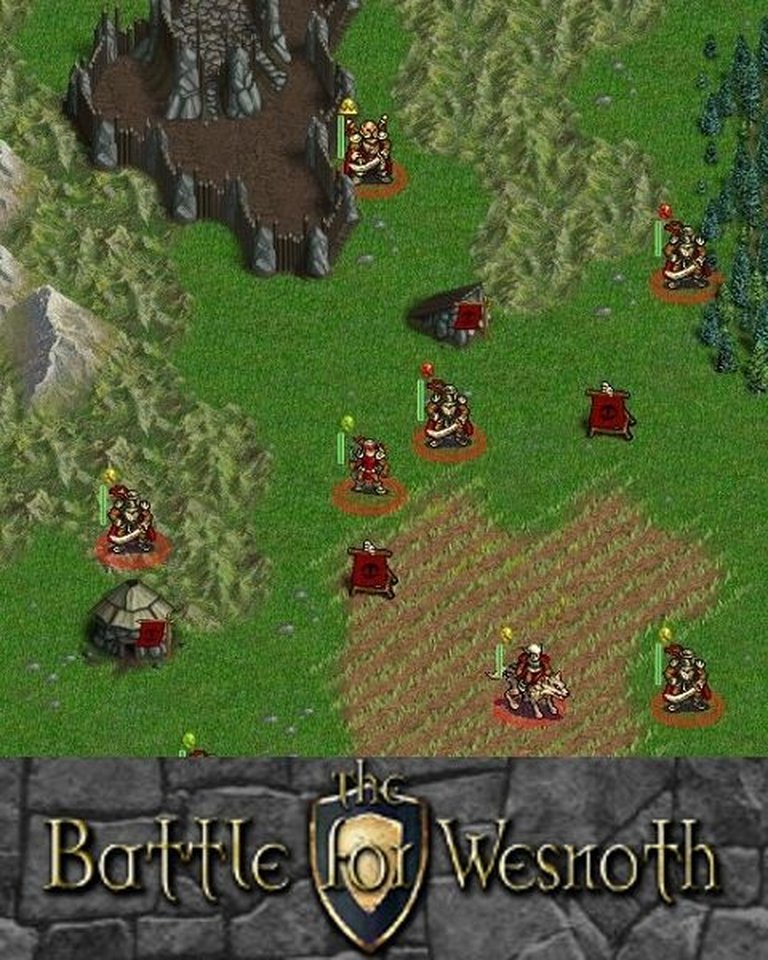
The Battle for Wesnoth is a turn-based fantasy strategy game set in the land of Wesnoth, where players command high-level leaders from various races—including humans, elves, dwarves, drakes, and undead—in battles for territorial control across different eras. Recruit units to fight on hexagonal maps influenced by terrain, day-night cycles, and matchups, gaining experience to evolve them, with single-player campaigns, multiplayer modes, a map editor, and user-generated content enhancing replayability.
Gameplay Videos
The Battle for Wesnoth Free Download
The Battle for Wesnoth Mods
The Battle for Wesnoth Guides & Walkthroughs
The Battle for Wesnoth Reviews & Reception
metacritic.com (87/100): The Battle for Wesnoth is one of the most well-designed games I have yet played.
reddit.com : An amazing example of free community driven game comparable to Fire Emblem or Advance Wars.
rpgfan.com : BfW offers more quality and quantity than almost any commercial title available.
mobygames.com (84/100): Deserves praise for its unique tactical variety that forces deep strategical thinking.
steambase.io (94/100): Very Positive player reviews with a 94/100 score.
The Battle for Wesnoth Cheats & Codes
PC
Access command mode by pressing Shift + : in single-player scenarios. For Steam, add -console to launch options if the console does not appear. Type :debug to enable advanced debug commands.
| Code | Effect |
|---|---|
| :debug | Enables advanced debug-mode commands |
| :nodebug | Disables debug-mode commands |
| :gold amount | Adds the specified amount of gold to the current player |
| :create unit_type | Creates a unit of the specified type |
| :unit hitpoints=amount | Sets hitpoints for the selected unit |
| :unit experience=amount | Sets experience for the selected unit |
| :unit moves=amount | Sets movement for the selected unit (1-99) |
| :unit level=number | Sets level for the selected unit |
| :unit advances=N | Advances/levels up the selected unit N times |
| :unit invulnerable=yes | Makes the selected unit invulnerable |
| :unit status=petrified,-slow | Sets or unsets statuses on the selected unit (use – to unset) |
| :unit side=1 | Changes the side of the selected unit |
| :unit max_hitpoints=XXX | Sets maximum hitpoints for the selected unit |
| :unit max_moves=XXX | Sets maximum moves for the selected unit |
| :unit canrecruit=no | Prevents the selected unit/leader from recruiting |
| :unit attacks_left=1 | Allows the selected unit to attack again |
| :n | Skips to the next scenario by activating a win |
| :next_level | Skips to the next scenario by activating a win |
| :cl | Opens a menu to select and move to a specific scenario |
| :choose_level | Opens a menu to select and move to a specific scenario |
| :fog | Toggles fog of war on or off |
| :shroud | Toggles shroud on or off |
| :inspect | Shows inspector menu with variables, team, and AI info |
| :show_coordinates | Shows overlay of x,y coordinates on map tiles |
| :sc | Shows overlay of x,y coordinates on map tiles |
| :show_terrain_codes | Shows overlay of terrain codes on visible map tiles |
| :tc | Shows overlay of terrain codes on visible map tiles |
| :lua statement | Executes a Lua statement |
| :turn number | Changes the current turn to the specified number (increases by one if no number) |
| :turn_limit number | Changes the turn limit to the specified number (turns off if no number) |
| :set_var attribute=value | Sets a WML variable to a given value |
| :show_var attribute | Shows a menu with the content of the variable |
| :throw event_name | Throws/fires the specified event |
| :fire event_name | Throws/fires the specified event |
| :discover | Shows all hidden unit descriptions |
| :undiscover | Hides known unit descriptions |
The Battle for Wesnoth: Review
Introduction
In an era dominated by multimillion-dollar blockbusters with photorealistic graphics and microtransaction-driven economies, The Battle for Wesnoth emerges as a defiant masterpiece—a free, open-source turn-based strategy game that has endured for over two decades through sheer ingenuity, community passion, and tactical brilliance. Launched in its nascent form in 2003 by David White and a growing cadre of volunteer developers, Wesnoth quickly became a beacon for indie gaming, amassing millions of downloads and influencing titles from 0 A.D. to modern tactical RPGs. Its legacy lies not in flashy spectacle but in a deceptively simple hex-grid battlefield where every village captured, unit leveled, and dawn breaking can swing the tides of war. This review argues that The Battle for Wesnoth is a landmark in video game history: a triumph of accessible depth, modular design, and collaborative creativity that proves excellence need not come with a price tag, cementing its place as the gold standard for free strategy gaming.
Development History & Context
The Battle for Wesnoth was born from David White’s (aka Sirp) vision in June 2003, inspired by Sega Genesis classics like Master of Monsters and Warsong (aka Langrisser). White sought a “simple rules, hard to master” turn-based strategy game with strong AI, free availability, and cross-platform reach—hallmarks of the early 2000s open-source ethos amid a gaming landscape dominated by real-time strategy giants like Warcraft III and StarCraft. Technological constraints of the era, such as reliance on SDL middleware for 2D rendering and no budget for professional assets, shaped its pixel-art aesthetic and lightweight engine, programmed primarily in C++ with Lua and Python for scripting.
Developed by “The Battle for Wesnoth Project”—a decentralized collective under publishers like Wesnoth Inc. and Androth Softworks—the game exploded from a solo prototype to a behemoth with 784 credited contributors by its 1.0 release on October 2, 2005. Ports proliferated across exotic platforms: BeOS and Amiga in 2005, OS/2 in 2008, iOS/Android/Browser later. Notable luminaries like Eric S. Raymond (Open Source Initiative co-founder) and Rusty Russell (Linux kernel dev) contributed code, underscoring its appeal to free software pioneers.
The 2000s gaming scene, rife with proprietary RTS bloat and console exclusives, found Wesnoth’s open-source model revolutionary. Its GPL-2.0-or-later license enabled community mods via Wesnoth Markup Language (WML), a map editor, and an add-on server for campaigns/eras. Ongoing updates—1.18 in 2024 adding “Winds of Fate”—reflect chronic understaffing yet fervent evolution, from Steam integration (2018) to 55-language support. In a pre-Steam Workshop world, Wesnoth pioneered user-generated content, fostering a self-sustaining ecosystem amid indie strategy droughts.
Narrative & Thematic Deep Dive
Wesnoth’s lore unfolds across the planet Irdya’s Great Continent, centered on the Kingdom of Wesnoth—a Tolkienesque realm of humans, elves, dwarves, drakes, orcs, trolls, and undead—spanning “Years Wesnoth” (YW) from 12 BW (The Rise of Wesnoth) to 858 YW (Son of the Black-Eye). Campaigns weave a tapestry of exile, invasion, and moral ambiguity, eschewing linear epic fantasy for branching, replayable tales.
Core Campaigns and Plots: Heir to the Throne (original, 517-518 YW) follows Prince Konrad reclaiming his throne from usurper Queen Asheviere via elven alliances, blending heroism with betrayal. Prequel The Rise of Wesnoth chronicles founder Haldric I’s flight from orc-ravaged Green Isle, forging Wesnoth through hardship. Northern Rebirth births the orcish Northern Alliance via slave revolt leader Tallin; Descent into Darkness traces necromancer Malin Keshar’s fall from promising mage to lich, exploring hubris. Dwarven epics like The Hammer of Thursagan quest for lost kin amid undead horrors, while Under the Burning Suns (far future) depicts desert-adapted elves battling orcs/undead post-cataclysm—two suns from hubristic magic scorched the world.
Characters and Dialogue: Protagonists shine: Konrad’s youthful resolve, Delfador’s sage counsel (Heir tutorial), Kalenz’s tragic leadership (Legend of Wesmere). Antagonists like Mal-Ravanal (Eastern Invasion) embody undead menace; Malin Keshar rationalizes genocide. Dialogue—text-based with portraits—delivers terse, flavorful exchanges: dwarves bark “Up axes!”, elves wax poetic on forests. Branching paths (The South Guard‘s elf/human dilemma) yield replayable moral choices, like allying bandits or purging undead.
Themes: Wesnoth probes exile and foundation (humanity’s origins), moral decay (necromancy’s corruption), alliance fragility (elves/dwarves vs. orcs), and hubris (suns’ apocalypse). Gray morality prevails: orcs form civilizations (Son of the Black-Eye), elves commit atrocities. Day/night cycles mirror lawful/chaotic tensions, villages symbolize sustenance, evolutions reflect growth/fall. User campaigns expand this—To Lands Unknown‘s summoners add Arabian flair—creating a living canon via wiki-documented timeline.
Gameplay Mechanics & Systems
Wesnoth’s hex-based TBS core is a masterclass in elegant complexity: recruit from keeps, seize villages for gold (upkeep fuels armies), level units via XP for evolutions. Combat hinges on probabilistic strikes (40-80% hit chance, terrain/day-night modulated), fostering tension—horsemen charge plains but falter in mountains; skeletons resist pierce but melt to fire.
Core Loops:
– Recruitment/Recall: Leaders spawn level 1 units (e.g., Loyalist Cavalry); survivors recall for 20g, retaining levels/traits (Loyal negates upkeep).
– Progression: Units advance 3x (e.g., Spearman → Swordsman/Pikeman/Javelineer), gaining attacks/abilities. AMLA post-max yields HP/heals.
– Terrain/Time: 12+ types bonus defense (elves in forests: 60%); lawful thrive day, chaotic night. Orbs track movement (green/yellow/red).
– Factions/UI: 6 defaults (Loyalists: versatile humans; Undead: poison/drain). Point-and-click interface shines—hover previews fights, encyclopedia details matchups. Fog/shroud hides foes; ZoC slows passersby.
Innovations/Flaws:
| Mechanic | Strength | Flaw |
|---|---|---|
| Day/Night | Tactical timing (Drakes day-rush) | Predictable cycles |
| Luck Element | Replayability, excitement | Frustrates purists (e.g., 95% hits miss) |
| Editor/WML | Infinite UMC (eras, campaigns) | Steep learning curve |
| AI | Ruthless village-poaching, flanks | Baitable via rivers/forests |
Multiplayer ladders demand adaptation; campaigns vary objectives (survive turns, escort). Difficulty spikes via smart AI teach mastery—villages fund rotations, evos counter foes. Bugs (sync issues) minor; moddability eternal.
World-Building, Art & Sound
Wesnoth’s Great Continent—west-coast Wesnoth amid forests, mountains, swamps—pulses with lived-in detail: orc raids, lich incursions, drake castes (Gliders hunt, Clashers enforce). Geography ties to lore (Northern Alliance hills; desert elves post-apocalypse). Atmosphere evokes gritty fantasy—supply lines strain, wounded retreat.
Visuals: Isometric pixel sprites evolve from crude 2003 art to polished 2024 animations (e.g., drake fire-breath). Portraits (Kathrin Polikeit/Emlen Rotival) shift from anime to realistic; hex tiles burst variety (lava damages!). Community assets ensure cohesion.
Sound: Synthesized orchestral score (Doug Kaufman, Mattias Westlund) channels medieval pomp—”Main Theme” swells epics, “Elf Lands” whispers mystery. 30+ tracks (e.g., “Over the Northern Mountains”) loop subtly; effects (rooster dawns, berserk laughs) immerse. Repetitive? Marginally, but evocative.
Elements synergize: hex fog evokes peril; twilight favors drakes, heightening stakes.
Reception & Legacy
Critics hailed Wesnoth’s 2005 launch: MobyScore 8.2/10 (#1148/27K), 84% average (100% iPad, 90% Linux/Windows). Praises: “Tactical wet dream” (Curlymcdom), “incredibly deep” (GamePro); gripes: luck (“flipping a coin”—Alex Z), uneven campaigns, hardness. Players average 4.2/5; 8M+ SourceForge downloads, Steam success.
Reputation evolved: Early freeware darling grew via ports (Android 2011), Steam (2018). Influences: Freeciv, 0 A.D.; modding inspired Steam Workshop. Open-source model (55 languages, add-ons) democratized design, proving viability sans publisher. Ladder/multiplayer thrives; campaigns (17 mainline + UMC) yield 100+ hours.
Conclusion
The Battle for Wesnoth transcends its origins as a hobby project, distilling TBS essence into a free, infinitely extensible gem. Its masterful mechanics—terrain interplay, faction calculus, community forge—outshine commercial peers, while lore’s epic scope and moral nuance reward immersion. Flaws like RNG frustration pale against virtues: accessibility, depth, longevity. In gaming history, Wesnoth exemplifies open-source triumph—a eternal battlefield where amateurs became architects, securing its throne as the definitive free strategy eternal. Verdict: 9.5/10 – Essential, timeless mastery. Download it now; the orcs won’t wait.