
- Release Year: 1998
- Platforms: DOS, Windows
- Publisher: MicroProse Software, Inc.
- Genre: Compilation
- Game Mode: Online Co-op, Single-player
- Average Score: 74/100
Description
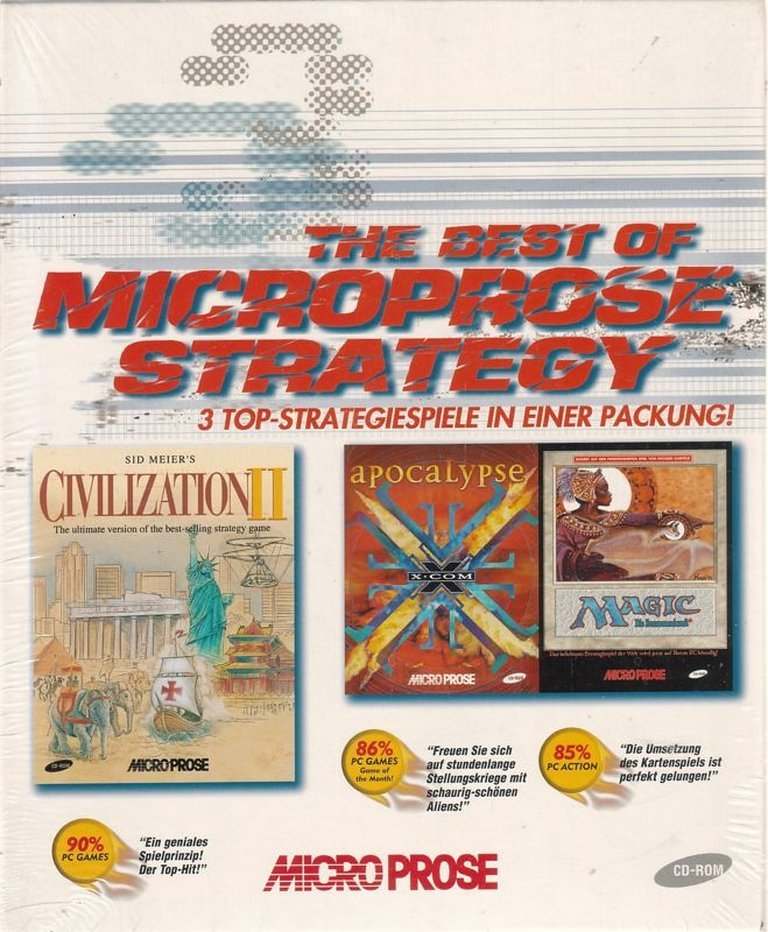
The Best of Microprose Strategy is a compilation of three classic strategy games from the renowned developer MicroProse. Released in 1998, this collection includes Magic: The Gathering, Sid Meier’s Civilization II, and X-COM: Apocalypse. Each game offers a unique strategic experience, from the turn-based empire-building of Civilization II to the tactical combat of X-COM: Apocalypse and the card-based strategy of Magic: The Gathering. This compilation is a must-have for fans of deep, engaging strategy games.
The Best of Microprose Strategy Reviews & Reception
retro-replay.com : Whether you’re a seasoned strategist or a newcomer hungry for tactical challenges, this compilation delivers hours of replayable excitement backed by robust AI and immersive gameplay.
The Best of Microprose Strategy Cheats & Codes
Civ II: Fantastic Worlds
Enter the following codes during Gameplay:
| Code | Effect |
|---|---|
| Ctrl + Shift + T | Alter Council Time |
| Ctrl + Shift + U | Alter Unit |
| Hold Shift and press 123456 release Shift and press T | God Mode |
| Ctrl + Shift + Q | Remodel Throne Room |
Civilization II: Multiplayer Gold Edition
Enter the following codes during Gameplay:
| Code | Effect |
|---|---|
| Ctrl + Shift + T | Alter Council Time |
| Ctrl + Shift + U | Alter Unit |
| Hold Shift and press 123456 release Shift and press T | God Mode |
| Ctrl + Shift + Q | Remodel Throne Room |
Sid Meier’s Civilization II
Enter the following codes during Gameplay:
| Code | Effect |
|---|---|
| god | Invincibility |
| Ctrl + Shift + T | Alter Council Time |
| Ctrl + Shift + U | Alter Council Unit |
| Hold Shift and press 123456 then release Shift and press T | God Mode |
| Q | Remodel Throne Room |
| V, move diagonally into their city and press enter | Control Opponent’s City |
| leemur | Start with 100,000 gold |
X-COM: Apocalypse
In order to use any of the cheats listed below, first activate Cheat Mode. To do this, go into the main interface and hold alt and type ‘ufo cheat’. The message bar should confirm that cheat mode has been enabled. Then you can enter one of the following codes for the desired effect.
| Code | Effect |
|---|---|
| Alt + T | Apocalypse (Terror) Mission |
| Alt + N | Display Number of Aliens in Buildings |
| Alt + 0, 1, 2, 3, 4, 5, 6, or 7 | Flip Dimensions |
| Alt + B | Force Base Mission |
| Alt + S | Force Overspawn |
| Alt + C | Force UFOs to crash |
| Alt + M | Gain $100,000 |
| Alt + [Keypad Plus] | Gain One More of All Equipment |
| Alt + X | Gain One of Each Vehicle Type |
| Alt + Z | Show People Tube Connections |
| Alt + G | Test Alien Dimension |
The Best of Microprose Strategy: Review
Introduction
In the pantheon of video game history, few studios command as much reverence as MicroProse, the legendary developer-publisher that defined strategy and simulation gaming in the 1980s and ’90s. The Best of Microprose Strategy (1998) is a compilation that encapsulates the studio’s golden era, bundling three landmark titles: Magic: The Gathering (1997), Sid Meier’s Civilization II (1996), and X-COM: Apocalypse (1997). While this collection lacks the cohesion of a curated greatest-hits package, its value lies in preserving three wildly different approaches to strategic thinking. For players seeking a time capsule of MicroProse’s brilliance—or a gateway into its legacy—this compilation delivers, albeit with caveats tied to its era and presentation.
Development History & Context
The Studio Behind the Legend
Founded in 1982 by Sid Meier and Bill Stealey, MicroProse built its reputation on deep, systems-driven games that merged realism with addictive gameplay loops. By the mid-’90s, the studio had become synonymous with cerebral strategy titles, even as financial turbulence led to its acquisition by Spectrum HoloByte in 1993 and later Hasbro Interactive in 1998. The Best of Microprose Strategy arrived during this transitional period, a stopgap release capitalizing on the studio’s prestige.
Technological Constraints & Gaming Landscape
Released in June 1998, the compilation targeted PC gamers during a transformative era. The rise of 3D accelerators and real-time strategy titans like StarCraft overshadowed MicroProse’s turn-based and simulation-focused DNA. Yet, the included games—Civilization II and X-COM: Apocalypse—showcased the studio’s mastery of complex UI design within the limitations of 640×480 resolutions and CD-ROM storage. Magic: The Gathering’s digital adaptation, meanwhile, struggled to replicate the tactile joy of physical card battles but laid groundwork for future CCG videogames.
Narrative & Thematic Deep Dive
Civilization II: The Birth of a Legacy
Sid Meier’s magnum opus, Civilization II, is a 4X juggernaut (eXplore, eXpand, eXploit, eXterminate) that tasks players with shepherding a civilization from the Stone Age to space colonization. Its narrative emerges dynamically through diplomacy, warfare, and technological breakthroughs, with historical leaders like Gandhi and Genghis Khan serving as flawed mirrors to the player’s ambitions. The game’s themes—progress vs. preservation, conquest vs. diplomacy—remain timeless.
X-COM: Apocalypse: Desperation in a Dying World
The third entry in the X-COM series eschews the global defense premise of its predecessors for a dystopian urban battleground. Set in the domed city of Mega-Primus, Apocalypse pits players against alien infiltrators, corrupt corporations, and societal collapse. Its narrative is darker and more fragmented, reflecting late-’90s anxieties about urbanization and secrecy. While criticized for its uneven pacing, the game’s emergent storytelling—via permadeath soldiers and faction alliances—elevates its stakes.
Magic: The Gathering: Digital Dueling’s Rough Draft
MicroProse’s adaptation of Richard Garfield’s iconic card game captures the strategic depth of deck-building but falters in presentation. The lack of licensed art and clunky AI (even on higher difficulty settings) undermines the fantasy of being a planeswalker. Yet, its Campaign Mode—a series of escalating duels—hints at the potential for digital CCGs, a genre that would explode decades later with Hearthstone and Magic: Arena.
Gameplay Mechanics & Systems
Civilization II: Empire-Building Perfected
- Core Loop: Manage cities, research tech, negotiate with rivals, and conquer territories across randomly generated maps.
- Innovations: The introduction of cultural influence and wonders of the world added layers to victory conditions beyond military domination.
- Flaws: Late-game micromanagement and sluggish AI turns tested patience, even on robust ’90s hardware.
X-COM: Apocalypse: Tactical Evolution
- Core Loop: Recruit soldiers, research alien tech, and execute turn-based (or real-time) missions in a reactive cityscape.
- Innovations: The fully destructible environments and faction reputation system were ahead of their time.
- Flaws: The shift to urban combat diluted the series’ eerie isolation, and the AI’s pathfinding often broke immersion.
Magic: The Gathering: A Foundation for Digital CCGs
- Core Loop: Build decks from a limited card pool and duel AI opponents using mana-based resource systems.
- Innovations: The deck editor and card combos showcased the potential for strategic depth in digital adaptations.
- Flaws: No multiplayer support and a lack of card variety compared to the physical game hindered longevity.
World-Building, Art & Sound
Visual Design
- Civilization II: Bright, isometric pixel art brought historical eras to life, with distinct visual identities for each civilization.
- X-COM: Apocalypse: Grimy, cyberpunk-inspired cityscapes contrasted with the sterile laboratories of X-COM’s headquarters.
- Magic: The Gathering: Generic fantasy aesthetics and placeholder art (due to licensing issues) undermined the game’s atmosphere.
Soundscapes
- Civilization II: Jeff Briggs’ orchestral score—from the stirring menu theme to era-specific music—elevated the game’s grandeur.
- X-COM: Apocalypse: Moody synth tracks enhanced the tension of missions, though lacked the iconic status of earlier X-COM soundtracks.
- Magic: The Gathering: Forgettable MIDI renditions of spell effects and duel ambiance failed to capture the tabletop game’s magic.
Reception & Legacy
Critical Response
- GameStar (Germany): Awarded the compilation a 74% score, praising Civilization II and X-COM: Apocalypse for their depth but critiquing the collection’s redundancy for owners of individual titles.
- Player Reviews: A 3.0/5 average from MobyGames users reflects appreciation for the classics but frustration with dated interfaces and compatibility issues on modern systems.
Industry Influence
- Civilization II became the blueprint for 4X strategy games, inspiring franchises like Europa Universalis and Endless Legend.
- X-COM: Apocalypse’s urban focus and faction mechanics presaged later narrative-driven tactics games like Divinity: Original Sin.
- Magic: The Gathering’s digital shortcomings highlighted the challenges of adapting physical games, lessons learned by successors like Hearthstone.
Conclusion
The Best of Microprose Strategy is a flawed but fascinating artifact, encapsulating a studio at the height of its creative powers but on the brink of corporate upheaval. For newcomers, it offers a tantalizing glimpse into the origins of modern strategy gaming, with Civilization II standing as the unequivocal crown jewel. Veterans, however, will find little beyond nostalgia—no remastered visuals, no quality-of-life updates, just three unvarnished classics.
In the annals of video game history, this compilation is neither essential nor forgettable. It is a testament to MicroProse’s genius—a studio that dared to make players think, plan, and lose themselves in worlds of their own creation. Whether that’s worth revisiting depends on your tolerance for ’90s jank and your appetite for foundational strategy experiences.
Final Verdict: A B-tier compilation showcasing S-tier games—best suited for historians and strategy devotees willing to forgive its rough edges.