
- Release Year: 1994
- Platforms: DOS, Macintosh, Windows
- Publisher: Electronic Arts, Inc., ORIGIN Systems, Inc.
- Developer: ORIGIN Systems, Inc.
- Genre: Compilation
- Perspective: Top-down
- Game Mode: Single-player
- Gameplay: Interactive environment, Open world exploration, Party management, Real-time combat
- Setting: Fantasy
- Average Score: 89/100
Description
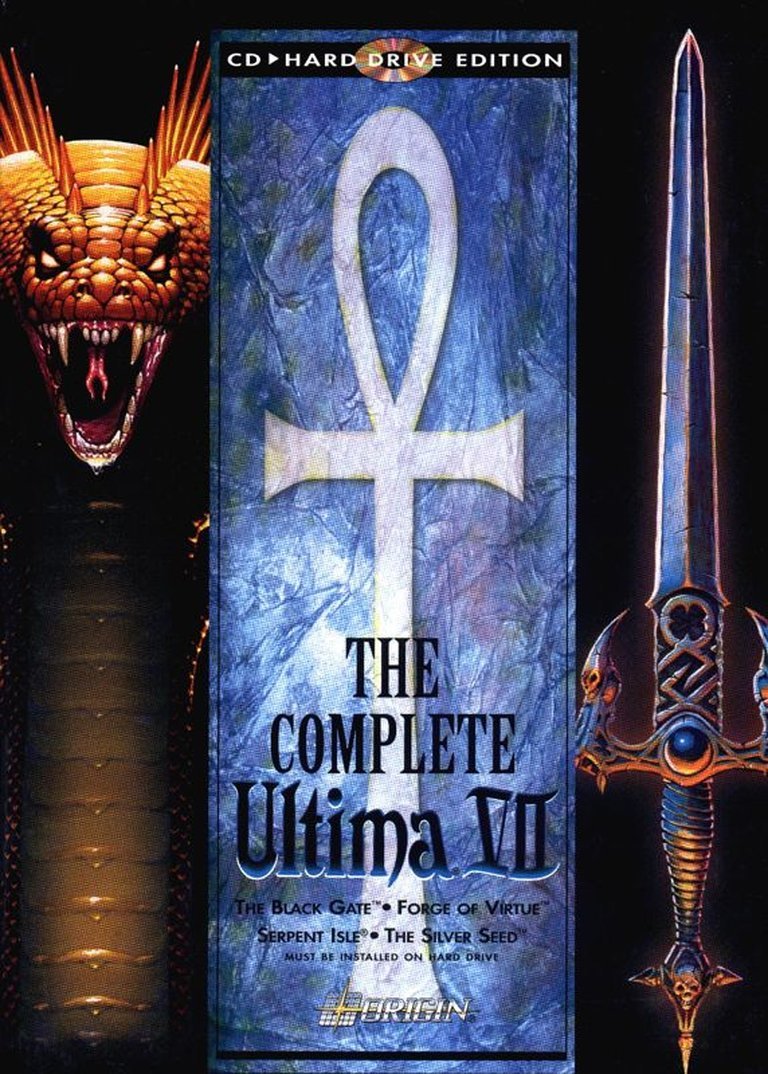
The Complete Ultima VII is a compilation featuring Ultima VII: The Black Gate and its Forge of Virtue expansion, alongside the sequel Ultima VII Part Two: Serpent Isle with The Silver Seed add-on. Set in the immersive fantasy world of Britannia, players control the Avatar and a customizable party of up to eight companions, engaging in highly interactive exploration, real-time combat with tactical AI behaviors, and countless side activities like flipping coins or changing diapers, all while unraveling epic quests against otherworldly threats in a living, reactive environment.
Where to Buy The Complete Ultima VII
PC
The Complete Ultima VII Free Download
The Complete Ultima VII Reviews & Reception
mobygames.com (89/100): The single best Ultima that was ever made.
The Complete Ultima VII Cheats & Codes
PC (Ultima VII: The Black Gate)
Start the game with the command line: ultima7 followed by a space and the invisible character created by [Alt]+255 (hold Alt and type 255 on numpad). Variations: ultima7 abcd[Alt]+255, ultima7 ABCD[Alt]+255, U7 ABCD[Alt]+255.
| Code | Effect |
|---|---|
| [F2] | Opens cheat menu / debug menu |
| [F3] | Teleport map |
| [Alt] + 4 | Click on a person to force them to drop all items |
| ENDGAME | Shows the end-game animation |
| ENDGAME ereiamjh | Triggers end animation |
PC (The Silver Seed)
Type the code in-game.
| Code | Effect |
|---|---|
| SERPENT MANIMAL | Enables debug mode (uses similar keys and effects as Serpent Isle debug mode) |
The Complete Ultima VII: Review
Introduction
Imagine stepping into a medieval fantasy world so alive with detail that you can bake bread from scratch, forge your own sword, or even change a baby’s diaper to scare off bandits—all while unraveling a conspiracy that skewers real-world cults and corporate greed. The Complete Ultima VII (1994), a CD-ROM compilation bundling Ultima VII: The Black Gate (1992), its Forge of Virtue expansion, Ultima VII Part Two: Serpent Isle (1993), and The Silver Seed add-on, represents the zenith of Richard Garriott’s visionary Ultima series. Released by Origin Systems under Electronic Arts, this package delivers over 200 hours of open-world mastery, cementing its status as a foundational text in RPG history. My thesis: While flawed in core RPG mechanics like combat and progression, The Complete Ultima VII endures as the ultimate sandbox RPG, pioneering environmental interactivity and narrative depth that influenced generations, proving that a living world trumps mechanical perfection.
Development History & Context
Origin Systems, founded by Richard Garriott (aka Lord British) in 1983, had evolved from Apple II pioneers into DOS-era titans by the early 1990s, with Ultima VI (1990) pushing boundaries in NPC dialogue and tile-based worlds. The Black Gate marked a bold leap: Garriott planned it as the first of a trilogy culminating in Ultima IX, shifting from grid-based movement to fluid, real-time exploration on a 386/486 PC landscape hungry for innovation.
Key figures included designer Garriott, programmer Ken Demarest, artist Jeff Dee, writer Raymond Benson, and composers Dana Karl Glover, Kirk Winterrowd, and Herman Miller. Producer Warren Spector (later of Deus Ex fame) oversaw the compilation. Development cost $1 million, ambitious for 1992, incorporating a custom “Voodoo” DOS extender for unreal mode CPU access—eschewing DPMI standards, which caused compatibility woes on Windows 95+ (necessitating boot disks or fan tools like DOSBox/Exult).
The era’s tech constraints (4-8 MB RAM, VGA graphics) birthed genius workarounds: full-screen worlds ditched UI bloat; mouse-drag interfaces replaced keyboard parsing. Contextually, RPGs like Ultima Underworld (1992) innovated 3D, but Ultima VII targeted top-down sandboxes amid a market dominated by Gold Box turn-based titles (Eye of the Beholder) and first-person dungeon crawlers (Lands of Lore). Inspirations included Times of Lore and Dungeon Master for action-RPG flow, with subversive nods: the Fellowship cult parodied Scientology; Guardian generators mimicked EA’s logo (cube/sphere/tetrahedron), reflecting Origin’s impending EA acquisition (September 1992). Expansions like Forge of Virtue (1992) added Isle of Fire quests; Serpent Isle (1993) expanded to a parallel world; Silver Seed (1993) introduced Moonshade intrigue. The 1994 CD-ROM compilation (The Complete Ultima VII) bundled all, easing 46 MB installs but retaining DOS quirks—no audio tracks or demos, just PDF docs.
Narrative & Thematic Deep Dive
The Complete Ultima VII‘s storytelling masterclass unfolds across two epics, blending moral philosophy, cult critique, and cosmic horror in Britannia’s timeline (circa 340-364 BC per Ultima Codex).
The Black Gate: Two centuries post-Ultima VI, the Avatar returns via red moongate amid Trinsic’s ritual murder of blacksmith Christopher. Probing reveals the Fellowship—a “philosophical society” preaching “Triad of Inner Strength” (Truth/Strength/Courage)—as a Guardian-backed cult. Batlin, Elizabeth, and Abraham orchestrate murders, blackrock generators disrupt magic (driving mages insane), and societal decay festers: oppressive taxes, caste rigidity, Lord British’s apathy. Clues span Britannia—Minoc’s forge murder, lich-ruled Skara Brae, Yew’s gallows, Buccaneer’s Den piracy. Peaks at Isle of Avatar’s Black Gate ritual, destroyed mid-alignment. Themes skewers blind faith (Fellowship as Scientology proxy), virtue erosion (Avatar steals/murders sans Codex penalty, but NPCs revolt), and alter-egos (Guardian as Avatar’s dark mirror, revealed in Ultima IX). Expansions deepen: Forge of Virtue tests principles on risen Isle of Fire, yielding Black Sword and max stats; Silver Seed isn’t included here but fits Serpent Isle’s Moonshade politics.
Serpent Isle: Sequel sends Avatar/Dupre/Iolo/Shamino via Serpent Pillars. Imbalance fractures reality—teleport storms swap buildings; Banes possess companions. Batlin’s immortality quest unleashes Chaos/Order serpents; subplots expose Fawn’s corrupt Oracle, Monitor’s goblin spies, Moonshade’s mages. Climax recaptures Banes, sacrifices Dupre to restore Earth Serpent, averts multiverse collapse. Themes escalate: exile’s isolation (Shamino’s haunted castle), guilt (Dupre’s suicide), cosmic balance vs. Guardian’s tyranny.
Dialogue trees innovate—keywords contextualize (e.g., “thief caught” post-arrest), voiced Guardian taunts chill. Nonlinear subquests (e.g., Alagner’s wisp tragedy) reward exploration; evil paths tempt (join Fellowship), but redemption arcs (party revolts) enforce consequences. Benson’s prose evokes emotion—Fellowship’s allure seduces NPCs, mirroring real cults; generators allegorize pollution/tech overreach.
Gameplay Mechanics & Systems
Ultima VII revolutionized CRPGs with real-time sandbox loops, but stumbles on RPG staples.
Core Loops: Mouse-driven freedom—drag-drop items (no “move/drop” commands); gumps (pop-up inventories for bags/books/spells) enable paper-doll equipping (Serpent Isle). Party (up to 8) auto-AI combats: assign stances (berserk/flee/protect), manual Avatar targeting. Real-time pauses for menus/inventories; travel via horse/carriage/ship/serpent gate/carpet.
Combat: Chaotic brilliance/flaw—AI swaps weapons, pathing errs (friendly fire via triple crossbows), respawns instantly. Tactics minimal; Level 8 Avatar dominates physically. Magic gimped: 100+ spells, but most useless (e.g., “Fireworks,” “Swarm”); reagents cheapen via Create Gold.
Progression/UI: No classes/skills—STR/DEX/INT cap 100 (Forge doubles STR); 8 levels via kills. UI iconic: full-screen world, double-click portraits; flaws abound (key hunts, food micromanagement—party starves/vomits). Sandbox shines: milk cows, flip coins, paint portraits, donate quests to museum. Nonlinear—Trinsic start, free roam post-escape.
Flaws: Inventory Tetris, no-save exploits, bugs (e.g., vanishing items). Serpent Isle refines (paper dolls, better pathing) but inherits chaos. Expansions trivialize via OP gear/stats.
| Mechanic | Innovation | Flaw |
|---|---|---|
| Interactivity | Forge/bake/parent—world lives | No puzzle integration |
| Combat AI | Autonomous party behaviors | Pathing/friendly fire |
| Magic | Vast spellbook, reagent economy | Mostly inert |
| Exploration | Deeds for vehicles, stacking puzzles | Linear main quest |
World-Building, Art & Sound
Britannia/Serpent Isle burst with verisimilitude—Victorian-tech farms, buccaneer dens, gargoyle ruins (Terfin). Sandbox depth: NPCs schedule (sleep/work), react to crimes (party flees thefts); hunger/thirst kills; vomit at gore/booze. Black Gate: Trinsic/Britain/Minoc evoke virtue decay; generators poison ether. Serpent Isle: Fawn/Monitor/Moonshade fracture via imbalance—emps die, ghosts haunt.
Visuals: Isometric VGA splendor—layered tiles, ocean waves, day/night; full-screen immersion (vs. Ultima VI‘s text bars). Jeff Dee’s art: detailed towns (Buccaneer’s Den casino), eerie dungeons (Hythloth Black Gate).
Sound: Adlib/MIDI scores evoke mood (ominous combat chimes); effects immersive (door creaks, gulps)—but intrusive (static/weapons). Guardian’s FMV taunts iconic. Comps lack OST (promised, delayed to 1993).
Atmosphere captivates: cricket chirps, isolated hermits, shipwrecks beg tales—ineffable “walking simulator” joy amid RPG shell.
Reception & Legacy
Launched to acclaim: PC Games (90%), Hyper (92%), PC Player (85%); MobyGames 7.9/10 (89% critics). Dragon/CGW praised graphics/story/UI, nitpicked bugs/speed/combat (Scorpia: “patience required”). Sales boomed; SNES port (1994) altered action-RPG. Player love: “Great RPG Classic” (willyum)—interactivity/replayability shine; modern woes (DOS-only) noted.
Reputation soared: PC Gamer #10 all-time (2013), “best Ultima”; GamesMaster #72 (1996). CRPG Addict’s 51 GIMLET echoes: world/story 8/10, mechanics 3s. Influence profound—Exult (GPL engine) fixes bugs/ports; GOG DOSBox. Sandbox pioneer: drag-drop, reactivity inspired Divinity series, Morrowind, Infinity Engine (Baldur’s Gate). No direct clones (save shareware), but open-world DNA in Gothic, Kenshi. Flaws (combat/food) cemented “ineffable classic” status—flawed yet transcendent.
Compilations like Ultima Collection (1996) preserved it; ESRB Teen (violence/gore).
Conclusion
The Complete Ultima VII is video game history’s flawed masterpiece—a sandbox colossus where baking bread rivals slaying daemons, Fellowship hatred rivals Thalmor loathing. Peaks (interactivity, narrative subversion) eclipse troughs (chaotic combat, sparse progression), earning a definitive 9.5/10—the series’ pinnacle, RPG innovator sans peer. Play via Exult/GOG; its legacy endures in every explorable pixel. Britannia calls—answer, Avatar.