
- Release Year: 2013
- Platforms: Windows
- Publisher: Tagstar Publishing Ltd.
- Developer: Two Desperados Ltd.
- Genre: Adventure, Puzzle
- Perspective: 1st-person
- Game Mode: Single-player
- Gameplay: Hidden object, Mini-games
- Setting: Fantasy
Description
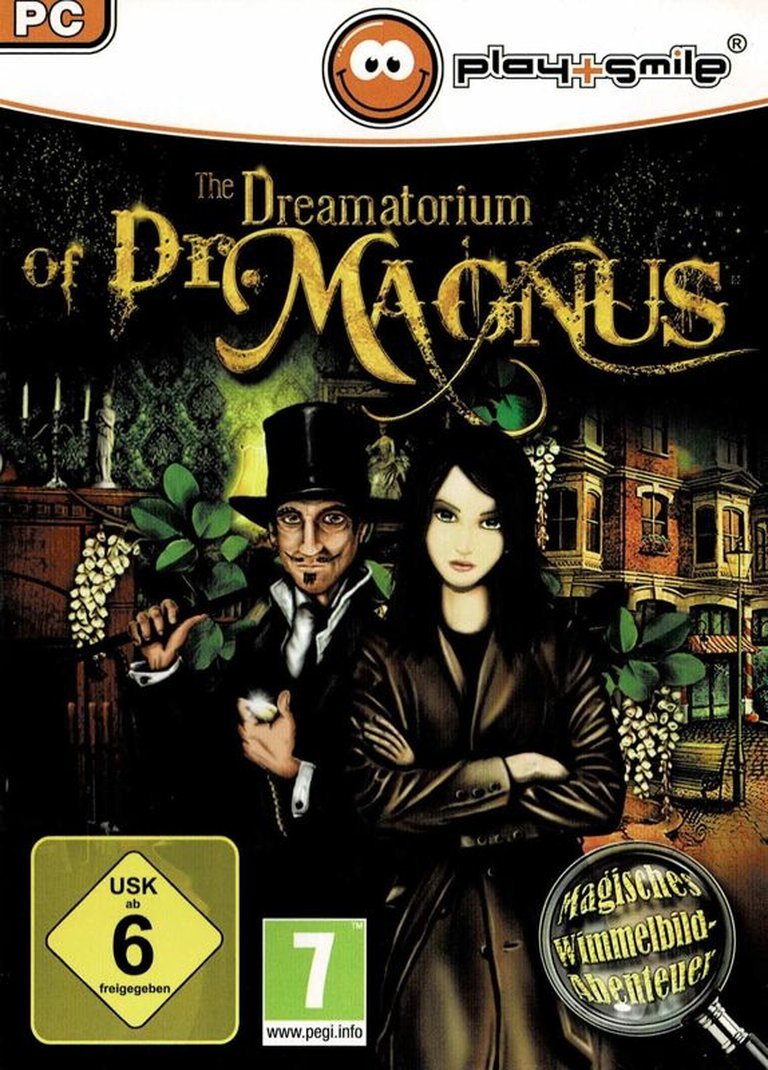
In ‘The Dreamatorium of Dr. Magnus,’ players step into the shoes of detective Sarah Green to unravel the mysterious disappearance of the eccentric Dr. Magnus. Set within a surreal fantasy world, the game blends hidden object puzzles, mini-games, and exploration across eerie locations like Dr. Magnus’ mansion, a haunted graveyard, and a mysterious castle. Players must uncover clues, solve intricate puzzles, and collect Golden Eyes of Horus to piece together the truth behind the doctor’s vanishing, all while navigating a first-person perspective and richly interactive environments.
Gameplay Videos
Where to Buy The Dreamatorium of Dr. Magnus
PC
The Dreamatorium of Dr. Magnus Guides & Walkthroughs
The Dreamatorium of Dr. Magnus Reviews & Reception
gamezebo.com : Inconsistent in presentation and sloppy in the details, this is one adventure title that was definitely a preemie.
gadgetspeak.com : The Dreamatorium of Dr. Magnus does lack a little in content and is not too particularly difficult.
The Dreamatorium of Dr. Magnus: Review
Introduction
In the crowded landscape of hidden object adventures, The Dreamatorium of Dr. Magnus (2013) stands as a curious artifact—a game that marries supernatural mystery with puzzles, yet stumbles under the weight of its own ambitions. Developed by the indie studio Two Desperados, this first-person adventure casts players as detective Sarah Green, tasked with unraveling the disappearance of a grief-stricken doctor obsessed with communing with the dead. While its premise brims with Gothic potential, the game’s execution remains divisive, blending moments of charm with glaring flaws. This review argues that The Dreamatorium is a flawed but fascinating relic of its genre, offering a glimpse into the era’s hidden object trends while failing to transcend them.
Development History & Context
Studio Vision & Constraints
Two Desperados, a small team with limited prior visibility, aimed to craft a narrative-driven hidden object game that leaned into occult detective fiction. Released in 2013, the game arrived during the genre’s golden age on digital platforms like Big Fish Games, where titles like Mystery Case Files dominated. However, budgetary and technological constraints are evident: the game’s modest 304MB size and 600 MHz CPU requirement reflect its focus on accessibility over graphical prowess.
The 2013 Landscape
By 2013, hidden object games had evolved beyond static scenes, integrating adventure mechanics and light puzzles. The Dreamatorium attempted to capitalize on this shift, blending exploration, inventory puzzles, and mini-games—a formula popularized by franchises like Dark Parables. Yet, its lack of voice acting and reliance on text-heavy storytelling felt dated compared to contemporaries like Grim Legends, which offered richer production values.
Narrative & Thematic Deep Dive
Plot & Characters
The story revolves around Dr. Macario Magnus, a Victorian-esque physician who retreats into madness after his wife and daughter perish in a car crash. Obsessed with bridging the gap between the living and the dead, he constructs the “Dreamatorium”—a series of metaphysical experiments that culminate in his disappearance. As Sarah Green, players traverse his manor, a graveyard, and surreal dreamscapes, piecing together clues through notes, symbols, and fragmented memories.
Themes & Flaws
The game’s themes—grief, obsession, and the dangers of unchecked ambition—are undercut by inconsistent tone. Bright, cartoonish visuals clash with the somber narrative, while Dr. Magnus’ melodramatic design (complete with a top hat and waxed mustache) feels at odds with the modern setting implied by the car wreck. The decision to reveal Magnus’ fate in the opening cinematic further deflates tension, leaving players with little mystery to unravel.
Dialogue & Translation
Textual snippets, such as newspaper clippings and spellbooks, suffer from awkward translations (e.g., “A DARE SEEK HEM TRY” morphing into “DREAMS ARE THE KEY”). While these moments add unintentional humor, they undermine the game’s immersion.
Gameplay Mechanics & Systems
Core Loop
The game follows a traditional hidden object adventure structure:
1. Hidden Object Scenes (HOS): Items are scattered in uncluttered environments, often requiring pairs (e.g., matching earrings).
2. Puzzles & Mini-Games: From symbol-matching locks to memory-based card games, these vary in creativity. A standout involves arranging trophies by year and color.
3. Inventory Puzzles: Combining items (e.g., brewing “Dream Juice” with cranberries and gooseberries) adheres to classic adventure logic.
Innovations & Flaws
While collectible Golden Eyes of Horus (25 in total) incentivize exploration, they offer minimal payoff—a common critique. The lack of a map forces backtracking through 39 scenes, exacerbating frustration when progression hinges on unclear triggers (e.g., acid-melting bolts). The hint system recharges slowly in “Advanced” mode, catering to casual players but alienating purists.
World-Building, Art & Sound
Visual Design
Environments blend Gothic and fantastical elements: crooked gravestones, alchemy labs, and ethereal mirrors litter the world. However, the art style is inconsistent—some scenes feature detailed watercolor backdrops, while others resort to flat, garish colors. Character portraits, particularly Dr. Magnus’, lean into caricature, clashing with the somber narrative.
Sound Design
A jaunty accordion-heavy soundtrack undermines the game’s darker themes, evoking a carnival rather than a haunted manor. Sound effects are serviceable but forgettable, with no voice acting to elevate the text-driven narrative.
Reception & Legacy
Initial Reception
Critics panned the game’s narrative incoherence and technical shortcomings. Gamezebo’s review (2012) called it “sloppy” and “confusing,” while GadgetSpeak (2022) noted its “childish” tone. Player reviews were sparse, though some praised its relaxed difficulty and hidden object scenes.
Long-Term Influence
Despite its flaws, The Dreamatorium exemplifies the hidden object genre’s mid-2010s trends: modular puzzles, collectibles, and paranormal narratives. Its sequels—The Dreamatorium of Dr. Magnus 2 (2015) and Magnus Failure (2021)—refined the formula but failed to achieve mainstream recognition.
Conclusion
The Dreamatorium of Dr. Magnus is neither a hidden object masterpiece nor a total misfire. It thrives in moments of puzzle-solving whimsy but falters under narrative and tonal inconsistencies. For genre enthusiasts, it offers a nostalgic, if flawed, time capsule of early 2010s design. For others, its clunky execution may prove insurmountable. Ultimately, the game’s legacy lies in its ambition—a modest attempt to blend mystery and melancholy, even if the pieces never fully align.
Final Verdict: A curiosity for hidden object completists, but overshadowed by sharper contemporaries.