
- Release Year: 1999
- Platforms: PlayStation, Windows
- Publisher: Dice Multi Media Europe B.V., Electronic Arts, Inc.
- Developer: Electronic Arts UK Ltd., Software Creations Ltd.
- Genre: Sports
- Perspective: 3rd-person
- Game Mode: LAN, Online PVP, Single-player
- Gameplay: Player skill upgrade, Star collection
- Setting: England
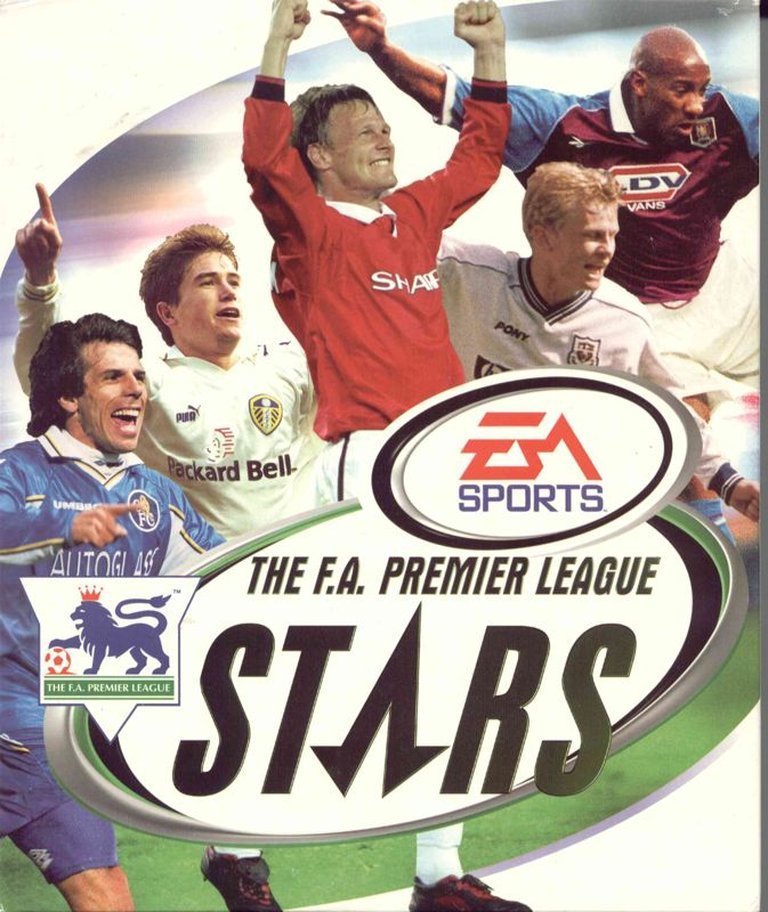
Description
The F.A. Premier League Stars is a 1999 football simulation game developed by EA Sports, exclusively licensed for the English Premier League with real teams, players, and stadiums. It distinguishes itself with a ‘Stars’ mechanic where earning stars through matches allows players to upgrade individual attributes like passing and shooting, providing a faster-paced, arcade-style experience compared to the more realistic FIFA series.
Gameplay Videos
The F.A. Premier League Stars Free Download
The F.A. Premier League Stars Reviews & Reception
mobygames.com : While I dislike some aspects of the title, the gameplay is truly excellent.
myabandonware.com : While I dislike some aspects of the title, the gameplay is truly excellent.
The F.A. Premier League Stars Cheats & Codes
PC
| Code | Effect |
|---|---|
| Goalrush Utd | 6 Goal Advantage Plus 1000 Stars |
PlayStation
| Code | Effect |
|---|---|
| WTF | 500 stars |
The F.A. Premier League Stars: A Cult Classic’s Flawed Ascent and Swift Descent
Introduction: The Bold Gamble for a League’s Soul
In the annals of football video game history, 1999 stands as a pivotal year. EA Sports’ FIFA series was reaching its creative zenith with FIFA 99, yet the company made a daring, region-specific detour: The F.A. Premier League Stars. This was not merely another annualized sports title; it was a calculated, high-stakes bet on the singular cultural potency of England’s top flight. Conceived as a love letter to Premier League fanatics, the game traded the global scope of FIFA for hyper-focused authenticity, promising the complete emotional and visual package of a Sky Sports broadcast—from sponsored kits to Martin Tyler’s voice. Its most audacious innovation was the “Stars” system, a rudimentary RPG-lite mechanic that let you sculpt your team’s destiny through persistent performance. This review argues that Premier League Stars is a fascinating, deeply flawed artifact: a game whose passionate specificity was both its greatest strength and ultimate weakness, a brilliant premise hamstrung by executional stumbles that saw it eclipsed by its own corporate sibling and a new genre rival, ultimately relegating it to a curious footnote in the pre-Pro Evolution Soccer era.
Development History & Context: A UK Studio’s Secret Project
The F.A. Premier League Stars emerged from a unique confluence of business strategy and regional pride. While the main FIFA series was helmed by EA Canada, this project was assigned to EA UK (with additional work by Software Creations Ltd.), a studio steeped in the local football culture. This UK-centric development team, led by Producer Danny Isaac and PSX Producer Anthony Casson, was granted a licensing coup: an official partnership with The Football Association for the Premier League itself. This was a deeper level of league integration than FIFA had achieved, encompassing not just team names and player likenesses, but also official stadiums, sponsor logos on shirts, and the distinctive Premier League typography for player numbers.
The technological context was the tail end of the PlayStation 1/Windows 98 era. Graphics were transitioning from the iconic but polygonal models of FIFA 98 to more detailed textures. The game utilized an updated version of the FIFA 99 engine (as noted by PC Player), which provided a solid graphical foundation but was alsobeing stretched thin. The development team faced the classic constraint of building a full game on a compressed timeline, slated for an August 1999 European release—just months before the global juggernaut FIFA 2000. The strategic intent was clear: create a must-have for the UK’s massive Premier League fanbase during the close season, a “stopgap” with unparalleled official branding, before the next FIFA arrived. Its subsequent regional rebrandings as Bundesliga Stars 2000 and Primera Division Stars confirm EA’s experiment in licensed league exclusivity, a model that would later be absorbed into the main FIFA franchise rather than spun off.
Narrative & Thematic Deep Dive: The Unseen Manager’s Journey
Unlike a narrative-driven title, Premier League Stars constructs its “story” through procedural generation and player investment. The core narrative is the classic underdog/managerial tale, but its themes are delivered through systems, not script.
-
The Authenticity Principle: The game’s entire thematic backbone is die-hard, parochial Premier League fandom. Every detail—the chants (though criticized as “blecherne” by Video Games), the specific stadium architectures, the Sky Sports presentation package—works to simulate the visceral experience of being a fan in 1999 England. This isn’t just a simulation of football; it’s a simulation of watching football on British television. The choice of music from the Ministry of Sound label (notably ATB’s “9pm (‘Til I Come)”) reinforces a late-90s/early-00s British mainstream pop culture aesthetic, grafting the era’s clubland energy onto the sporting experience.
-
The Stars System as Narrative Engine: The innovative “Stars” mechanic is the game’s central thematic device, transforming a match into a character progression quest. Earning stars for winning, scoring, fair play, etc., creates a tangible cause-and-effect relationship between on-pitch action and long-term club development. This frames every match as a chapter in your club’s biography. The system introduces a tactical role-playing layer: do you spend stars on a immediate transfer marquee, or patiently nourish a youth player’s “speed” attribute? The narrative emerges from these decisions. A reviewer from My Abandonware poignantly notes how the system could “destroy” loyalties, forcing a Birmingham City fan to contemplate managing Villa—a testament to the system’s power to generate genuine club identity conflict.
-
The Illusion of a Living League: The game simulates the other fixtures of the Premier League season (and European competitions) via a complex star-rating-based simulation. Teams’ performances are dictated by their accumulated star totals. This creates a believable, if not chronologically accurate, league table where traditional powerhouses like Man U. and Arsenal typically lead, but your interventions can create dramatic upsets. The theme here is one of causal influence: your management directly reshapes the competitive landscape. However, as the My Abandonware review astutely questions, this simulation is a black box, creating a league that feels real but operates on opaque rules, adding a layer of managerial mystery.
-
Thematic Shortcomings: The narrative suffers from depth deprivation. The absence of a true career mode with promotion/relegation threats (as criticized by GameStar), a second division, or a dynamic transfer market where AI clubs actively compete for players, limits the epic scope of the managerial story. The narrative remains a pleasant, repetitive loop rather than a sprawling saga.
Gameplay Mechanics & Systems: Action over Sim, Innovation Over Polish
Premier League Stars deliberately positions itself as a more arcadey, faster-paced alternative to FIFA. This design philosophy informs every system.
-
Core Matchplay: The gameplay is characterized by a higher tempo and reduced tactical complexity compared to FIFA 99. The ball moves quicker, player physics feel slightly more responsive, and the emphasis is on direct passing and shooting. The control scheme, while similar to FIFA, introduces bewildering variations (as noted by NowGamer and My Abandonware), such as dedicated buttons for through balls and lob passes. Crucially, the power bar system for shots and passes is both a blessing and a curse. It adds skill-based nuance but often leads to frustrating over-power shots that sail into the stand. Special moves like the step-over and drag-back are present but, as PC Action observed, the overall simplification of techniques results in gameplay that can mutate into “eintönigen Flachpaß-Geschiebe” (monotonous flat-pass shoving) on higher difficulties.
-
The Stars Ecosystem: This is the game’s defining mechanical identity.
- Acquisition: Stars are awarded post-match based on performance metrics: goals, shots on target, tackles, fair play, and Man of the Match.
- The Star Bank: Accumulated stars are pooled.
- Expenditure: Stars fuel two core activities:
- Player Upgrades: Six core attributes (Control, Heading, Passing, Shooting, Speed, Stamina) can be incremented, with each player having a cap (0-5 stars initially). This is a direct, RPG-like stat boost.
- Transfer Market: Stars can be spent to purchase players from other clubs. The market is static and initially bare, encouraging patience until the season progresses.
The system’s brilliance is its long-term motivation. Mega Fun correctly identified its “unheimlich viel Motivationspotential” (incredible motivational potential). Thematic Deep Dive explores how it creates a narrative.
The system’s flaws are profound. As Absolute Playstation devastatingly demonstrated, it is brutally exploitable. Pumping all stars into a single striker’s shooting and speed results in a “solo goal machine,” utterly breaking the game’s competitive balance. This turns a sophisticated progression engine into a potential cheat code. Furthermore, the lack of a balanced AI economy around the star system means the challenge curve is erratic.
-
Game Modes & Presentation: The offering is curiously slim for an EA Sports title. There is no indoor mode, no multitude of world leagues. The modes are: Friendly, Premier League Season, FA Cup, European Cup (Champions League analog), and a World Club Championship for league/European winners. The menu system was panned as “benutzerfeindlich” (user-hostile) by Video Games. Replays are a high point, with three-angle goal replays mimicking TV coverage. The commentary, provided by the real Sky Sports team (Richard Keys, Martin Tyler, Andy Gray), is a double-edged sword. While authentic, its repetitive nature—especially the infamous “archer” joke for every off-target shot—becomes maddening quickly, a point driven home by the My Abandonware reviewer’s aversion to using it for a full season.
-
Rule Inaccuracies & Bugs: The game carries forward a notorious exploit from FIFA International Soccer: the “goalkeeper dive trick” where placing a player in front of the keeper as they punt causes a deflection and a simple goal. This is a deliberate, unlicensed “feature” that breaks realism. Other bugs include a goal being credited to the nearest opponent after a goalkeeper’s comical pass-back own-goal (My Abandonware), and inconsistent penalty keeper control.
World-Building, Art & Sound: The Authentic Premise, Imperfect Realization
This is where Premier League Stars most directly competes with FIFA and largely triumphs in ambition, if not in flawless execution.
-
Visuals & Atmosphere: The game leverages the FIFA 99 engine to present stunningly authentic Premier League stadiums. The attention to detail—specific stands, correct sponsor logos, accurate team colours—was groundbreaking for its time and directly fulfilled the “full licensed league” promise. Player models, while lacking individualized facial sculpting, are discernible by silhouette and kit. The animation is generally smooth, though some reviews (Power Play, PC Action) noted moments of “line-dancing” where player spacing felt unnatural, detracting from the fluidity of real football. The presentation layer is deliberately televisual: broadcast-style camera angles (which can be restrictive near the touchlines), slick menu screens, and those multi-angle replays all sell the Sky Sports fantasy. However, the PlayStation version was notably hampered by severe frame-rate issues (CVG‘s “super jerky-o-vision”), making the superior PC version the definitive experience.
-
Sound Design: This is a patchwork of successes and failures.
- Commentary: The use of the actual Sky Sports team was a major selling point, offering unprecedented authenticity. However, the scripting was limited, leading to repetitive, often irrelevant comments that broke immersion.
- Stadium Ambience: The chants and crowd noise, while present, were criticized as generic or “blecherne” (tinny). The specific, targeted chants for clubs like Tottenham or Liverpool that would define later games are absent.
- Menu Music: The licensed track list from Ministry of Sound, anchored by ATB’s “9pm,” is a time capsule of 1999 British dance culture. For some, it’s a nostalgic asset; for others, a grating, brand-driven intrusion that feels dated almost immediately. It perfectly encapsulates the game’s attempt to fuse football authenticity with contemporary (if ephemeral) youth culture.
Reception & Legacy: Critical Split and a Quiet Dissolve
Premier League Stars landed in a highly polarized critical space, reflected in its aggregate MobyScore of 7.1 and critic average of 74%, but with a staggering range from 87% (GameSpy, PC Player) down to 40% (CVG PlayStation).
- The Positive Camp (~85-87%): Publications like GameSpy and PC Player (Germany) celebrated it as a gem for the dedicated UK/EU fan. GameSpy‘s review is telling: “The only people who won’t like FAPLS are those who object to anything which isn’t FIFA.” They praised the unparalleled Premier League atmosphere, the faster, more enjoyable arcade gameplay compared to the “sim” leanings of FIFA, and the compelling motivational pull of the Stars system. For them, the trade-off of a narrower league selection was worth the intensification of the core experience.
- The Critical Middle (70-78%): Reviews from PC Action, GameStar, Power Play, and Mega Fun acknowledged the game’s strengths—its presentation, speed, and innovative system—but levied fundamental criticisms. Common complaints: the gameplay was too simplified, stripping away the tactical nuance of FIFA; the Star system, while cool, was unbalanced and exploitable; the absence of a proper career mode and second division was a glaring omission; and technical issues (graphics stepping back in some areas, poor PlayStation performance) marred the package. PC Action‘s verdict is succinct: it had “sehr gute Ideen” (very good ideas) but its gameplay weaknesses created “eintönigen Flachpaß-Geschiebe” (monotonous flat-pass shoving).
- The Negative Camp (40-66%): Outlets like CVG (PlayStation), Video Games (Germany), and Absolute Games (RU) were scathing. They saw it as a cash-grab, a stripped-down FIFA with an inferior engine. Video Games called it “abgespecktes ‘FIFA'” (scaled-down FIFA) with “hakelig, zu wenig Moves” (jerky, too few moves). Absolute Games lamented a “three steps back in gameplay” for a “small step forward in graphics.” The PlayStation version’s technical failings were particularly damning.
Commercial & Long-Term Legacy: The game sold enough to warrant an EA Sports Classics re-release, indicating a solid, if not spectacular, commercial performance in its target region. Its direct legacy is the 2001 sequel, which itself received reviews focused on a lack of evolution, signaling the formula’s exhaustion. More importantly, the game’s most valuable contributions were assimilated and perfected by its successors:
1. The Licensed League Focus: The deep, single-league integration with official stadia, kits, and branding became a standard expectation, fully realized in later FIFA and Pro Evolution Soccer (PES) iterations.
2. The “Ultimate Team” Precursor: The Stars system—collecting rewards to improve your squad—is the direct conceptual ancestor to FIFA Ultimate Team (FUT), one of gaming’s most lucrative and enduring modes. The idea that performance in-game feeds directly into squad customization was pioneered here, albeit in a far simpler form.
3. The Fate of a Spin-Off: The series’ quiet death after Stars 2001 demonstrates EA’s reconsolidation around the global FIFA brand. The experiment proved that while regional passion could drive sales, the economies of scale and global appeal of the main franchise were irreplaceable.
Its historical niche is as a transitional, cult classic: beloved by a subset of UK fans for its hyper-specific authenticity and its proto-RPG team-building, but remembered by most as a missed opportunity—a game whose heart was in the right place, but whose execution couldn’t match the soaring ambition of its concept or the quality of its own stablemate, FIFA 99.
Conclusion: A Star That Burned Bright, Briefly
The F.A. Premier League Stars is not a great game by conventional metrics. Its gameplay is imbalanced, its feature set thin, its technical presentation inconsistent, and its core mechanic fatally exploitable. Yet, to dismiss it as merely a failed FIFA spin-off is to miss its profound, if flawed, significance. It was the first major attempt to build a football game entirely around the lived experience of a specific football league’s fans, not the global sport. Its Stars system, for all its faults, planted a seed that would grow into the monolithic FIFA Ultimate Team.
In the pantheon of football games, it occupies the space of an interesting failure—a bold, regionally passionate experiment that highlighted what fans truly craved (authenticity, progression, identity) but couldn’t yet deliver it with the sophistication required. It was outmaneuvered by the polish and depth of FIFA 2000 and the revolutionary gameplay of ISS Pro Evolution. Its legacy is not in sequels, but in absorbed ideas. It remains a fascinating “what if”: what if the Stars system had been balanced? What if the UK studio had been given the resources of its Canadian counterpart? As it stands, The F.A. Premier League Stars is a brilliant, battered time capsule—a game that captures the specific fever of the 1999-2000 Premier League season with loving detail, all while stumbling over its own ambitious feet. It is, ultimately, a testament to the fact that in game development, as in football, passion and authenticity must be met with impeccable execution to truly conquer the world. On those counts, this particular star shone brightly for a moment, then faded into the well-deserved, albeit nostalgic, shade of history.