
- Release Year: 2003
- Platforms: Windows
- Publisher: 4am Entertainment Corporation Ltd
- Developer: Tronwell, Inc.
- Genre: RPG
- Perspective: Diagonal-down
- Game Mode: Single-player
- Gameplay: Action RPG, Day, night cycle, Party system, Weather effects
- Setting: Fantasy
- Average Score: 80/100
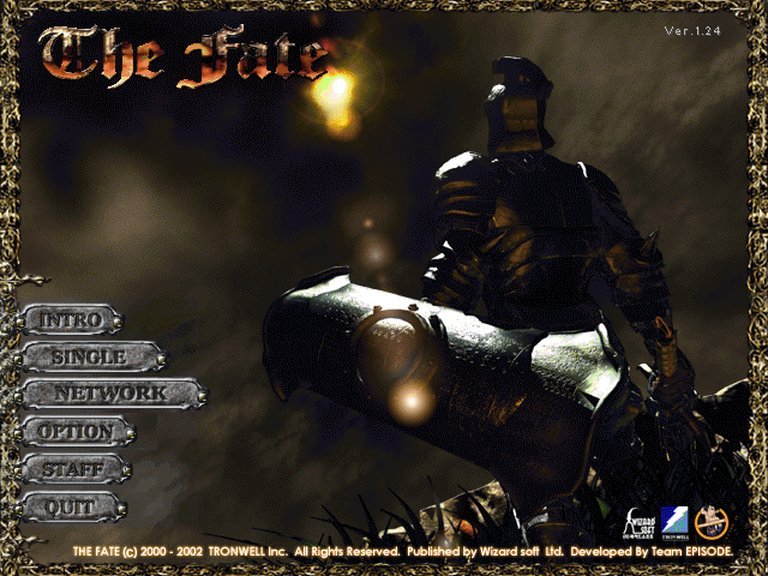
Description
The Fate is a classic action RPG similar to Diablo, where you play as Lony, a warrior who arrives on a mysterious fantasy island to search for the legendary blade of Eukleed with his brother Ranon. After a collapse in ancient ruins potentially separates them, Lony must navigate the island’s dynamic day-night cycles and weather, battle monsters, and recruit companions to uncover his brother’s fate and the blade’s secrets.
Where to Buy The Fate
PC
The Fate Reviews & Reception
metacritic.com (80/100): Hack-and-slash addicts will enjoy the old-school experience.
The Fate Cheats & Codes
PC
Press Ctrl+Shift+~ to display the console window, then enter codes.
| Code | Effect |
|---|---|
| god | Level up ten times and pet gains eight levels |
| fame | Gain 1000 fame points |
| experience | Gain 5000 experience points |
| heal | Restore all health |
| ascend # | Ascend specified levels in the current dungeon |
| descend # | Descend specified levels in the current dungeon |
| gold # | Gain gold equal to the amount entered |
| Gold | Gain 500,000 gold |
| levelup # | Gain levels equal to the amount entered |
| Levelup | Gain one experience level |
| blood | Show blood during combat |
| noblood | Hide blood during combat |
| discoverall | Reveal all areas on the map |
| skill points | Gain 500 skill points for all skills |
| superior gem | Gain five of each superior gem |
| dumpmap | Generate maze.txt file with current map description |
| Fountain of Wellness | Spawn a Fountain of Wellness that replenishes health and mana |
| Fountain of Health | Spawn a Fountain of Health that replenishes health |
| Fountain of Mana | Spawn a Fountain of Mana that replenishes mana |
| Fountain of Stamina | Spawn a Fountain of Stamina that replenishes stamina |
| Shrine of Learning | Spawn a Shrine of Learning that gives random stat effect |
| Fate Statue | Spawn a Fate Statue that gives unique monster or gems |
| Magic Anvil | Spawn a Magic Anvil that enhances items |
| Storage trunk | Spawn a Storage trunk that cannot be opened in town |
| Small Chest | Spawn a Small Chest with nothing inside |
| Chest | Spawn a Chest with nothing inside |
| Large Chest | Spawn a Large Chest with nothing inside |
| cat | Spawn a pet cat |
| terrier | Spawn a pet dog |
| cat # | Spawn number of enemy cats |
| superior sapphire | Spawn a superior sapphire |
| weapon rack | Spawn weapon rack that cannot be opened |
| town portal spell | Spawn a Town Portal spell |
The Fate (2003): Review
A Note on Distinction: This review addresses the obscure Korean-developed action RPG The Fate (2003), developed by Tronwell, Inc. and published in the West by 4am Entertainment. It is a distinct work from the vastly more famous Japanese visual novel Fate/stay night (2004) by Type-Moon, which spawned a multi-billion dollar media franchise. The two share only a coincidental title and a superficial “fantasy dungeon crawler” premise. This analysis is based on the limited archival data available for the 2003 title.
1. Introduction: A Ghost in the Machine
In the vast necropolis of gaming history, some titles are celebrated monuments, others are forgotten rubble. The Fate (2003) is a piece of rubble with a curious inscription—a stark, isometric Diablo-clone from a Korean studio that arrived in Western markets with little fanfare and left virtually no trace. Yet, its existence is a crucial data point in the global diffusion of the “action RPG” or “dungeon crawler” template in the early 2000s. While Blizzard’s Diablo series defined the genre for the West, its DNA was being decoded, reassembled, and localized in unexpected places, from Seoul to Moscow. The Fate represents one such attempt: a competent but unremarkable iteration of a proven formula, notable less for its innovations and more for what its obscurity reveals about the volatile landscape of PC gaming at the time. This review argues that The Fate is historically significant not as a masterpiece, but as a canonical example of the “Diablo variant” that proliferated globally, embodying both the accessible appeal and the creative stagnation of the genre during its transitional period.
2. Development History & Context: The Korean Wave Before the Wave
Studio & Vision: The Fate was developed by Tronwell, Inc., a South Korean studio, and published in the West by 4am Entertainment Corporation Ltd., a company known for localizing Korean MMORPGs like Flyff and Rohan: Blood Feud. This publishing context is key: 4am was not a major Western publisher but a niche localizer for the burgeoning “Korean grinder” MMORPG market. The Fate was thus an outlier in their catalog—a single-player, offline action RPG in an era dominated by their online, fee-based titles. Its original release in Korea (as 더페이트) and subsequent European/Western release suggests a strategy of repackaging domestic hits for fragmented international markets, a common practice for Korean developers before the “Korean wave” (Hallyu) fully hit gaming.
Technological Constraints & The Diablo Shadow: The game was released in 2003 for Windows. Its specified perspective—diagonal-down isometric 2D scrolling—immediately places it in the lineage of Diablo and Diablo II (1996, 2000), which used a fixed, 2.5D isometric view. The early 2000s was the golden age of this style, before fully 3D engines became standard for ARPGs. The Fate’s use of 2D scrolling sprites for characters and environments, as opposed to Diablo II‘s pre-rendered 3D assets or Fate/stay night‘s (2004) full 3D, indicates a modest budget and technological scope, typical of many Asian-developed PC games of the period that emulated popular Western designs.
Gaming Landscape: 2003 was a pivotal year. Diablo II’s expansion, Lord of Destruction, had cemented the game’s legacy. The market was saturated with “Diablo clones”: Sacred (2004), Nox (2000), Darkstone (1999). The Fate entered this crowded field with no notable marketing, relying on 4am’s distribution channels. Its primary differentiators, per the MobyGames description—day/night cycles, weather effects, and a dynamic pet/companion system—were minor refinements, not genre-redefining features. In contrast, Type-Moon’s Fate/stay night, released in Japan just months later (January 2004), would redefine the visual novel genre and spawn a multimedia empire. The Fate (2003) stands as a forgotten contemporary to a titan, a game that played the same notes but in a empty hall.
3. Narrative & Thematic Deep Dive: Plot as Procedural Excuse
The narrative of The Fate is a masterclass in functional minimalism. From the MobyGames description:
“You play as Lony, a warrior who just arrived on an island. You have been searching for the blade of Eukleed with your brother Ranon. While in the ruins, fighting monsters, the area collapses and your brother may not have made it out.”
This is the entire inciting incident. There is no political intrigue, no philosophical debate, no character development beyond the most rudimentary “brother is missing, find him/avenge him.” The “blade of Eukleed” is a classic MacGuffin, a named artifact to justify dungeon delving. The island setting is a contained biome, a logical constraint for a game with a single, massive mega-dungeon.
Characters: Lony is a blank-slate protagonist. The brother Ranon is a plot device. There is no mention of a supporting cast with arcs. This contrasts violently with Fate/stay night, where the Holy Grail War is a stage for dense character studies (Shirou’s idealism, Saber’s regal burden, Rin’s duality). The Fate offers no such depth. NPCs, if they exist beyond town vendors, are likely quest-givers (per TV Tropes’ description of the series) dispensing fetch quests: “kill 20 rats,” “retrieve this pendant from level 47.” The story is a procedural scaffold: enter dungeon, descend, kill boss, retire or continue.
Themes: None are discernible from the source material. There is no exploration of power, sacrifice, or consequence (beyond mechanical death penalties). The title itself, The Fate, is presumably a reference to the protagonist’s predetermined journey or perhaps to a personified “Fate” character (as in Fate/stay night or the Fate series’ personification), but the sources provide no evidence of such a character. The theme is simply questing. It is the antithesis of Fate/stay night‘s core thematic trio: “oneself as an ideal,” “struggling with oneself as an ideal,” and “the friction with real and ideal.” The Fate has no ideals to struggle with, only monsters to slay.
4. Gameplay Mechanics & Systems: The Diablo Blueprint, Faintly Runes
The Fate’s gameplay is described as an Action RPG (ARPG) with point-and-select interface and isometric 2D scrolling. Deconstructing this with information from MobyGames and the detailed mechanics of its spiritual successors in the Fate series (from TV Tropes/Wikipedia), we can infer its likely systems:
-
Core Loop: The loop is quintessential ARPG: enter the mega-dungeon (with randomized layouts and randomized monster/NPC/treasure spawns per TV Tropes), fight monsters, collect loot, gain experience, return to town to sell/buy, and descend again. The ultimate goal is to reach a specific, randomly generated boss level (40th–50th) to complete the main quest.
-
Character Progression: It employs a point-build system. When gaining a level, the player allocates stat points (likely Strength, Dexterity, Vitality, Magic—standard for the era) and skill points. Fame/Renown levels (from the Fate series) are a later innovation, but The Fate may have had a simpler reputation system for accessing higher-tier gear. There is a level cap (likely 99, standard for the period).
-
Inventory & Loot: The grid-based inventory (10×4 grid per TV Tropes) is a hallmark. Loot is randomly generated with color-coded tiers (Uncommon/Green, Elite/Purple, Legendary/Yellow), socketed equipment for gems, and artifact items with fixed stats. The vendor buy/sell ratio is notoriously poor (1/8th of sell price), encouraging inventory management and reliance on the pet.
-
The Pet System (The Core Innovation): This is The Fate‘s most significant mechanic, directly influencing the later Fate series. The player has a permanent pet (dog or cat) that:
- Fights alongside the player.
- Carries extra inventory (crucial for the grid system).
- Can be sent to town to sell items automatically.
- Can be transformed via fish into more powerful creatures for a duration (or permanently with a flawless fish). Fishing is a minigame—waiting for a bite on a button press—with pools found in dungeons and towns. This creates a rich secondary economy and power curve.
- Is functionally immortal but flees if HP hits 0, requiring healing via potions, fountains, or sending it to town.
-
Death & Retirement: Death is not permanent. A personified Fate (or Grim Reaper) offers choices: revive on-spot (cost XP/Fame), teleport to a nearby level (cost gold), or teleport up 3 levels (drop all gold). Gold left on a level * refreshes after 20 minutes* if the player is not present (no portal), a harsh penalty for carelessness.
- Retirement is a New Game+ system. After the main quest, the player can “retire” the character, passing one heirloom item to a descendant. The heirloom’s enchantments are augmented by 25% each transmission, creating a long-term progression incentive.
-
Missing/Flawed Systems: MobyGames notes the game has no multiplayer, a significant omission even in 2003 (Diablo II had it). The short development time (likely 5-6 months, inferred from Fate (2005) dev time) probably contributed to this. The UI is “point and select,” which can feel clunky compared to modern ARPGs. The limited camera rotation (only slight left/right) restricts visibility. The fishing minigame is simple to the point of passive. Most critically, the narrative integration is zero—quests are pure fetch/kill tasks with no story context.
5. World-Building, Art & Sound: Serviceable Atmosphere
Setting & Atmosphere: The world is a single town (Grove) built around a dungeon gate. Grove is a serviceable hub with vendors, a healer, and an enchanter. The dungeon is the true world—a procedurally generated, endless vertical labyrinth of increasing difficulty. The day/night cycle and weather (mentioned in MobyGames) provide basic atmospheric variation, but there is no indication they significantly impact gameplay beyond visuals.
Visual Direction: The 2D isometric sprite-based graphics are dated even for 2003, looking more like late-90s Diablo or Nox. The character and monster designs are generic fantasy (orcs, skeletons, giant spiders, nagas per TV Tropes). The color-coded item glow is a clear, functional UI element. The art lacks the cohesive identity of Diablo‘s gothic horror or Fate/stay night‘s sharp, modern-fantasy aesthetic. It is purely utilitarian.
Sound Design: This is a total blind spot in the sources. No composer or sound engineer is listed in the MobyGames credits snippet. We can assume standard fantasy sound effects (clangs, roars, spell zaps) and perhaps atmospheric dungeon music. In stark contrast, Fate/stay night had a meticulously curated soundtrack mixing Celtic folk for town and original, tense compositions for dungeons, with specific credited artists. The Fate‘s audio is almost certainly generic and forgettable.
Contribution to Experience: The art and sound do not elevate the experience; they ground it in a familiar but unremarkable fantasy template. The pet animations (per GameSpy’s praise of the later Fate series) were likely a highlight—small, charming movements in an otherwise stark world. The dungeon’s procedural generation is the primary driver of visual and auditory variety, not artistic direction.
6. Reception & Legacy: Echoes in a Silent Chamber
Critical & Commercial Reception at Launch: By all available metrics, The Fate (2003) was a commercial and critical non-event. MobyGames shows no critic reviews and only 10 players have recorded collecting it in their database (as of the provided snapshot). It generated no significant press coverage, no award nominations, and no sales data in the West. It was a niche product in a niche publisher’s catalog, lost in the post-Diablo II deluge.
Evolution of Reputation: Its reputation has not evolved; it has remained in oblivion. It has no cult following, no speedrunning community, no modding scene (unlike Diablo or even the later Fate series, which had MOD folders). It is a “lost game” known only to archivists and completists. The MobyGames entry itself was added in 2019 by users “Swizzle” and “Fureksu,” evidence of its obscurity.
Influence on the Industry & Subsequent Games: Here lies its only historical importance: as a footnote in the global spread of the ARPG genre.
1. The “Diablo Clone” Diaspora: It demonstrates how the Diablo formula was localized by non-Western studios. Korean developers were particularly adept at creating “grind-heavy” versions of Western genres (see Maplestory, Rohan). The Fate applies this ethos to a single-player ARPG, emphasizing the endless loot treadmill and pet-based inventory management.
2. Proto-Template for the Fate Series (2005-): The most intriguing connection is to the Fate series by WildTangent (starting 2005). TV Tropes details how the WildTangent Fate games feature the exact same pet system (dog/cat, fish transformations, town-running), the same grid inventory, the same death/retirement mechanics, and the same color-coded item tiers. The designer of the WildTangent series, Travis Baldree, has stated he wanted to combine Diablo and NetHack for a casual audience. The coincidence in mechanics is too specific to ignore.
* Hypothesis: It is highly probable that Baldree, an American developer, was aware of the Asian ARPG scene, including The Fate (2003). The pet-as-inventory-bot and fish-transformation mechanic is such a specific, quirky feature that it suggests direct inspiration or at least a shared regional design trend in Korea/China. The WildTangent Fate series, which became a long-running and influential franchise (leading to Fate: Reawakened in 2025), can be seen as the successful, polished, and marketed evolution of the ideas first coarsely executed in Tronwell’s The Fate. One was forgotten; the other spawned sequels, merchandise, and a remaster.
3. A Lesson in Market Forces: The Fate’s obscurity versus the Fate series’ success highlights the critical importance of distribution, marketing, and polish. Both share a core DNA: a simple Diablo-like with a pet. The WildTangent series had a dedicated website, Steam/GOG presence, consistent sequels, and eventually a full remaster. The Fate (2003) had a brief, unheralded Western release through a localizer and vanished. It is a case study in how a decent mechanic is not enough; ecosystem and persistence are everything.
7. Conclusion: The Significance of Being Forgotten
The Fate (2003) is not a good game by any conventional standard. Its narrative is nonexistent, its art is dated, its sound is invisible, and its mechanics are a direct, unoriginal copy of a superior contemporary (Diablo II). Its sole claim to fame is the pet-and-fishing system, a clever but poorly implemented quirk that found its true calling in the more refined Fate series by WildTangent.
Its place in video game history is as a curator’s specimen. It represents the “second wave” of Diablo-clones—the wave that flooded non-Western markets but failed to reinvigorate the genre in the West. It shows the template being deconstructed into its base components (dungeon, loot, level-up) and reassembled without the narrative or atmospheric ambition of Blizzard’s work. It is the archetypal “forgotten ARPG”: technically functional, mechanically dense on paper, but soulless.
The tragicomic irony is that the game titled The Fate (2003) was destined for obscurity, while a completely unrelated work with a near-identical name (Fate/stay night) would become one of the most influential media franchises of the 21st century. One was a fate of anonymity; the other, a fate of destiny. For the historian, The Fate (2003) is a vital reminder that for every Diablo or Fate/stay night, there are dozens of clones lost to time—games that played the same notes but never composed a song anyone remembers. Its legacy is to be a ghost in the machine of the ARPG genre, a spectral example of what happens when execution fails to match ambition, and when the market simply moves on.
Final Verdict: Historically Significant as an Example, Irrelevant as an Experience. Do not seek it out to play; seek it out to understand the ecosystem that allowed both its failure and the later, greater success of a nominally similar franchise.