
- Release Year: 2008
- Platforms: Windows
- Publisher: Shockwave
- Developer: Large Animal LLC
- Genre: Action
- Perspective: 3rd-person (Other)
- Game Mode: Single-player
- Gameplay: Arcade
- Setting: Circus
- Average Score: 80/100
Description
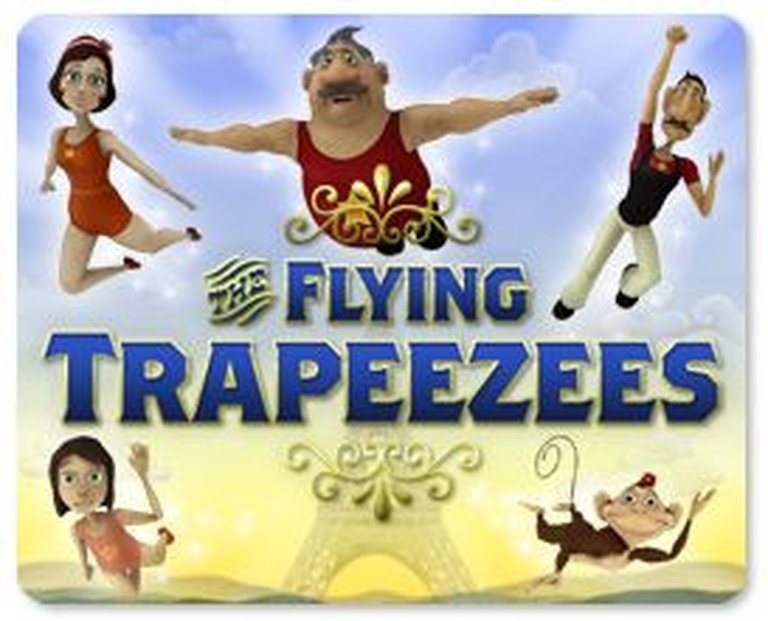
The Flying Trapeezees is an arcade game set in a 19th-century French circus, where players select cartoonish family members as flying acrobats launched from a cannon and guide them with the mouse to collect floating jewels while slowly descending. Each jewel builds a magical trail that cheers the silhouetted crowd at the bottom of the screen, with mouse-click special moves prompting hat tosses to collect for more audience satisfaction, unlocking new characters and abilities as players progress through performances.
The Flying Trapeezees Reviews & Reception
gamezebo.com : While fairly simple and repetitive, not to mention unlikely to challenge veteran keyboard jocks, hey… we can confidently say it’s the most fun you’ll have in tights, outside of the odd dance recital.
retro-replay.com : delivers fast-paced fun and vibrant visuals—an irresistible treat for arcade aficionados and casual gamers alike.
The Flying Trapeezees: Review
Introduction
Imagine hurtling through the Parisian sky in a leotard, trailing a ribbon of magical sparkles as you snatch glittering gems amid a chorus of cheering silhouettes—welcome to The Flying Trapeezees, a 2008 arcade gem that channels the exuberance of a 19th-century French circus into pixelated whimsy. Developed by the boutique studio Large Animal LLC and published via Shockwave’s shareware model, this unassuming title emerged during the heyday of casual browser games, offering players a brief escape into aerial acrobatics. As a game historian, I view it as a nostalgic artifact of the late-2000s digital distribution boom, where simple joys trumped sprawling epics. My thesis: The Flying Trapeezees excels as a labor of love, blending charming originality and thematic flair into an accessible arcade romp, but its repetitive mechanics and limited depth relegate it to a delightful curiosity rather than a timeless classic.
Development History & Context
The Flying Trapeezees was crafted by Large Animal LLC, a small independent studio whose team punched above their weight with a 14-person credit list dominated by multi-hat wearers. Andrew Burrows served as producer, senior producer, level designer, and co-game designer, embodying the scrappy ethos of indie development in the Flash/Shockwave era. Bob Paradiso led programming, supported by Yossi Horowitz on additional code and Josh Welber as technical director, while artistic duties fell to Jiro Ietaka (lead artist and designer), Mark Weismantel (artist and 3D artist), and Brad MacDonald (art director and designer). Executive producers like Wade Tinney, Peter Glover, and David Bergantino brought publishing heft from Shockwave, with SomaTone Interactive Studios handling music and sound. QA came from Jan Ruocco, and launch producer Dana Van Devender ensured a smooth rollout.
Released on June 11, 2008, for Windows as a shareware download (requiring minimal specs: 800 MHz processor, 256 MB RAM), the game arrived amid a casual gaming renaissance. Shockwave’s platform dominated with bite-sized titles like Jewel Quest, emphasizing mouse-driven accessibility over console complexity. Technologically constrained by Flash-like engines (no realistic physics, 2D sprites), the developers leaned into arcade purity, evoking 1980s coin-ops like Circus Charlie but with mouse controls suited to PC casuals. The 2008 landscape featured Wii’s motion experiments and Steam’s indie surge, yet Trapeezees thrived in the overlooked shareware niche—117 levels across 25 French towns promised progression without commitment. This context reveals a visionary pivot: in an era of bloated AAA titles, Large Animal captured circus escapism for downtime players, prioritizing charm over innovation.
Narrative & Thematic Deep Dive
At its heart, The Flying Trapeezees weaves a lighthearted fable of national revival through spectacle, framed as a tongue-in-cheek silent film serial. Monsieur Francois and Madame Amélie Trapeezee, archetypal down-on-their-luck aerialists, embody France’s collective malaise—a “wave of depression” gripping the “land of wine and cheese.” Nostalgic reminiscences uncover a hidden cache behind a portrait of Jules Léotard (the real-life trapeze inventor), yielding a trick handbook and enchanted map. This propels the family—playable roster includes daughter Celeste, grandpa Maurice, uncle Pierre, cousin Lucille, and a pet monkey—on a tour de force across venues like Nice’s sun-kissed promenades, Reims’ cathedrals, Strasbourg’s canals, and Mont Saint-Michel’s misty cliffs.
Told via grainy, cartoonish “vintage” clips with filters mimicking early cinema, the narrative eschews dialogue for visual gags: dramatic bows, pratfalls, stoic nods before cannon launches. Themes of joy as antidote to despair resonate subtly—the family’s “magic trail” literally illuminates drab crowds, turning gray silhouettes into colorful cheer. Cartoon stereotypes (exaggerated mustaches, berets) satirize French tropes while celebrating circus camaraderie, unlocking new members as metaphors for troupe expansion. No deep arcs or branches exist; it’s whimsical backdrop, reinforcing arcade brevity. Yet, this simplicity amplifies thematic purity: performance as communal catharsis, echoing historical circuses like Barnum & Bailey’s morale-boosting tours. In 2008’s recession-shadowed world, it offered escapist uplift, though purists might decry its superficiality.
Gameplay Mechanics & Systems
The Flying Trapeezees distills trapeze artistry into a hypnotic core loop: select a family caricature and venue, launch via left-click cannon blast, then mouse-steer your acrobat’s descent from 300 meters through gem-laden skies. Gems (floating, balloon-tethered, or moving) build a lengthening “magic trail,” tinting crowd hats below by color—red gems for red hats, etc. Success demands cheering a quota of silhouettes, quantified by an applause meter; rows must clear fully, as stragglers lose interest.
Left-clicks trigger special moves—swimming strokes, splits, pirouettes, disco spins—prompting matching-hat viewers to hurl bowlers/berets for collection, multiplying satisfaction. Progression unlocks five characters (each with flair: monkey’s agility, grandpa’s endurance?), 16 power-ups (hoops, fireworks, bi-planes for gem generation; dust sprinkles to recolor hats; super gems via loops), and extras like family swings. UI is minimalist: altitude markers, crowd bar, score overlay—intuitive for mouse/keyboard, single-player only.
Flaws emerge in repetition: no physics yields arcade floatiness, height limits force rushed plays, clustered gems invite miscoloring, string-cut obstacles add peril. Difficulty escalates smartly—early acts tutorialize, later demand precision amid denser hazards—balancing accessibility with challenge. Leaderboards foster competition, but absent multiplayer or robust progression, marathons tedium. Innovative yet flawed: color-matching elevates gem collection beyond Luxor-like shooters, yet lacks depth for veterans. Replay shines in high-score chases and unlocks, cementing its casual allure.
World-Building, Art & Sound
The game’s 19th-century France pulses with theatrical immersion, venues evoking a traveling circus: Champs-Élysées bustle, Seine banks’ dreaminess, Big Top tents. Each of 25 towns boasts bespoke palettes—cobblestones to cliffs—framing dynamic skies where particle-laden gems cascade. Art direction homage 1800s posters: crisp 2D cartoons with arched brows, flowing tights, mustaches; exaggerated silhouettes cheer responsively, hats arcing skyward. Magic trails glitter, confetti bursts on tricks—effects pop against muted backdrops, though rare slowdowns plague older rigs. Animations fluidly blend weighty arcs and snappy flourishes, prioritizing showmanship.
Sound design elevates: SomaTone’s period soundtrack—calliope waltzes, oompah brass—loops infectiously, syncing to stunts. SFX crisp: cannon booms, gem chimes, crowd roars build tension/release. No voiceover needed; auditory feedback (hat flings, trail whooshes) reinforces flow. Collectively, these craft atmospheric escapism—the trail’s glow mirroring circus lights, crowds embodying communal pulse—transforming mechanics into spectacle. Minor hitches aside, production values dazzle, outshining tech limits.
Reception & Legacy
Launch reception was muted but positive: GameZebo’s sole critic review (80/100, June 16, 2008) lauded “pure originality” and “fun under the virtual big top,” critiquing repetition yet hailing charisma. MobyGames echoes this (80% critics, unranked user), collected by one player—indicative of niche appeal. Shareware model spurred downloads via Shockwave/Retro Replay/White Fuzzy, but no sales figures endure; blogs like Edgetype/rapid4game touted 117 levels/16 power-ups.
Legacy endures as casual obscurity: influencing no direct successors, it epitomizes 2000s mouse-arcades amid Angry Birds precursors. Team credits (e.g., Bergantino’s 90+ games) fed broader indiedom—Snapshot Adventures, LEGO Bricktopia—but Trapeezees faded post-Flash demise. Retro sites preserve it as family-friendly whimsy, akin Circus Charlie or Flying Carpet. In history, it spotlights shareware’s role pre-App Store, a charming footnote for circus-themed rarities.
Conclusion
The Flying Trapeezees soars as a whimsical arcade vignette—original mechanics, evocative themes, and polished production capturing circus magic amid 2008’s casual wave—yet clips wings via repetition and shallowness. Large Animal’s passion shines, but it thrives best in short bursts. Verdict: 8/10—a must-emulate curio securing modest immortality in indie archives, ideal for historians craving unpretentious joy. Seek Shockwave archives; the big top awaits.