
- Release Year: 2012
- Platforms: Macintosh, Windows
- Publisher: Cliff Johnson
- Developer: Cliff Johnson
- Genre: Puzzle
- Perspective: 3rd-person (Other)
- Game Mode: Single-player
- Gameplay: Puzzle elements
- Setting: Fantasy
- Average Score: 85/100
Description
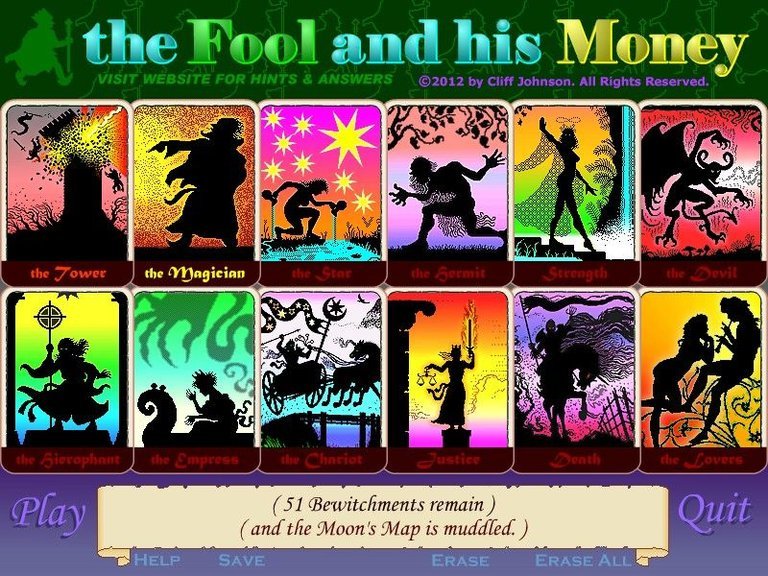
The Fool and His Money is a puzzle video game and sequel to the 1987 classic The Fool’s Errand, featuring 77 diverse Bewitchments—including word, logic, and number puzzles—set in a fantastical geography inspired by the Tarot deck, where a map given to the Fool by the Moon gradually reveals itself as puzzles are solved, leading to the ultimate resolution of an overarching meta-puzzle.
The Fool and His Money Free Download
The Fool and His Money Guides & Walkthroughs
The Fool and His Money Reviews & Reception
metacritic.com (70/100): there is no other game like it. It is worth a look.
justadventure.com : an instant classic.
The Fool and His Money Cheats & Codes
PC (Archived Download)
Enter one of the passwords at the password prompt to start the game.
| Code | Effect |
|---|---|
| DAV526EUN | Allows the game to start |
| AMA653EUQ | Allows the game to start |
| REA728AFN | Allows the game to start |
| THE298OKG | Allows the game to start |
| MYP862LRS | Allows the game to start |
The Fool and His Money: Review
Introduction
Imagine a game so labyrinthine, so intellectually voracious, that it devours weeks of your life, only to leave you grinning in triumph at its denouement—a puzzle epic where every solution peels back layers of a cosmic riddle, echoing the arcane wisdom of the Tarot itself. The Fool and His Money, Cliff Johnson’s 2012 magnum opus and spiritual successor to his 1987 masterpiece The Fool’s Errand, is no mere collection of brainteasers; it’s a meta-puzzle odyssey that redefines the genre. Born from a decade of solitary obsession, this self-published gem thrusts players into a fantastical realm of bewitched kingdoms, word-hoarding pirates, and a Moon-forged map that unravels only after conquering 77 fiendishly varied “Bewitchments.” My thesis: The Fool and His Money stands as the crowning achievement of indie puzzle design, a testament to one creator’s genius that elevates solitary puzzling into symphonic artistry, demanding reverence from historians and masochists alike.
Development History & Context
Cliff Johnson, a polymath puzzle auteur with credits spanning 11 games since the Macintosh era, single-handedly birthed The Fool and His Money over a grueling decade, transforming a 2002/2003 announcement into a 2012 reality. Self-financed through preorders from devoted “True Believers”—a prescient crowdfunding model predating Kickstarter—Johnson weathered dozens of delays, joked upon for the title’s ironic prescience (a fool and his money soon parted, indeed). A 2009 preview tantalized with a prologue and five puzzles, but full release arrived October 25, 2012, for Windows XP+ and Mac OS X 10.4+, one day ahead of schedule.
Crafted in Adobe Director with embedded Flash, the game navigated early-2010s indie constraints: a modest 800×600 windowed mode, no resizable display, and reliance on manual DRM via personal key files. This era’s gaming landscape brimmed with casual Flash portals like Kongregate and the rise of iOS puzzlers (World of Goo, Cut the Rope), yet Johnson’s vision harkened to 1980s meta-puzzles amid a flood of linear adventures (The Walking Dead) and action-RPGs (Skyrim). Technological limits—Flash’s vector animations, Sound Forge effects, open-source music—forced elegant minimalism, amplifying puzzle purity over spectacle. Johnson’s filmmaker background infused cinematic pacing, while Photoshop/Fireworks visuals evoked gem-like Tarot artistry. In a post-Portal world craving clever mechanics, TFaHM was a defiant throwback: pure intellect in an age of explosions.
Narrative & Thematic Deep Dive
The Fool and His Money opens where The Fool’s Errand closed: our titular protagonist, crowned with wisdom after reclaiming 14 Tarot treasures, strides toward reward, knapsack brimming. “What a glorious sunset!” he crows, daydreaming of adulation. Yet fate, ever the trickster, intervenes—seven pirates plunder his bounty, stripping even his knapsack. Thrust into bewitched kingdoms (Swords, Wands, Cups, Pentacles), the Fool confronts a land addled by “Wordage”: citizens trademark syllables, gobble herbs, swig elixirs, their speech fractured into alliterative curses. Guided by the Moon’s cryptic map—pieced from puzzle spoils—the Fool navigates marshes, mountains, and metafictional perils, uncovering Egyptian gods, a scheming Prince, and pirate plunderers siphoning gold via magical fiat.
Characters pulse with thematic depth: alliterative NPCs like Payne (Patchwork), Ursula (Umbrage), or Caine (Curses) embody folly’s facets—greed, vanity, obsession. Dialogue scrolls poetically, laced with clues: the West Wind’s “Montes cut off his nose” hints at hubris; locals’ word auctions parody intellectual property mania, where the Fool conjures unowned terms from ether, only for pirates to abscond with proceeds. Underlying themes exalt the Tarot’s Fool’s Journey—innocence tested by materialism—while skewering commodified language (a prescient IP satire amid rising digital rights battles). The ur-puzzle culminates in the Finale, resolving bewitchments into enlightenment, affirming Johnson’s motif: true wealth lies in wisdom, not gold. No voice acting, yet prose sings; interconnected narratives demand rereads, transforming puzzles into mythic allegory.
Gameplay Mechanics & Systems
At its core, TFaHM is a meta-puzzle colossus: 70 main Bewitchments (unlocked progressively from the “Seventh House” menu) plus 7 stained-glass windows (each a 4-stage epic: Deliveries, Hexes, Remainders, Connections), yielding 150+ screens and 300+ sub-puzzles. Alliterative titles telegraph types—Lawley’s Literals (wordplay), Garrison’s Gridlock (logic grids), Wyck’s Wager (Tarot card games), Jasper Junction (path-tracing)—spanning words, numbers, anagrams, auctions, metamorphoses, horizontals, inventories, and “action” mouse-traces.
Progression loops elegantly: solve a Bewitchment, earn a Moon’s Map fragment; assemble the map to unlock Finale puzzles. The Seventh House evolves—windows shift from daylight (Deliveries) to night (Connections), colors signaling gates (green, blue, red) opened via house rituals. No combat or progression trees; “character growth” is cognitive, difficulty ramping smoothly per Andrew Plotkin’s praise: breathers amid heartbreakers, rules often opaque (e.g., wager opponents hide hands). UI shines: scrollable story/help (essential “Instructions”), 12 Tarot save slots (one active per profile, manual backups needed), hyperlinked hint PDFs online.
Flaws? Non-minimizable window irks multitaskers; wager opacity frustrates (learn rules via trial-by-loss). Innovations abound: interconnected clues (e.g., scroll hints solve downstream puzzles), Flash animations (jigsaws that “build” themselves), no handholding—mirroring life’s enigmas. Loops foster addiction: wake pondering Radcliff’s Reminiscences, triumph via shower epiphany. Exhaustive yet fair, it’s puzzle design’s Sistine Chapel.
World-Building, Art & Sound
Tarot’s mysticism births a breathtaking cosmos: four Kingdoms evoke suits’ essences—Swords’ stark logic, Wands’ fiery auctions, Cups’ fluid scrambles, Pentacles’ earthy grids—stitched by the Moon’s fantastical geography, a jigsaw of marshes, hills, and pirate coves. The Seventh House, a stained-glass sanctum, morphs from dawn to lunar eclipse, windows pulsing with narrative weight. Egyptian gods, Princes, and pirates expand lore, grounding abstraction in whimsy.
Visuals mesmerize: Brad Parker’s silhouette Tarot art (reprising Errand) frames Johnson’s Photoshop/Fireworks gems—vibrant, handcrafted scenes in 800×600 splendor, animations fluid (e.g., tracing zigzags, patchwork assembly). Sound design elevates: Sound Forge effects punctuate reveals (triumphal chimes, ominous groans), open-source tracks swell dramatically—wind howls, elixirs bubble—crafting immersion sans voice. Atmosphere? Claustrophobic genius: static screens breathe via mouse interaction, mood shifting from pastoral to eldritch, mirroring the Fool’s arc. Elements synergize, puzzles feeling organic to lore, not bolted-on.
Reception & Legacy
Launch reception crowned it puzzle royalty: Just Adventure’s Greg Collins bestowed a career-first A+ (100/100), hailing “genius and quality we may never see again”; Jay Is Games named it 2012’s best indie puzzle; Andrew Plotkin lauded superior sequencing, variety, and “crazy-hard” escalation. MobyGames echoes 100% (1 critic); Metacritic/DarkStation averaged 70-100, praising uniqueness despite price (~$40-50). Commercial? Self-pub success via preorders, but niche: 2 Moby collectors, abandonware aura by 2025—official site defunct, Johnson deeming it “no longer operational,” preserved via Wayback (passwords: DAV526EUN et al.).
Legacy endures: puzzle fanatics dissect it as Errand‘s superior (3x size, harmonious flow), influencing meta-hybrids (Baba Is You, The Witness). In indie evolution—from Flash to Unity—TFaHM embodies auteur purity amid AAA bloat, its cult status growing via wikis/forums. Historians cite it in Macintosh preservation; its IP satire resonates eternally. Flaws (price, saves) fade against transcendence—influencing hard-puzzle niches, securing Johnson’s pantheon spot.
Conclusion
The Fool and His Money is exhaustive virtuosity: a decade’s alchemy yielding 77 Bewitchments in Tarot splendor, where narrative folly, mechanical brilliance, and atmospheric poetry converge in meta-triumph. Flaws—clunky saves, opacity, cost—pale against genius; it’s brutally fair, endlessly replayable. Verdict: An unassailable masterpiece, TFaHM claims eternal throne as indie puzzle pinnacle, essential for connoisseurs. In video game history, it joins Tetris and Myst as archetype-defining—play if puzzles are your religion; worship if you’ve conquered it. A fool’s errand? Nay: the sage’s fortune. Score: 10/10