
- Release Year: 1999
- Platforms: Windows
- Publisher: Mindscape International Ltd.
- Genre: Compilation
- Game Mode: Single-player
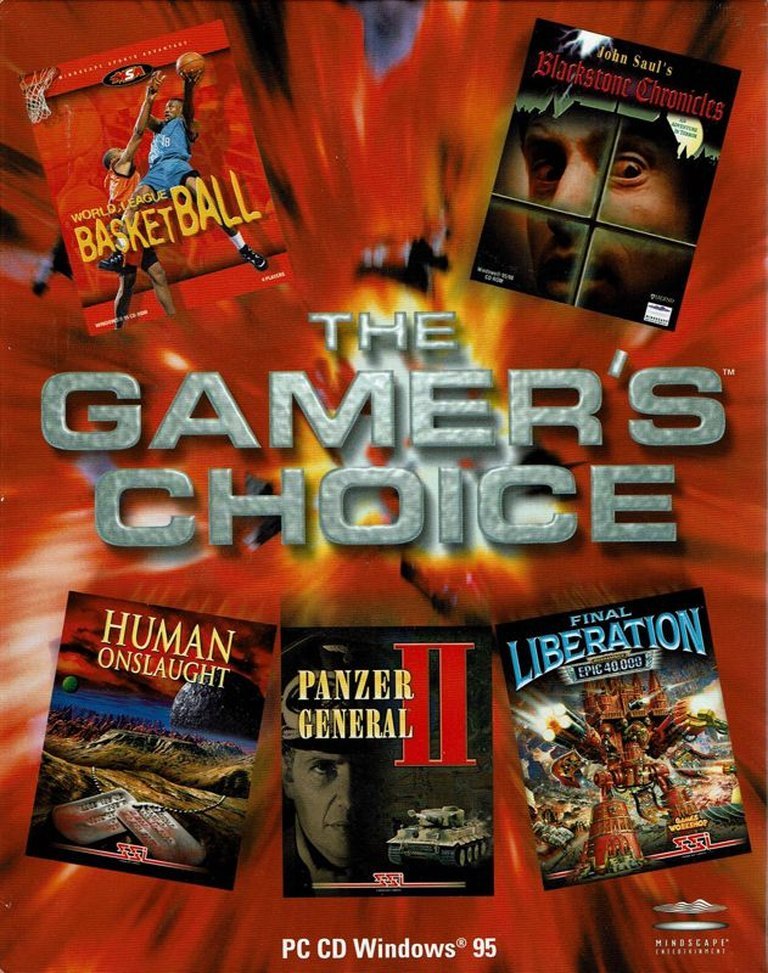
Description
Released in 1999 on Windows by Mindscape International Ltd., The Gamer’s Choice is a commercial CD-ROM compilation featuring five diverse games: the strategy title Final Liberation: Warhammer Epic 40,000, the horror adventure John Saul’s Blackstone Chronicles: An Adventure in Terror, the turn-based strategy Panzer General II, the real-time strategy War Wind II: Human Onslaught, and the sports simulation World League Basketball. This compilation offers varied gameplay experiences controlled via keyboard and mouse input, catering to different gaming preferences within a single package.
The Gamer’s Choice: Review
Introduction
In the late stages of the 20th century, as personal computers became more ubiquitous and gaming evolved into a legitimate entertainment industry, compilations of games became a common sight on store shelves. These bundles, often aimed at budget-conscious consumers, offered the promise of multiple gaming experiences in a single package. “The Gamer’s Choice” is one such compilation from 1999, released by Mindscape International Ltd. But beyond being a simple collection of titles, does it offer any unique insights into the gaming landscape of its time?
Development History & Context
Mindscape, during the 90s, was a publisher known for creating and distributing a wide range of computer games. The Gamer’s Choice project likely arose from a desire to capitalize on the popularity of compilation packs by packaging together games that might not have been individual hits but collectively offered variety. Technological constraints of the era, such as the CD-ROM format and the transition from DOS to Windows-based systems, played a role in selecting titles compatible with late 90s hardware specifications.
The gaming landscape of 1999 was diverse, with genres like real-time strategy (RTS), turn-based strategy, and adventure games all finding niches. The compilation reflects this by including titles like Final Liberation (an RTS), Panzer General II (turn-based), and John Saul’s Blackstone Chronicles (adventure). Each of these individual games was developed by separate studios, with Mindscape acting as the publisher for the compilation rather than the developer of each title.
Narrative & Thematic Deep Dive
While compilations by their nature lack a unified narrative, each of the five included titles in The Gamer’s Choice brings its own story and themes. For example:
-
Final Liberation: Warhammer Epic 40,000 – Set in the grimdark universe of Warhammer 40k, this RTS explores themes of war, sacrifice, and duty. Players lead space marines against orks, facing the moral ambiguity of a galaxy in perpetual conflict.
-
John Saul’s Blackstone Chronicles: An Adventure in Terror – A horror-themed adventure, this game delves into dark family secrets, the occult, and the consequences of past actions coming back to haunt present generations.
-
Panzer General II – A World War II turn-based strategy game that examines large-scale military conflicts and the strategic decisions that determine the course of battles. It raises questions about the moral implications of waging war and the role of individual leaders.
-
War Wind II: Human Onslaught – A fantasy RTS where humans, elves, and orcs clash. Themes include power struggles, heroism, and the clash between elemental forces.
-
World League Basketball – A sports simulation focusing on the global game of basketball. While narrative is minimal, it highlights competition, team dynamics, and the quest for athletic supremacy.
Each game contributes its own distinct narrative voice to the compilation, offering a broad spectrum of storytelling styles and thematic explorations.
Gameplay Mechanics & Systems
The core gameplay loop of The Gamer’s Choice as a compilation revolves around selecting and immersing oneself in each individual game’s mechanics. Here’s a breakdown of the gameplay systems for each included title:
-
Final Liberation – Classic RTS gameplay with resource gathering, base building, unit production, and real-time battles. Notable features include detailed unit animations and a lush, dystopian environment.
-
John Saul’s Blackstone Chronicles – Puzzle-solving and item collection within a branching narrative. The game uses FMV (full motion video) sequences and a point-and-click interface to deliver its horror story.
-
Panzer General II – Turn-based strategy on a grid-based map. Players must manage unit movement, elevation, and visibility, with upgrades and experience points affecting unit performance.
-
War Wind II: Human Onslaught – Another RTS but with fantasy elements. Units and buildings are built using mana, and elemental creatures can be summoned. Unique features include hero units with special abilities.
-
World League Basketball – Team management and simulation. Players control a basketball team through seasons, making trades, hiring staff, and making gameplay decisions during matches.
The compilation’s UI is minimal, providing a main menu to select which game to launch. Each title maintains its own distinct systems and interfaces, with no cross-game progression or integration.
World-Building, Art & Sound
The world-building in The Gamer’s Choice is a mosaic of the individual games’ universes. Each title brings its own unique setting:
- Final Liberation – A bleak, sci-fi interpretation of the Warhammer 40k universe with gothic architecture and macabre detailing.
- Blackstone Chronicles – RR联邦的城 commencement Gothic Horror-inspired environments ranging from decrepit mansions to underground crypts.
- Panzer General II – Historically inspired World War II battlefields with detailed unit sprites and destructible environments.
- War Wind II – Vibrant fantasy landscapes with elemental themes, such as fire and ice kingdoms.
- World League Basketball – Modern-day basketball arenas and facilities, reflecting real-world teams (though names are fictional).
The art direction varies widely from realistic to stylized, with FMV sequences in Blackstone Chronicles, detailed isometric worlds in the RTS games, and 2D sprites in Panzer General. Soundtracks also run the gamut from orchestral to electronic, with voice acting prominent in Blackstone Chronicles and战场classified sound effects like gunshots and explosions.
Reception & Legacy
Upon its initial release, The Gamer’s Choice didn’t receive significant critical coverage, a common fate for budget compilations. However, among players looking for a varied gaming experience, it may have found a niche. Over time, its legacy has been influenced by the individual games’ reception. For instance:
- Final Liberation was considered a solid entry in the Warhammer 40k RTS space, if somewhat overshadowed by other titles like Warhammer 40,000: Dawn of War.
- John Saul’s Blackstone Chronicles received mixed reviews due to technical issues but its story remains a point of interest for horror fans.
- Panzer General II enjoyed a cult following among strategy gamers for its deep tactics and historical context.
- War Wind II had its moments as an underdog RTS with creative unit design but struggled against market leaders like Warcraft III.
- World League Basketball fit into the sports simulation genre but didn’t make significant waves.
The compilation as a whole serves as a time capsule of late-90s game design, reflecting both the strengths and limitations of the era. It influenced subsequent compilation releases by demonstrating that niche games could find a wider audience when bundled together.
Conclusion
The Gamer’s Choice stands as a significant artifact of 1990s PC gaming culture. It’s more than just a collection of disparate games; it’s a snapshot of the breadth of experiences available to gamers at the turn of the millennium. By offering diverse genres within a single package, it allowed players to explore a variety of gameplay styles without committing deeply to any one.
While not every game in the compilation may be remembered fondly, the compilation itself remains a testament to the era’s creativity and the arrival of computer gaming as a diverse, multifaceted medium. For historians and fans alike, revisiting The Gamer’s Choice offers an opportunity to reflect on the evolution of game design and the role of compilations in making that possible.