
- Release Year: 2010
- Platforms: Windows
- Publisher: Sloth Games
- Developer: Sloth Games
- Genre: Action, Puzzle
- Perspective: 3rd-person
- Game Mode: Co-op, Single-player
- Gameplay: Platform, Puzzle elements
Description
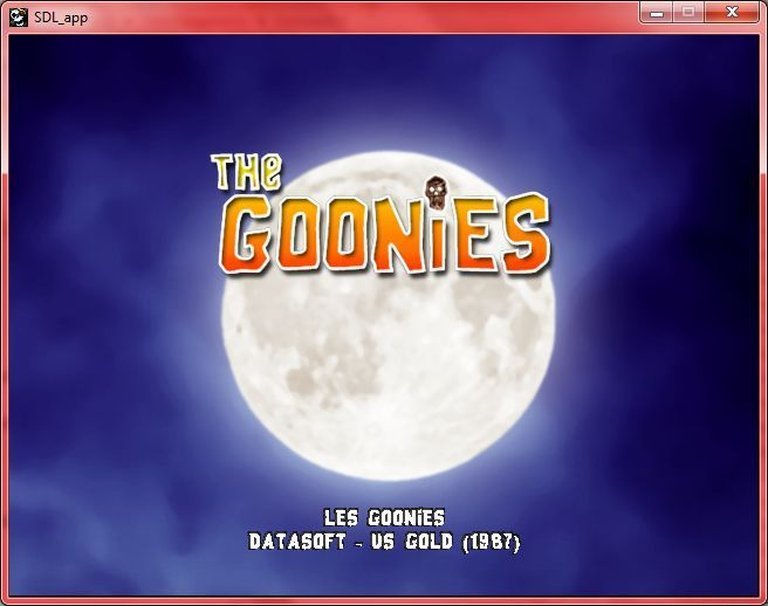
The Goonies is a freeware action-platformer and puzzle game based on the 1985 film of the same name. Players control two characters who must cooperate to solve puzzles and navigate through levels, blending platforming with teamwork mechanics. The game features enhanced graphics, music, and additional levels compared to the original 1986 release, and can be played solo or with a friend, switching between characters as needed.
The Goonies Free Download
The Goonies Patches & Updates
The Goonies Guides & Walkthroughs
The Goonies Reviews & Reception
honestgamers.com : A triumphant return to form for the series.
steemit.com : The game controls very well, with tight and responsive gameplay.
indiegamerchick.com : It doesn’t do a lot and it doesn’t last very long, but it still manages to be basically non-stop fun.
The Goonies Cheats & Codes
NES
Enter codes using Game Genie or Raw addresses.
| Code | Effect |
|---|---|
| SSOOUZVI | Freeze Time |
| SZSUNTSA | Infinite Energy |
| 00A1:18 | Infinite Health |
| 0046:03 | Infinite Lives |
| OZEALLVK | Infinite Lives |
| 0090:80 | Infinite Time/Note |
| 05F6:40 | Invincibility/Note |
| AVIOOI | Invincibility |
| 0049:FF | Set All Equipment |
| 05F3:FA | Set Infinite Bombs |
| 05DF:04 | Set Infinite Keys |
| 05F2:64 | Set Infinite Slingshot (99) |
| 05D8:03 | Set Max. Diamonds |
| 05D6:07 | Set Max. Goonies Rescued |
| AEOEPOUY | Skip Title Scroll |
| ZASZYTPA | Walk Faster/Note |
| SXNPTZAX | Walk Through Walls/Note |
MSX
Press CTRL + K to enter the password screen.
| Code | Effect |
|---|---|
| GOONIES | Level 1 |
| MR SLOTH | Level 2 |
| GOON DOCKS | Level 3 |
| DOUBLOON | Level 4 |
| ONE EYED WILLY | Level 5 |
The Goonies: A Comprehensive Retrospective on a Cult Classic
Introduction
The Goonies is more than just a game—it’s a relic of an era when video games were still finding their voice, a time when the line between cinema and interactive entertainment was just beginning to blur. Based on the 1985 Steven Spielberg-produced film of the same name, The Goonies video game exists in multiple iterations across different platforms, each offering a unique interpretation of the beloved adventure. From the cooperative puzzle-platforming of the Commodore 64 version to the action-heavy Famicom release and the maze-like MSX adaptation, The Goonies is a fascinating study in how a single license can inspire vastly different gaming experiences.
This review will delve deep into the game’s development history, narrative and thematic elements, gameplay mechanics, artistic and auditory design, reception, and legacy. By examining the various versions of The Goonies, we can appreciate how each iteration reflects the technological and creative constraints of its time while contributing to the game’s enduring appeal.
Development History & Context
The Birth of a License
The Goonies film, directed by Richard Donner and executive produced by Steven Spielberg, was a cultural phenomenon upon its release in 1985. Its blend of adventure, comedy, and heart resonated with audiences, making it a prime candidate for adaptation into other media, including video games. The licensing of The Goonies for video games was a strategic move to capitalize on the film’s popularity, but the execution varied significantly depending on the platform and developer.
The Developers: Konami vs. Datasoft
Two primary developers took on the challenge of adapting The Goonies into a video game: Konami and Datasoft.
-
Konami’s Versions: Konami, already a powerhouse in the arcade and console space, developed versions for the Famicom (NES in Japan), MSX, and arcade (VS. System). Their approach leaned heavily into action-platforming, with a focus on exploration and combat. The Famicom version, released in February 1986, is the most well-known, though it never saw a retail release outside Japan. The MSX version, while similar in premise, offered a distinct experience with its maze-like level design and stripped-down combat.
-
Datasoft’s Version: Datasoft, a prominent publisher of home computer games, created a version for the Commodore 64, as well as ports for the Apple II, Atari 800/XL, and MSX. Their take on The Goonies was more faithful to the film’s narrative, emphasizing cooperative puzzle-solving across single-screen stages. This version is often praised for its clever level design and teamwork mechanics, which required players to switch between two characters to overcome obstacles.
Technological Constraints
The mid-1980s were a time of rapid evolution in video game technology, but developers still faced significant limitations:
-
Memory and Storage: Cartridge-based systems like the Famicom had strict memory constraints, limiting the complexity of levels and the amount of audio and visual data that could be included. The Commodore 64, while more flexible with its disk-based storage, still required careful optimization to fit within the 64KB of RAM.
-
Graphics and Sound: The 8-bit era meant that visuals were blocky and sound was limited to simple chiptunes. Despite these limitations, both Konami and Datasoft managed to create distinctive auditory experiences. Konami’s Famicom version featured a chiptune rendition of Cyndi Lauper’s “The Goonies ‘R’ Good Enough”, while Datasoft’s Commodore 64 version included a memorable, if repetitive, soundtrack by John A. Fitzpatrick.
-
Gameplay Mechanics: The hardware of the time also influenced gameplay. The Famicom’s controller, with its two buttons and D-pad, was ideal for action-platforming, while the Commodore 64’s keyboard controls allowed for more complex interactions, such as switching between characters and manipulating objects.
The Gaming Landscape of 1985-1986
The mid-1980s were a pivotal period for video games. The industry was recovering from the crash of 1983, and Nintendo’s Famicom (released as the NES in North America in 1985) was beginning to dominate the console market. Meanwhile, home computers like the Commodore 64 and Apple II were popular platforms for gaming, offering a different kind of experience than consoles.
The Goonies arrived at a time when licensed games were becoming more common, though they were often rushed or poorly executed. What sets The Goonies apart is the care and creativity that went into its various adaptations. Rather than being a quick cash-in, each version of The Goonies offered something unique, whether it was Konami’s action-heavy Famicom game or Datasoft’s puzzle-focused Commodore 64 title.
Narrative & Thematic Deep Dive
Plot Overview
The narrative of The Goonies video game varies depending on the version, but all iterations draw inspiration from the film’s central premise: a group of kids embarking on a treasure hunt to save their homes from foreclosure.
-
Datasoft’s Version (Commodore 64): This version follows the film’s plot more closely. The game begins in the attic of Mikey’s house, where the Goonies discover a treasure map leading to the hideout of the pirate One-Eyed Willie. The players control two of the Goonies (switching between them as needed) as they navigate through eight levels, each representing a key scene from the film. The goal is to work together to overcome obstacles, such as distracting Mama Fratelli with money while the other Goonie extinguishes a fire to escape.
-
Konami’s Famicom Version: This version takes a more abstract approach. Mikey is the sole playable character, and his friends have been captured by the Fratelli family. The game’s six stages task Mikey with rescuing his friends while navigating treacherous caverns and avoiding the Fratellis. The final stage takes place on One-Eyed Willie’s pirate ship, where Mikey must collect treasure before escaping.
-
Konami’s MSX Version: This iteration is the most stripped-down in terms of narrative. The player controls Sloth (a departure from the film, where Sloth is a friend of the Goonies) as he searches through a series of caves to rescue the other Goonies. The focus is purely on exploration and combat, with little in the way of story progression.
Characters and Dialogue
-
Mikey: The protagonist of the Famicom and arcade versions, Mikey is the de facto leader of the Goonies. His in-game representation is minimal, with no dialogue or personality beyond his role as the player’s avatar.
-
The Fratellis: The primary antagonists, the Fratelli family appears in various forms across the different versions. In the Famicom game, they are persistent enemies who chase Mikey through the levels, attacking with guns or musical notes. In the Commodore 64 version, Mama Fratelli is a key obstacle in the first level, requiring the players to distract her to progress.
-
Sloth: In the MSX version, Sloth is the playable character, which is a significant departure from the film. This choice is likely due to the MSX’s limitations, as Sloth’s simple design and straightforward combat style would have been easier to implement.
Themes
-
Teamwork and Cooperation: The Commodore 64 version of The Goonies is built around the idea of teamwork. Players must switch between two characters to solve puzzles, emphasizing the importance of cooperation. This theme is central to the film, where the Goonies’ success depends on their ability to work together.
-
Adventure and Discovery: All versions of The Goonies capture the spirit of adventure that defines the film. Whether it’s exploring caverns, solving puzzles, or rescuing friends, the games encourage players to embrace the thrill of discovery.
-
Perseverance: The Famicom version, in particular, is notable for its difficulty. Players must navigate complex levels, avoid persistent enemies, and manage limited resources. The game’s challenge reinforces the theme of perseverance, as players must keep trying despite setbacks.
Narrative Strengths and Weaknesses
-
Strengths: The Commodore 64 version excels in its faithfulness to the film’s narrative and its emphasis on cooperative gameplay. The Famicom version, while less narrative-driven, offers a compelling adventure that captures the essence of the Goonies’ treasure hunt.
-
Weaknesses: The MSX version is the weakest in terms of narrative, offering little beyond a basic rescue mission. Additionally, none of the versions feature significant dialogue or character development, which limits their storytelling potential.
Gameplay Mechanics & Systems
Core Gameplay Loops
-
Datasoft’s Commodore 64 Version: The gameplay revolves around solving puzzles across eight single-screen levels. Players control two Goonies, switching between them to manipulate objects, avoid enemies, and progress. For example, in the first level, one Goonie must throw money to distract Mama Fratelli while the other extinguishes a fire to escape.
-
Konami’s Famicom Version: This version is an action-platformer with a focus on exploration and combat. Mikey must navigate through six stages, collecting keys and rescuing his friends. The game features a health system, power-ups (such as a slingshot and protective gear), and persistent enemies like the Fratellis.
-
Konami’s MSX Version: The MSX version is a maze-like platformer where Sloth must rescue the other Goonies. The gameplay is simpler, with a focus on navigation and combat. The lack of a slingshot or other ranged weapons makes combat more challenging.
Combat and Character Progression
-
Combat: Combat varies across versions. The Famicom version features a kick attack, bombs, and a slingshot, while the MSX version relies solely on a punch. The Commodore 64 version has no combat mechanics, focusing instead on puzzle-solving.
-
Character Progression: The Famicom version includes power-ups that enhance Mikey’s abilities, such as a firesuit to protect against flames and earmuffs to block musical attacks. The MSX version features an “EXP” meter that fills as enemies are defeated, restoring health when full. The Commodore 64 version has no progression system, as the focus is on puzzle-solving rather than combat.
UI and Controls
-
Famicom Version: The controls are tight and responsive, with the A button for jumping and the B button for kicking. The UI is minimal, with a health meter and item indicators.
-
Commodore 64 Version: The controls are keyboard-based, with keys for moving, jumping, and switching characters. The UI is simple, with a score and level indicator.
-
MSX Version: The controls are similar to the Famicom version, with a focus on jumping and punching. The UI is sparse, with a health meter and key counter.
Innovative and Flawed Systems
-
Innovative: The Commodore 64 version’s cooperative puzzle-solving is a standout feature, requiring players to think strategically and work together. The Famicom version’s hidden power-ups and non-linear exploration were also innovative for the time.
-
Flawed: The MSX version’s combat is overly simplistic, and the lack of a ranged weapon makes it frustrating. The Famicom version’s random placement of hidden items can be confusing, and the game’s difficulty may deter casual players.
World-Building, Art & Sound
Setting and Atmosphere
-
Famicom Version: The game’s stages are inspired by the film, with levels set in a restaurant, caverns, and a pirate ship. The atmosphere is dark and adventurous, with a sense of danger lurking around every corner.
-
Commodore 64 Version: The levels are designed to resemble key scenes from the film, such as the restaurant and the caverns. The atmosphere is more lighthearted, with a focus on puzzle-solving and teamwork.
-
MSX Version: The setting is limited to caves, which can feel repetitive. However, the maze-like design adds a sense of mystery and exploration.
Visual Direction
-
Famicom Version: The visuals are typical of early Famicom games, with blocky sprites and limited animation. Despite these limitations, the game’s art direction is effective, with distinct enemy designs and atmospheric backgrounds.
-
Commodore 64 Version: The graphics are more detailed than the Famicom version, with colorful sprites and intricate level designs. The visuals are functional, with a focus on clarity and puzzle-solving.
-
MSX Version: The visuals are the simplest of the three versions, with basic sprites and repetitive backgrounds. However, the game’s maze-like design is well-executed, with clear pathways and obstacles.
Sound Design
-
Famicom Version: The soundtrack features a chiptune rendition of Cyndi Lauper’s “The Goonies ‘R’ Good Enough”, which is a highlight of the game. The sound effects are punchy and clear, adding to the game’s atmosphere.
-
Commodore 64 Version: The music is catchy but repetitive, with a focus on creating a sense of adventure. The sound effects are functional, with clear indicators for actions like jumping and switching characters.
-
MSX Version: The soundtrack is minimal, with a simple chiptune melody. The sound effects are basic but effective, with clear indicators for actions like punching and jumping.
Reception & Legacy
Critical and Commercial Reception
-
Famicom Version: The game was well-received in Japan, with praise for its tight controls and challenging gameplay. However, its lack of a Western release limited its commercial success outside Japan.
-
Commodore 64 Version: The game was praised for its faithful adaptation of the film and its cooperative gameplay. It was a commercial success, with strong sales on the Commodore 64 and other home computer platforms.
-
MSX Version: The game received mixed reviews, with praise for its maze-like design but criticism for its simplistic combat and repetitive setting.
Evolution of Reputation
Over time, The Goonies has gained a cult following, particularly among retro gaming enthusiasts. The Famicom version, in particular, is now seen as a hidden gem, with fans praising its challenging gameplay and atmospheric design. The Commodore 64 version is remembered fondly for its cooperative mechanics and faithful adaptation of the film.
Influence on Subsequent Games
-
Cooperative Gameplay: The Commodore 64 version’s emphasis on teamwork influenced later cooperative games, such as The Lost Vikings and Portal 2.
-
Non-Linear Exploration: The Famicom version’s non-linear exploration and hidden power-ups were precursors to later Metroidvania-style games, such as Castlevania: Symphony of the Night.
-
Maze-Like Design: The MSX version’s maze-like design influenced later puzzle-platformers, such as Spelunky and La-Mulana.
Conclusion
The Goonies is a fascinating case study in how a single license can inspire vastly different gaming experiences. From the cooperative puzzle-solving of the Commodore 64 version to the action-heavy Famicom release and the maze-like MSX adaptation, each iteration of The Goonies offers something unique.
While the game’s various versions have their strengths and weaknesses, they all capture the spirit of adventure and teamwork that defines the film. The Famicom version, in particular, is a standout, offering tight controls, challenging gameplay, and a memorable soundtrack. The Commodore 64 version excels in its faithful adaptation of the film and its emphasis on cooperative gameplay. The MSX version, while the weakest of the three, still offers a fun and engaging experience.
Ultimately, The Goonies is a testament to the creativity and ingenuity of the developers who worked on it. Despite the technological constraints of the time, they managed to create games that are still enjoyable today. Whether you’re a fan of the film or a retro gaming enthusiast, The Goonies is a game worth experiencing.
Final Verdict: The Goonies is a cult classic that deserves its place in video game history. While its various versions have their flaws, they all offer a unique and engaging experience that captures the spirit of adventure and teamwork. If you’re a fan of retro games or the film, The Goonies is a must-play.