
- Release Year: 2003
- Platforms: Windows
- Publisher: Activision Value Publishing, Inc., MicroProse Software Pty Ltd
- Developer: iEntertainment Network, Inc.
- Genre: Simulation, Strategy, Tactics
- Perspective: 1st-person
- Game Mode: Single-player
- Gameplay: Flight combat, Real-time, Vehicular combat
- Setting: Historical events, World War II
- Average Score: 81/100
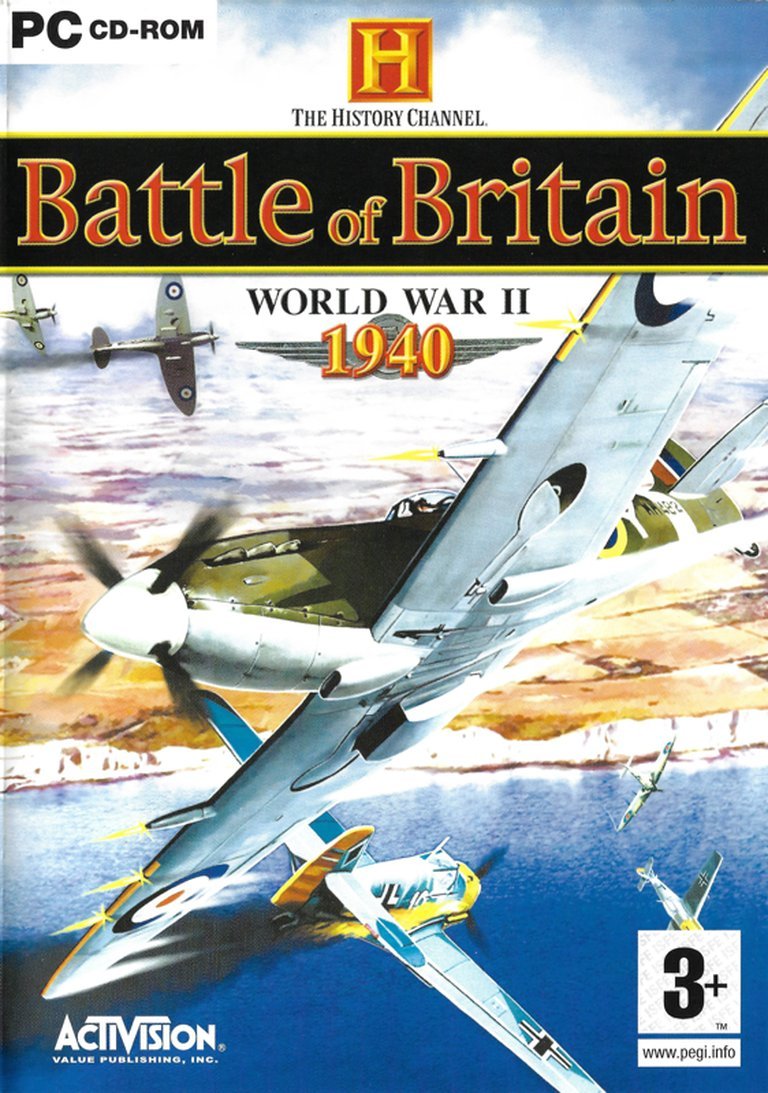
Description
The History Channel: Battle of Britain – World War II 1940 is a 3D flight combat simulator set during the pivotal aerial conflict of 1940. Players can take on the role of either the German Luftwaffe or the Royal Air Force, engaging in historical campaigns with over 70 authentic aircraft. The game offers multiple difficulty levels, training modes, and the ability to switch between cockpit and third-person views, providing an immersive experience of one of WWII’s most famous battles.
Gameplay Videos
Where to Buy The History Channel: Battle of Britain – World War II 1940
PC
The History Channel: Battle of Britain – World War II 1940 Cracks & Fixes
The History Channel: Battle of Britain – World War II 1940 Patches & Updates
The History Channel: Battle of Britain – World War II 1940 Reviews & Reception
ign.com (83/100): Don’t let the budget price fool you. This title soars high above it.
myabandonware.com (80/100): best game must play
The History Channel: Battle of Britain – World War II 1940: A Comprehensive Retrospective
Introduction: The Sky as a Battleground
Few moments in history have captured the imagination of aviation enthusiasts and historians alike as vividly as the Battle of Britain. The summer of 1940 saw the Royal Air Force (RAF) and the German Luftwaffe locked in a desperate struggle for air superiority over the English Channel and British skies—a conflict that would determine the fate of nations. The History Channel: Battle of Britain – World War II 1940, released in 2003, sought to immortalize this pivotal chapter of World War II in interactive form. Developed by iEntertainment Network and published under the auspices of Activision and MicroProse, the game arrived at a fascinating juncture in gaming history: a time when flight simulators were evolving from niche hobbyist software into more accessible, historically grounded experiences.
This review aims to dissect Battle of Britain with the precision of a Spitfire pilot targeting a Messerschmitt. We will explore its development context, narrative ambitions, gameplay mechanics, technical achievements, and lasting legacy. While it may not have reached the stratospheric heights of contemporaries like IL-2 Sturmovik, this title occupies a unique niche—bridging the gap between hardcore simulation and accessible historical entertainment. Through this analysis, we will determine whether Battle of Britain soars as a triumph of interactive history or stalls as a missed opportunity.
Development History & Context: A License to Fly
The Studio Behind the Stick
iEntertainment Network, the developer behind Battle of Britain, was a studio with a pedigree in both simulation and historical gaming. Known for titles like Warbirds and Aces Over Europe, iEntertainment had carved out a reputation for creating flight combat experiences that balanced realism with approachability. The studio’s collaboration with The History Channel—a brand synonymous with documentary excellence—was a strategic move to lend authenticity and educational value to the product. This partnership reflected a broader trend in the early 2000s, where media licenses were increasingly used to market games as both entertainment and edutainment.
The game’s development coincided with a period of rapid evolution in flight simulation technology. The early 2000s saw the rise of 3D acceleration, with graphics cards like the NVIDIA GeForce series enabling more detailed environments and smoother frame rates. Battle of Britain leveraged these advancements to create a visually immersive representation of 1940s aerial combat, though it remained constrained by the hardware limitations of its time.
The Gaming Landscape of 2003
When Battle of Britain launched in October 2003, it entered a crowded marketplace. The flight simulation genre was dominated by heavyweights like Microsoft Flight Simulator 2002 and IL-2 Sturmovik, which catered to hardcore enthusiasts with meticulous physics and complex control schemes. Meanwhile, arcade-style flight games such as Secret Weapons Over Normandy offered more accessible, action-oriented experiences.
The History Channel: Battle of Britain attempted to straddle these two worlds. It was marketed as a “historical package” that could appeal to both casual players and history buffs, thanks in part to its association with The History Channel. The game’s budget pricing—often retailing for under $20—positioned it as an affordable entry point for players curious about WWII flight combat but intimidated by the steep learning curves of more hardcore simulators.
Technological Constraints and Innovations
Developing a flight simulator in 2003 presented unique challenges. While 3D graphics were becoming more sophisticated, the computational power required to render vast, open skies with dynamic weather and numerous aircraft was still a significant hurdle. Battle of Britain addressed this by focusing on smaller, more manageable battle spaces, prioritizing historical accuracy in mission design over expansive, open-world freedom.
One of the game’s most notable technical features was its support for a wide range of input devices, including joysticks, rudder pedals, and throttle controls. This flexibility allowed players to tailor their experience to their preferred level of immersion, from keyboard-and-mouse casual play to full flight stick setups for simulation purists.
The inclusion of a multiplayer “arena” mode—advertised as a free online component—was another innovative touch. Though not a full-fledged MMO, this feature hinted at the growing interest in online multiplayer experiences, even in niche genres like flight simulation.
Narrative & Thematic Deep Dive: History in the Cockpit
A Dual Perspective on War
The History Channel: Battle of Britain distinguishes itself by offering players the opportunity to experience the conflict from both sides: as a pilot in the RAF defending British skies or as a Luftwaffe pilot executing Operation Sea Lion. This dual perspective is more than a gameplay gimmick; it serves as a narrative device to humanize both factions, presenting the Battle of Britain not as a one-sided triumph but as a complex, morally ambiguous struggle.
The game’s 12 historical campaigns are structured around key engagements of the Battle of Britain, from the initial Luftwaffe raids on British shipping convoys to the climactic attacks on London during the Blitz. Each mission is framed by historical context, with briefings that draw from The History Channel’s archives. These briefings are a standout feature, blending documentary-style narration with period-appropriate visuals to immerse players in the historical moment.
Characters and Dialogue: The Voices of War
While Battle of Britain does not feature deep character development in the vein of narrative-driven games, it does attempt to convey the personalities and pressures faced by WWII pilots. Mission briefings and radio chatter are peppered with authentic terminology and accents, reinforcing the game’s commitment to historical fidelity. RAF pilots speak with clipped British tones, while Luftwaffe commanders bark orders in German—a small but effective detail that enhances immersion.
The dialogue, however, is functional rather than profound. Pilots exchange terse, tactical communications rather than engaging in meaningful exchanges. This is understandable given the game’s focus on combat, but it does mean that the human drama of the Battle of Britain—such as the camaraderie of “The Few” or the psychological toll of constant sorties—is only hinted at rather than explored in depth.
Themes: Heroism, Sacrifice, and the Fog of War
At its core, Battle of Britain grapples with themes of heroism and sacrifice. The game’s historical framing emphasizes the RAF’s underdog status, outnumbered and outgunned but ultimately victorious through a combination of superior tactics, radar technology, and sheer determination. Players are encouraged to see themselves as part of this David-and-Goliath narrative, whether they’re scrambling to intercept a wave of Heinkel bombers or diving into a furball of dogfighting Messerschmitts.
The game also touches on the moral complexities of war. Playing as the Luftwaffe, for instance, forces players to confront the ethical dimensions of bombing civilian targets—a reality of the Blitz that the game does not shy away from. While it does not delve into these themes with the nuance of a narrative-driven game, the mere inclusion of both perspectives is a commendable attempt to present history in all its messy, contradictory glory.
Historical Accuracy: A Double-Edged Sword
One of the game’s most ambitious goals was to serve as an interactive history lesson. To this end, Battle of Britain incorporates a wealth of historical detail, from the accurate modeling of aircraft like the Supermarine Spitfire and Messerschmitt Bf 109 to the recreation of key battles and tactical formations. The game’s missions are based on real engagements, and the inclusion of archival footage and historical briefings further cements its educational aspirations.
However, the game’s commitment to historical accuracy is not without its compromises. While the aircraft models are meticulously researched, the flight physics are simplified to accommodate a broader audience. This decision—while understandable from a commercial standpoint—drew criticism from hardcore simulation fans who expected a more rigorous treatment of aerodynamics and combat mechanics.
Gameplay Mechanics & Systems: Dogfights and Design
Core Gameplay Loop: From Scramble to Victory
The History Channel: Battle of Britain structures its gameplay around a series of mission-based campaigns, each representing a pivotal moment in the Battle of Britain. Players begin by selecting a faction (RAF or Luftwaffe) and a difficulty level (Cadet, Intermediate, or Expert). The Cadet setting is particularly noteworthy for its accessibility, offering simplified controls and more forgiving flight physics—a boon for players new to the genre.
Each mission follows a similar structure: a briefing outlining objectives, a takeoff sequence, and then the main combat phase, which can involve anything from escorting bombers to engaging in large-scale dogfights. The game’s pacing is deliberate, with missions often lasting 15-30 minutes—a reflection of the methodical, strategic nature of WWII aerial combat.
Combat and Flight Mechanics: The Art of the Dogfight
Combat in Battle of Britain is a mix of arcade-style accessibility and simulation-lite depth. The game employs a third-person chase camera as the default view, which makes it easier for players to track enemies and execute maneuvers. However, the option to switch to a first-person cockpit view adds a layer of immersion, though it can be disorienting for newcomers.
The flight model is where the game’s design philosophy becomes most apparent. Unlike hardcore simulators, which require players to manage throttle, rudder, and aileron inputs with precision, Battle of Britain streamlines these controls to make them more approachable. Aircraft handle responsively, and the game’s physics engine prioritizes fun over fidelity. This approach makes the game more accessible but also means that veteran flight sim players may find the experience lacking in depth.
One of the game’s most effective mechanics is its damage modeling. Aircraft sustain realistic damage, with hits to the engine, wings, or fuel tanks affecting performance in measurable ways. This system adds a layer of strategy to combat, as players must decide whether to press an attack or disengage when their plane is critically damaged.
Character Progression and Customization
The History Channel: Battle of Britain does not feature a traditional RPG-style progression system. Instead, players unlock new aircraft and missions as they progress through the campaign. The game’s 70 aircraft—ranging from iconic fighters like the Spitfire and Hurricane to bombers like the Heinkel He 111—are historically accurate and offer varied handling characteristics.
While there is no deep customization of individual pilots, the game does allow players to choose their aircraft loadouts, selecting between different armament configurations and fuel loads. This level of customization, while not extensive, adds a tactical dimension to mission planning.
User Interface and Accessibility
The game’s UI is functional but unremarkable. Mission objectives are clearly displayed, and the HUD provides essential information such as altitude, speed, and enemy positions. The radar system—a critical tool for tracking enemy aircraft—is simplified but effective, though it lacks the sophistication of real-world radar systems.
One of the game’s most user-friendly features is its training mode, which walks players through the basics of flight, combat, and navigation. This mode is particularly valuable for newcomers, as it lowers the barrier to entry for a genre that can often feel overwhelming.
Multiplayer and Replayability
At launch, Battle of Britain included a multiplayer “arena” mode, which allowed players to engage in online dogfights. This feature was a notable inclusion for a budget title, though it was not as robust as the multiplayer offerings of more established flight sims. The arena mode supported up to 16 players, with a variety of game types including team deathmatch and cooperative missions.
The game’s replayability is further enhanced by its branching campaign structure. Depending on mission performance, players can unlock different pathways through the campaign, adding a layer of variability to subsequent playthroughs. However, the lack of a dynamic campaign system—where player actions significantly alter the course of the war—means that replayability is somewhat limited compared to more modern titles.
World-Building, Art & Sound: The Skies of 1940
Setting and Atmosphere: A War-Torn Europe
The History Channel: Battle of Britain excels in its recreation of the Battle of Britain’s geographical and historical setting. The game’s environments are meticulously researched, with accurate representations of key locations such as the White Cliffs of Dover, the Thames Estuary, and the skies over London. The terrain is rendered in 3D, with textures that—while not cutting-edge even for 2003—convey a sense of place and historical authenticity.
The game’s dynamic weather system is another standout feature. Cloud cover, rain, and fog all play a role in missions, affecting visibility and tactics. Flying through a storm or navigating dense cloud banks adds a layer of challenge and immersion, reinforcing the game’s commitment to recreating the conditions faced by real WWII pilots.
Visual Direction: A Study in Functional Aesthetics
Visually, Battle of Britain is a product of its time. The aircraft models are detailed and historically accurate, with recognizable silhouettes and liveries. The Spitfire’s elliptical wings, the Bf 109’s sleek fuselage, and the Hurricane’s rugged frame are all faithfully recreated. However, the textures and lighting effects are somewhat dated, with flat shading and low-resolution textures that betray the game’s budget origins.
The game’s environments are similarly functional. While the landscapes of southern England and the English Channel are recognizable, they lack the depth and detail of more modern flight sims. Buildings, trees, and other terrain features are rendered in a simplified style, prioritizing performance over visual fidelity.
Sound Design: The Roar of Engines and the Crack of Gunfire
Where Battle of Britain truly shines is in its sound design. The game’s audio is a masterclass in immersion, with the roar of Merlin engines, the stutter of machine guns, and the distant thud of anti-aircraft fire all contributing to a visceral sense of combat. The sound of a Spitfire diving into a stall, the whine of a damaged engine, and the crackle of radio chatter all serve to pull players into the cockpit.
The game’s musical score is understated but effective, with orchestral pieces that evoke the grandeur and tragedy of war. The use of period-appropriate music—such as the RAF’s signature “Scramble” fanfare—adds to the historical authenticity.
Reception & Legacy: A Mixed Bag of Triumph and Turbulence
Critical Reception: A Budget Title with Lofty Ambitions
Upon its release, The History Channel: Battle of Britain received a mixed but generally positive reception. Critics praised the game’s historical accuracy, accessibility, and sound design, while noting its technical limitations and simplified flight model.
GameSpy’s review, which awarded the game a 60% score, encapsulated this sentiment. The reviewer noted that while Battle of Britain was “neither the historical package nor the new single-player simulation its retail packaging might lead you to think it is,” it was nevertheless “a decent offering and an affordable way for a player to build skills and eventually enter the fray in Warbirds online.” This assessment highlights the game’s role as a gateway title—an accessible introduction to WWII flight combat that could serve as a stepping stone to more complex simulators.
IGN’s review was more generous, awarding the game an 8.3 out of 10. The reviewer praised the game’s historical missions, sound design, and multiplayer arena, concluding that it “soars high above” its budget price point. This positive reception underscores the game’s success in balancing accessibility with historical depth.
Commercial Performance: A Niche Hit
The History Channel: Battle of Britain was not a blockbuster success, but it found a dedicated audience among history enthusiasts and flight sim curious. Its budget pricing and association with The History Channel helped it stand out in a crowded marketplace, and it developed a cult following among players who appreciated its blend of education and entertainment.
The game’s commercial longevity is evident in its continued availability on digital platforms like Steam, where it has been re-released in 2025. This enduring presence speaks to the game’s lasting appeal, even as more advanced flight simulators have emerged in the intervening years.
Influence and Legacy: Paving the Way for Historical Flight Sims
While Battle of Britain may not have revolutionized the flight simulation genre, it played a significant role in demonstrating the commercial viability of historically grounded, accessible flight combat games. Its success helped pave the way for later titles like The History Channel: Battle for the Pacific and IL-2 Sturmovik: Cliffs of Dover, which continued to explore the intersection of history and interactive entertainment.
The game’s legacy is also evident in its influence on the “edutainment” genre. By leveraging The History Channel’s brand and incorporating archival footage and historical briefings, Battle of Britain showed that games could be both fun and educational—a lesson that has been embraced by subsequent historical titles.
Conclusion: A Noble Effort with Room to Soar
The History Channel: Battle of Britain – World War II 1940 is a game that defies easy categorization. It is neither a hardcore flight simulator nor a pure arcade shooter, but rather a hybrid that attempts to bridge the gap between these two extremes. In this endeavor, it succeeds more often than it fails, delivering an accessible, historically rich experience that remains engaging even by modern standards.
The game’s greatest strength lies in its commitment to historical authenticity. From its meticulously researched aircraft and missions to its use of archival footage and period-appropriate sound design, Battle of Britain is a love letter to the pilots and machines that shaped one of WWII’s most pivotal battles. Its dual perspective—allowing players to fight for both the RAF and the Luftwaffe—adds a layer of moral complexity that is often absent from more jingoistic war games.
However, the game’s simplified flight model and dated visuals prevent it from achieving true greatness. While these compromises make the game more accessible, they also limit its appeal to hardcore simulation fans. The lack of a dynamic campaign system and deeper narrative elements further restricts its replayability.
Ultimately, The History Channel: Battle of Britain is a game that punches above its weight. It may not have the polish or depth of more modern flight simulators, but its historical ambition and educational value make it a worthy addition to the libraries of WWII enthusiasts and flight sim curious alike. In the pantheon of WWII flight combat games, it occupies a unique niche—a budget-friendly, historically rich experience that serves as both a gateway to the genre and a testament to the enduring fascination with the Battle of Britain.
Final Verdict: 7.5/10 – A commendable blend of history and gameplay that soars on accessibility but is held back by technical limitations.
For those seeking a deeper, more hardcore experience, titles like IL-2 Sturmovik or DCS World may be more satisfying. But for players looking for an accessible, historically grounded introduction to WWII aerial combat, The History Channel: Battle of Britain remains a solid choice—a game that, like the pilots it honors, punches above its weight and leaves a lasting impression.