
- Release Year: 2003
- Platforms: Windows
- Publisher: Activision Value Publishing, Inc.
- Developer: Zono, Inc.
- Genre: Strategy, Tactics
- Perspective: Diagonal-down
- Game Mode: Single-player
- Gameplay: Campaign, Experience gain, Missions, Real-time strategy, Relics, Resource gathering, Unit creation
- Setting: Historical events, Middle East
- Average Score: 73/100
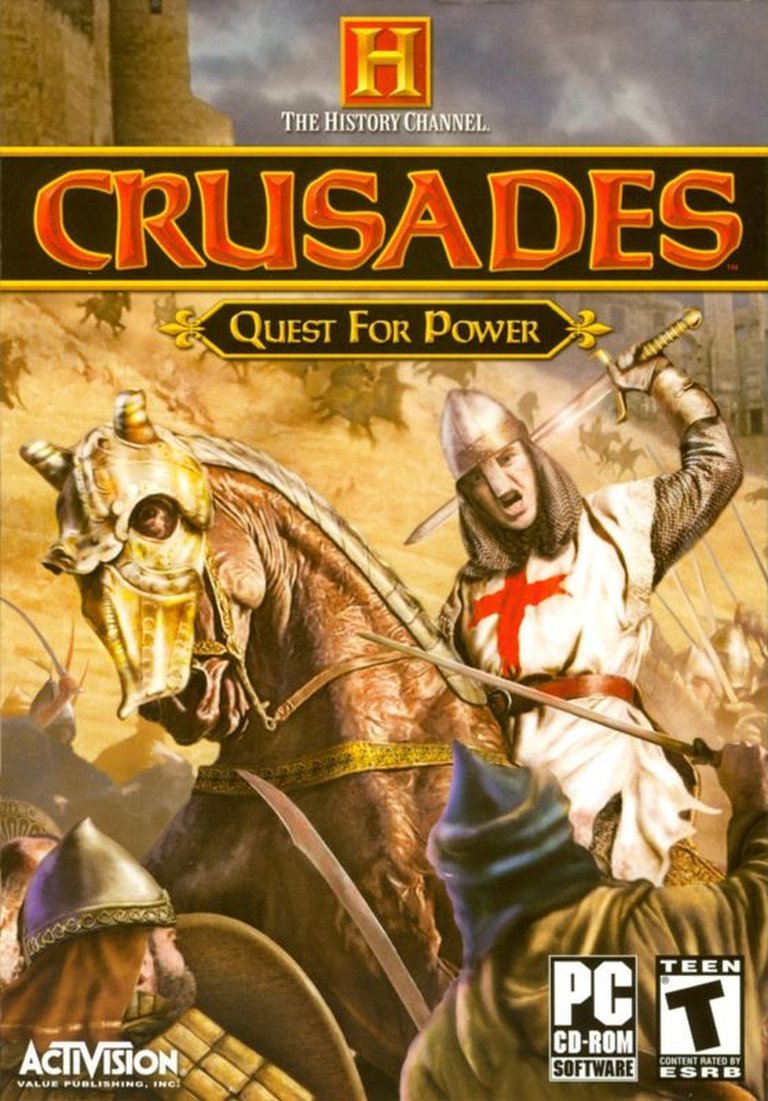
Description
The History Channel: Crusades – Quest for Power is a real-time strategy game set during the historical Crusades, where players choose between two campaigns—each with eight missions—to lead either the Western Christian Crusaders or the Eastern Infidels in battles for the Holy Land. Featuring unit types like infantry, crusaders, archers, and priests, gameplay involves gathering gold from enemies, building units via tents, gaining experience for special abilities, and collecting relics to upgrade healing units, with survivors carrying over between missions and a skirmish mode for random encounters.
The History Channel: Crusades – Quest for Power Mods
The History Channel: Crusades – Quest for Power Reviews & Reception
metacritic.com (73/100): If you are a fan of the crusades or a first time RTS buyer though, the low price tag may also be a good way for you to get your feet wet and the simple gameplay style overall could be a good stepping stone into the more detailed titles out on the shelves.
pc.gamespy.com : Crusades offers no value.
The History Channel: Crusades – Quest for Power: A Case Study in Licensed Shovelware
Introduction: A Holy War Waged in Pixels, or A Budget Title’s Burden?
In the early 2000s, the landscape of PC gaming was a fertile ground for a peculiar subgenre: the licensed “historical edutainment” real-time strategy game. cable networks like The History Channel, seeking to extend their brand into the interactive realm, frequently partnered with budget publishers to produce titles that promised to blend entertainment with a veneer of historical authenticity. The History Channel: Crusades – Quest for Power (2003) stands as a stark, almost paradigmatic, example of this trend—not for its successes, but for its profound failures. Its very existence is a testament to a cynical market calculation: attach a respected name to a cheaply produced, mechanically shallow RTS, and profit from the curiosity of unsuspecting consumers and history buffs. This review will argue that Crusades – Quest for Power is a game defined entirely by its constraints—technological, financial, and imaginative. It fails as a strategy game, as an educational tool, and as an engaging piece of interactive entertainment, yet it persists as a fascinating artifact of a specific moment in gaming history where licensing often trumped quality, and simplicity was mistaken for accessibility. Its legacy is not one of influence, but of caution.
Development History & Context: Zono, Activision Value, and the Budget Matrix
The game was developed by Zono, Inc., a studio with a curious portfolio that included a mix of original titles (Everest: The Ultimate Strategy Game) and a significant number of licensed and children’s games (SeaWorld Adventure Parks Tycoon, Tough Trucks: Modified Monsters). This pattern suggests Zono was a work-for-hire studio adept at delivering functional products on tight deadlines and tighter budgets for publishers seeking to fill retail shelves with recognizable brands. They were not a studio known for genre-defining strategy games; their expertise was in translation—taking a concept (a license, a theme) and building a competent but unexceptional game around it.
The publisher, Activision Value Publishing, Inc., was Activision’s dedicated budget label. Its business model was built on producing low-cost titles often sold in “value packs” or at dramatically reduced prices. The “Value” in its name was not a descriptor of quality but of price point. For them, Crusades fit a perfect template: a topical license (The History Channel), a proven if simplistic genre (RTS), and a development cycle that minimized risk and cost. The game’s system requirements—a 700MHz CPU, 128MB RAM, 32MB graphics card—were modest for 2003 but already lagging behind the high-end market, explicitly targeting the lowest common denominator of PC gaming hardware.
The gaming landscape of late 2003 was dominated by giants of the RTS genre: Warcraft III: The Frozen Throne (expansion), Age of Mythology, and the perennial classic Age of Empires II: The Age of Kings. Against these titles, with their deep economies, diverse tech trees, and engaging narratives, Crusades was entering a saturated market with a product that was technically and design-wise a generation behind. Its use of the History Channel license was its primary—and almost sole—marketing asset, implying an educational value that the gameplay utterly failed to deliver.
Narrative & Thematic Deep Dive: The Elision of History
Narratively, Crusades – Quest for Power is a stripped-down skeleton. The official description frames the conflict in stark, propagandistic terms: “the wars between the Christian Crusaders and the so-called ‘Infidels’ for the Holy Land.” This language, borrowed from medieval Christian chronicles, immediately establishes a biased, ahistorical perspective that the game does nothing to interrogate or contextualize. There is no complexity here—no discussion of Byzantine appeals, Seljuk Turk expansion, trade route disputes, or the multifaceted political motivations of European monarchs. The “Infidel” designation is used without irony, framing the Eastern forces purely as an obstacle to be cleared.
The game offers two 8-mission campaigns: a Western Campaign where players lead the Crusader invasion, and an Eastern Campaign where players defend as the “Infidels.” The mission briefings, as noted in reviews, are delivered via text and simple cutscenes, outlining objectives like “seize a fortress” or “recover sacred relics.” There are no named characters, no personal quests, no branching narratives. The story is pure operational简报: move your blob of units to point B and eliminate the enemy blob. The thematic element of recovering “sacred artifacts, stolen long ago by the Infidels,” including the Holy Grail, reduces centuries of religious and cultural conflict to a simple treasure-hunt. It infantilizes the history, transforming a epoch-defining series of wars into a cartoonish scavenger hunt. The game’s title, Quest for Power, ironically has nothing to do with the political or spiritual power struggles of the real Crusades; “power” here is merely the tactical advantage gained from killing enemies for gold. The History Channel’s brand is leveraged not for education, but for a superficial coat of historical “flavor” that quickly washes off under any critical scrutiny.
Gameplay Mechanics & Systems: The RTS Skeleton Without Flesh
At its core, Crusades is a minimalist RTS, but its minimalism crosses the line into impoverishment.
Core Loop & Economy: The loop is agonizingly simple. You begin with a few units. You click on a unit, you click on an enemy unit, they fight. You kill enemies to collect gold (a literally “blood money” economy). You use gold to build tents (Infantry Tents, Archer Tents, Crusader Tents). These tents act as both production buildings and unit spawn points. There is no base building beyond tent placement. No resource gathering structures, no technology upgrades at a town center, no market, no idle villager mechanics. The economy is entirely loot-based, a decision that removes all strategic resource management and replaces it with a focus on aggressive, early combat to secure gold drops. This creates a brutally simple, rush-oriented meta where the player who kills the most enemies fastest wins, with little room for economic boom or tech advantage.
Unit Composition & Tactics: Each side has four symmetrical unit types, differentiated only by name:
1. Infantry/Warrior (50g): Cheap, fast melee. Their “good against ranged” note implies a standard rock-paper-scissors dynamic that the game doesn’t meaningfully develop.
2. Crusader/Holy Warrior (150g): Expensive, slow, durable “tank” unit.
3. Archer (100g): Fragile ranged unit, the core damage dealer.
4. Priest/Holy Man (0g/1g?): A non-combatant healer. Crucially, new healing units cannot be created. You start with one (or a few), and if they die, they are gone for the mission. This creates a fragile, precious support unit that dramatically increases the cost of any loss.
This roster is catastrophically small compared to contemporaries. Age of Empires II featured over a dozen unique units per civilization, plus naval units, siege weapons, and monks. The tactical depth here is nonexistent. Archers beat crusaders (who are slow), crusaders beat infantry, infantry beat archers. That’s it. There is no special abilities aside from the experience ranks (see below). No formations, no complex stances, no meaningful terrain usage (outside of narrow paths on some maps).
Progression & Persistence: The sole innovative-seeming mechanic is unit persistence and experience. Units gain ranks (1-4) by scoring kills. Each rank unlocks a special attack: e.g., Rank 2 archers might get fire arrows. This is a compelling idea—it incentivizes protecting veteran units and creates an emotional attachment to your squad. Furthermore, units that survive a mission carry over to the next one in the campaign. This creates a “carry-over army” legacy. However, this system is fatally undermined by the game’s other flaws. First, the high mortality rate of Priests means your healing capacity is permanently degraded if they fall. Second, the campaigns are only 8 missions long, so the legacy doesn’t truly blossom. Third, the experience gain is slow and kills are required, encouraging reckless aggression to level up key units, often leading to their demise. The relics that upgrade Priests are a secondary progression layer, rewarding map exploration, but on small, linear mission maps, exploration is often a quick detour.
AI & Pathfinding: The reviews are unanimous in citing boring, buggy, and simplistic AI. The “tank rush” strategy mentioned by GameSpot is likely the dominant and often only viable tactic: mass cheap infantry to absorb damage while archers fire, protected by your few crusaders. The AI seemingly lacks any strategic variation or adaptive behavior. Pathfinding, a notorious issue in early 3D RTS games, is cited as problematic, with units getting stuck on environmental geometry—a critical failure in a game with no complex micro-management to compensate.
User Interface & Skirmish: The UI is described as “straightforward” and “no-nonsense,” which is a polite way of saying it is bare-bones and uninformative. There is a minimap, unit portraits, and a gold counter. The random skirmish mode offers a brief respite from the campaigns but inherits all the core combat flaws with no narrative to distract from them.
In summary, the gameplay is a barely functional RTS framework stripped of all complexity. It lacks a meaningful economy, depth in unit composition, sophisticated AI, or a compelling meta-game. The experience system is its only intriguing feature, but it cannot carry a game whose fundamental tactical moment-to-moment play is so shallow.
World-Building, Art & Sound: Functional, Forgettable, and Faceless
The game’s presentation is a product of its budget and era.
Visuals & Art Direction: Using a diagonal-down, isometric perspective, the game employs simple 3D models with low polygon counts and basic textures. The color palette is appropriately “earthy”—browns, tans, greens—evoking a generic Middle Eastern landscape. Environments include “desert temples, ancient ruins, dunes, cliffs, tombs, churches and streets,” as per the feature list. These are blocky and indistinct, serving more as tactical obstacles than immersive locations. The most telling detail in the credits is Todd Pickens’ credit for “Environmental art and some nice fruit,” a humorous admission of the limited scope and occasional, almost accidental, detail. Unit models are the most critical element, and here they are functional. You can tell a Crusader (big, slow, shield) from an Archer (bow) from Infantry (smaller, faster). The “Design Strike Team!” credit for Peter Green might hint at efforts to ensure readability, which is the primary goal of RTS art. However, the animations are “serviceable,” and overall the graphics are dated even for 2003, looking more like a 1999 title. There is no awe, no grandeur, no sense of epic scale.
Sound Design & Music: The credits list Jason Hough for sound design, humorously noting it was created “and the contents of Jeff’s garage.” David Schmidt composed the music. Reviews do not mention the soundtrack, implying it was forgettable ambient loops. Sound effects are likely standard, stock sword clashes and arrow twangs. The lack of voice acting in briefings (relying on text) further cheapens the production. The audio exists to fill silence, not to build atmosphere.
Atmosphere & Historical Feel: The game fails utterly to create a convincing historical atmosphere. The unit names are generic, the settings are generic, the “relics” are fantasy treasure-hunt items. It does not simulate the discipline of a medieval army, the logistics of a crusade, or the cultural clash of the era. It feels like a generic medieval fantasy RTS with the serial numbers filed off and a History Channel sticker slapped on. The atmosphere is one of cheapness and emptiness, not the dusty, fervent, brutal reality of the 11th-century Levant.
Reception & Legacy: A Paragon of Poorly Reviewed Licensed Games
The critical reception was devastating and unanimous.
* GameSpot (2.8/10): Called it a “half-baked RTS,” a “buggy mess” with “nothing to do with the actual Crusades” or “fulfilling, engaging gameplay.”
* GameSpy (1/5): Stated it was “excruciatingly awful” and that even at a bargain price, it “offers no value,” recommending classic titles like Stronghold or Age of Kings instead.
* Jeuxvideo.com (4/20): Labeled it “the shame of real-time strategy,” criticizing its “quasi-total absence of gameplay possibilities” and “stripped aesthetics.”
* Absolute Games (48/100): Called it “superficial, straightforward and templated.”
* GameZone (73%): Was the sole outlier, suggesting it might be a “good stepping stone into the more detailed titles” for first-time RTS buyers due to its “simple gameplay style.”
The aggregate MobyScore of 38% and a Metacritic equivalent around 30/100 cement its status as a critical failure. The few player ratings (2.6/5) suggest a similar divide, perhaps between nostalgic low-expectation players and those annoyed by the waste of money.
Its commercial legacy is tied to the “Activision Value” bargain bin. It was a cheap, impulse-buy title for parents or history enthusiasts who didn’t know better. Its cultural legacy is almost non-existent. It is not cited as an influence on any major RTS series. It represents the nadir of the licensed game trend: a product where the license is an advertising tool, not a creative springboard. Its only lasting impact is as a cautionary tale about the perils of licensed development without creative oversight or sufficient resources.
In recent years, it has found a second life on abandonware sites and among retro gaming enthusiasts who collect “so-bad-it’s-good” curiosities or study the evolution of the genre’s missteps. Community efforts have produced a widescreen and FOV fix, a testament to the dedication of a tiny player base that persists despite the game’s flaws. It is occasionally mentioned in discussions of the worst historical games ever made, often alongside other History Channel titles like Great Battles of Rome.
Conclusion: Verdict and Historical Place
The History Channel: Crusades – Quest for Power is not merely a bad game; it is a paradigm of transactional game development. It was conceived not to explore the rich tactical and strategic possibilities of the Crusades—fortification siege, supply line management, morale in a religious war, faction asymmetry—but to minimally occupy a shelf space with a trending brand. Its mechanics are anemic, its narrative absent, its presentation cheap, and its AI brain-dead. The single potentially interesting idea—persistent veteran units—is strangled by the surrounding poverty of design.
Its place in video game history is not as a classic, nor even as a cult favorite, but as a benchmark for failure. It demonstrates what happens when a license is treated as a skin for a pre-made, uninspired game template, rather than as an invitation to creative research and design. It is a fossil from the era of the “value pack,” a period when the low bar for budget titles was subterranean. For the professional historian of games, it is an essential case study in the economics of shovelware and the erosion of quality in licensed products. For the player, it is a stark warning: a trusted brand name is no guarantor of quality, and sometimes, the “quest for power” is just a greedy publisher’s quest for a quick buck.
Final Verdict: 2/10. A profoundly dull, shallow, and cynical attempt at strategy gaming that fails on every fundamental level—historical, mechanical, artistic, and fun. It is only of interest as a museum piece of early-2000s budget game development.