
- Release Year: 2014
- Platforms: Android, Linux, Macintosh, Windows
- Publisher: Humble Bundle, Inc.
- Developer: Amanita Design
- Genre: Compilation
- Game Mode: Single-player
Description
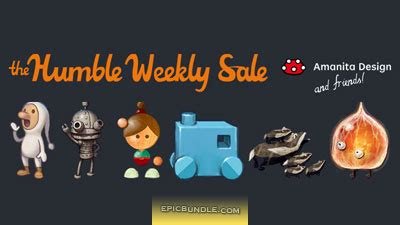
The Humble Weekly Sale: Amanita & Friends is a curated compilation of indie games, featuring titles like Machinarium, Botanicula, and Samorost 2 by Amanita Design, alongside other creative works such as Lume, Windosill, and Shelter. Released in 2014, this pay-what-you-want bundle offered DRM-free games across multiple platforms, with additional content like soundtracks, art books, and Steam keys for higher-tier purchases. The bundle supported charities and was available for a limited time, showcasing a mix of puzzle, adventure, and atmospheric games known for their unique art styles and storytelling.
The Humble Weekly Sale: Amanita & Friends Reviews & Reception
indiegamereviewer.com : A great casual game. The puzzles aren’t intimidating, and scouring the gorgeous, hand-painted landscape for things to click results in a wealth of delightful surprises.
intomobile.com : A great deal on a selection of games, the game creators are compensated directly, and charities such as Child’s Play get funding.
The Humble Weekly Sale: Amanita & Friends: A Masterclass in Indie Curation
Introduction: A Bundle That Redefined Value and Artistry
The Humble Weekly Sale: Amanita & Friends (2014) stands as a landmark in the history of digital game distribution—a meticulously curated compilation that transcended the typical “bundle” mentality. Released on January 2, 2014, this collection was not merely a transactional offering but a cultural artifact, a snapshot of indie gaming’s golden age. At its core, it showcased the works of Amanita Design, a studio whose handcrafted, surreal, and deeply atmospheric games had already redefined the point-and-click adventure genre. Paired with complementary titles from like-minded developers, this bundle was a love letter to whimsy, puzzle-solving, and the power of visual storytelling.
The thesis of this review is clear: The Humble Weekly Sale: Amanita & Friends was more than a commercial product—it was a curatorial masterpiece that democratized access to some of the most artistically significant indie games of the 2000s and early 2010s. Its pay-what-you-want model, charitable integration, and cross-platform accessibility made it a watershed moment for both developers and players, cementing its legacy as one of the most influential game compilations ever assembled.
Development History & Context: The Rise of Humble Bundle and Amanita’s Vision
The Humble Bundle Phenomenon
By 2014, the Humble Bundle had already revolutionized the gaming industry. Launched in 2010 as a pay-what-you-want promotion for indie games, it introduced a radical business model: consumers could purchase DRM-free games while allocating their payment between developers, charities (notably Child’s Play and the Electronic Frontier Foundation), and Humble Bundle itself. This model was not just financially disruptive—it was ethically transformative, fostering a sense of community and shared purpose.
The Weekly Sale format, introduced in 2013, refined this approach by focusing on themed collections, often centered around a single developer or studio. The Amanita & Friends bundle was a natural evolution, spotlighting a studio whose games were already beloved by critics and players alike.
Amanita Design: The Architects of Whimsy
Founded in 2003 by Jakub Dvorský, Amanita Design emerged from the Czech Republic with a singular mission: to create games that felt like interactive storybooks. Their debut, Samorost (2003), was a free browser-based adventure that introduced players to a world of hand-drawn surrealism, where a tiny gnome navigated a cosmos of bizarre creatures and mechanical oddities. The studio’s philosophy was rooted in:
– Visual storytelling over text: Their games often featured minimal dialogue, relying instead on evocative imagery and environmental narration.
– Tactile, organic puzzles: Unlike traditional adventure games, Amanita’s puzzles were intuitive yet challenging, often requiring players to engage with the world in unconventional ways.
– A rejection of cynicism: In an era where many games embraced gritty realism, Amanita’s work was unapologetically joyful, even when exploring darker themes.
By 2014, Amanita had released several critically acclaimed titles:
– Samorost 2 (2005) – A sequel that expanded the original’s scope with richer visuals and deeper puzzles.
– Machinarium (2009) – Their magnum opus, a dystopian robot adventure that won the Independent Games Festival’s Excellence in Visual Art Award.
– Botanicula (2012) – A vibrant, ecological fable about tree creatures battling parasitic invaders.
The Gaming Landscape in 2014
The early 2010s were a period of indie renaissance. Platforms like Steam, GOG, and itch.io had democratized distribution, while crowdfunding (via Kickstarter) and bundles (like Humble) provided alternative funding models. Yet, the market was also becoming saturated. The Amanita & Friends bundle arrived at a pivotal moment:
– Point-and-click adventures were resurging, thanks to titles like The Walking Dead (Telltale) and Broken Age (Double Fine).
– Aesthetic diversity was celebrated: Games like Journey and Kentucky Route Zero proved that visual and narrative experimentation could thrive.
– Charity bundles were becoming a cultural force, with Humble Bundle leading the charge in blending commerce with philanthropy.
The Amanita & Friends bundle was thus both a retrospective and a statement—a celebration of what indie games could achieve when unshackled from commercial constraints.
Narrative & Thematic Deep Dive: Stories Without Words
The games in this bundle share a common language: they communicate through atmosphere, symbolism, and player interaction rather than exposition. Below is an analysis of each title’s narrative and thematic core.
1. Machinarium (2009) – The Robot’s Redemption
- Plot: A small robot, Josef, is exiled from his city and must return to save his girlfriend from a gang of thugs.
- Themes:
- Isolation and belonging: The game’s dystopian city is both oppressive and oddly charming, filled with machines that feel alive despite their mechanical nature.
- Environmental storytelling: The world is a character unto itself, with every rusted pipe and flickering light telling a story of decay and resilience.
- Silent protagonists: Josef never speaks, yet his emotions are palpable through animation and sound design.
- Dialogue: The game uses a pictographic speech system, where characters “talk” in thought bubbles filled with icons—a brilliant workaround that enhances immersion.
2. Samorost 2 (2005) – A Cosmic Odyssey
- Plot: A gnome chases aliens who have kidnapped his dog, traversing a series of surreal planets.
- Themes:
- The sublime in the small: The gnome’s journey is epic in scope but intimate in execution, emphasizing curiosity over combat.
- Absurdist humor: The game’s tone oscillates between melancholic and whimsical, with creatures that are equal parts adorable and grotesque.
- Exploration as narrative: There is no “wrong” way to progress—every click reveals something new, rewarding curiosity.
3. Botanicula (2012) – Ecology as Adventure
- Plot: Five tree creatures embark on a quest to save their home from parasitic invaders.
- Themes:
- Environmentalism: The game’s lush, organic world is a celebration of nature’s interconnectedness.
- Cooperative survival: Each of the five protagonists has unique abilities, reinforcing the idea that diversity is strength.
- Joy in the face of adversity: Despite the looming threat, the game radiates optimism, with vibrant colors and playful interactions.
4. Lume (2011) – The Mystery of the Paper World
- Plot: A young girl investigates a power outage in her grandfather’s house, uncovering a deeper conspiracy.
- Themes:
- Nostalgia and memory: The game’s paper-and-cardboard aesthetic evokes childhood craft projects, blending warmth with unease.
- The uncanny: The photorealistic sets create a sense of hyper-reality, where the mundane becomes sinister.
- Puzzle as narrative: Every solved puzzle reveals a new layer of the story, making progression feel like unraveling a mystery.
5. Windosill (2009) – A Dream Logic Puzzle Box
- Plot: There is no traditional plot—players explore a series of surreal rooms, solving physics-based puzzles to progress.
- Themes:
- The subconscious mind: The game’s dreamlike environments defy logic, inviting players to embrace ambiguity.
- Play as discovery: There are no fail states, only experimentation. The joy comes from understanding the world’s rules.
- Minimalism: With no text or dialogue, the game communicates purely through visuals and sound.
6. Shelter (2013) – The Brutality of Nature
- Plot: A mother badger must protect her cubs while foraging for food in a hostile wilderness.
- Themes:
- Parental sacrifice: The game’s emotional core lies in the tension between nurturing and survival.
- Nature’s indifference: The world is beautiful but cruel—predators lurk, storms rage, and food is scarce.
- Survival as narrative: Unlike the other games, Shelter is not a puzzle adventure but a simulation of vulnerability.
Unifying Themes Across the Bundle
Despite their differences, these games share:
– A rejection of traditional game design tropes: No combat, no fail states (in most cases), no hand-holding.
– An emphasis on feeling over mechanics: The emotional resonance of each game is prioritized over gameplay complexity.
– A celebration of the handmade: Whether through hand-drawn art (Machinarium), paper crafts (Lume), or organic textures (Botanicula), these games feel tactile.
Gameplay Mechanics & Systems: The Art of the Puzzle
The Amanita & Friends bundle is united by its point-and-click adventure roots, but each game iterates on the formula in unique ways.
Core Gameplay Loops
-
Observation and Interaction:
- Players must look closely at environments, clicking on objects to trigger animations or reveal hidden mechanics.
- Example: In Machinarium, examining a seemingly mundane background element might reveal a crucial tool.
-
Inventory-Based Puzzles:
- Classic adventure game mechanics are present, but Amanita’s designs are more organic.
- Example: In Samorost 2, items are often used in unexpected ways (e.g., a mushroom might become a parachute).
-
Physics and Environmental Manipulation:
- Windosill and Lume introduce physics-based puzzles where objects react realistically to player input.
- Example: In Windosill, tilting the environment causes objects to roll, unlocking new paths.
-
Non-Linear Exploration:
- Unlike traditional adventures, these games often allow players to tackle puzzles in multiple orders.
- Example: Botanicula’s hub-based structure lets players choose which areas to explore first.
Innovations and Flaws
| Game | Innovation | Potential Flaw |
|---|---|---|
| Machinarium | Pictographic dialogue system | Some puzzles rely on obscure logic |
| Samorost 2 | Seamless world transitions | Short length (~1.5 hours) |
| Botanicula | Cooperative character abilities | Limited replayability |
| Lume | Photorealistic paper aesthetic | Some puzzles feel overly abstract |
| Windosill | Dreamlike, open-ended design | Lack of narrative may alienate some |
| Shelter | Emotional survival mechanics | Repetitive gameplay loop |
UI and Accessibility
- Minimalist interfaces: Most games eschew traditional HUDs, relying on contextual cues.
- Intuitive controls: Designed for both mouse and touch (in the case of Machinarium’s Android port).
- No hand-holding: Players are expected to experiment, which can be frustrating but ultimately rewarding.
World-Building, Art & Sound: A Feast for the Senses
The Amanita & Friends bundle is a masterclass in atmospheric design, where every visual and auditory element serves the game’s emotional core.
Visual Direction
- Machinarium: A steampunk dystopia rendered in meticulous detail, with rusted metal, flickering lights, and expressive robot designs. The game’s color palette—dull browns and grays punctuated by warm oranges—creates a sense of melancholic beauty.
- Samorost 2: A cosmic fairy tale, with planets that resemble living organisms. The art style blends surrealism with childlike wonder.
- Botanicula: A living ecosystem, where every creature and plant feels alive. The game’s vibrant colors and fluid animations evoke a storybook come to life.
- Lume: A tactile, photorealistic world made entirely of paper and cardboard. The game’s use of light and shadow creates a hauntingly beautiful atmosphere.
- Windosill: A dreamlike collage of floating objects and impossible geometry. The game’s visuals feel like a Dali painting interactive.
- Shelter: A watercolor wilderness, with soft edges and muted tones that emphasize the fragility of life.
Sound Design and Music
- Machinarium: Features a jazz-infused soundtrack by Floex, which perfectly complements the game’s mechanical world. The sound design—clanking metal, whirring gears—immerses players in the robot’s reality.
- Botanicula: Uses ambient, organic sounds (rustling leaves, chirping creatures) to create a sense of a living forest.
- Shelter: The soundtrack is minimalist and somber, with soft piano melodies that underscore the badger’s struggle.
- Windosill: Employs ethereal, almost otherworldly soundscapes that enhance its dreamlike quality.
Atmosphere and Immersion
The bundle’s games excel in environmental storytelling:
– Machinarium’s city feels like a character, with its towering scrap heaps and hidden alleyways.
– Samorost 2’s planets are each miniature worlds, filled with secrets and oddities.
– Shelter’s forest is both beautiful and threatening, a place where danger lurks behind every tree.
Reception & Legacy: A Bundle That Changed the Game
Critical and Commercial Reception
- The bundle received universal acclaim from players, with a 5/5 average rating on MobyGames (based on 4 ratings).
- Critics praised its value ($49 worth of games for as little as $1) and curation, with outlets like IntoMobile and IndieGameReviewer highlighting its significance.
- Steam reviews for individual games (e.g., Machinarium’s “Overwhelmingly Positive” rating) reflect the bundle’s lasting appeal.
Influence on the Industry
-
Proved the Viability of Artistic Bundles:
- The Amanita & Friends bundle demonstrated that curated collections could be as successful as quantity-driven ones.
- It paved the way for future themed bundles, such as the Humble Indie Bundle and Fantastic Arcade collections.
-
Elevated Amanita Design’s Profile:
- The bundle introduced Amanita’s games to a wider audience, solidifying their reputation as pioneers of the artistic adventure game.
- It also boosted sales for their subsequent titles, including Chuchel (2018) and Creaks (2020).
-
Charitable Impact:
- The bundle’s pay-what-you-want model, with proceeds supporting Child’s Play and the EFF, set a standard for ethical bundling.
- It contributed to Humble Bundle’s legacy as a force for good in gaming.
-
Inspired Indie Developers:
- The success of Amanita & Friends showed that niche, artistic games could find a mainstream audience when presented in the right context.
- It encouraged other indie studios to experiment with form and narrative.
Conclusion: A Timeless Collection
The Humble Weekly Sale: Amanita & Friends was not just a bundle—it was a cultural milestone. It democratized access to some of the most visually stunning, emotionally resonant, and mechanically innovative games of the indie renaissance. By combining Amanita Design’s masterpieces with complementary titles like Lume and Shelter, it created a cohesive experience that celebrated the art of play.
Its legacy endures in:
– The continued influence of Amanita Design’s work on modern adventure games.
– The evolution of game bundles as both commercial products and charitable endeavors.
– The proof that games can be art—not just in isolated cases, but as part of a movement.
Final Verdict: 10/10 – A Masterpiece of Curation
The Humble Weekly Sale: Amanita & Friends is more than a collection of games—it is a time capsule of indie gaming’s golden age. For those who experienced it in 2014, it was a revelation; for those discovering it today, it remains a testament to the power of creativity unshackled. If you have even a passing interest in adventure games, puzzle design, or artistic storytelling, this bundle is essential playing.
Post-Script: In an era where game bundles are often dismissed as quantity over quality, Amanita & Friends stands as a reminder of what curation can achieve. It was, and remains, a love letter to the medium—one that deserves to be remembered, revisited, and revered.