
- Release Year: 1994
- Platforms: DOS, Macintosh, Windows 16-bit, Windows
- Publisher: Cendant Software Europe S.A., Cybelle, Sierra On-Line, Inc.
- Developer: Dynamix, Inc., Jeff Tunnell Productions
- Genre: Puzzle
- Perspective: Side view
- Game Mode: Hotseat, Single-player
- Gameplay: Editor mode, Machine building, Puzzle solving
- Setting: Comic-book style
- Average Score: 79/100
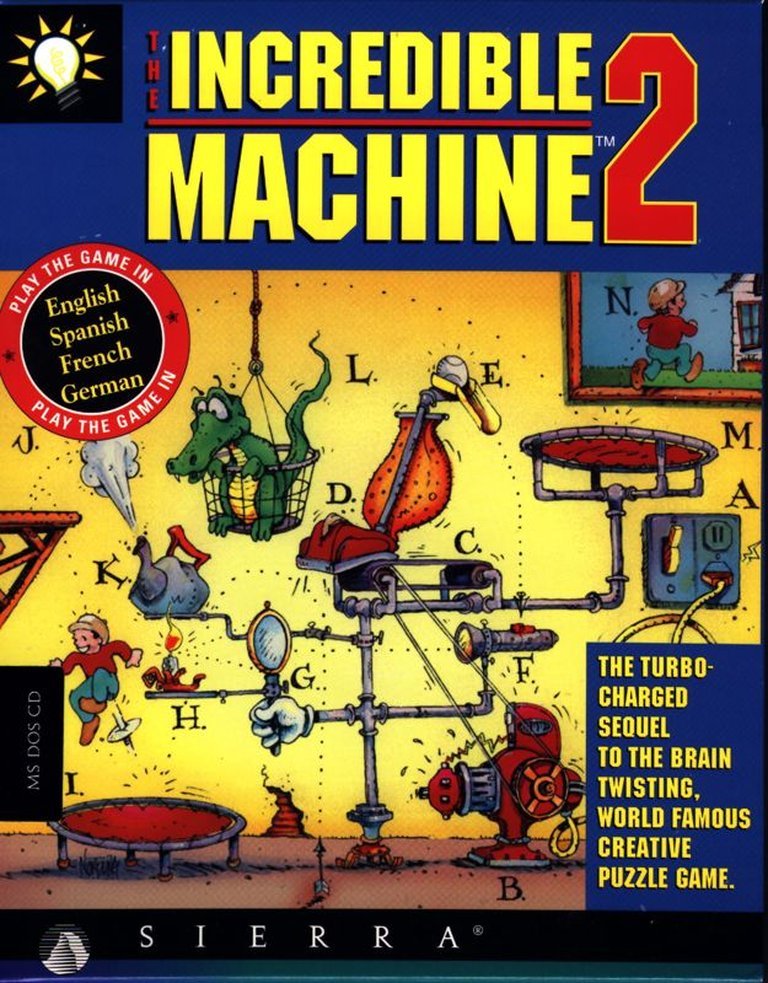
Description
The Incredible Machine 2 is a puzzle game where players design and complete whimsical Rube Goldberg-style machines by placing missing parts in the correct order. Featuring a wide array of quirky components—from cats and super balls to lava lamps and monkeys on treadmills—the game challenges players to solve increasingly complex puzzles to achieve specific tasks. It also includes a built-in editor, allowing players to create their own custom machines or puzzles for others to solve.
Gameplay Videos
The Incredible Machine 2 Free Download
The Incredible Machine 2 Patches & Updates
The Incredible Machine 2 Guides & Walkthroughs
The Incredible Machine 2 Reviews & Reception
gamepressure.com (73/100): A triumphant return to form for the series.
gamesreviews2010.com (90/100): A Wacky and Wonderful Puzzle-Solving Masterpiece.
mobygames.com (79/100): One of the best puzzle games ever created.
ign.com (75/100): Get ready for more insane, crazy-good fun with the sequel to the award winning Incredible Machine!
The Incredible Machine 2 Cheats & Codes
PC
Enter passwords at the level select screen.
| Code | Effect |
|---|---|
| PASSWORD | Unlocks all levels |
| RHOMBUS | Unlocks all levels, including secret ones |
| SIERRA | Unlocks level 2 |
| DYNAMIX | Unlocks level 3 |
| MACHINE | Unlocks level 4 |
| DISK | Unlocks level 5 |
| SHUTTLE | Unlocks level 6 |
| SATURN | Unlocks level 7 |
| KING | Unlocks level 8 |
| DRAGON | Unlocks level 9 |
| ANTS | Unlocks level 10 |
| BASEBALL | Unlocks level 11 |
| BEAR | Unlocks level 12 |
| FISH | Unlocks level 13 |
| DALE | Unlocks level 14 |
| CHESTERTON | Unlocks level 15 |
| SIZE | Unlocks level 16 |
| IRELAND | Unlocks level 17 |
| WORD | Unlocks level 18 |
| BRIEF | Unlocks level 19 |
| HOT DOG | Unlocks level 20 |
| COUNTDOWN | Unlocks level 21 |
| PSALMS | Unlocks level 22 |
| TANK | Unlocks level 23 |
| NIGHT | Unlocks level 24 |
| GAMES | Unlocks level 25 |
| WESTERN | Unlocks level 26 |
| LOG HOME | Unlocks level 27 |
| GRAPHICS | Unlocks level 28 |
| KNUTH | Unlocks level 29 |
| DONALD | Unlocks level 30 |
| COMPACT DISK | Unlocks level 31 |
| SHAVER LAKE | Unlocks level 32 |
| RHEUMATISM | Unlocks level 33 |
| HARPSICHORD | Unlocks level 34 |
| MARKET | Unlocks level 35 |
| DESK | Unlocks level 36 |
| MYRTLE | Unlocks level 37 |
| QUATERNION | Unlocks level 38 |
| AQUARIUM | Unlocks level 39 |
| SHOE | Unlocks level 40 |
| FLOWER | Unlocks level 41 |
| STORE | Unlocks level 42 |
| CLARE | Unlocks level 43 |
| KERRY | Unlocks level 44 |
| FLANGE | Unlocks level 45 |
| SEASON | Unlocks level 46 |
| TRIBOLOGY | Unlocks level 47 |
| ABRASIVE | Unlocks level 48 |
| DEFORMATION | Unlocks level 49 |
| ELASTIC | Unlocks level 50 |
| ADHESION | Unlocks level 51 |
| SPECTRA | Unlocks level 52 |
| INDUCTION | Unlocks level 53 |
| POLARIZATION | Unlocks level 54 |
| OVERJOY | Unlocks level 55 |
| DISCURSIVE | Unlocks level 56 |
| CROSS | Unlocks level 57 |
| CHOCOLATE | Unlocks level 58 |
| PLATO | Unlocks level 59 |
| WELLSPRING | Unlocks level 60 |
| HYDROPLANE | Unlocks level 61 |
| PALM | Unlocks level 62 |
| SOMBRERO | Unlocks level 63 |
| JOIST | Unlocks level 64 |
| ASTRONAUT | Unlocks level 65 |
| MARIONETTE | Unlocks level 66 |
| OSMIUM | Unlocks level 67 |
| ASSURANCE | Unlocks level 68 |
| CALCULATOR | Unlocks level 69 |
| SUPERIOR | Unlocks level 70 |
| PHILHARMONIC | Unlocks level 71 |
| ANGULAR | Unlocks level 72 |
| ZIPPER | Unlocks level 73 |
| UMPIRE | Unlocks level 74 |
| RECOVER | Unlocks level 75 |
| SHADOW | Unlocks level 76 |
| IONIZE | Unlocks level 77 |
| QUAKE | Unlocks level 78 |
| OCTOBER | Unlocks level 79 |
| BILATERAL | Unlocks level 80 |
| LYRIC | Unlocks level 81 |
| NEEDLE | Unlocks level 82 |
| THEORY | Unlocks level 83 |
| LOBSTER | Unlocks level 84 |
| SAMURAI | Unlocks level 85 |
| SPLICE | Unlocks level 86 |
| GULF | Unlocks level 87 |
| RHOMBUS | Unlocks level 88 |
| OLIVE | Unlocks level 89 |
| POLYNOMIALS | Unlocks level 90 |
| PARAMETRIC | Unlocks level 91 |
| SOLAR SYSTEM | Unlocks level 92 |
| MARBLE | Unlocks level 93 |
| HEAVY | Unlocks level 94 |
| REPUBLIC | Unlocks level 95 |
| QUATRAIN | Unlocks level 96 |
| TYRANNOSAUR | Unlocks level 97 |
| SULFURIC | Unlocks level 98 |
| DOPA | Unlocks level 99 |
| MINARET | Unlocks level 100 |
| DOVETAIL | Unlocks level 101 |
| JASMINE | Unlocks level 102 |
| WRANGLE | Unlocks level 103 |
| KUDOS | Unlocks level 104 |
| CULDESAC | Unlocks level 105 |
| YODEL | Unlocks level 106 |
| XYLOPHONE | Unlocks level 107 |
| MONKEY | Unlocks level 108 |
| HEIST | Unlocks level 109 |
| CAPTURE | Unlocks level 110 |
| PURSE | Unlocks level 111 |
| HOBBY | Unlocks level 112 |
| DEIFY | Unlocks level 113 |
| MERGANSER | Unlocks level 114 |
| SEAL | Unlocks level 115 |
| CONTRAPTION | Unlocks level 116 |
| FLAX | Unlocks level 117 |
| PRIMORDIAL | Unlocks level 118 |
| RAVE | Unlocks level 119 |
| HYACINTH | Unlocks level 120 |
| SPIDER | Unlocks level 121 |
| YAMMER | Unlocks level 122 |
| NERVE | Unlocks level 123 |
| GRATE | Unlocks level 124 |
| EMULSION | Unlocks level 125 |
| INPUT | Unlocks level 126 |
| PARADISE | Unlocks level 127 |
| SAMURAI | Unlocks level 128 |
| CHAOS | Unlocks level 129 |
| BRAWL | Unlocks level 130 |
| ASIDE | Unlocks level 131 |
| AXIS | Unlocks level 132 |
| OFFBEAT | Unlocks level 133 |
| QUIP | Unlocks level 134 |
| NEWMAN | Unlocks level 135 |
| SLOPE | Unlocks level 136 |
| TENON | Unlocks level 137 |
| CROSSCUT | Unlocks level 138 |
| NORM | Unlocks level 139 |
| HOUSE | Unlocks level 140 |
| MACARONI | Unlocks level 141 |
| TALON | Unlocks level 142 |
| BEAK | Unlocks level 143 |
| BIRETTA | Unlocks level 144 |
| FREQUENT | Unlocks level 145 |
| STREAM | Unlocks level 146 |
| UMIAK | Unlocks level 147 |
| HIATUS | Unlocks level 148 |
| CREEK | Unlocks level 149 |
| CROQUET | Unlocks level 150 |
| ACID | Unlocks level 151 |
| BABY | Unlocks level 152 |
| SEAN | Unlocks level 153 |
| QUALM | Unlocks level 154 |
| THIAMINE | Unlocks level 155 |
| TURN | Unlocks level 156 |
| KANGAROO | Unlocks level 157 |
| CONTENT | Unlocks level 158 |
| BELLOC | Unlocks level 159 |
| PASSWORD | Unlocks level 160 |
PC
Press the following keys during gameplay.
| Code | Effect |
|---|---|
| V | Instant win |
| Ctrl+V | Advance to the next level |
The Incredible Machine 2: A Masterclass in Puzzle Design and Creative Problem-Solving
Introduction
The Incredible Machine 2 (1994) is not just a game—it is a testament to the power of creative problem-solving, a celebration of the absurd, and a landmark in the puzzle genre. Developed by Jeff Tunnell Productions and published by Sierra On-Line, this sequel to The Incredible Machine (1992) refines and expands upon its predecessor’s formula, delivering an experience that is as intellectually stimulating as it is whimsically entertaining. At its core, The Incredible Machine 2 challenges players to construct Rube Goldberg-esque contraptions using an eclectic array of objects—from mundane tools like ropes and pulleys to the downright bizarre, such as cats, monkeys, and lava lamps. The game’s brilliance lies in its ability to blend physics-based puzzle-solving with unrestrained creativity, offering a sandbox where logic and imagination collide.
This review will dissect The Incredible Machine 2 in exhaustive detail, exploring its development history, gameplay mechanics, artistic and auditory design, cultural impact, and enduring legacy. By the end, it will be clear why this title remains a beloved classic, a touchstone for puzzle enthusiasts, and a blueprint for games that dare to prioritize ingenuity over convention.
Development History & Context
The Studio and Creative Vision
The Incredible Machine 2 was developed by Jeff Tunnell Productions, a studio founded by Jeffrey Tunnell, a former employee of Dynamix. Tunnell’s vision for the Incredible Machine series was rooted in his fascination with Rube Goldberg’s cartoonishly complex machines, which performed simple tasks through convoluted, multi-step processes. The first game, The Incredible Machine (1992), was a critical success, but Tunnell saw room for improvement. His goal for the sequel was to refine the gameplay, expand the toolset, and enhance the game’s accessibility without sacrificing its core appeal: the joy of creative problem-solving.
The development team included Brian Hahn as art director, Michael Waite as writer, and a roster of engineers and artists who collectively brought Tunnell’s vision to life. The game was published by Sierra On-Line, a studio renowned for its adventure games (King’s Quest, Space Quest) but equally committed to fostering innovative puzzle experiences. Sierra’s support allowed Tunnell’s team to push the boundaries of what a puzzle game could be, both technically and creatively.
Technological Constraints and Innovations
Released in 1994, The Incredible Machine 2 was developed during a transitional period in PC gaming. The industry was moving from DOS-based systems to early Windows environments, and hardware limitations were still a significant consideration. The game’s system requirements were modest by modern standards—386SX 25 MHz processor, 2 MB RAM, and DOS/Windows 3.x—but these specs were typical for the era. The challenge for the developers was to create a game that was visually engaging and mechanically complex without overwhelming the hardware.
One of the most notable technical achievements of The Incredible Machine 2 was its physics engine. While rudimentary by today’s standards, it was sophisticated enough to simulate gravity, momentum, and basic interactions between objects. This engine was crucial for the game’s core mechanic: allowing players to experiment with different configurations of parts and observe how they behaved in real-time. The game also introduced improved graphics, with a comic-book aesthetic that gave it a distinct, playful identity. The shift from the first game’s more sterile visuals to TIM2’s vibrant, cartoonish style was a deliberate choice to enhance the game’s accessibility and charm.
Another innovation was the enhanced editor mode, which allowed players to design their own puzzles from scratch. This feature was not merely an afterthought but a core component of the game’s design philosophy. Tunnell and his team recognized that the true appeal of The Incredible Machine lay in its sandbox potential—the ability for players to create, test, and share their own contraptions. The editor in TIM2 was more robust than its predecessor’s, offering greater flexibility in defining puzzle parameters and success conditions.
The Gaming Landscape of 1994
The mid-1990s were a golden age for puzzle games, with titles like Tetris, Lemmings, and Myst dominating the genre. However, The Incredible Machine 2 stood out due to its unique blend of physics-based gameplay and open-ended creativity. While other puzzle games relied on pattern recognition or spatial reasoning, TIM2 demanded a different kind of thinking—lateral, experimental, and often counterintuitive.
The game’s release also coincided with the rise of educational software, a market that Sierra was keen to explore. The Incredible Machine 2 was not explicitly marketed as an educational tool, but its emphasis on logical reasoning, cause-and-effect relationships, and problem-solving made it a natural fit for classrooms and homes alike. This dual appeal—both as a challenging puzzle game and a cerebral playground—helped it carve out a niche in a crowded market.
Narrative & Thematic Deep Dive
The Absence of Story and Its Strength
The Incredible Machine 2 is a rare example of a game that thrives without a traditional narrative. There are no characters to follow, no plot to unravel, and no dialogue to parse. Instead, the game’s “story” is told through its mechanics and level design. Each puzzle is a self-contained challenge, a miniature narrative of cause and effect where the player is both the author and the protagonist.
This absence of story is not a weakness but a deliberate design choice. By stripping away narrative distractions, the game forces players to focus entirely on the puzzle-solving experience. The satisfaction comes not from advancing a plot but from overcoming a challenge through ingenuity. This approach aligns with the philosophy of Rube Goldberg himself, whose machines were celebrated for their absurdity and complexity, not their narrative coherence.
Themes: Creativity, Persistence, and the Joy of Discovery
While The Incredible Machine 2 lacks a conventional narrative, it is rich in thematic depth. Several key themes emerge through its gameplay:
-
Creativity as Problem-Solving:
The game’s most prominent theme is the idea that creativity is not just an artistic endeavor but a practical one. Players are encouraged to think outside the box, combining objects in unexpected ways to achieve their goals. A puzzle might require using a cat to trigger a switch, a monkey on a treadmill to generate power, or a lava lamp to create a timing mechanism. The game rewards unconventional thinking, reinforcing the idea that there is no single “correct” solution to a problem. -
Persistence and Trial-and-Error:
The Incredible Machine 2 is unapologetically difficult at times, with later puzzles demanding precision, patience, and perseverance. The game’s difficulty curve is steep, but it is also fair. Failure is not punished harshly—instead, it is treated as a learning opportunity. Players are encouraged to iterate, experiment, and refine their designs, mirroring the scientific method. This theme resonates with real-world problem-solving, where success often comes after multiple attempts and adjustments. -
The Joy of Discovery:
There is a palpable sense of wonder in The Incredible Machine 2, particularly when a player’s contraption finally works after numerous failed attempts. The game’s sound design and visual feedback—gears turning, balls bouncing, cats meowing—enhance this feeling, making each success feel like a miniature triumph. This theme taps into a universal human experience: the thrill of figuring something out through one’s own effort and ingenuity. -
Absurdity and Playfulness:
The game’s whimsical tone is another key theme. The inclusion of absurd objects (e.g., cheese to lure mice, monkeys on treadmills) and cartoonish physics creates a world where logic and nonsense coexist. This playfulness is not just for comedic effect—it serves a gameplay purpose by encouraging players to approach problems with a lighthearted, experimental mindset. The game’s humor disarms frustration, making even the most challenging puzzles feel fun rather than punishing.
The Role of the Player
In The Incredible Machine 2, the player is cast in the role of inventor, engineer, and tinkerer. There are no avatars or protagonists—the player’s imagination is the star. This design choice reinforces the game’s themes of creativity and self-directed learning. The player is not following a scripted path but forging their own, making the experience deeply personal.
The game’s hint system further emphasizes this role. Rather than providing direct solutions, the hints nudge the player in the right direction, preserving the sense of discovery. This approach aligns with the game’s educational potential, teaching players how to think rather than what to think.
Gameplay Mechanics & Systems
Core Gameplay Loop
At its heart, The Incredible Machine 2 is a physics-based puzzle game where players must assemble machines to complete specific tasks. The core gameplay loop can be broken down into the following steps:
-
Objective Presentation:
Each puzzle begins with a clear objective, such as “get the ball into the basket” or “turn on the light bulb.” The objective is always simple in concept but often deceptively complex in execution. -
Part Selection:
Players are given a limited set of parts to work with, ranging from basic components (e.g., ropes, pulleys, gears) to more exotic items (e.g., cats, mice, dynamite). The challenge lies in selecting the right parts and figuring out how to combine them effectively. -
Machine Assembly:
Players drag and drop parts onto the playfield, arranging them in a way that (hopefully) achieves the objective. This phase is where creativity and logic intersect. Players must consider physics (e.g., gravity, momentum), timing (e.g., when a part activates), and interactions (e.g., how one part affects another). -
Testing and Iteration:
Once the machine is assembled, players hit the “go” button and watch their creation in action. More often than not, the machine fails spectacularly, requiring the player to analyze what went wrong and adjust their design. This trial-and-error process is where the game’s depth and replayability shine. -
Success and Progression:
When the machine finally works, the player is rewarded with visual and auditory feedback—gears spin, balls roll, lights flash—and the satisfaction of having solved the puzzle. The game then progresses to the next challenge, which is typically more complex than the last.
Puzzle Design and Difficulty Curve
The Incredible Machine 2 features over 200 puzzles, divided into four difficulty levels: Easy, Medium, Hard, and Expert. The puzzles are meticulously designed to introduce new mechanics gradually while ramping up complexity in a way that feels organic rather than arbitrary.
-
Easy Puzzles:
These serve as tutorials, introducing basic parts and mechanics. For example, a early puzzle might require using a rope to pull a lever, teaching the player how forces interact. -
Medium Puzzles:
These introduce more complex interactions, such as timing-based mechanisms (e.g., using a pendulum to trigger a switch at the right moment) or multi-step processes (e.g., using a mouse to move a ball into position). -
Hard Puzzles:
Here, the game tests the player’s mastery of the mechanics. Puzzles may require precise placement of parts, unconventional solutions, or chaining multiple interactions in sequence. For example, a puzzle might involve using a fan to blow a ball into a basket, but the fan’s position and the ball’s weight must be perfectly calibrated. -
Expert Puzzles:
These are brutally difficult, often requiring lateral thinking and outside-the-box solutions. Some puzzles in this category feel almost unfair, demanding pixel-perfect placement or counterintuitive part usage. However, solving them provides an unmatched sense of accomplishment.
One of the game’s few criticisms is its imbalanced difficulty curve. As noted in player reviews, the jump from Hard to Expert can feel abrupt, with the final puzzles being disproportionately challenging. This imbalance is a minor flaw in an otherwise brilliantly designed progression system.
The Editor: A Sandbox of Infinite Possibilities
One of The Incredible Machine 2’s most groundbreaking features is its built-in editor, which allows players to design their own puzzles from scratch. This feature transforms the game from a linear puzzle experience into a creative sandbox, offering near-limitless replayability.
The editor is intuitive yet powerful, allowing players to:
– Place any part from the game’s extensive library.
– Define custom objectives (e.g., “get the ball into the basket within 10 seconds”).
– Set success conditions (e.g., “the light bulb must turn on”).
– Test and refine their creations in real-time.
This feature was ahead of its time, anticipating the user-generated content trends that would later define games like LittleBigPlanet and Super Mario Maker. The editor not only extended the game’s lifespan but also fostered a community of players who shared their custom puzzles, further enriching the experience.
Multiplayer Mode: A Missed Opportunity?
The Incredible Machine 2 includes a two-player hotseat mode, where players take turns solving puzzles or competing to complete objectives faster. While this mode is a welcome addition, it is not as polished as the single-player experience. The competitive aspect feels tacked on, lacking the depth and creativity of the main game.
Critics at the time, such as Computer Gaming World, noted that the multiplayer mode “could have been better.” It is a minor disappointment in an otherwise flawlessly executed game, but it does not detract significantly from the overall experience.
User Interface and Controls
The game’s UI is simple and functional, designed to minimize friction between the player and the puzzle-solving process. The mouse-driven controls are intuitive, allowing players to drag, drop, and rotate parts with ease. The hint system is integrated seamlessly, providing subtle guidance without spoiling the solution.
One minor technical limitation is the game’s sensitivity to cursor placement, which can sometimes lead to frustration when trying to position parts precisely. However, this is a minor quibble in an otherwise well-designed interface.
World-Building, Art & Sound
Visual Design: A Comic-Book Aesthetic
The Incredible Machine 2’s art style is one of its most distinctive and enduring features. The game adopts a comic-book aesthetic, with bold outlines, vibrant colors, and exaggerated animations. This style serves multiple purposes:
-
Accessibility:
The clear, cartoonish visuals make it easy for players to distinguish between parts and understand their functions. For example, a gear is instantly recognizable, and a cat’s movement is exaggerated to highlight its role in the machine. -
Whimsy and Charm:
The art style reinforces the game’s playful tone. The over-the-top animations—cats pouncing, monkeys running, balls bouncing—add a layer of humor and personality that makes the game feel alive. -
Timelessness:
Unlike many games of its era, which relied on realistic or pixelated graphics, The Incredible Machine 2’s stylized art has aged exceptionally well. It feels fresh and engaging even decades after its release.
The game’s backgrounds and environments are equally charming, featuring detailed, hand-drawn settings that evoke a mad scientist’s workshop. The attention to detail in the visual feedback—sparks flying when a circuit completes, gears turning smoothly—enhances the satisfaction of solving a puzzle.
Sound Design: A Symphony of Chaos
The sound design in The Incredible Machine 2 is understated but effective, playing a crucial role in immersing the player in the game’s world. Every action has a distinct auditory cue:
- Mechanical sounds (e.g., gears turning, ropes tightening) provide feedback on the machine’s operation.
- Animal noises (e.g., cats meowing, mice squeaking) add personality to the game’s absurd cast of characters.
- Success and failure sounds (e.g., a ding when a puzzle is solved, a clunk when a part fails) reinforce the emotional highs and lows of the experience.
The game’s soundtrack is another standout feature. Composed by Timothy Steven Clarke, Randy Dersham, Jan Paul Moorhead, and Ken Rogers, the music spans multiple genres, from blues to prog rock. This eclectic mix is unusual for a puzzle game, but it complements the game’s whimsical tone perfectly. The upbeat, jazzy tunes create a relaxed, creative atmosphere, while the more intense tracks heighten the sense of urgency during challenging puzzles.
The CD version of the game, released in 1995, features CD-quality audio tracks instead of MIDI, further enhancing the auditory experience. The inclusion of voice-overs in some versions adds another layer of polish, making the game feel more dynamic and engaging.
Atmosphere: A Playground of Possibilities
The Incredible Machine 2’s atmosphere is one of unbridled creativity and experimentation. The game’s visual and auditory design work in harmony to create a world where anything is possible. The comic-book aesthetic and playful sound effects make the game feel like a living, breathing toy box, inviting players to tinker, explore, and discover.
This atmosphere is crucial to the game’s success. It disarms frustration, making even the most difficult puzzles feel fun rather than punishing. The game’s humor and charm ensure that players keep coming back, eager to see what wacky contraption they can create next.
Reception & Legacy
Critical and Commercial Reception
The Incredible Machine 2 was widely acclaimed upon its release, earning praise for its innovative gameplay, charming presentation, and endless replayability. Critics and players alike hailed it as one of the best puzzle games of its era, and its MobyGames score of 8.1 (based on 13 critic reviews) reflects its critical consensus.
Here’s a breakdown of the critical reception:
-
Computer Gaming World (90%):
“In every way, TIM2 is an improvement, keeping the best parts of the original yet giving the player more options and flexibility.”
The magazine praised the game’s expanded part library, improved graphics, and enhanced editor, calling it “a game that’s as rewarding as it is challenging.” -
PC Gamer (90%):
“Dozens of puzzles; a do-it-yourself mode; and near open-ended game play.”
The review highlighted the game’s replayability and creativity, noting that it offered exceptional value for puzzle fans. -
Power Play (85%):
The German magazine commended the game’s improved puzzle design, new parts (like lasers and flipper elements), and simplified controls, calling it “a must-play for fans of logical challenges.” -
Mac Gamer (82%):
“For adults, especially those that grew up with Mousetrap and Wile E., the game is really cool.”
The review emphasized the game’s nostalgic appeal and accessibility, noting its broad appeal beyond hardcore gamers. -
PC Joker (73%):
While still positive, this review noted that the game’s puzzle design could feel imbalanced, with some later puzzles being unnecessarily difficult. However, it concluded that the game was “still a worthy follow-up” to the original.
The game’s player reception was equally enthusiastic, with a MobyGames player score of 4.2/5 based on 54 ratings. Players praised the game’s creativity, challenge, and charm, with many calling it “one of the best puzzle games ever created.”
Awards and Accolades
The Incredible Machine 2’s critical success was further validated by several awards:
-
Computer Gaming World’s Readers’ Choice Award (1996):
The game won the “Classics/Puzzles Game of the Year” award, a testament to its enduring popularity among players. -
Power Play’s Best Puzzle Game (1995):
The German magazine recognized the game as the best in its genre for the year, highlighting its innovative design and engaging gameplay.
These accolades cemented The Incredible Machine 2’s reputation as a landmark title in the puzzle genre.
Cultural Impact and Influence
The Incredible Machine 2’s influence extends far beyond its critical and commercial success. The game redefined what a puzzle game could be, blending physics-based mechanics, creative freedom, and whimsical presentation in a way that had never been seen before.
Its impact can be seen in several areas:
-
Inspiration for Future Games:
The game’s sandbox puzzle design influenced numerous titles, including:- Crazy Machines series (2004–present):
A direct spiritual successor, featuring similar physics-based puzzles and user-generated content. - Human: Fall Flat (2016):
A modern puzzle-platformer that emphasizes creative problem-solving and absurd physics. - The Incredible Machine: Even More Contraptions (2001):
A later entry in the series that expanded on TIM2’s mechanics while retaining its core appeal.
- Crazy Machines series (2004–present):
-
Educational Potential:
While not explicitly an educational game, The Incredible Machine 2 found a natural home in classrooms. Its emphasis on logical reasoning, cause-and-effect relationships, and experimental learning made it a valuable tool for teaching physics, engineering, and problem-solving skills. The game’s accessibility and engaging presentation made it appealing to students of all ages, from young children to college students. -
Community and Modding:
The game’s editor mode fostered a community of creators who shared their custom puzzles online. This user-generated content extended the game’s lifespan far beyond its initial release, keeping it relevant and engaging for years. The game’s modding potential anticipated the rise of player-created content in modern gaming, from Minecraft to Roblox. -
Nostalgia and Retro Appeal:
Decades after its release, The Incredible Machine 2 remains a beloved classic among retro gaming enthusiasts. Its timeless art style, charming sound design, and engaging gameplay have ensured its enduring appeal. The game is frequently revisited in retrospectives, featured in “best puzzle games” lists, and celebrated for its innovation.
Re-Releases and Compilations
The game’s popularity led to multiple re-releases and compilations, including:
-
The Incredible Machine Version 3.0 (1995):
A Windows port of TIM2 with improved interface, CD-quality audio, and voice-overs. -
The Incredible Machine Mega Pack (2009):
A compilation featuring TIM2 alongside other entries in the series, introducing the game to new generations of players. -
Digital Distribution:
The game has been made available on modern platforms through services like GOG.com and Steam, ensuring its accessibility in the digital age.
Conclusion: A Timeless Masterpiece
The Incredible Machine 2 is more than just a puzzle game—it is a celebration of creativity, a testament to the power of experimentation, and a landmark in interactive entertainment. Its brilliant gameplay design, charming presentation, and endless replayability have cemented its place as one of the greatest puzzle games ever made.
The game’s legacy is evident in its influence on subsequent titles, its enduring popularity among players, and its continued relevance in educational and creative contexts. It is a rare example of a game that is both intellectually stimulating and immensely fun, appealing to casual players and hardcore puzzle enthusiasts alike.
In an era where many games prioritize graphical fidelity and narrative spectacle, The Incredible Machine 2 stands out for its focus on pure, unadulterated gameplay. It is a reminder that the most memorable gaming experiences often come from simple, elegant mechanics executed with precision and passion.
For those who have yet to experience it, The Incredible Machine 2 is essential playing. For those who grew up with it, it remains a cherished classic, a time capsule of creativity and joy. It is, in every sense of the word, incredible.
Final Verdict: 9.5/10 – A Puzzle Masterpiece
The Incredible Machine 2 is a timeless classic that deserves its place in the pantheon of gaming greats. Its innovative gameplay, charming presentation, and endless creativity make it a must-play for puzzle fans and gamers of all stripes. While its difficulty curve can feel imbalanced and its multiplayer mode is underwhelming, these are minor flaws in an otherwise flawless experience.
Pros:
– Brilliant puzzle design that encourages creative problem-solving.
– Charming comic-book aesthetic and whimsical sound design.
– Endless replayability thanks to the robust editor mode.
– Timeless appeal that has aged exceptionally well.
Cons:
– Difficulty spike in later puzzles can feel unfair.
– Multiplayer mode is underdeveloped.
– Cursor sensitivity can lead to minor frustration.
Final Thought:
The Incredible Machine 2 is not just a game—it is an experience, a playground of possibilities, and a testament to the power of imagination. It is a masterclass in puzzle design, and its legacy continues to inspire gamers and developers alike. If you have even a passing interest in puzzle games, do yourself a favor and play this classic. You won’t just be solving puzzles—you’ll be creating memories.