
- Release Year: 2023
- Platforms: Nintendo Switch, PlayStation 5, Quest, Windows, Xbox Series
- Publisher: Wired Productions, Ltd.
- Developer: Wolf & Wood Interactive Ltd
- Genre: Action
- Perspective: 1st-person
- Game Mode: Single-player
- Gameplay: Hacking, Job simulation, Puzzle elements, Shooter, Stealth
- Setting: Fantasy, Futuristic, Sci-fi
- Average Score: 68/100
- VR Support: Yes
Description
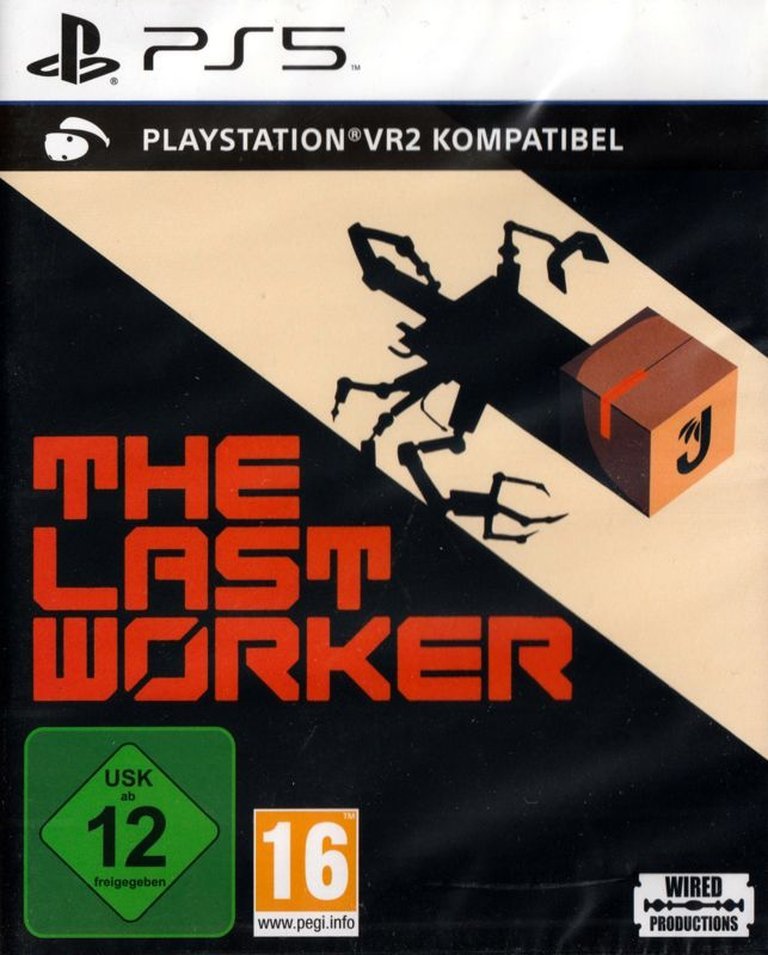
In a dystopian future where automation has rendered human labor obsolete, players step into the shoes of Kurt, the last worker in a vast, surreal warehouse. Combining first-person action with puzzle-solving and shooting mechanics, the game blends narrative-driven storytelling with dynamic gameplay in a visually distinct style, exploring themes of humanity and rebellion against a mechanized world.
Gameplay Videos
Where to Buy The Last Worker
The Last Worker Free Download
The Last Worker Patches & Updates
The Last Worker Guides & Walkthroughs
The Last Worker Reviews & Reception
pcgamer.com : The Last Worker’s free-flying hovercraft gameplay is inventive, but its most exciting implications are left boxed up.
thegeekwave.com : Unfortunately, The Last Worker fails to do this, despite having some fun characters and well done voice acting.
The Last Worker: Review
Introduction
In a gaming landscape saturated with blockbusters and sequels, The Last Worker emerges as a defiantly original and politically charged experience. Set in a dystopian future where humanity has been rendered obsolete by automation, this first-person narrative adventure tasks players with being the final human worker in a colossal Amazon-esque fulfillment center. Released in March 2023 to a wave of critical curiosity, the game promises a potent blend of satire, stealth, and social commentary. As a professional game journalist and historian, it is imperative to dissect this ambitious title through the lens of its thematic depth, mechanical execution, and historical context. Despite its striking art direction and stellar voice acting, The Last Worker ultimately presents a fascinating yet flawed vision—one that struggles to reconcile its sharp satire with inconsistent gameplay and narrative pacing. This review will argue that while the game succeeds as a thought-provoking piece of interactive fiction, its mechanical ambitions outpace its design, leaving players with more questions than answers about the future of work.
Development History & Context
Developed by the UK-based studio Wolf & Wood Interactive and published by Wired Productions, The Last Worker represents a passion project helmed by writer-director Jörg Tittel. The game’s genesis lies in Tittel’s desire to explore the dehumanizing effects of late-stage capitalism through an interactive medium. Its development was notable for its collaborative nature, involving 201 credited individuals, including veteran comic artist Mick McMahon (responsible for the distinctive cel-shaded visuals) and composer Oliver Kraus, whose score underscores the game’s emotional beats. Technologically, the game was designed as a dual-experience title, playable both in traditional flat-screen formats and in VR (specifically Meta Quest and PSVR2). This dual focus influenced its control schemes and spatial design, though critics often noted that the VR version offered a more immersive and thematically resonant experience. Released on March 30, 2023, The Last Worker arrived amid a surge of interest in narrative-driven indie games and VR content, competing with titles like Scorn and Disco Elysium. Its budget-friendly $19.99 price point and multi-platform availability (Windows, PS5, Xbox Series, Switch, and Quest) positioned it as an accessible, if ambitious, entry in the growing genre of “working” simulations.
Narrative & Thematic Deep Dive
At its core, The Last Worker is a darkly comedic yet poignant allegory of labor in an automated world. Players assume the role of Kurt, a weary 25-year veteran of the Jüngle Corporation— a transparent pastiche of Amazon—who remains the last human employee after waves of layoffs. The narrative follows Kurt’s reluctant involvement in a rebellion against Jüngle’s oppressive regime, led by the enigmatic Hoverbird, whose consciousness resides in a robot avatar. The story’s central twist reveals that the rebels are not altruistic freedom fighters but opportunistic profiteers, muddying the waters of moral certainty and satirizing the naivety of anti-corporate resistance.
Characterization is one of the game’s strongest assets. Kurt’s internal conflict—loyalty to the corporation that employs him versus the desire for liberation—drives the narrative, though his motivations are inconsistently portrayed, shifting abruptly between compliant worker and revolutionary. Supporting characters breathe life into the story: Skew, a rebellious robot voiced with gruff charm by Jason Isaacs, provides comic relief and cynical commentary, while Hoverbird serves as the moral compass, advocating for human dignity. The villain, Josef Jüngle, epitomizes corporate excess with his rainbow hair and hollow progressive platitudes, embodying the absurdity of “woke capitalism.”
Dialogue is sharp and often hilarious, with Skew’s profanity-laced tirades and holographic product parodies (e.g., a “Grizzly Man Action Figure” featuring tiny Werner Herzog) offering biting satire of consumer culture. However, the writing occasionally over-explains its jokes, as when a character explicitly mocks Jüngle’s rainbow-haired “progressiveness” after the visual gag is already apparent. Thematically, the game tackles timely issues: the devaluation of human labor, the ethics of automation, and the illusion of choice in late capitalism. Yet these themes are explored superficially, reducing complex socio-economic critiques to broad strokes. As The Guardian noted, the game fails to answer its own most incisive question: “Who buys all this tat when nobody has a job?”
Gameplay Mechanics & Systems
The Last Worker’s gameplay is a hybrid of puzzle-solving, stealth, and traversal, built around Kurt’s hovercraft—a versatile vehicle with six degrees of freedom. The central loop involves package sorting: using a compass to locate parcels, inspecting them for damage, weight, or size discrepancies, and routing them to “recycling” or fulfillment chutes. This mechanic, reminiscent of Papers, Please’s bureaucratic tedium, is initially satisfying but quickly grows repetitive due to its lack of challenge. Critics like PC Gamer lamented that the game “never reaches a satisfying climax” in this loop, with quota targets being easily met and no meaningful consequences for failure.
The second major pillar is stealth and hacking. Players must evade Jüngle’s patrol bots while using the JungleGun to hack terminals, solve shape-matching puzzles, or manipulate environments. Stealth sequences are divisive: Nintendo Life criticized them as “fiddly” and “frustrating,” with the hovercraft’s verticality underutilized, making sections feel like “a bull in a China shop.” Conversely, Shacknews praised the tension in timed hacking challenges, which force players to balance risk and reward. The game attempts variety through racing sections, shooting encounters, and even Flappy Bird-inspired mini-games, but these feel disjointed and poorly integrated.
Character progression is minimal; the JungleGun gains new abilities (e.g., hacking) as the story progresses, but these are rarely leveraged in innovative ways. The UI is functional but inconsistent, with package-sorting interfaces being clear, while stealth mechanics suffer from opaque feedback. Ultimately, the gameplay feels like a collection of disconnected ideas rather than a cohesive system, as noted by The Gamer: “When the most compelling gameplay is the tedious day job […] you know there’s a problem.”
World-Building, Art & Sound
The Jüngle fulfillment center is a marvel of dystopian world-building. This Manhattan-sized warehouse is a labyrinth of steel, conveyor belts, and towering shelves, its oppressive scale emphasizing the insignificance of the individual worker. The art style, a vibrant cel-shaded aesthetic by Mick McMahon, is the game’s standout feature. Textures resemble hand-drawn comic panels, giving the world a stylized, almost animated quality that contrasts with its bleak subject matter. Character designs are memorable—Jüngle’s rainbow hair, Skew’s mismatched eyes—and environmental details, like satirical holographic ads, reinforce the satire of consumerism.
Atmosphere is achieved through a masterful blend of visual design and sound. Oliver Kraus’s score oscillates between melancholic piano melodies and tense, electronic beats, amplifying the game’s emotional highs and lows. Voice acting is uniformly excellent, particularly Jason Isaacs’s turn as Skew, whose deadpan delivery and sarcastic quips inject levity into the narrative. Sound design, from the whirr of hovercrafts to the robotic drones of patrol bots, grounds the world in tactile reality. However, the experience varies by platform; VR players report enhanced immersion due to spatial audio and motion controls, while flat-screen users often cite the game’s frequent load times and clunky movement as detractors.
Reception & Legacy
At launch, The Last Worker received a mixed-to-positive reception, with a Metacritic score of 70 (based on 15 reviews) and an OpenCritic average of 67. Critics lauded its art style, voice acting, and timely themes. Shacknews awarded it 90%, calling it “one of the year’s best narratives,” while GameTyrant praised its “entertaining take on a capitalist dystopia.” However, gameplay inconsistencies dampened enthusiasm. PC Gamer scored it 68, noting that its “exciting implications are left boxed up,” and Push Square criticized the VR version as “better without it.” Commercial performance data is scarce, but the game’s budget price and multi-platform release suggest modest sales.
Legacy-wise, The Last Worker has become a cautionary tale of ambitious ideas undermined by execution. While its unique setting and art style have influenced subsequent indie titles—particularly those blending satire with VR—it has not achieved the cultural impact of peers like Disco Elysium. Its reputation has evolved from a “promising debut” to a “missed opportunity,” with retrospectives focusing on its uneven tone and mechanical flaws. As Rock, Paper, Shotgun summarized, its “satirical punches rarely leave lasting bruises.”
Conclusion
The Last Worker is a game of striking contrasts: its cel-shaded beauty and sharp social commentary shine, yet its gameplay and narrative are riddled with inconsistencies. As a work of interactive fiction, it succeeds in provoking thought about labor, automation, and corporate power, but its mechanical ambitions often clash with its thematic depth. The package-sorting loop, while initially engaging, never evolves beyond a repetitive chore, and the stealth sequences feel half-baked. Yet, for all its flaws, the game lingers in the memory—thanks to Kurt’s weary resilience, Skew’s profane wit, and the haunting beauty of its dying world.
In the pantheon of video game history, The Last Worker will not be remembered as a masterpiece but as a valiant, if flawed, experiment. It is a game that asks more questions than it answers, leaving players to ponder the cost of progress in an age of automation. For those seeking a short, satirical journey with a unique artistic vision, it offers a compelling, if imperfect, ride. For gamers seeking tight mechanics or profound narrative depth, however, it may feel like a package returned to sender. Verdict: A thought-provoking but mechanically uneven satire that deserves attention for its vision, if not its execution.