
- Release Year: 2009
- Platforms: PlayStation 3, Windows, Xbox 360
- Publisher: Electronic Arts, Inc.
- Developer: Pandemic Studios, LLC
- Genre: Action
- Perspective: Behind view
- Game Mode: LAN, Online Co-op, Online PVP, Single-player
- Setting: Fantasy
- Average Score: 56/100
Description
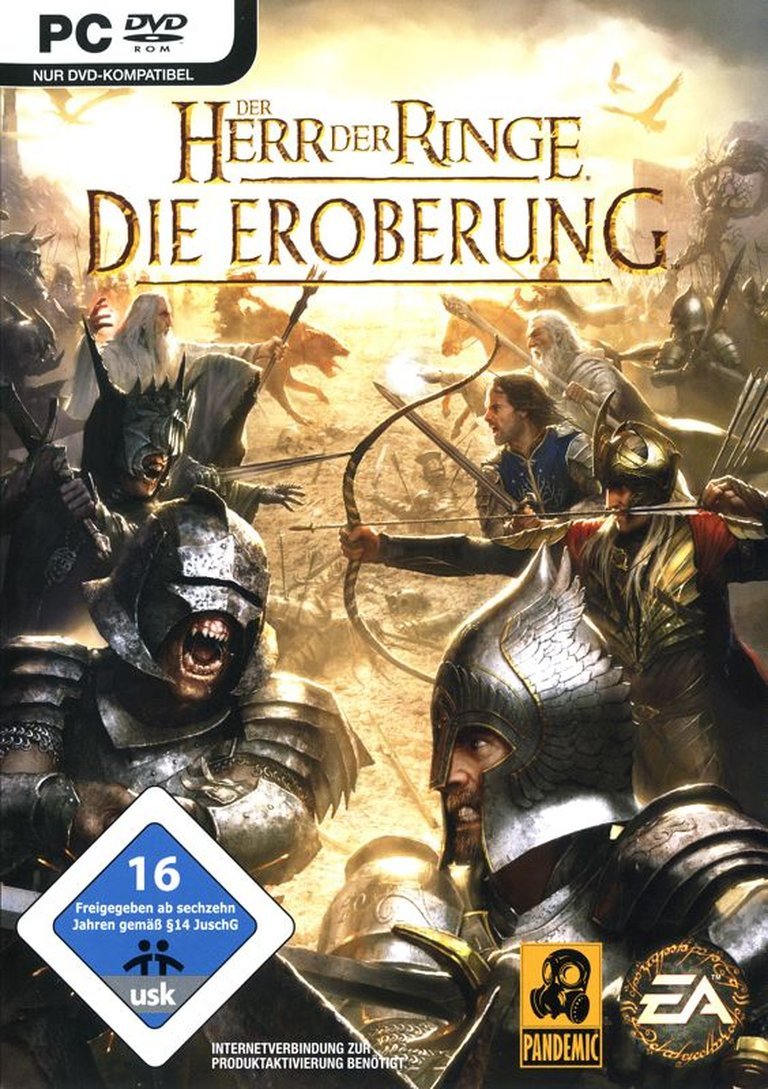
The Lord of the Rings: Conquest immerses players in the epic battles of Middle-earth’s Third Age, including iconic conflicts like Helm’s Deep, Gondor, and the Black Gate. Offering two campaigns where players can fight for either the forces of good or evil, the game features a third-person perspective with four distinct classes—Warrior, Mage, Scout, and Archer—each with unique abilities and special attacks fueled by energy gained from defeating enemies. Players can engage in large-scale combat on foot, mount horses, or wield battlefield siege weapons like catapults, with single-player missions dynamically spawning heroes like Gandalf and the Balrog, while multiplayer supports up to 16 players across modes like Conquest, Team-Deathmatch, and Find the Ring.
Gameplay Videos
Where to Buy The Lord of the Rings: Conquest
PC
The Lord of the Rings: Conquest Free Download
The Lord of the Rings: Conquest Patches & Updates
The Lord of the Rings: Conquest Guides & Walkthroughs
The Lord of the Rings: Conquest Reviews & Reception
metacritic.com (55/100): We are going to go ahead and declare The Lord of the Rings: Conquest as a great game concept.
ign.com : Thankfully it’s the near perfect use of the franchise that is the game’s silver lining; it’s just too bad that the core design can’t quite stack up.
gamesradar.com : Battlefront managed a thoroughly decent bit of shooty-shooty-bang-bang between Empire and Rebel forces, but Conquest takes its cue from Dynasty Warriors and makes the combat so intangible and repetitive, and the combo system so incompetent there’s not a single decent punch-up to be had.
The Lord of the Rings: Conquest Cheats & Codes
PlayStation 3
Enter button combinations during gameplay.
| Code | Effect |
|---|---|
| Hold Weak Attack, then press Jump (Eowyn) | Invincible front flip |
| Hold Strong Attack for 5s, then press Weak Attack (Aragorn) | Summons army of the dead |
| Hold Weak Attack for 5s, then press Jump (Legolas) | Ride on shield |
Nintendo DS
Enter codes via Action Replay device.
| Code | Effect |
|---|---|
| 62100c14 00000000 62000000 1c02b405 e2000000 00000024 1c02b405 68004806 d10242b0 42885a80 bc05dc02 e0005231 38d8bc05 46c04770 027e144c 00000000 d0000000 00000000 62100c14 00000000 521145b8 38d85231 52000000 1c02b405 021145b8 fd22f6eb d0000000 00000000 |
Infinite Health |
| 62100c14 00000000 9211205a 00005281 1211205a 000046c0 d0000000 00000000 |
Infinite Mana |
| 94000130 fe7f0000 62100c14 00000000 5203b4b0 8ca884a8 1203b4b0 000046c0 d0000000 00000000 94000130 febf0000 5203b4b0 8ca846c0 1203b4b0 000084a8 d0000000 00000000 52100c14 00000000 5203b4b0 8ca846c0 1203b4b0 000084a8 d0000000 00000000 |
Stop Timer (R+Down) / Start Timer (R+Up) |
The Lord of the Rings: Conquest: Review
Introduction
From the hallowed halls of Helm’s Deep to the fiery plains of Mordor, The Lord of the Rings: Conquest promised players a chance to rewrite history as both hero and villain in Middle-earth’s most iconic battles. Developed by Pandemic Studios—creators of the beloved Star Wars: Battlefront series—this 2009 action title arrived at a pivotal moment in gaming, leveraging the cultural omnipotence of Peter Jackson’s film trilogy to deliver a “hyper real” war experience. Yet, while its ambition was undeniable, Conquest emerged as a fascinating paradox: a game that captured fleeting moments of chaotic brilliance only to be undone by technical flaws, design inconsistencies, and a failure to honor its own epic promise. This review dissects Conquest as both a product of its time and a cautionary tale about the perils of licensed game development.
Development History & Context
Pandemic Studios approached Conquest with the battle-tested blueprint of Star Wars: Battlefront, transposing its class-based multiplayer framework into Tolkien’s meticulously crafted world. The studio’s vision, articulated by director Eric Gewirtz, was to craft an experience that felt “more than just the movies,” blending film authenticity with original gameplay twists. Technologically, Conquest built upon Pandemic’s proprietary Zero engine, upgraded to support 150 units on-screen—a notable feat for 2009. Weta Digital’s involvement added credibility, providing digitized assets like fell beasts and leveraging film-cut footage for cutscenes.
Released in January 2009 for Windows, PlayStation 3, and Xbox 360, Conquest arrived amid the twilight of the seventh console generation. The gaming landscape was saturated with licensed titles, and Battlefront’s formula remained a gold standard for large-scale warfare. Pandemic, however, was in flux: Mercenaries 2: World in Flames (2008) had been critically panned, and The Dark Knight tie-in was canceled mid-development. This context explains Conquest’s rushed feel—it was a game where ambition outpaced polish, with features like mounts and hero control added late in development after demos showed demand. The Nintendo DS version, handled by Artificial Mind & Movement, further diluted the experience, stripping away classes and mounts for an isometric perspective.
Narrative & Thematic Deep Dive
Conquest’s narrative is split into two campaigns: “War of the Ring” (good) and “Rise of Sauron” (evil). The former loosely adapts key battles from the films—Helm’s Deep, the Battle of the Black Gate—while the latter reimagines history by positing Frodo’s failure to destroy the Ring. This “what if” premise is Conquest’s most intriguing narrative element, allowing players to assault Minas Tirith as Oliphaunts or besiege Rivendell as Sauron. Yet, the execution is perfunctory. Cutscenes splice together film footage with awkwardly recorded narration by Hugo Weaving, whose Elrond voiceover feels disconnected from the gameplay. In-game dialogue is a cacophony of repetitive orders (“Hold the gate!”) and cringeworthy overacting, reducing epic moments to caricature.
Thematically, Conquest leans into Tolkien’s core duality of good versus evil but lacks nuance. The evil campaign, while conceptually bold, reduces Sauron’s conquest to simplistic power fantasies. Characters like Gandalf or Aragorn appear as playable “hero” archetypes rather than developed figures, their presence feeling more like fan-service than narrative integration. The game’s greatest thematic misstep is its failure to convey scale: battles are advertised as “epic,” but players fight in confined arenas against respawning foes, with “thousands of enemies” relegated to looping background animations. This disconnect undermines Tolkien’s themes of overwhelming odds and hope, reducing the War of the Ring to a series of isolated skirmishes.
Gameplay Mechanics & Systems
Conquest’s core gameplay mirrors Battlefront’s class-driven chaos. Players choose from four archetypes: the melee-focused Warrior, the long-range Archer, the stealthy Scout, and the spell-slinging Mage. Each class has distinct abilities—Warriors gain energy for combos by killing enemies, Archers use fire/poison arrows, Scouts turn invisible for backstabs, and Mages heal allies or project shields. These systems, however, are undermined by severe balance issues. Mages dominate with impenetrable shields and area-of-effect attacks, while Scouts can one-shot heroes with backstabs. Warriors feel sluggish, and Archers rely on repetitive headshots. The energy mechanic, intended to add strategy, devolves into button-mashing as players spam special attacks between enemy spawns.
Combat is further hampered by unresponsive controls and poor AI. Allies and enemies alike behave erratically—NPCs walk into walls, bosses fall off cliffs, and respawns are punishingly unforgiving, forcing players to restart entire levels after losing all lives. Despite these flaws, Conquest shines in moments of unbridled chaos. Controlling heroes like Gandalf or villains like the Balrog, or mounting Oliphaunts to trample hordes, delivers fleeting catharsis. Multiplayer modes—including “Conquest” (capture-and-hold objectives), “Team Deathmatch,” and “Find the Ring” (a flag variant)—support 16 players, emphasizing chaotic teamwork. Yet, lag and a lack of bots on PC made online play inconsistent, and servers were shut down by 2010.
World-Building, Art & Sound
Conquest excels at re-creating Middle-earth’s visual identity. Environments like Minas Tirith’s white marble or Moria’s cavernous depths are lifted directly from Jackson’s films, benefiting from Howard Shore’s iconic score. The soundtrack—featuring tracks like “The Bridge of Khazad-Dûm” and “The Ride of the Rohirrim”—elevates battles, even if the game’s own audio design falters. Character models resemble their film counterparts, but animations are stiff and textures blur into “a messy brown blur” (IGN UK). The DS version, with its isometric view and muddy sprites, further highlights the limitations of Pandemic’s vision.
Sound design is a mixed bag. Hugo Weaving’s narration provides gravitas, but in-game voice acting is gratingly overdone, with officers barking orders in jarring, looped phrases. Environmental effects—clashing swords, Oliphaunt trumpets—are atmospheric but lack immersion. Ultimately, Conquest captures Tolkien’s world superficially: its landscapes are recognizable, but they fail to evoke the trilogy’s sense of wonder or dread. The game’s art direction prioritizes familiarity over originality, resulting in a world that feels less like a living, breathing Middle-earth and more like a movie-themed diorama.
Reception & Legacy
Upon release, Conquest received mixed-to-negative reviews, with a 58% average on Metacritic. Critics praised its ambition and multiplayer but lambasted its execution. Game Informer called it “a joyless trip,” while IGN lamented its “poorly designed” combat. Player reviews on MobyGames averaged 3.6/5, with one noting: “It messes up a lot, but when it gets something right, it gets it really right”—a sentiment echoed by those who enjoyed chaotic split-screen sessions despite technical woes.
Commercially, Conquest underperformed, becoming the last LOTR title published by EA before the license shifted to Warner Bros. Its legacy is one of “what could have been.” The game is remembered for its innovative evil campaign and hero moments but criticized for its rushed state. It influenced few future titles, though its Battlefront-like formula foreshadowed the hero-shooter trend. In retrospect, Conquest stands as a relic of an era when licensed games prioritized brand loyalty over polish—a cautionary study in unfulfilled potential.
Conclusion
The Lord of the Rings: Conquest is a game of glorious contradictions. Its premise—to fight in Middle-earth’s pivotal battles as both hero and villain—remains intoxicating, and moments of multiplayer catharsis or hero-powered mayhem still resonate. Yet, these highlights are islands in a sea of mediocrity: combat is repetitive, the narrative is threadbare, and technical issues plague every system. Pandemic Studios crafted a game that felt like a mod for Battlefront rather than a standalone epic, one that leveraged Tolkien’s world without honoring its depth.
For modern players, Conquest is a curio—a flawed time capsule of 2009’s licensed game landscape. It offers fleeting fun for Tolkien completists or Battlefront purists but fails to justify a revisit beyond nostalgia. In the pantheon of LOTR games, it ranks among the most disappointing, a reminder that even the most promising concepts can crumble under the weight of rushed development and design myopia. Verdict: A fascinating failure—ambitious, chaotic, and ultimately forgettable.