
- Release Year: 1993
- Platforms: Amiga CD32, Amiga, DOS, Game Boy Advance, Genesis, SNES, Windows
- Publisher: Accolade, Inc., Blizzard Entertainment Inc., Interplay Productions, Inc., Nintendo UK Entertainment Limited, T&E Soft, Inc., Virgin Interactive Entertainment (Europe) Ltd., Vivendi Universal Games, Inc.
- Developer: Silicon & Synapse, Inc.
- Genre: Action, Puzzle
- Perspective: Side view
- Game Mode: Single-player
- Gameplay: Character Switching, Inventory management, Platform, Puzzle
- Setting: Fantasy, Futuristic, Sci-fi
- Average Score: 75/100
Description
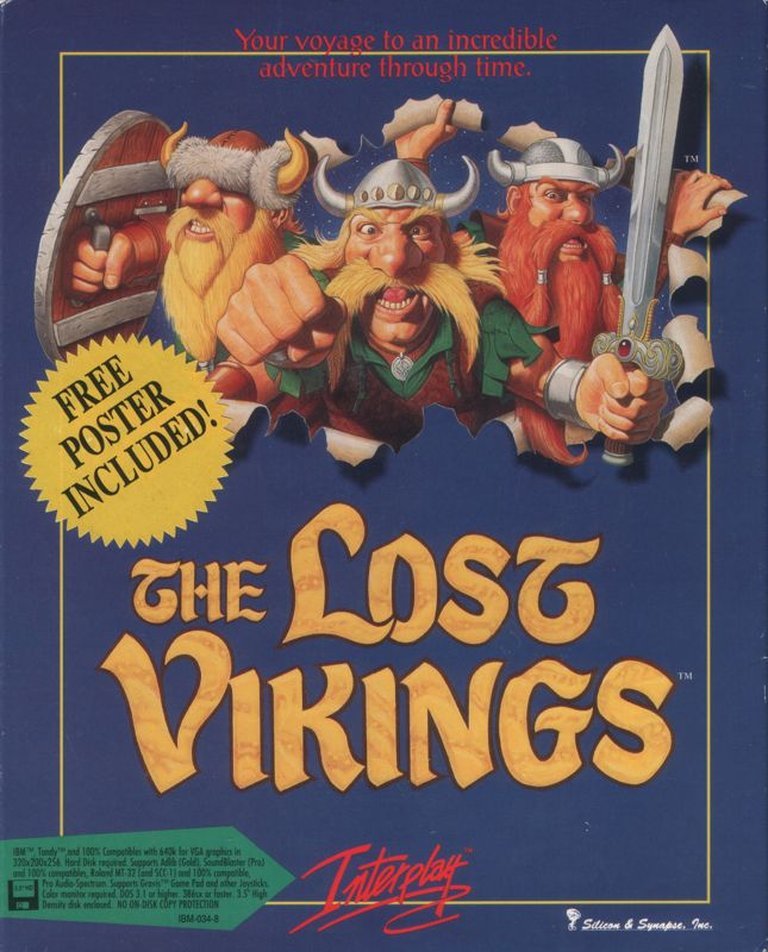
The Lost Vikings is a classic side-scrolling puzzle-platformer where three distinct Viking heroes—Eric the Swift, Olaf the Stout, and Baleog the Fierce—each possess unique abilities like agility, defensive shielding, and archery. Kidnapped by the alien Tomator, they must collaborate to navigate through comical, challenging levels blending fantasy and sci-fi elements, solving puzzles and overcoming enemies to escape and defeat their captor.
Gameplay Videos
Where to Buy The Lost Vikings
PC
The Lost Vikings Free Download
The Lost Vikings Guides & Walkthroughs
The Lost Vikings Reviews & Reception
metacritic.com (75/100): Simple and addictive.
The Lost Vikings Cheats & Codes
Super Nintendo
| Code | Effect |
|---|---|
| 1D23-D7AF | Infinite HP For All Vikings (Instant Death Still Kills You) |
| XX62-0FD4 | Start At Level X (Skips Logos & Intro) |
| DD | Level 1 |
| DF | Level 2 |
| D4 | Level 3 |
| D7 | Level 4 |
| D0 | Level 5 |
| D9 | Level 6 |
| D1 | Level 7 |
| D5 | Level 8 |
| D6 | Level 9 |
| DB | Level 10 |
| DC | Level 11 |
| D8 | Level 12 |
| DA | Level 13 |
| D2 | Level 14 |
| D3 | Level 15 |
| DE | Level 16 |
| FD | Level 17 |
| FF | Level 18 |
| F4 | Level 19 |
| F7 | Level 20 |
| F0 | Level 21 |
| F9 | Level 22 |
| F1 | Level 23 |
| F5 | Level 24 |
| F6 | Level 25 |
| FB | Level 26 |
| FC | Level 27 |
| F8 | Level 28 |
| FA | Level 29 |
| F2 | Level 30 |
| F3 | Level 31 |
| FE | Level 32 |
| 4D | Level 33 |
| 4F | Level 34 |
| 44 | Level 35 |
| 47 | Level 36 |
| 40 | Level 37 |
| 49 | Continue Screen |
| 41 | Title Screen |
| 45 | Interplay Logo |
| 46 | Silicon & Synapse Logo |
| 4B | Scene With Vikings Warping |
| 4C | Main Menu |
| 48 | Intro Part I |
| 4A | Intro Part II |
| 42 | Ending Part I |
| 43 | Ending Part II |
| 4E | Credits |
| GR8T | Start game at level 2 |
| TLPT | Start game at level 3 |
| GRND | Start game at level 4 |
| LLM0 | Start game at level 5 |
| FL0T | Start game at level 6 |
| TRSS | Start game at level 7 |
| PRHS | Start game at level 8 |
| CVRN | Start game at level 9 |
| BBLS | Start game at level 10 |
| VLCN | Start game at level 11 |
| QCKS | Start game at level 12 |
| PHR0 | Start game at level 13 |
| C1R0 | Start game at level 14 |
| SPKS | Start game at level 15 |
| JMNN | Start game at level 16 |
| TTRS | Start game at level 17 |
| JLLY | Start game at level 18 |
| PLNG | Start game at level 19 |
| BTRY | Start game at level 20 |
| JNKR | Start game at level 21 |
| CBLT | Start game at level 22 |
| H0PP | Start game at level 23 |
| SMRT | Start game at level 24 |
| V8TR | Start game at level 25 |
| NFL8 | Start game at level 26 |
| WKYY | Start game at level 27 |
| CMB0 | Start game at level 28 |
| 8BLL | Start game at level 29 |
| TRDR | Start game at level 30 |
| FNTM | Start game at level 31 |
| WRLR | Start game at level 32 |
| TRPD | Start game at level 33 |
| TFFF | Start game at level 34 |
| FRGT | Start game at level 35 |
| 4RN4 | Start game at level 36 |
| MSTR | Start game at level 37 |
| 7E0FE908 | Infinite HP For All Vikings (Instant Death Still Kills You) |
| 7E19DDXX | Level Select |
| 7E0402XX | Erik’s Item Slot #1 |
| 7E0404XX | Erik’s Item Slot #2 |
| 7E0406XX | Erik’s Item Slot #3 |
| 7E0408XX | Erik’s Item Slot #4 |
| 7E040AXX | Balrog’s Item Slot #1 |
| 7E040CXX | Balrog’s Item Slot #2 |
| 7E040EXX | Balrog’s Item Slot #3 |
| 7E0410XX | Balrog’s Item Slot #4 |
| 7E0412XX | Olaf’s Item Slot #1 |
| 7E0414XX | Olaf’s Item Slot #2 |
| 7E0416XX | Olaf’s Item Slot #3 |
| 7E0418XX | Olaf’s Item Slot #4 |
| Hold A + X + B + Y | advance to the next level |
| PRKS | Start game at level 7 |
| TR33 | Start game at level 10 |
| CIR0 | Start game at level 14 |
| SNDS | Start game at level 17 |
| TMPL | Start game at level 18 |
| RVTS | Start game at level 24 |
| HOPP | Start game at level 26 |
| WK99 | Start game at level 30 |
| PDDY | Start game at level 36 |
| 4RN4 | Start game at level 40 |
| MSTR | Start game at level 41 |
| 0CLK | Access level 12 |
| BBLL | Access level 22 |
| H0PP | Level 29 |
| JLLY | Level 24 |
PC
| Code | Effect |
|---|---|
| m0my | Level Select |
| TLPT | Start game at level 2 |
| GRND | Start game at level 3 |
| LLMO | Start game at level 4 |
| FLOT | Start game at level 5 |
| TRSS | Start game at level 6 |
| PRHS | Start game at level 7 |
| CVRN | Start game at level 8 |
| BBLS | Start game at level 9 |
| TR33 | Start game at level 10 |
| VLCN | Start game at level 11 |
| QCKS | Start game at level 12 |
| PHR0 | Start game at level 13 |
| CIR0 | Start game at level 14 |
| SPKS | Start game at level 15 |
| JMNN | Start game at level 16 |
| SNDS | Start game at level 17 |
| TMPL | Start game at level 18 |
| TTRS | Start game at level 19 |
| JLLY | Start game at level 20 |
| PLNG | Start game at level 21 |
| BTRY | Start game at level 22 |
| JNKR | Start game at level 23 |
| RVTS | Start game at level 24 |
| CBLT | Start game at level 25 |
| HOPP | Start game at level 26 |
| SMRT | Start game at level 27 |
| V8TR | Start game at level 28 |
| NFL8 | Start game at level 29 |
| WK99 | Start game at level 30 |
| CMB0 | Start game at level 31 |
| 8BLL | Start game at level 32 |
| TRDR | Start game at level 33 |
| FNTM | Start game at level 34 |
| WRLR | Start game at level 35 |
| PDDY | Start game at level 36 |
| TRPD | Start game at level 37 |
| TFFF | Start game at level 38 |
| FRGT | Start game at level 39 |
| 4RN4 | Start game at level 40 |
| MSTR | Start game at level 41 |
| 0CLK | Access level 12 |
| BBLL | Access level 22 |
Amiga
| Code | Effect |
|---|---|
| 4RN4 | Level 36 |
| CBLT | Level 28 |
| FNTM | Level 31 |
| FRGT | Level 35 |
| H0PP | Level 29 |
| MSTR | Level 37 |
| TFFF | Level 34 |
| TRDR | Level 30 |
| TRPD | Level 33 |
| WRLR | Level 32 |
MS-DOS
| Code | Effect |
|---|---|
| 4RN4 | Level 36 |
| CBLT | Level 28 |
| FNTM | Level 31 |
| FRGT | Level 35 |
| H0PP | Level 29 |
| MSTR | Level 37 |
| TFFF | Level 34 |
| TRDR | Level 30 |
| TRPD | Level 33 |
| WRLR | Level 32 |
The Lost Vikings: A Masterclass in Cooperative Puzzle-Design
Introduction: The Triune Foundation of a Genre
In the pantheon of 16-bit era classics, few titles embody a specific, genre-defining innovation as perfectly as The Lost Vikings. Released in 1993 by Silicon & Synapse—the studio that would soon become Blizzard Entertainment—it did not merely add another title to the crowded platformer landscape; it architecturally redefined what cooperative gameplay could be on a home console. While contemporaries focused on single-hero power fantasies or direct multiplayer combat, The Lost Vikings presented a cerebral, interdependent puzzle-box where victory was impossible without the harmonious execution of three distinct, limited abilities. Its legacy is twofold: as a pristine example of puzzle-platforming excellence and as the foundational blueprint for Blizzard’s enduring design philosophy of “easy to learn, hard to master” synergy, later perfected in Warcraft, StarCraft, and Heroes of the Storm. This review asserts that The Lost Vikings is not just a great game of its time, but a timeless design achievement whose core loop of strategic character-switching remains a profoundly influential and underserved mechanic in modern gaming.
Development History & Context: From Lemmings Hordes to a Trio of Heroes
The game’s genesis lies directly in the shadow of DMA Design’s Lemmings (1991). The Silicon & Synapse team, led by co-founders Allen Adham, Michael Morhaime, and Frank Pearce, and designer Ron Millar Sr., was captivated by the emergent, systemic puzzle-solving of directing a crowd. Their initial prototype was an ambitious evolution: managing hundreds of tiny, 8-pixel-tall Vikings, each with tools like torches and ladders, tasked with conquering fortifications in a side-scrolling warzone. This vision, however, collided with the stark realities of early 90s console hardware, particularly the Super Nintendo Entertainment System (SNES).
The SNES imposed severe constraints: a limited number of on-screen sprites, memory restrictions, and a tight color palette (just 15 colors per sprite). These technical shackles forced a critical refinement. As recounted in Blizzard’s own post-mortem analyses, the team scaled back from a horde to five, then to the iconic trio of Erik, Baleog, and Olaf. This reduction was not a compromise but a serendipitous masterstroke. It transformed the gameplay from logistical crowd management to intimate, strategic triage. Each Viking had to be a keystone, not a cog, elevating the puzzle complexity from “where do I send 100 lemmings?” to “which Viking do I control right now to solve this specific spatial problem?”
This scaling also influenced the game’s iconic visual identity. To ensure the characters popped on television screens (a concern amplified by co-founder Allen Adham’s colorblindness), artists Clyde Matsumoto, Jason Magness, and Joeyray Hall employed a aggressively vibrant, cartoonish palette. They favored bold, saturated hues over realism, a choice that gave the game its enduring, cheerful aesthetic and compensated for the SNES’s color limitations. The development cycle was remarkably swift for a team that never exceeded about a dozen people, spanning several months in 1992. Playtesting, led by Adham, was instrumental in shaping the difficulty curve; a famous anecdote details an early tester dying repeatedly to a simple pitfall, prompting the team to ensure level introductions were more forgiving, teaching mechanics without punitive repetition.
The game was built for the SNES first (April 1993 NA release), but its cross-platform journey is a study in 16-bit porting politics. The Amiga and DOS versions (1993) were direct ports. The Sega Genesis/Mega Drive version (1994) was the most divergent, adding five exclusive levels and a two-player cooperative mode (with an optional multitap for three), but suffering from toned-down graphics and sound due to the Genesis’s inferior color palette and audio hardware. The Amiga CD32 port (1994) was widely criticized as a lazy, unenhanced cash-grab. This version fragmentation is crucial to understanding the game’s historical reception, as purists often debate which port best captured the original vision.
Narrative & Thematic Deep Dive: Absurdism as a Design Pillar
The plot of The Lost Vikings is a paper-thin, gloriously absurd MacGuffin. Three stereotypical Norse warriors—Erik the Swift, Baleog the Fierce, and Olaf the Stout—are plucked from their mead-hall by Tomator, the despotic emperor of the “Croutonian” empire, for his intergalactic zoo. A chaotic escape scatters them through time via malfunctioning portals, leading them through prehistoric jungles, Egyptian pyramids, futuristic factories, and surreal “wacky” realms before a final showdown on Tomator’s mothership.
This narrative is not a vehicle for deep lore but a flexible, humorous Scaffolding. Its primary function is to justify the game’s eclectic level themes and anachronistic humor. The Vikings, armed with swords, bows, and shields, blithely confront dinosaurs, mummies, and laser-grid robots. This collision of eras generates a consistent, gentle satire of both sci-fi abduction tropes and Viking clichés. They are not noble saga heroes; they are goofy, perpetually complaining cartoons trapped in a deadly game show.
The thematic heart of the game is cooperation as survival. The narrative frames the three as literal brothers (“the Viking brothers”), and the gameplay mechanically enforces their interdependence. They cannot progress alone; their escape is a literal team effort. This is reinforced by the game’s famous, dynamic dialogue system. Between levels, the Vikings bicker, insult the player’s competence after repeated failures, and offer non-sequitur complaints (“I’m hungry,” “My helmet itches”). More profoundly, if a player fails a level multiple times, the Vikings will begin to consult Norse gods (Odin, Thor) for help, breaking the fourth wall with self-aware desperation. This “hidden dialog” (as noted in MobyGames trivia) is a landmark in character-building for the era, giving the trio personalities that extend beyond their skill sets and making their inevitable success feel like a earned camaraderie.
Gameplay Mechanics & Systems: The Elegant Trinity
The Lost Vikings is a side-scrolling puzzle-platformer where the player controls one Viking at a time, switching instantly between them to navigate hazardous levels. The core, immutable rule: all three must reach the exit alive. A single death renders the level unwinnable, forcing a full restart. This “single-point-of-failure” design is the game’s central tension and genius.
Each Viking is a fixed, non-upgradable tool:
* Erik the Swift: The agile scout. He runs faster, jumps (the only character who can), and performs a helmet bash to break specific walls/stun enemies. His mobility makes him the key to verticality and scouting paths.
* Baleog the Fierce: The combat specialist. He wields a sword for melee and a bow with a “lifetime supply of arrows” for ranged attacks. His bow can hit distant switches, making him the primary tool for activating remote mechanisms and clearing enemy threats.
* Olaf the Stout: The defensive tank. His large shield can block projectiles and melee attacks. More creatively, he can raise it overhead to glide slowly downward (functioning as a parachute or a raft over water) and, most critically, plant it on the ground to create a stationary platform for the others to stand on.
These abilities are not balanced in a traditional RPG sense but in a spatial puzzle sense. Erik’s jump is useless without Olaf’s platform or Baleog clearing the landing zone. Baleog’s range is moot if he can’t reach a switch, requiring Erik’s speed or Olaf’s platform. Olaf’s shield is immobile, needing Erik or Baleog to get him into position. The player’s mental model becomes one of a mobile, three-part machine: positioning, sequencing, and timing are everything.
Inventory & Progression: Vikings can carry one item each (keys, bombs, food that heals 1 HP). Items can be passed between them when in proximity, creating secondary puzzles about item logistics. Health is a mere 3 hit points, and death is often instant from spikes, pits, or certain enemies. There is no character progression; the challenge derives entirely from level design and the player’s mastery of the trio’s fixed toolkit.
Level Structure: The SNES version contains 37 levels across six worlds (Spaceship, Prehistoric, Egyptian, Industrial, “Wacky,” and Final Spaceship). The Genesis version expands this to 42 levels with five exclusive stages. Levels are discrete puzzle chambers, often with multiple sub-areas. The password system (replaced by battery-backed saves in the GBA port) encourages replaying favorite puzzles. The unlimited continues soften the brutal penalty of failure, turning death into a learning tool rather than a resource drain.
Innovations & Flaws: The system was revolutionary. The seamless, real-time character switch (no pause menu) kept tension high. The cooperative design was baked into single-player, a novel approach that later games like Trine would emulate. However, flaws emerged. Controls could be imprecise, especially on keyboard (DOS/Amiga) versus the SNES’s superior gamepad. Jumping physics were sometimesfloaty. The “unwinnable” state after one death, while thematically consistent, could lead to frustrating restarts of long, complex levels—a pain point noted by many contemporary reviewers. The lack of a “rewind” or “browse” function (unlike Lemmings) was a significant omission.
World-Building, Art & Sound: A Vibrant, Thematic Menagerie
The game’s settings are a greatest hits of pulp adventure tropes: a claustrophobic alien spaceship, lush prehistoric jungles with dinosaurs, sandy Egyptian tombs with mummies, grimy factory belts with steam vents, and a psychedelic “wacky” world full of giant fruits and candy. This time-hopping framework, while nonsensical, provides immense visual variety and reinforces the comedy of Vikings out of time.
Visual Direction: The SNES version is widely regarded as the pinnacle. The hand-drawn, sprite-based artwork is rich with personality. Animations are exaggerated and humorous: Vikings get electrocuted and turn to skeletons, slide into quicksand waving goodbye, or get comically flattened. The backgrounds, while not parallax-scrolling heavy, are detailed with environmental storytelling—crumbling stone, flickering monitors, bubbling lava. The color palette, as noted, is deliberately bold and bright, a direct response to hardware limits that became an aesthetic strength. The Genesis port’s downgrade to a more muted, limited palette was a common criticism. The Amiga version, while detailed, suffered from color constraints but was still praised for its “Amiga in origin” charm.
Sound Design: Composer Charles Deenen (with Allister Brimble on Amiga, Matt Furniss on Genesis) crafted a chiptune masterpiece. The soundtrack is famously thematic and adaptive. The spaceship features a funky, electronic “dancefloor” beat. Prehistoric levels use primal drum rhythms. The Egyptian world employs exotic, melodic percussion. The factory is all clanging industrial noise. This musicality does heavy thematic lifting, instantly orienting the player to each world’s mood. The iconic, upbeat main theme is endlessly catchy. Sound effects are sharp and comedic—the Viking grunts, the thwack of Erik’s helmet, the twang of Baleog’s bow, the metallic clang of Olaf’s shield.
Together, art and sound create a cohesive, immersive, and fun atmosphere. The game never takes itself seriously, and this consistent, high-quality presentation ensures the humor never falls flat.
Reception & Legacy: Critical Darling and Genre Architect
Contemporary Reception (1993-1994): The Lost Vikings was a critical success across platforms, though scores varied. The SNES version averaged in the high 80s/90s, with Nintendo Power ranking it the 7th best SNES game of 1993. Amiga World gave it a perfect 100%, calling it “a splendid arcade/puzzler.” Praise universally centered on its innovative mechanics, humor, and charm. Criticisms were consistent: control precision issues (especially on PC), punishing difficulty spikes in later levels, and the lack of a save/rewind feature.
Port-specific critiques were harsh. The Amiga CD32 version was panned as “shovelware” for its lack of enhancements. The Genesis version was praised for its extra levels and co-op but docked for inferior audiovisuals. The core gameplay, however, was almost universally hailed as fresh and compelling. Computer Gaming World called it “a clever blend of comedy and role-playing,” while VideoGames & Computer Entertainment championed its “funny, fresh and challenging” design.
Long-Term Assessment & Cult Status: Retrospectives have cemented its status. IGN ranked it #30 on its “Top 100 SNES Games of All Time,” calling it a “Masterpiece” with “nearly perfect puzzle dynamics.” It is frequently cited as the direct predecessor to the Trine series, which adopted the three-character, ability-switching formula into a beautiful 3D space. Its influence on Blizzard’s own design is inescapable: the core tenets of unit diversity, synergy, and emergent problem-solving became the bedrock of Warcraft’s RTS formula and Heroes of the Storm’s MOBA design, where the Vikings themselves returned as a single, tripartite hero.
Cameos & Cultural Footprint: The Vikings’ cameo appearances are a testament to their iconic status. They appear as secret characters in Rock n’ Roll Racing (1993) and Blackthorne (32X), as subtle sculptures in ClayFighter 2, and achieved their most significant legacy as recurring NPCs in World of Warcraft (Uldaman dungeon, Cataclysm Badlands quests, Dragonflight remake). Their names are even used for StarCraft II units and dialogues. This integration into Blizzard’s broader universe elevated them from a one-off game to foundational franchise lore.
Modern Re-releases & Preservation: The game’s journey through digital storefronts is a story of preservation. Its 2014 free release on Battle.net (via DOSBox) introduced it to a new generation. The definitive modern edition is the Blizzard Arcade Collection (2021) for Switch, PS4, Xbox One, and PC. This compilation is exemplary, offering both the purist SNES version and the expanded Genesis version, plus a clever “Definitive Edition” that merges the SNES’s superior audiovisuals with the Genesis’s extra levels and 3-player co-op. It adds rewinds, save states, and watch modes—quality-of-life features that elegantly solve the original’s frustration points without altering its core design. Its inclusion in Xbox Game Pass (2025) further secures its accessibility.
Conclusion: An Enduring Blueprint
The Lost Vikings is more than a nostalgic artifact; it is a masterclass in systemic game design. Its premise—three limited beings, one goal, inexorably linked—is deceptively simple. The genius lies in the breathtaking, almost冷酷的 elegance of its puzzles, which never rely on twitch reflexes or hidden items but on the player’s understanding of a spatial logic built from three distinct verbs: jump/bash, shoot/fight, block/glide/platform. The humorous writing and vibrant art provide a delightful veneer, but the mechanical core is what has endured.
Its flaws are of its era: the control stiffness, the brutal restart penalty, the password system. Yet, the Blizzard Arcade Collection’s modern enhancements mitigate these without compromising the original’s stern, rewarding integrity. The game’s true legacy is twofold. First, it proved that cooperative gameplay could be deeply strategic and puzzle-focused even in a single-player context. Second, it established a design template that Blizzard would mine for decades: distinct, complementary roles creating emergent complexity. From the unit composition of StarCraft to the hero selection of Heroes of the Storm, the ghost of the three Vikings looms large.
In the history of video games, The Lost Vikings occupies a unique and hallowed space. It is not the most technically advanced, the most narratively deep, or the most commercially successful game of its time. It is, however, a perfectly realized fusion of concept and execution. It took a nascent idea (Lemmings), refined it under constraint, and produced a timeless puzzle. It is a game that demands—and rewards—thought, patience, and teamwork, both from the characters on screen and the player at the controller. For that, it deserves its place not just as a classic, but as a cornerstone in the architecture of cooperative game design. It is, unequivocally, one of the greats.