
- Release Year: 2005
- Platforms: PlayStation 2, Windows, Xbox
- Publisher: Akella, Atari Europe S.A.S.U., Atari, Inc., Mastertronic Games Ltd.
- Developer: Shiny Entertainment, Inc.
- Genre: Action
- Perspective: 3rd-person
- Game Mode: Single-player
- Gameplay: Beat ’em up, brawler, Time manipulation
- Setting: Cyberpunk, dark sci-fi, Futuristic, Sci-fi
- Average Score: 66/100
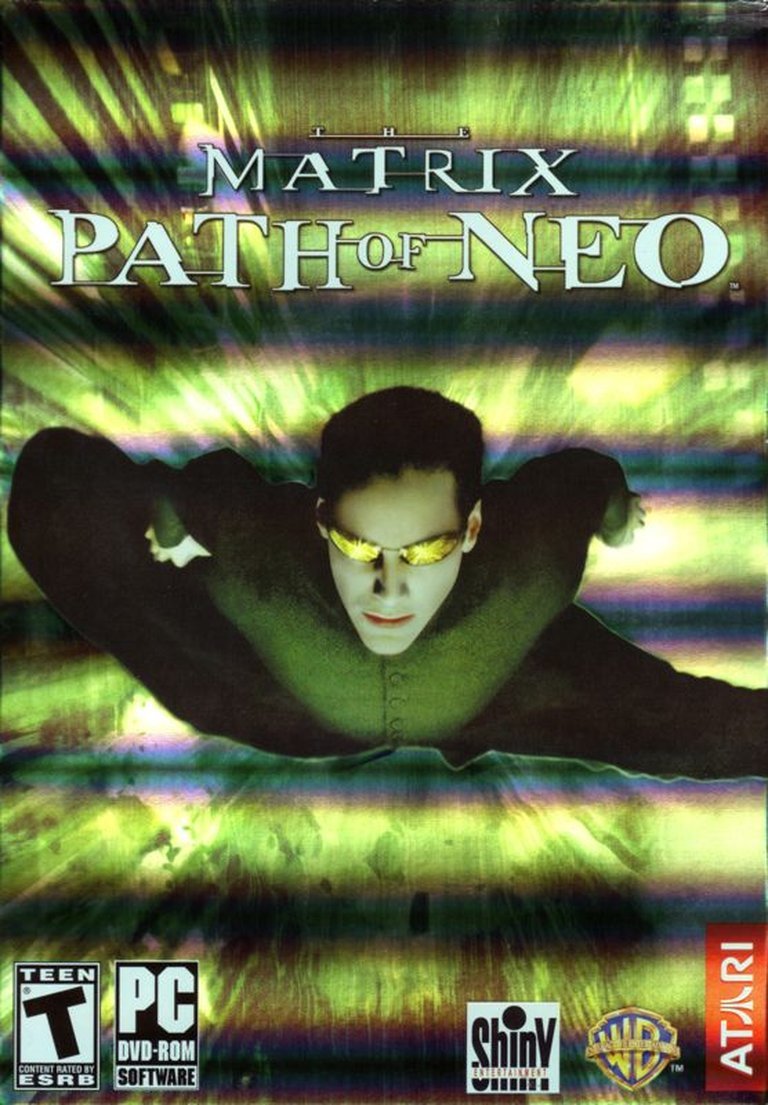
Description
The Matrix: Path of Neo by Shiny Entertainment allows players to experience Neo’s journey from his capture by agents to the final battle against Agent Smith, starting as the untrained Thomas Anderson and progressing through iconic events from the Matrix trilogy. Players develop combat skills through training and movie-inspired missions, enabling complex combos against upgraded agents, while also exploring in-depth storylines only briefly mentioned in the films.
Gameplay Videos
The Matrix: Path of Neo Free Download
The Matrix: Path of Neo Cracks & Fixes
The Matrix: Path of Neo Patches & Updates
The Matrix: Path of Neo Guides & Walkthroughs
The Matrix: Path of Neo Reviews & Reception
metacritic.com (69/100): At first, combat seems too twitchy and simplistic, while the training sequences last too long, but as you grow in power, and unlock your substantial latent wealth of special moves and combination plays, the rich combat possibilities reveal themselves.
ign.com (65/100): There’s a difference between knowing the path and walking the path.
games.criticker.com (67/100): Very good fun, though could have been amazing with better jumping mechanics and a better tutorial for the skill upgrades (or any tutorial at all). Was cool getting to play through the movies. Though they could’ve left out the final boss.
The Matrix: Path of Neo Cheats & Codes
PlayStation 2
| Code | Effect |
|---|---|
| Circle(2), X(3), Circle, Triange(3), X(2), Triangle | All Weapons |
PlayStation 2 (NTSC-U)
Enter codes using a CodeBreaker device.
| Code | Effect |
|---|---|
| B4336FA9 4DFEFB79 | Enable Code (Must Be On) |
| 0F4D95FA 21B9861E | Enable Code (Must Be On) |
| EAC25D22 E4DD4B8A | Enable Code (Must Be On) |
| EF2E73D4 57D8F417 | Enable Code (Must Be On) |
| 13AFEE4B F5AA3CF6 | Infinite Focus Usage |
| 0A7D32E5 F532792A | 1-Hit Death (Enemies) |
| B55DB282 C5EF44C2 | Infinite Ammo |
| FE0CE7AD 4A00CE74 | Max Infinite Ammo |
| 84B56627 6EB11DA1 | Extra Ammo |
| 434750E5 CBDF5DBE | Never Reload |
| 553F32BE A17A03FC | Infinite Health |
| A90F908E F59765E2 | Infinite Health |
| F6060B5B DDE9C59B | Infinite Focus |
| AA731C8E 5E8C012B | Infinite Focus |
| C31D75E1 BD514FDB | P1 Press R1+Select For More Upgrade Points |
| D775447A BF2F5FC2 | P1 Press R1+Select For More Upgrade Points |
| E94D4015 9B3D7E85 | P1 Press R+Select For No Upgrade Points |
| 75D11581 724B8FCB | P1 Press R+Select For No Upgrade Points |
The Matrix: Path of Neo: Review
Introduction
In the wake of The Matrix trilogy’s cultural revolution, gamers yearned for an experience that truly let them embody Neo’s journey—bullet dodges, reality-bending powers, and all. The Matrix: Path of Neo, the 2005 action-adventure developed by Shiny Entertainment and published by Atari, promised to deliver exactly that. As the direct sequel to the divisive Enter the Matrix, it shifted focus to the prophesied One himself, reimagining the trilogy’s pivotal moments through interactive gameplay. Yet, while the game’s ambition to replicate the films’ cyberpunk grandeur is undeniable, its execution is a study in contrasts: a loving homage to the Matrix universe shackled by technical flaws and design inconsistencies. This review deconstructs Path of Neo as both a piece of Matrix lore and a standalone game, arguing that despite its shortcomings, it remains a cult artifact for fans—a flawed but fascinating artifact of mid-2000s gaming ambition.
Development History & Context
Studio and Vision
Shiny Entertainment, the studio behind cult classics like Earthworm Jim and MDK, undertook Path of Neo as a redemption after the lukewarm reception of Enter the Matrix (2003). Led by president David Perry, the team aimed to rectify the prior game’s core failing: the absence of Neo as a playable character. As Perry stated, “Path of Neo is basically the game the gamers wanted first time around… The Neo Game!” The Wachowskis, who co-directed and wrote the game, ensured narrative fidelity by scripting original dialogue, designing exclusive missions, and even crafting a non-canonical ending. Their vision blended cinematic authenticity with interactive freedom, allowing players to reshape Neo’s journey while maintaining the trilogy’s philosophical underpinnings.
Technological Constraints and Era
Released on November 8, 2005, for PlayStation 2, Xbox, and PC, Path of Neo operated within the constraints of sixth-generation consoles. The PS2 version, as the lead platform, leveraged its hardware for advanced effects like image warping (simulating the Matrix’s visual distortion), but struggled with low-polygon models and blurry textures. Xbox and PC ports suffered further: the Xbox lacked widescreen support, while the PC version’s controls were notoriously unresponsive, forcing players to use gamepads for optimal play. The game’s custom engine, an evolution of Enter the Matrix’s tech, prioritized physics-based combat and destructible environments but faltered under the weight of ambitious ideas—like crowds of Agent Smiths—due to memory limitations.
Gaming Landscape
2005 was a brutal year for licensed games, with high-profile releases like Batman Begins and The Chronicles of Riddick setting new standards for cinematic adaptations. Path of Neo entered a market saturated with Matrix tie-ins, including the MMO The Matrix Online (2005). Its release timing capitalized on the trilogy’s post-Revolutions hype, but the competitive holiday window (against Call of Duty 2 and Madden NFL 06) limited its commercial potential. Despite Atari’s marketing—highlighting E3 demos and IGN’s world-exclusive trailer—the game’s rushed development, acknowledged by team members as “PTSD-inducing,” left it technically uneven.
Narrative & Thematic Deep Dive
Plot and Structure
Path of Neo retells the trilogy through Neo’s eyes, compressing three films into 25 missions. It opens with Thomas Anderson’s office escape, where players choose between red/blue pills (selecting blue ends the game). Neo’s journey—from Morpheus’s training (including a dojo battle against a wall-shattering Morpheus) to the defense of Zion—mirrors the films but expands on lore. Missions like “Matrix Errors” (inspired by The Animatrix) let players rescue glitch-causing characters, altering story branches. The narrative interweaves motion-captured gameplay with edited film clips, creating a hybrid experience that requires prior knowledge of the trilogy to appreciate its nuances.
Characters and Dialogue
Voice acting is a standout, featuring archival recordings of Keanu Reeves, Carrie-Anne Moss, and Laurence Fishburne. New dialogue, written by the Wachowskis, deepens character dynamics: Neo’s quips during combat reflect his growing confidence, while Trinity’s lines reinforce their partnership. The Merovingian and Oracle appear as exiled programs, their roles expanded to explore themes of control and choice. However, the script’s tonal shifts—from philosophical monologues to self-referential humor (e.g., Neo complaining about “lame” movie endings)—can jar the narrative cohesion.
Themes and Alternate Ending
Central themes of free will vs. determinism permeate the game. Branching paths (e.g., successful rooftop evasion vs. capture) emphasize player agency within a predestined universe. The game’s true legacy, however, lies in its alternate ending. Rejecting Revolutions’ sacrificial finale, the Wachowskis crafted a meta-spectacle: Neo battles “Mega Smith,” a skyscraper-sized fusion of Agent Smith clones, to Queen’s “We Are the Champions.” In a white void, the Wachowskis (as 8-bit sprites) mock the film’s ending as “Hulk vs. Galactus,” urging players to “enjoy enlightenment.” This fourth-wall break subverts the trilogy’s solemnity, prioritizing cathartic gameplay over canon—a bold, if polarizing, choice.
Gameplay Mechanics & Systems
Core Mechanics
Path of Neo blends beat ’em up, stealth, and light puzzle elements. As Neo, players navigate linear levels using WASD (PC) or analog sticks, with jump (X/A), evade (Square/X), and interact buttons. Focus Mode (activated by LShift/LB) triggers bullet time, slowing time for enhanced dodging, aerial attacks, and environmental takedowns. Health auto-regenerates after seven seconds of safety, while focus meters refill via yellow packs or successful combos.
Combat and Progression
Combat is the game’s strength and weakness. Melee combos—chainable into 6-hit sequences—feel cinematic, with moves like Bullet Stop (telekinetically halting bullets) and Flight (unlocked mid-game). Environmental weapons (pipes, swords) add variety, but targeting is imprecise in crowds. Ranged combat (dual-wielding guns) shines in Focus Mode, though auto-aim often fails. Progression uses a ring-based menu between missions: players choose permanent upgrades (e.g., extended combos) or temporary Atman Principles (e.g., ally healing). While the 600+ combos sound impressive, complex inputs (e.g., triple-directional + button presses) make execution frustrating, reducing combat to mashing in Focus Mode.
Level Design and Systems
Levels are a mixed bag. Iconic set pieces—the lobby shootout, chateau escape—are recreated with destructible environments, but padding missions (e.g., protecting a guard in a clock tower) test patience. Stealth sections rely on clunky wall-leaning, while vehicle segments (helicopter turret, motorcycle chases) feel tacked-on. Puzzles use Code Vision to reveal hidden paths, but objectives are often vague. Checkpoints are sparse, and respawn mechanics punish mistakes. Collectible code symbols unlock extras, encouraging replays, but the 8–12-hour campaign feels truncated.
World-Building, Art & Sound
Setting and Atmosphere
The Matrix’s dual worlds are recreated faithfully. The Matrix’s green-hued urban sprawl (offices, rooftops) contrasts with the Nebuchadnezzar’s gritty realism. Levels like the Kung Fu Dojo and Freeway Chase expand on film locations, while Animatrix-inspired dream sequences (e.g., “flowering glitches”) add surreal depth. However, the game’s cyberpunk atmosphere is undermined by inconsistent tone—a serious war narrative clashes with Mega Smith’s absurd boss battle.
Art and Visuals
Visually, Path of Neo is a product of its era. The PS2 version boasts the best effects (image warping), but low-polygon character models and blurry textures plague all platforms. The PC version’s higher resolution can’t fix its muddy aesthetics, while the Xbox’s 4:3 aspect ratio feels dated. Enemy design is strong—Agents’ angular models and Smith’s cloning effects are iconic—but environments lack detail. Loading screens use cascading green code to maintain immersion, but technical glitches (vanishing textures) break immersion.
Sound Design
Sound is where Path of Neo excels. The soundtrack, composed by Tobias Enhus with tracks from Junkie XL and Queen, perfectly mirrors the films’ blend of orchestral and electronic themes. Voice acting is impeccable, blending original cast lines with new performances. Sound effects—shattering glass, bullet ricochets—enhance combat, though crowd audio is repetitive. THX-enhanced sound on Xbox delivers dynamic audio, making Focus Mode’s slo-mo acoustics particularly visceral.
Reception & Legacy
Critical and Commercial Reception
Path of Neo received mixed reviews, with Metacritic scores averaging 69% (PS2), 73% (Xbox), and 64% (PC). Critics praised its combat, voice acting, and faithfulness to the source material. IGN lauded the lobby recreation and Focus Mode, while GamePro noted the “rich combat possibilities” as Neo’s powers grew. However, flaws dominated reviews: GameSpot criticized “chaotic hand-to-hand combat,” and Edge awarded a 5/10, calling it “unrefined.” Commercially, it sold 0.8 million copies—peaking at #69 in UK sales—and contributed 14.4% to Atari’s 2006 revenues, but Atari still reported $67.1 million in losses.
Evolution of Reputation
Over time, Path of Neo has been reevaluated as a cult classic. Fans praise its alternate ending and combat spectacle, while acknowledging its technical debt. Mod communities on PC added widescreen support and texture fixes, preserving its legacy. Speedrunning communities celebrate the game for its catharsis, with world records updated as recently as 2024. Retrospectives, like Polygon’s oral history, frame it as an ambitious “false prophet”—a game that almost captured the Matrix magic but was undone by rushed development.
Influence and Legacy
The game’s impact on the Matrix universe is thematic, not narrative. It expanded lore through original missions, influencing later transmedia projects like The Matrix Awakens (2021). Its emphasis on player agency (branching paths, upgrades) set a template for licensed games prioritizing fan service over strict canon. Yet, its technical flaws cemented it as a cautionary tale: even with creative vision, hardware limitations and rushed deadlines can cripple a game’s potential. For Matrix fans, it remains a time capsule—an imperfect but essential journey into the heart of the trilogy.
Conclusion
The Matrix: Path of Neo is a paradox: a game that fulfills the fantasy of being Neo while failing to transcend the mediocrity of its era. Its combat, when it clicks, is a ballet of bullet time and superhuman moves, and its narrative expansions—especially the Wachowskis’ self-aware ending—offer a unique spin on the trilogy’s themes. Yet, technical hiccups, clunky controls, and repetitive levels prevent it from greatness. Ultimately, it stands as a testament to the Matrix franchise’s enduring appeal—a flawed but fascinating artifact where ambition outpaced execution. For fans, it’s a worthy, if frustrating, pilgrimage into the heart of the Matrix. For historians, it’s a snapshot of mid-2000s gaming struggles: a licensed title that dared to dream big, even if its code couldn’t keep up.