
- Release Year: 2009
- Platforms: OnLive, Windows, Xbox 360
- Publisher: Microsoft Corporation, Twisted Pixel Games, LLC
- Developer: Twisted Pixel Games, LLC
- Genre: Action
- Perspective: Third-person
- Game Mode: Single-player
- Gameplay: Platforming, Puzzle elements, Quick Time Events
- Setting: Fantasy, Futuristic, Sci-fi
- Average Score: 76/100
Description
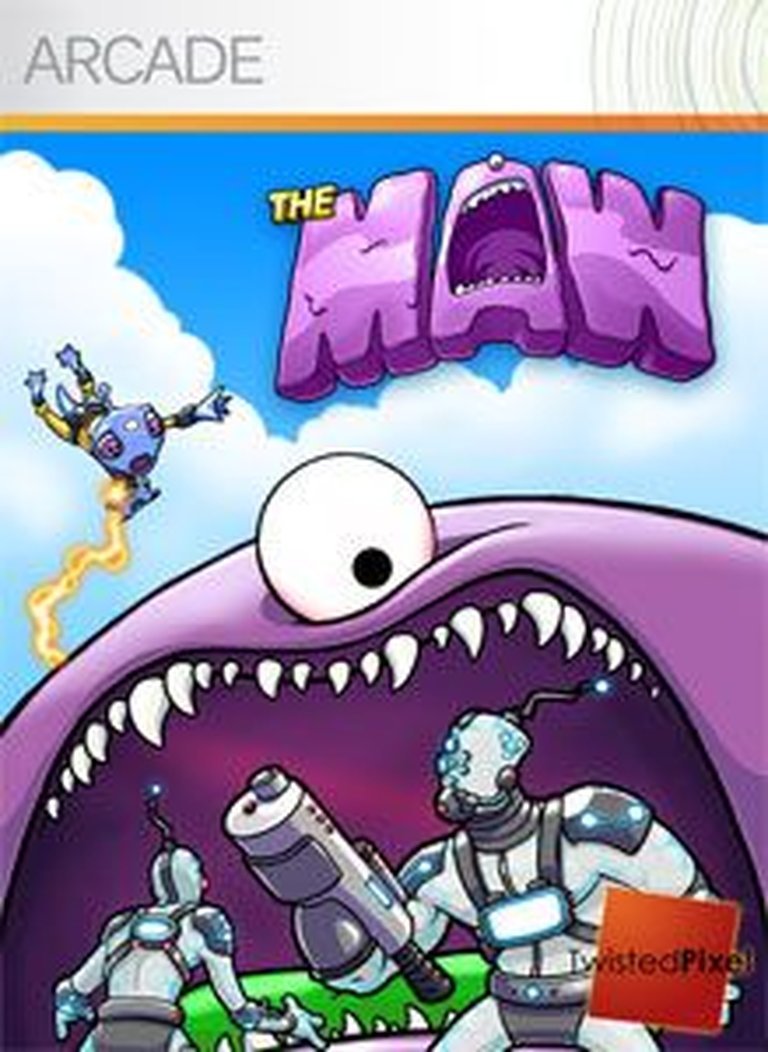
The Maw is a 3D third-person action game set on an exotic alien planet where a galactic bounty hunter’s spaceship crash-lands, leaving survivors Frank, a friendly alien, and Maw, a voracious blob-like creature known as the universe’s deadliest organism. Frank uses an electric leash to guide Maw through the world, feeding him various creatures that cause Maw to grow and gain special abilities—like breathing fire after eating lizards—to solve puzzles, overcome obstacles, and escape pursuing bounty hunters, blending platforming, action, and puzzle elements in a sci-fi fantasy adventure.
Gameplay Videos
Where to Get The Maw
PC
Patches & Mods
Guides & Walkthroughs
Reviews & Reception
metacritic.com (75/100): Roll The Maw’s gameplay, visuals and audio together and you have one very tasty yumyum, not to mention one of the better original IP’s to hit Xbox Live Arcade in awhile.
metacritic.com (75/100): The Maw is a fine little romp for people who feel the platformer genre doesn’t get enough respect these days.
ign.com : a traditional platformer that doesn’t pack the depth or scope of a game like Banjo-Kazooie but makes up for it in excellent visuals, sound and animations.
gamecritics.com (80/100): The visual design is very warm, appealing and cohesive throughout the entire game.
The Maw: Review
Introduction
Imagine a vast, alien landscape where a plucky little extraterrestrial and his ravenous, blob-like companion must navigate perilous worlds, devouring everything in sight to survive. This is the whimsical yet perilously charming setup of The Maw, a 2009 Xbox Live Arcade gem from indie studio Twisted Pixel Games. As one of the early breakout hits on Microsoft’s digital platform, The Maw captured hearts with its blend of heartfelt companionship and absurd humor, earning accolades like the 2008 PAX10 Audience Choice Award and a finalist spot at the 2009 Independent Games Festival. In an era when digital downloads were still proving their worth against retail behemoths, this title showcased the potential for compact, polished experiences that prioritized personality over epic scope.
At its core, The Maw is a testament to indie ingenuity: a short, sweet action-adventure that transforms the simple act of feeding a pet into a clever puzzle-platformer. My thesis is straightforward yet profound—The Maw endures not despite its brevity, but because of it, delivering a tightly woven tale of friendship and growth that punches far above its weight class, influencing a wave of character-driven digital titles while reminding us that quality trumps quantity in gaming’s evolving landscape.
Development History & Context
Twisted Pixel Games, a small Austin-based studio founded in 2008 by a team of industry veterans, burst onto the scene with The Maw as their inaugural original project. Prior to this, the studio had cut its teeth on contract work, including contributions to Midway’s 2004 basketball title NBA Ballers and its sequel. Led by CEO and creative director Michael Wilford, along with key figures like Josh Bear (director) and Sean Riley (lead designer), Twisted Pixel envisioned The Maw as a character-driven adventure that embodied their philosophy: quirky humor, rich narratives, and content-packed experiences tailored for digital distribution. As Bear noted in early announcements, the game aimed to infuse more personality and levity than typical retail fare, drawing inspiration from the likes of Katamari Damacy for its growth mechanics and Banjo-Kazooie for its platforming charm.
The development occurred amid the Xbox 360’s mid-cycle heyday, where Microsoft’s XBLA service was revolutionizing indie accessibility. Launched in 2006, XBLA allowed developers to bypass traditional publishing hurdles, but imposed strict constraints: a 150MB file size limit, budget caps around $100,000–$500,000 for indies, and a focus on quick, replayable content. Twisted Pixel navigated these brilliantly, building The Maw on their in-house BEARD engine (a lightweight 3D tool) and middleware like Granny 3D for animations. The game’s futuristic, alien setting was a deliberate nod to sci-fi tropes, with a subtle homage to Halo‘s final level titled “The Maw,” reflecting the studio’s roots in console gaming.
The broader gaming landscape in early 2009 was dominated by sprawling retail epics like Fallout 3 and Grand Theft Auto IV, which emphasized length and complexity. XBLA, however, was carving a niche for bite-sized innovations—titles like Braid and Geometry Wars proved indies could thrive with creativity over scale. The Maw fit this mold perfectly, released on January 21, 2009, for 800 Microsoft Points ($10), with a PC port by Hothead Games following on March 9 via Steam and other services. Sound design came from GL33k (with voices by Christopher Sabat and Brina Palencia), while composer Winifred Phillips crafted an interactive score that amplified the game’s emotional beats. DLC was planned from the outset, with three “deleted scenes” levels (Brute Force, River Redirect, and Speeder Lane) released shortly after launch, leveraging unfinished assets to extend the experience without compromising the core vision. In an era of economic uncertainty for indies, The Maw exemplified how digital platforms could foster bold, original IPs.
Narrative & Thematic Deep Dive
The Maw‘s story unfolds as a compact, dialogue-free odyssey of unlikely friendship amid cosmic chaos, blending lighthearted adventure with subtle undertones of environmentalism and anti-exploitation. The plot kicks off with a dramatic crash: a Galactic Bounty Hunter ship plummets onto an uncharted planet, freeing two captives—Frank, a pacifist Teltarian alien with a glowing headstone that empathically bonds him to others, and The Maw, a purple, amorphous blob labeled “the deadliest organism in the universe.” Frank, ever the gentle soul from a quarantined peaceful world, fashions an electric leash from wreckage to guide the dim-witted but indestructible Maw, who communicates through guttural gurgles and eager chomps. Their goal: trek across exotic biomes to a distant communications tower, evading ruthless bounty hunters who deploy towering spires and swarms to recapture them.
Without spoken words, the narrative relies on expressive animations, environmental storytelling, and Maw’s insatiable hunger to propel the tale. Frank’s leash mechanic symbolizes their budding partnership—initially a tool of control, it evolves into a lifeline of mutual reliance. As Maw devours creatures like the fiery Gastro (pack-hunting lizards that grant fire-breathing) or the armored Beetull (rhinoceros-like behemoths enabling charges), he swells from a timid blob to a colossal force, mirroring themes of growth and adaptation. Hidden lore via collectibles (like Snuffles, Maw’s favorite rancid treat) reveals a universe where the Galactic Council quarantines “threats” like the empathetic Teltarians or overpopulated Bulbous (genetically engineered light sources gone awry), critiquing bureaucratic overreach and exploitation of nature.
Thematically, The Maw explores companionship as survival: Frank’s intellect complements Maw’s brute (and gluttonous) strength, forming a Laurel-and-Hardy duo that’s equal parts heartwarming and hilarious. Maw’s unlimited growth hints at unchecked consumption’s double edge—empowering yet potentially destructive—while the planet’s vibrant, endangered wildlife underscores ecological fragility. Subtle humor shines in Maw’s puppy-like antics (chasing tails or lounging post-feast) and Frank’s exasperated tugs on the leash, evoking a pet-owner bond without descending into sentimentality. Critically, the story’s brevity (3-4 hours) amplifies its charm, avoiding bloat and leaving players yearning for more, much like a well-told fable.
Gameplay Mechanics & Systems
The Maw distills platforming into an elegant loop of exploration, consumption, and cooperation, where core mechanics revolve around Frank’s mobility and Maw’s evolving appetite. Players directly control Frank in third-person perspective, using standard jumps, climbs, and a plasma leash for interaction. The leash is the game’s innovative linchpin: attach it to Maw for guidance (calling him with a whistle if slack), or use it to drag/throw objects, food, or even enemies toward Maw. Early levels emphasize basic feeding—Maw starts small, munching pink Yums (cute, genetically bred pets) to grow incrementally—while later ones demand puzzle-solving, like platforming to hidden ledges to toss Gloobers (camouflaged delicacies) to the insatiable blob.
Combat is minimal and non-lethal, fitting the E10+ rating: bounty hunters fire ineffective stun blasts, and failure merely resets checkpoints without death (a QTE-heavy final boss nods to this mercy). Progression ties to Maw’s abilities, acquired via diet—devour Puff-Tors for burrowing/flight, Loofers for multi-eyed agility, or fire lizards for incendiary blasts to clear foliage. These temporary powers (lasting per level segment) encourage experimentation, turning linear paths into branching puzzles. UI is clean and intuitive: a mini-map tracks objectives, a hunger meter monitors Maw’s size, and subtle icons hint at interactables without hand-holding tutorials, allowing organic learning.
Innovations shine in the dual-character dynamic—Frank scouts inaccessible areas for Maw, who bulldozes barriers—creating satisfying teamwork without co-op. Flaws emerge in pacing: levels (eight total, plus DLC) can feel repetitive with backtracking, and Maw’s sluggish movement (especially pre-growth) frustrates during chases. Quick Time Events add flair to Maw’s feasts but feel tacked-on. Replayability stems from achievements (e.g., 100% creature consumption for “Little Planet of Horrors”) and hidden Snuffles, but the game’s shortness limits depth. Overall, the systems cohere into a relaxed, accessible loop that’s perfect for casual play, though veterans may crave more complexity.
World-Building, Art & Sound
The Maw‘s universe is a kaleidoscope of fantastical biomes, blending sci-fi futurism with lush, alien fantasy to craft an immersive escape. The setting—a nameless planet teeming with quarantined oddities—serves as a vibrant sandbox for Maw’s rampage, from arid mesas dotted with Gastro lairs to flooded rivers patrolled by Puff-Tors, and shadowy forests hiding Loofers’ “terrible eyes.” World-building unfolds organically: bounty hunter spires loom as oppressive reminders of pursuit, while collectible lore (via in-game codex entries) fleshes out the Galactic Council’s xenophobic regime. The atmosphere evokes wonder and whimsy, with no true “dark” moments—it’s a playground where peril feels playful, contributing to the game’s stress-free vibe.
Visually, The Maw punches above its 150MB constraint, boasting cel-shaded art direction that’s vibrant and Pixar-esque. Frank’s expressive animations (frustrated leash-yanks, triumphant poses) and Maw’s jiggling transformations steal the show, with fluid physics making growth feel tangible. Colors pop—neon greens for Bulbous-lit caves, fiery oranges for Gastro encounters—while level variety (canyons, swamps, speeder lanes in DLC) keeps exploration fresh. Drawbacks include occasional camera constraints (no upward panning) and simplistic textures, but the cohesive style elevates it beyond typical XBLA fare.
Sound design amplifies the magic: Winifred Phillips’ orchestral score, with interactive swells during feasts or pursuits, blends whimsical flutes for light moments and tense strings for chases, earning IGN’s praise as “excellent and fitting.” Effects are a delight—Maw’s chomps echo with crunchy glee, Frank’s whistles carry comedic desperation, and ambient alien calls build immersion. Voices (minimal grunts from Sabat and Palencia) add personality without overwhelming the silent narrative. Together, these elements forge an atmosphere of joyful discovery, making every devoured Snuffle feel like a tiny triumph.
Reception & Legacy
Upon launch, The Maw garnered solid acclaim, averaging 75/100 on Metacritic across 40+ reviews, hailed as a “charming” XBLA standout. Critics like IGN’s Erik Brudvig (8/10) lauded its “adorable” duo, spot-on pacing, and soundtrack, calling it a “fine romp” for platformer fans and kids. Eurogamer (7/10) and GameSpot (7/10) praised the wit and personality, with GamesRadar’s Phillip Kollar highlighting the tutorial-free onboarding. German outlets like 4Players (80/100) appreciated the “originelle Spielidee” (original gameplay idea), while UOL Jogos (90%) deemed it “perfeito para crianças” (perfect for kids). Dissent focused on length—Edge (5/10) called it fun “while it lasts,” and Thunderbolt (5/10) lamented the “fleeting experience.” Player scores averaged 3.2/5 on MobyGames, with fans echoing the charm but noting low replayability.
Commercially, it sold 34,000 units in week one, surging to 95,000 by May 2009 and 237,000 by 2011, with DLC adding 60,000+ sales. This success validated XBLA’s model, earning Gamasutra’s honorable mention in 2009’s top downloadable console games. Legacy-wise, The Maw influenced indies like Splosion Man (where Maw cameos) and Dust: An Elysian Tail, proving short, character-focused titles could build cults. It highlighted digital distribution’s role in indie viability, paving the way for Twisted Pixel’s hits like Splosion Man and The Gunstringer. Today, it symbolizes XBLA’s golden age, with its PC version still available on Steam, enduring as a nostalgic beacon for accessible, joyful gaming amid modern bloat.
Conclusion
In synthesizing The Maw‘s development triumphs, narrative warmth, mechanical ingenuity, sensory splendor, and lasting impact, it’s clear this unassuming blob of a game is a small masterpiece. Its flaws—chiefly brevity and occasional repetition—are mere footnotes to a package brimming with charm, innovation, and heart. Twisted Pixel crafted a world where friendship devours fear, leaving players with smiles and a hunger for more. As a pivotal entry in video game history, The Maw secures its place as an XBLA essential: a definitive 8/10 verdict for anyone seeking pure, unadulterated fun in bite-sized form. If indie gaming’s soul is in its stories, The Maw gobbles it up whole.