
- Release Year: 2000
- Platforms: Windows
- Publisher: 1C Company, Cryo Interactive Entertainment, DreamCatcher Interactive Inc.
- Developer: Cryo Interactive Entertainment
- Genre: Adventure
- Perspective: 3rd-person
- Game Mode: Single-player
- Gameplay: Puzzle elements
- Setting: Futuristic, Sci-fi, Steampunk
- Average Score: 78/100
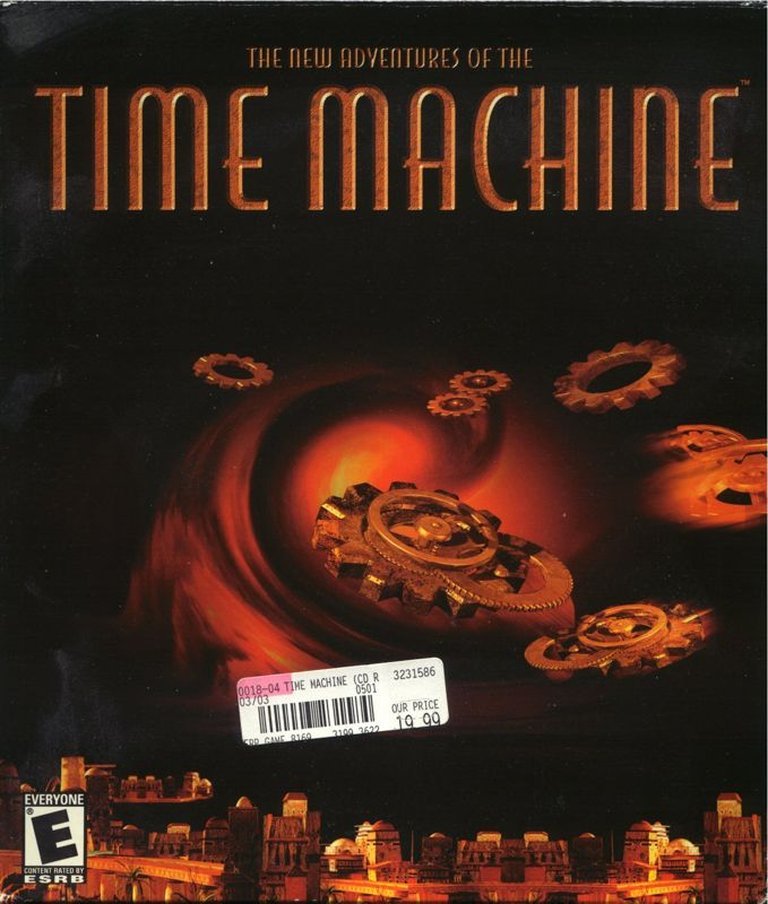
Description
Inspired by H.G. Wells’ classic tale, ‘The New Adventures of the Time Machine’ casts players as a time-traveling adventurer stranded in a mysterious future. To return home, you must seek the aid of Khronos, the Master of the Hourglass, while navigating a steampunk-infused world filled with puzzles, exploration, and occasional action. The game features a first-person perspective akin to ‘Myst’, with over 40 hours of gameplay, intricate environments, and a narrative that reimagines time as a fluid, unpredictable force.
Gameplay Videos
The New Adventures of the Time Machine Free Download
The New Adventures of the Time Machine Patches & Updates
The New Adventures of the Time Machine Reviews & Reception
en.wikipedia.org (90/100): Eurogamer praised the story and graphics and gave the game a 9/10.
gamespot.com : It’s a nonsensical story periodically interrupted by a string of infuriating puzzles.
mobygames.com (64/100): The worst of the schlocky mass-produced adventure games from Dreamcatcher, this one added false advertising to its sins.
ign.com : One small step for the developers, one giant leap for everybody’s sense of patience.
myabandonware.com (82/100): I was able to solve the cutscenes problem by configuring “Compatibility-Settings-Reduced Color Mode: 16-bit”.
The New Adventures of the Time Machine Cheats & Codes
PC
Enter ‘DIZZY’ as a name on the high score screen. Then, press 1, 2, 3, or 4 during gameplay to select a level. Press A or S during gameplay to select a new stage.
| Code | Effect |
|---|---|
| DIZZY | Enables level select by pressing 1, 2, 3, or 4 during gameplay to choose a level, or A or S to select a new stage. |
The New Adventures of the Time Machine: A Flawed but Fascinating Journey Through Time
Introduction
The New Adventures of the Time Machine (2000) is a game that exists in the shadow of its literary inspiration, H.G. Wells’ seminal The Time Machine. Developed by Cryo Interactive and published by DreamCatcher Interactive, it is a title that has polarized critics and players alike. On one hand, it offers a visually stunning, atmospheric world with a unique take on time manipulation and a narrative that, while divergent from Wells’ original, is ambitious in its own right. On the other, it is plagued by obtuse puzzles, clunky gameplay mechanics, and a dissonance between its premise and execution. This review will delve deeply into the game’s development, narrative, mechanics, and legacy, attempting to understand its place in the pantheon of adventure games.
Development History & Context
The Studio and Its Vision
Cryo Interactive, a French studio founded in 1992, was known for its ambitious, narrative-driven adventure games. Titles like Atlantis: The Lost Tales and Dragon Lore established the studio’s reputation for blending rich storytelling with intricate puzzles and atmospheric worlds. The New Adventures of the Time Machine was part of Cryo’s broader strategy to adapt classic literary works into interactive experiences, a trend that also included Dune and The Ring: Legend of the Nibelungen.
The game was directed by a team that included Jean-Martial Lefranc and Philippe Ulrich, with art direction by Olivier Train. The development process involved creating wireframe models for characters and environments, which were then rendered using Cryo’s proprietary “Warp” technology. This allowed for real-time 3D animation within pre-rendered sets, a technique that was cutting-edge at the time but also limited by the hardware constraints of the late 1990s.
Technological Constraints and Innovations
Released in 2000, The New Adventures of the Time Machine was designed for Windows PCs with a Pentium II 233 MHz processor and 32 MB of RAM. The game’s use of pre-rendered backgrounds with 3D character models was a common approach in adventure games of the era, exemplified by titles like Grim Fandango and Resident Evil. However, Cryo’s implementation was notable for its dynamic camera angles, which attempted to create a cinematic experience. Unfortunately, these camera shifts often proved disorienting, particularly during action sequences.
The game’s engine also supported real-time combat and spellcasting, a departure from Cryo’s traditional point-and-click adventures. This hybrid approach was intended to broaden the game’s appeal but ultimately contributed to its mixed reception.
The Gaming Landscape of 2000
The late 1990s and early 2000s were a transitional period for adventure games. The genre, which had dominated the early ’90s with titles like Myst and Monkey Island, was beginning to wane in popularity as 3D action games and first-person shooters rose to prominence. The New Adventures of the Time Machine arrived at a time when adventure games were increasingly seen as niche products, and its hybrid gameplay reflected an attempt to adapt to changing tastes.
Narrative & Thematic Deep Dive
Plot Overview
The New Adventures of the Time Machine begins with H.G. Wells (referred to as “Wales” in the game) traveling 800,000 years into the future in his time machine. Upon arrival, the machine is destroyed, stranding Wells in a mysterious desert city ruled by the demi-god Khronos, the Master of the Hourglass. The city is a surreal blend of ancient and futuristic elements, where time itself is unstable, and “time storms” randomly alter the ages of its inhabitants.
The narrative revolves around Wells’ quest to restore the balance of time and find a way back to his own era. Along the way, he encounters a cast of eccentric characters, learns the art of “chronomancy” (time magic), and uncovers the secrets of Khronos’ tyrannical rule. The story is ambitious, attempting to explore themes of time, memory, and the cyclical nature of history. However, its execution is often muddled, with poorly explained plot points and underdeveloped characters.
Themes and Symbolism
The game’s central theme is the manipulation of time, both as a narrative device and a gameplay mechanic. The concept of time storms, which randomly age or de-age characters, is a fascinating idea that could have been explored more deeply. Unfortunately, these storms often feel like arbitrary obstacles rather than meaningful narrative elements.
The city itself is a symbol of stagnation, a place where time has become a tool of control rather than a natural force. Khronos, as the god of time, represents the dangers of absolute power and the suppression of free will. The game’s exploration of these themes is uneven, but it does offer moments of genuine intrigue, particularly in its depiction of a society where time is both a curse and a commodity.
Characters and Dialogue
The characters in The New Adventures of the Time Machine are a mixed bag. Wells himself is a poorly realized protagonist, lacking the depth and charm of his literary counterpart. His transformation into “Wales” is never adequately explained, and his motivations often feel shallow. The supporting cast fares little better, with many characters serving as little more than puzzle dispensers.
Dialogue is another weak point. Conversations are often limited to one-line exchanges, and the game’s philosophical musings come across as pretentious rather than profound. The lack of meaningful dialogue options further hampers the player’s ability to engage with the world and its inhabitants.
Gameplay Mechanics & Systems
Core Gameplay Loop
The New Adventures of the Time Machine is a hybrid adventure game that combines traditional puzzle-solving with real-time combat and exploration. The core gameplay loop involves exploring the city, interacting with characters, collecting items, and solving puzzles to progress the story. The game’s structure is linear, with players moving from one location to another as they uncover the secrets of the city.
Puzzle Design
The puzzles in The New Adventures of the Time Machine are a major point of contention. Many are overly obscure, requiring players to engage in tedious pixel-hunting or trial-and-error experimentation. The game’s lack of clear objectives and hints exacerbates this issue, often leaving players frustrated and directionless.
One particularly egregious example involves a puzzle where Wells must find an ointment for a character’s back pain. The game provides no clues about what the ointment is or where to find it, forcing players to rely on brute-force exploration. This lack of guidance is a recurring problem, making the game feel more like a chore than an engaging experience.
Combat and Spellcasting
The game’s combat system is a departure from Cryo’s traditional adventure gameplay. Players can engage in real-time battles using a variety of weapons and spells. However, the combat is simplistic and often feels tacked on. Most encounters involve standing in one place and shooting at enemies until they are defeated. The spellcasting system, while innovative, is underutilized, with many spells proving useless in practice.
User Interface and Controls
The user interface in The New Adventures of the Time Machine is functional but clunky. The game’s dynamic camera angles, while intended to create a cinematic experience, often hinder navigation and combat. The controls are unresponsive, particularly during action sequences, and the game’s frequent slowdowns further detract from the experience.
World-Building, Art & Sound
Setting and Atmosphere
The game’s setting is one of its strongest aspects. The desert city is a visually striking blend of ancient and futuristic elements, with towering structures, intricate carvings, and eerie landscapes. The pre-rendered backgrounds are beautifully detailed, and the game’s use of dynamic camera angles creates a sense of scale and immersion.
The atmosphere is further enhanced by the game’s sound design. The soundtrack, while repetitive, is evocative and atmospheric, blending Middle Eastern influences with futuristic synths. The ambient sounds of the city, from the howling of time storms to the distant chatter of NPCs, add to the game’s sense of place.
Visual Direction
The art direction in The New Adventures of the Time Machine is ambitious and often successful. The game’s use of pre-rendered backgrounds allows for a level of detail and complexity that would have been difficult to achieve with real-time 3D. The character models, while blocky by modern standards, are expressive and well-animated.
However, the game’s visual presentation is not without its flaws. The dynamic camera angles, while cinematic, often make it difficult to navigate the environment or engage in combat. The game’s frequent slowdowns further detract from the experience, particularly during action sequences.
Sound Design
The sound design in The New Adventures of the Time Machine is one of its strongest aspects. The game’s soundtrack is atmospheric and evocative, blending Middle Eastern influences with futuristic synths. The ambient sounds of the city, from the howling of time storms to the distant chatter of NPCs, add to the game’s sense of place.
The voice acting, while not exceptional, is serviceable, and the game’s use of sound effects is effective. The lack of meaningful dialogue options, however, limits the impact of the voice acting, and many characters come across as one-dimensional.
Reception & Legacy
Critical Reception
The New Adventures of the Time Machine received mixed reviews upon its release. Critics praised the game’s ambitious narrative, striking visuals, and atmospheric sound design but criticized its obtuse puzzles, clunky gameplay, and underdeveloped characters. The game’s hybrid approach, combining traditional adventure gameplay with real-time combat, was seen as both innovative and flawed.
Eurogamer awarded the game a 9/10, praising its story and graphics, while GameSpot gave it a 3.8/10, calling it a “nonsensical story periodically interrupted by a string of infuriating puzzles.” IGN’s review was more measured, awarding the game a 7.6/10 and noting its “novel setting, thoughtful storyline, and awesome decor,” while acknowledging its gameplay flaws.
Commercial Performance
The game’s commercial performance was modest. According to PC Data, The New Adventures of the Time Machine sold 11,252 copies in North America in 2000, with additional sales in subsequent years. While not a commercial failure, the game did not achieve the widespread acclaim or sales figures of Cryo’s earlier titles.
Legacy and Influence
The New Adventures of the Time Machine is often remembered as a flawed but ambitious experiment. Its attempt to blend traditional adventure gameplay with real-time combat and its exploration of time as a narrative and mechanical device were innovative for the time. However, its obtuse puzzles, clunky controls, and underdeveloped characters have relegated it to the status of a cult classic rather than a genre-defining masterpiece.
The game’s legacy is further complicated by its departure from H.G. Wells’ original narrative. While some players appreciated the game’s unique take on the source material, others felt that it failed to capture the spirit of Wells’ work. This disconnect between expectation and execution has contributed to the game’s polarized reception.
Conclusion
The New Adventures of the Time Machine is a game of contradictions. It is visually stunning but mechanically flawed, ambitious in its narrative but underdeveloped in its execution. Its attempt to blend traditional adventure gameplay with real-time combat was innovative but ultimately unsuccessful. The game’s obtuse puzzles, clunky controls, and underdeveloped characters have made it a divisive title, beloved by some for its atmosphere and ambition but reviled by others for its frustrations.
Despite its flaws, The New Adventures of the Time Machine is a fascinating artifact of its time. It represents a transitional period in adventure gaming, where developers were experimenting with new mechanics and narratives in an attempt to adapt to changing tastes. While it may not be a masterpiece, it is a game that deserves to be remembered for its ambition and its willingness to take risks.
For players who can overlook its flaws, The New Adventures of the Time Machine offers a unique and atmospheric journey through a surreal and captivating world. For those who demand polished gameplay and coherent narratives, it may prove to be a frustrating and ultimately unrewarding experience. In the end, the game’s legacy is one of ambition and imperfection, a testament to the challenges and rewards of pushing the boundaries of interactive storytelling.