
- Release Year: 2007
- Platforms: Windows
- Publisher: MumboJumbo, LLC
- Developer: MumboJumbo, LLC
- Genre: Action, Strategy, Tactics
- Perspective: Top-down
- Game Mode: Single-player
- Gameplay: Pranks, Time management
- Setting: Office
- Average Score: 70/100
Description
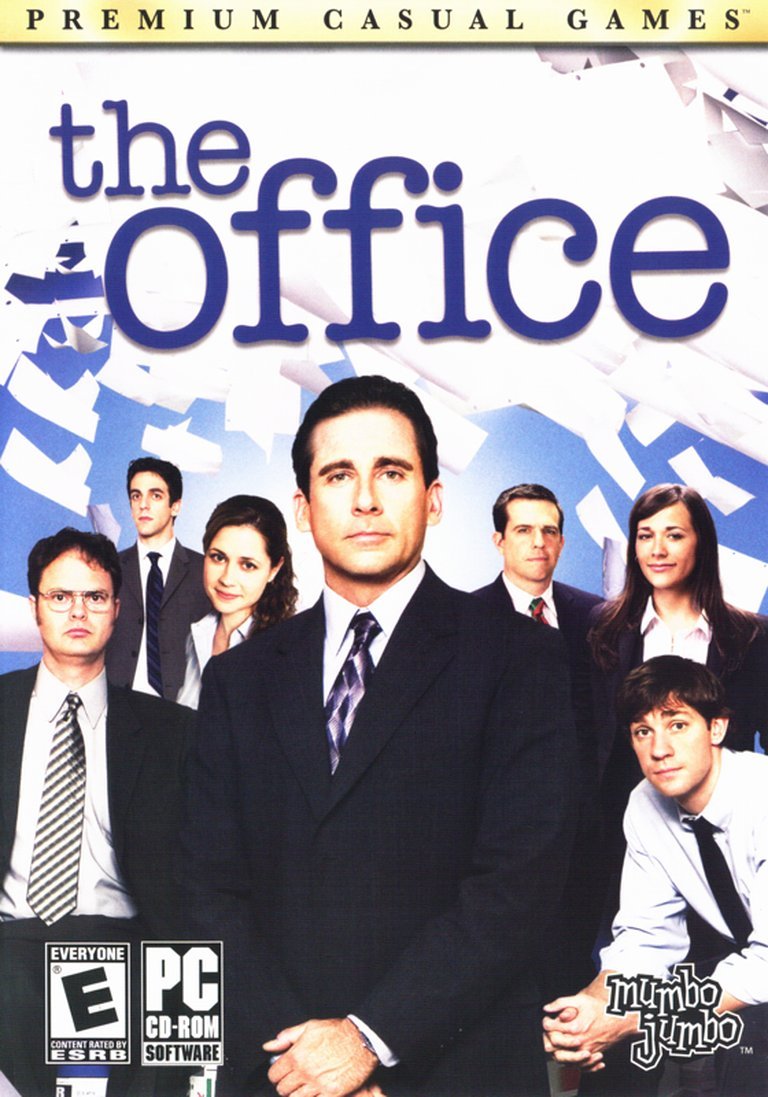
Based on the television series, ‘The Office’ game tasks players with competing against a rival to win a month’s paid vacation by completing office tasks like handing out folders or making deliveries. Set in a top-down perspective with bobble-head doll representations of characters, players earn points for each task, use pranks to sabotage opponents, and strive for achievements and expert rankings in this fast-paced time-management experience.
Gameplay Videos
Where to Buy The Office
PC
The Office Guides & Walkthroughs
The Office Reviews & Reception
metacritic.com (70/100): The Office is a casual game that borrows heavily from “Diner Dash” and will appeal to fans of the show who have a passing interest in video games, and not really much else.
The Office: Review
Introduction
In the mid-2000s, as NBC’s The Office transformed from a risky mockumentary into a cultural phenomenon, its cringe-comedy ethos and iconic characters permeated everything from water-cooler conversations to internet memes. Yet, one of the most curious—and nearly forgotten—artifacts of this era is the 2007 PC game The Office, developed by MumboJumbo. This title, featuring the Dunder Mifflin staff as bobblehead dolls in a top-down frenzy of task management, stands as a stark, almost surreal, translation of the show’s essence into interactive form. It is a game that asks players to embody Jim Halpert not through witty banter or heartfelt drama, but through the relentless, pointless pursuit of paper-related errands. This review argues that The Office video game is a fascinating, deeply flawed time capsule: a competent yet forgettable casual game that successfully channels the show’s atmosphere of absurd workplace monotony but ultimately fails to elevate its mechanics beyond a shallow, frantic distraction. Its legacy is not one of industry influence, but of a poignant case study in the challenges of translating specific, character-driven television comedy into the language of gameplay.
Development History & Context
Studio & Vision: The game was developed by MumboJumbo, LLC, a studio then-known for prolific casual titles like the Luxor series and 7 Wonders of the Ancient World. Their expertise lay in accessible, often puzzle-oriented, games designed for short play sessions—a perfect match for the burgeoning “casual games” market of the mid-2000s. According to MobyGames credits, the project was spearheaded by Creative Director Robert M. Atkins and Design Director Todd Rose, with a team of 40 developers. The vision, as described in the official blurb, was straightforward: “Based on the TV show of the same name, The Office puts you into a competition against your rivals for the reward of one month’s paid vacation.” This goal reflected a common approach to licensed games of the era: leverage familiar IP to provide a low-stakes, fan-service experience with minimal narrative complexity. The choice to depict characters as bobblehead dolls, noted across sources from MobyGames to the Office Wiki, was a deliberate stylistic decision that traded realism for a cute, stylized, and easily rendered aesthetic.
Technological Constraints & Platforms: The game was a Windows-exclusive release (November 2007), with planned but unclear releases for Nintendo DS, PlayStation Portable, and Xbox Live Arcade, as mentioned in the en-academic.com entry citing a Variety article. Its system requirements—a Pentium III 800 MHz, 256 MB RAM, and 50 MB hard drive space—place it firmly in the era of lightweight PC casual games, often distributed via download or cheap CD-ROM. The “slightly tilted top-down perspective” and simple bobblehead models were direct responses to these constraints, ensuring smooth performance on low-end hardware common in 2007. This technical modesty prevented any attempt at replicating the show’s visual aesthetic, instead opting for a functional, isometric office layout.
Gaming Landscape: The Office arrived at the peak of the casual gaming boom, fueled by platforms like Big Fish Games and the rise of social browser games. It directly competed in the “time management” or “dash” genre, alongside titles like Diner Dash (explicitly mentioned in the Screen Rant analysis). This genre’s core loop—rapidly completing discrete tasks under time pressure—was seen as a perfect analogue for workplace drudgery. The late 2000s also saw a surge in TV show adaptations (24: The Game, Heroes: The Official Mobile Game), often with mixed results. The Office game’s positioning as an “Everyone” rated, low-cost ($5-8 used) product targeted two audiences: dedicated fans seeking more Scranton content, and casual gamers looking for a quick, humorous distraction. As the Engadget article from June 2007 noted, MumboJumbo VP Mike Suarez acknowledged the game’s “simplicity and low cost” meant it wouldn’t appear on high-powered consoles, a pragmatic admission of its niche status.
Narrative & Thematic Deep Dive
Plot & Structure: The game’s narrative is almost nonexistent, a conscious design choice that aligns with the show’s “day-in-the-life” format but strips away all serialized character arcs. The sole premise, from the MobyGames description, is a competition among coworkers for “one month’s paid vacation.” Each of the 40 levels (across 5 stages representing office areas) tasks the player, as Jim Halpert, with assisting employees by completing menial chores: handing out colored folders, making deliveries, cleaning up Michael’s messes. The “plot” is purely mechanical—earn points faster than your designated rival (Dwight, Angela, etc.) to win the level. There is no dialogue-driven story, no cutscenes, and no acknowledgment of the show’s major events (Jim and Pam’s relationship, Michael’s departure, etc.). This minimalist approach, while faithful to the show’s mundane moments, removes the heart and humor that defined it.
Character Interpretation: The characterization is reduced to caricature through the bobblehead doll style and behavioral stereotypes. As the Screen Rant piece observes, the game “capitalizes more on the universe’s atmosphere than its story.” Dwight is the hyper-competitive rival, Angela is prim and demanding, Michael scatters items chaotically. These are broad, one-note approximations of their televised counterparts. The absence of voice acting—a significant cost and technological hurdle in 2007 for a budget title—means no delivery of iconic lines (“Bears. Beets. Battlestar Galactica.”), stripping away 90% of the characters’ charm. The player interacts with silent, button-mashing avatars.
Thematic Resonance: Thematically, the game accidentally mirrors the show’s core thesis: work is absurd, repetitive, and a series of petty competitions. The frantic task-completion loop evokes the Sisyphean nature of office life. The “Prank-O-Meter” mechanic—allowing players to hinder rivals—directly channels Jim’s defining trait. Yet, where the show used pranks for comedic character moments and cathartic viewer schadenfreude, the game reduces them to a simple strategic resource. The theme of “beating the system” (winning the vacation) replaces the show’s nuanced exploration of workplace dynamics, dignity, and quiet rebellion. The game captures the surface of Dunder Mifflin’s absurdity but misses its soul.
Gameplay Mechanics & Systems
Core Loop: The gameplay is a real-time task management sim. The player controls Jim (a silent, bobble-headed avatar) in a confined office space. Each level presents a series of errands (deliver X to Y, collect Z, etc.) generated by non-player employee characters. Completing a task awards points and fills a “Prank-O-Meter.” The rival AI simultaneously completes their own tasks. Victory is achieved by hitting a point threshold before the rival. This loop is pure Diner Dash: identify the next urgent task, navigate the crowded office, execute, repeat. The “frantic” pace, criticized by Softpedia and implied in the 69% MobyScore, is inherent to the design—levels ramp up in task density, transforming simple chores into a chaotic scramble.
The Prank System: This is the game’s sole innovative twist. As the player completes tasks, the Prank-O-Meter fills. Once full, the player can activate a prank on their rival (e.g., putting a whoopee cushion on their chair, locking them in a room). This temporarily halts the rival’s progress, creating strategic tension: do you focus on points or build a prank to cripple your opponent? The Screen Rant analysis correctly identifies this as capturing “classic Jim fashion,” but notes its implementation is mechanical rather than humorous. The pranks are visual gags with no lasting consequence, lacking the show’s payoffs (Jim’s smirk to the camera, Dwight’s explosive fury).
Progression & Flaws: The game features 40 levels across 5 office-themed stages (Reception, Sales, Accounting, etc.). Progression is linear; there is no character upgrade system or meaningful choice. The only meta-progression is achievement hunting (“expert rankings”) for replayability, as per the official description. The core flaw, repeatedly noted in reviews, is repetition. The Softonic review states it “gets a bit boring after playing it for a while,” while Softpedia acknowledges it becomes “too frantic at times.” The difficulty curve is less about strategy and more about sensory overload as task icons multiply. The AI rival has a fixed path, allowing for rote memorization rather than adaptive challenge. The game lacks a fail state beyond losing the level, removing tension.
UI & Controls: The interface is minimalist: a top-down view of the office, task icons above characters’ heads, a point counter, and a Prank-O-Meter. Controls are mouse-only (MobyGames specs), involving clicking to move Jim and clicking on interactable objects/characters. This simplicity is accessible but shallow; there is no inventory management, no complex interactions. The UI informs but does not immerse.
World-Building, Art & Sound
Visual Design: The art style is defined by the bobblehead doll representation. This choice, stemming from technical constraints and a desire for a “cute” aesthetic, fundamentally alters the tone. The show’s cringe-comedy, filmed in a gritty, documentary-style, is replaced by a playful, almost toy-box version of Scranton. The environment is a simplified, colorful isometric grid of cubicles and offices. While the layout vaguely resembles the show’s set (reception area, Michael’s office, accounting annex), it lacks specificity and lived-in detail. The “slightly tilted top-down perspective” (MobyGames) creates strategic clarity but destroys any sense of spatial realism or immersion. Character models, while recognizable in silhouette (Michael’s suit, Dwight’s farmer attire), are emotionless and static, a drastic departure from the actors’ nuanced performances.
Sound Design: Information on sound is scarce in the sources. It is virtually certain the game uses a simplified, perhaps synthesized, version of the iconic Jay Ferguson theme (as praised in the Wikipedia article on the show), likely during the title screen. In-game, sound would be limited to basic UI clicks, simple action jingles, and perhaps a few canned sound effects (a “boop” for a prank). There is likely no diegetic sound (phones ringing, printer hums) or voice lines. This audio minimalism further distances the game from the show’s rich soundscape of awkward silences, regional accents, and background music that punctuated scenes.
Atmosphere & Immersion: The combination of simplistic art and sparse sound creates an atmosphere that is more “cartoon office” than “Dunder Mifflin.” The game evokes the concept of the office—a maze of indistinguishable cubicles—but not its texture. The show’s genius was in finding profundity in the mundane; the game finds only busywork. The world feels like a game board, not a place where people work. This is the ultimate limitation: the mechanics of task-completion are antithetical to the show’s slow-burn, character-based humor. The frantic pace actively works against the feeling of oppressive, relatable boredom that was central to the series’ appeal.
Reception & Legacy
Critical & Commercial Reception: The game received mixed-to-average reviews, reflected in its 69% MobyScore from 5 critics and a 3.5/5 player rating. Reviews cited its core appeal for fans but fundamental flaws. Softpedia (85%) praised it as “a breath of fresh air” that “will for sure make your day better,” acknowledging its frantic nature but valuing its charm. GameZebo (80%) recommended it to “fans of the show” and “casual gamers… who enjoy time management games.” Conversely, Softonic (60%) and IGROMANIA (60%) found it “boring” after a while, with the latter dismissing its “mediocre graphics.” The Hrej! review (60%) noted it would “pobaví děti, pobaví dospělé” (entertain children, entertain adults), but only adults for a short time. The consensus was: a decent, short-lived distraction for die-hard fans, but不具备 broad appeal.
Commercially, it was a minor title. Its inclusion in the “MumboJumbo Collection (2008)” suggests modest bundling success, but it left no significant sales footprint. Its price quickly dropped to the $5-$8 used range on eBay, indicating it was not a high-demand commodity.
Legacy & Influence: The Office game has virtually no legacy in the industry. It did not spawn sequels, imitators, or influence major game design trends. Its primary legacy is as a forgotten footnote in two histories: the catalog of television adaptations (most of which are poor) and the portfolio of MumboJumbo (a studio later known for casual match-3 games). As Screen Rant succinctly states, “In hindsight, the game’s obscurity makes perfect sense.” It was too simplistic for hardcore gamers and too frantic and shallow for fans seeking authentic Office experiences. Its true successor in spirit is not another video game, but the 2021 mobile idle game The Office: Somehow We Manage, which better captures the show’s vibe through passive engagement and character interactions.
Culturally, it is a deep-cut curiosity. Its obscurity is so complete that it is often omitted from lists of video game adaptations of TV shows. It serves as a lesson: the specific tone of a character-driven comedy is exceptionally difficult to translate into game mechanics without losing what makes it special. The game’s existence is a testament to the mid-2000s casual gaming gold rush, where any recognizable IP could be molded into a simple clicker, with variable results.
Conclusion
The Office (2007) is a curious artifact of its time—a period when the immense popularity of a television sitcom could be funneled into a simplistic, top-down task manager. Developed by the capable but unambitious MumboJumbo, it is technically proficient for its budget and platform, and it mechanically understands the surface-level absurdity of office work. Its task-completion loop and prank mechanic provide a fleeting, frantic adrenaline rush that mirrors the show’s depictions of workplace chaos.
However, this mechanical translation is fundamentally hollow. By reducing the profound cringe-comedy and nuanced character dynamics of The Office to silent bobbleheads moving icons, the game loses the soul of its source material. The frantic pace replaces the show’s devastatingly slow-burn awkwardness; the point system replaces emotional investment. Critical reception accurately identified it as a “timewaster” (Softonic) for fans, but one that quickly grows repetitive and fails to engage on any deeper level.
In the grand history of video games, The Office is insignificant. It did not pioneer a genre, sell millions, or receive accolades. Its place is in the archives of “forgotten licensed games,” a cautionary tale about the perils of simplification. Yet, as a piece of cultural ephemera, it is fascinating. It represents a moment when the zeitgeist of a television masterpiece was deemed convertible into a casual game about handing out folders. It is, ultimately, the video game equivalent of a Schrute Farms beet: technically a product of the Dunder Mifflin ecosystem, but utterly alien to its spirit, and best left as a curious, minor footnote in the vast, complex orchard of gaming history. For historians, it is a clear marker of the mid-2000s casual boom; for fans, a relic of a time when their favorite show was so ubiquitous it could be rendered as a bobblehead dash game. Its final verdict is one of respectful obscurity: a competent but empty shell, proof that not all that is beloved on screen can be made meaningful in interactivity.