
- Release Year: 2001
- Platforms: Macintosh, Windows
- Publisher: Learning Company, The
- Developer: Riverdeep Interactive Learning Limited
- Genre: Educational, Simulation
- Perspective: 1st-person
- Game Mode: Single-player
- Gameplay: Business simulation, Managerial
- Setting: North America, Western
- Average Score: 81/100
Description
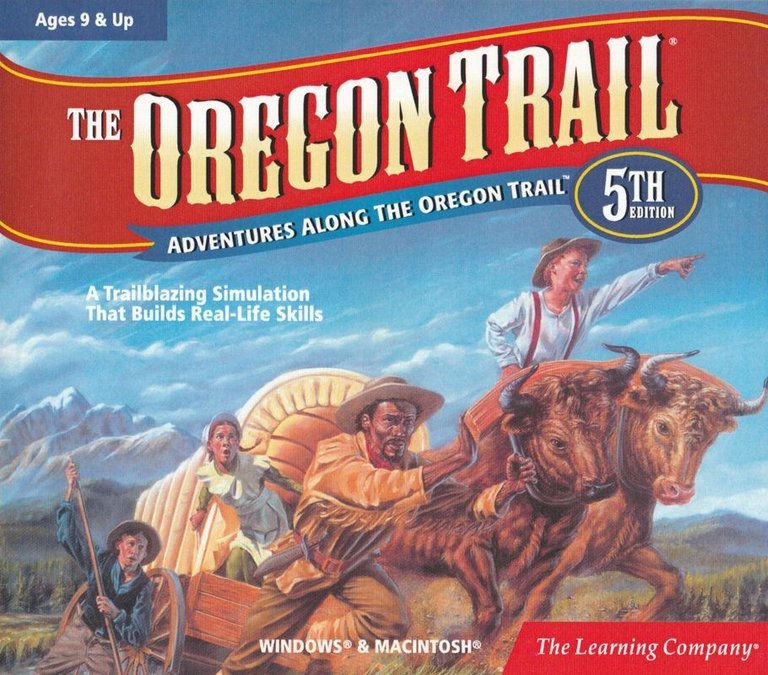
The Oregon Trail: 5th Edition is an educational simulation game set between 1840 and 1860, where players guide the Montgomery children—Jimmy, Cassie, and Parker—alongside mountain guide Captain Jed Freeman on a perilous wagon journey westward across the United States to find their father in Oregon, the Salt Lake Valley, or California, managing health, food, finances, hunting, fishing, river crossings, and other dangers while learning history, geography, math, and logical reasoning through interactive stories, journals, and guidebooks.
Gameplay Videos
The Oregon Trail: 5th Edition Free Download
The Oregon Trail: 5th Edition Guides & Walkthroughs
The Oregon Trail: 5th Edition Reviews & Reception
myabandonware.com (81/100): man it is cooooooollll
The Oregon Trail: 5th Edition: Review
Introduction
Imagine the creak of wooden wagon wheels echoing across vast prairies, the sting of dysentery claiming yet another party member, and the thrill of a successful buffalo hunt just in time to stave off starvation—these are the indelible memories etched into generations of gamers by The Oregon Trail series. Since its humble origins as a 1971 teletype experiment in a Minnesota classroom, the franchise has sold over 65 million copies, becoming the gold standard for educational gaming and a cultural touchstone that introduced millions to both American history and personal computing. The Oregon Trail: 5th Edition, released in 2001, represents the twilight of the classic era, a polished refinement of decades-old mechanics infused with narrative flair for a new millennium. My thesis: This edition isn’t merely an update; it’s the most narratively ambitious and educationally robust entry in the core series, cementing the Trail’s legacy as a masterful simulation of peril, perseverance, and pioneer life while bridging the gap between rote learning and immersive adventure.
Development History & Context
The Oregon Trail: 5th Edition emerged from the turbulent corporate saga of educational software in the late 1990s and early 2000s. Developed by Riverdeep Interactive Learning Limited (under the Broderbund banner) and published by The Learning Company, it arrived amid a landscape scarred by aggressive mergers. The Learning Company, itself a product of Softkey International’s (later led by Kevin O’Leary) buyouts of pioneers like MECC—the Minnesota Educational Computing Consortium that popularized the original game—had been swallowed by Mattel in a disastrous $3.6 billion deal in 1999, leading to massive write-downs and executive shakeups. Riverdeep, acquiring the assets, positioned this as the “last major update” before spin-offs and reboots diluted the formula.
Key visionaries included Design Manager Pete Shoemaker and Education Designer Sherri Wright, who explicitly based the core on Oregon Trail II (1995) while cherry-picking features from the 3rd (1997) and 4th Editions. Brand Producer Craig R. Bocks and Development Producer Luiz Fernando De Lima oversaw a team of 87 credits, including lead artists Pamela Stalker and Tony Villador, software engineers like Peter Fokos, Dan Tjandra, and Brian Tepper, and external collaborators like Wild Brain Art for character design. Technological constraints of the era—Windows 98/Mac OS 8.6, CD-ROM distribution, Bink Video middleware for cutscenes—limited it to fixed/flip-screen visuals in 640×480 at 256 colors, point-and-select interfaces, and real-time pacing without online features. This was the CD-ROM’s swan song; home PCs were shifting to broadband, but edutainment clung to offline, curriculum-aligned sims.
The gaming landscape in 2001 was bifurcated: AAA titles like Grand Theft Auto III and Halo heralded 3D open worlds, while edutainment (Reader Rabbit series, cross-credited here) targeted schools and families. Amid post-MECC corporate churn, 5th Edition aimed to complement social studies curricula (history, geography, math/logic/language arts), targeting ages 9+. It refined the series’ Apple II roots—where MECC bet big on the platform, making The Oregon Trail synonymous with classroom computing—into a hybrid of simulation and adventure, responding to demands for better graphics and sound over the 3-CD 3rd Edition.
Narrative & Thematic Deep Dive
At its heart, The Oregon Trail: 5th Edition weaves a fictional narrative thread absent in earlier iterations, transforming raw simulation into a story-driven odyssey. The player’s journey mirrors the historical 1840-1860 migration of over 300,000 emigrants from Independence, Missouri, to Oregon’s Willamette Valley, Salt Lake Valley, or California. But the true innovation is the Montgomery family saga: siblings Parker (15), Cassie (13), and Jimmy (10) embark with Captain Jed Freeman, an African American mountain guide, to reunite with their father. This quartet humanizes the Trail’s perils, triggering animated sequences at landmarks—Jimmy’s snakebite demands urgent decisions, while campfires yield Captain Jed’s historically accurate tales of the Donner Party’s cannibalism, California Gold Rush frenzy, and Santa Fe Trail rivalries.
Dialogue, delivered via static conversation pictures (a downgrade from prior animated ones), is sparse but poignant: Captain Jed’s folksy wisdom imparts geography and lore, blending adventure with education. Themes probe perseverance amid uncertainty—balancing resources evokes manifest destiny’s harsh economics—historical authenticity (scurvy remedies, river fording risks), and family bonds in crisis. Subtle nods to diversity (Captain Jed as trailblazer) update the pioneer mythos without preachiness. The Montgomery Journal and Oregon Trail Guidebook collect facts, maps, and player notes (printable for classrooms), reinforcing themes of documentation and reflection. Critically, it demystifies migration: no glorified heroism, just gritty trade-offs where one dysentery death cascades into party-wide doom. This narrative elevates the series from mechanic-driven drudgery to empathetic history lesson.
Gameplay Mechanics & Systems
Core loops revolve around managerial survival simulation: start by naming your five-person party (with profession bonuses like doctors reducing death rates or farmers bolstering oxen), budgeting cash for oxen, food, bullets, clothes, and parts. Real-time travel across 2,000 miles demands constant triage—hunt/fish for food (point-and-shoot buffalo hunts limit carry weight to 100-200 lbs, punishing overkill), gather plants (from 3rd/4th Editions, sans OTII‘s edible/poisonous quiz but retained for scurvy), trade at forts, and decide river crossings (ford, caulk/float, or ferry with updated graphics).
Innovations shine: Fishing adds low-risk foraging; story triggers pause for choices (e.g., rest sick members?). Progression ties to health/finances—delays from blizzards, thieves, broken axles, or “wrong trail” events force math/logic (rationing via arithmetic). UI is intuitive point-and-select, 1st-person map views flipping to events, but flaws persist: no save-scumming mid-event, random deaths frustrate young players, and repetitive loops test patience. No traditional combat, but hunting simulates marksmanship. Balance is key—overbuy early, starve later; skimp on clothes, freeze. Educational mini-games (implicit via decisions) teach without halting flow. On modern systems (per abandonware notes), Win10 repacks fix CD-ROM quirks via INI edits (e.g., rsrcpath=C:\OT5\Data), but 640×480 demands tweaks.
| Mechanic | Strengths | Flaws |
|---|---|---|
| Resource Management | Deep trade-offs mirror history | RNG-heavy failures |
| Hunting/Fishing | Skill-based, capacity-limited | Bullet waste temptation |
| River Crossings | Updated visuals, high stakes | Trial-and-error |
| Events | Educational triggers | Repetitive delays |
World-Building, Art & Sound
The setting immerses in 19th-century North America/Western frontier: prairies, forts (e.g., Fort Laramie), rivers, and mountains evoke the Trail’s desolation via fixed-screen vistas. Atmosphere builds tension—dusty trails, howling winds—enhanced by printable journals chronicling real landmarks. Visuals, lead by Stalker/Villador, upgrade OTII with crisp CD-ROM art: detailed wagons, wildlife, and Bink cutscenes for Montgomery vignettes (though static dialogues disappoint). Flip-screen progression maintains pace, fostering a sense of epic scale.
Sound design regresses: OTII‘s varied soundtrack yields to a single repeating audio loop, ambient twangs underscoring drudgery but lacking dynamism. SFX (wagon creaks, gunshots) and voiceovers (Captain Jed’s stories) punch above weight, contributing to nostalgia. Collectively, these craft a tangible, dusty authenticity—players feel the grind, making survival euphoric.
Reception & Legacy
Launch reception was warmly niche: Parents’ Choice awarded a Silver Honor (2002), praising “better graphics, greatly improved sound, and many little improvements” over the 3-CD 3rd Edition. No Metacritic aggregate (tbd), but MobyGames notes scant player reviews (4/5 average from one). Commercially, it rode the series’ 65M+ sales halo but suffered post-Mattel fallout—no blockbuster numbers amid edutainment’s decline.
Legacy endures: Final “classic” entry before 2008’s reboot and mobile spin-offs (American Settler), it influenced trail sims (The Trail, Pioneer Trail) and edutainment (Amazon Trail). Credited staff’s Reader Rabbit ties underscore TLC’s empire. Culturally, it’s “Oregon Trail Generation” fodder—teaching dysentery, fording, and computing grit. Abandonware vitality (MyAbandonware 4.06/5 from 188 votes; Archive.org repacks) proves timelessness, despite Win10 hurdles. It influenced industry by proving simulations educate via failure.
Conclusion
The Oregon Trail: 5th Edition distills 30 years of iteration into a poignant pinnacle: refined mechanics, heartfelt narrative via the Montgomerys and Captain Jed, and unyielding historical rigor make it the definitive digital pioneer trek. Flaws—sound loop monotony, RNG cruelty—pale against its educational alchemy, turning grim migration into addictive lore. In video game history, it claims an elite perch: not just edutainment icon, but blueprint for narrative sims. Verdict: Essential 9.5/10—ford the river, claim your legacy.