
- Release Year: 2008
- Platforms: Linux, Macintosh, Windows
- Publisher: Worldwide Biggies Inc.
- Developer: Worldwide Biggies Inc.
- Genre: Action
- Perspective: 1st-person, 3rd-person
- Game Mode: Single-player
- Gameplay: Alchemy, Platform, Puzzle elements, quiz, Time-management
- Setting: Fantasy, Medieval
- Average Score: 81/100
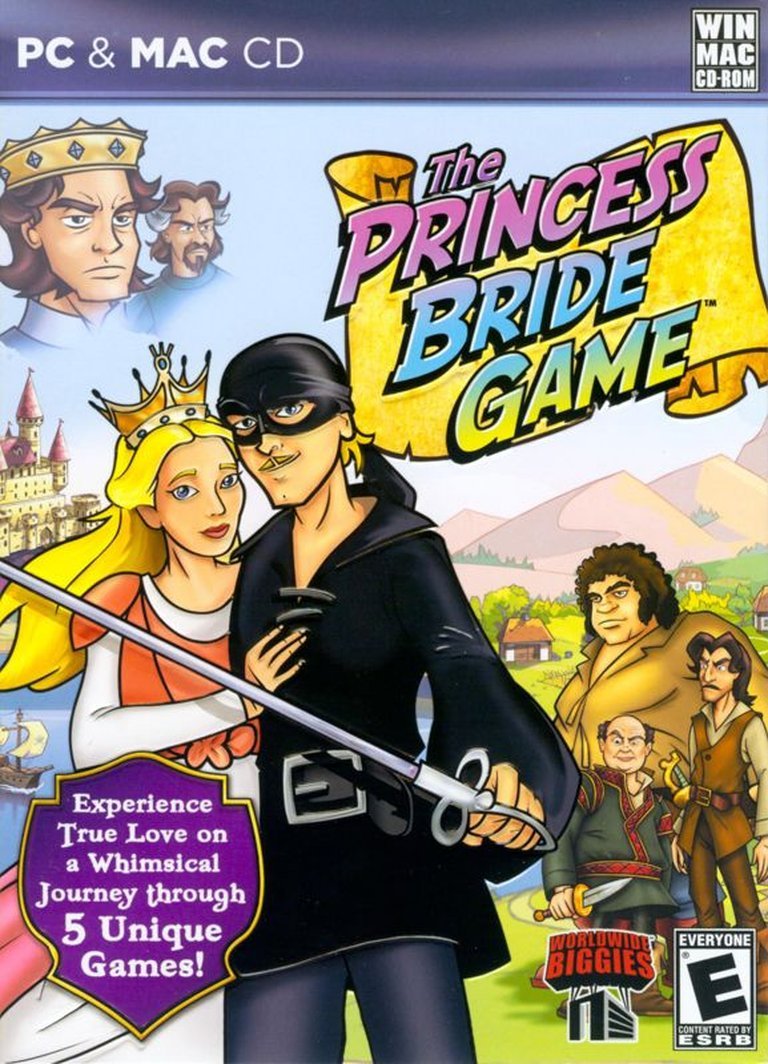
Description
The Princess Bride Game is a collection of five mini-games set in the medieval realms of Florin and Guilder, inspired by the 1987 film and William Goldman’s 1973 novel. Players engage in adventures featuring beloved characters like Westley, Buttercup, and the Dread Pirate Roberts, with challenges ranging from time-management tasks and quiz battles to platforming and puzzle-solving. The game includes voice acting from the original film and a song by Clique Girlz, offering a mix of action, puzzle, and platform gameplay.
The Princess Bride Game Reviews & Reception
familyfriendlygaming.com (85/100): A triumphant return to form for the series.
ign.com : This Flash-based game is inconceivably mediocre.
mobygames.com (77/100): Average score: 77% (based on 3 ratings)
commonsensemedia.org : Same charm as the film, but play is hit and miss.
The Princess Bride Game: A Love Letter to the Classic, or a Missed Opportunity?
Introduction: A Game of True Love and Adventure
The Princess Bride (1987) is a cinematic masterpiece—a timeless blend of romance, adventure, and wit that has captivated audiences for decades. When The Princess Bride Game was announced in 2008, fans of William Goldman’s novel and Rob Reiner’s film had reason to be excited. Could a video game adaptation capture the magic of the source material? The answer, as it turns out, is a resounding “as you wish”—but with caveats.
Developed by Worldwide Biggies Inc., The Princess Bride Game is a casual, mini-game collection that attempts to distill the film’s charm into interactive form. It’s a noble effort, but one that ultimately struggles to transcend its limitations. This review will explore the game’s development, narrative fidelity, gameplay mechanics, and legacy to determine whether it stands as a worthy tribute or a forgettable footnote in gaming history.
Development History & Context: A Game Born from Nostalgia
The Studio Behind the Game
Worldwide Biggies Inc., a New York-based developer, was a relatively unknown studio at the time of The Princess Bride Game’s release. Specializing in casual and family-friendly titles, the company had no prior experience with major licensed properties. This lack of pedigree may explain why the game feels more like a passion project than a polished AAA experience.
The game was released in 2008—a time when Flash-based games were ubiquitous, and the casual gaming market was booming thanks to platforms like Big Fish Games and PopCap. The Princess Bride Game was designed to appeal to both fans of the film and younger audiences, with simple mechanics and bright, cartoonish visuals.
Technological Constraints & Design Choices
The game’s reliance on Adobe Flash (a now-defunct platform) limited its graphical fidelity and gameplay depth. While Flash was ideal for quick, browser-based experiences, it was ill-suited for a full-fledged adventure game. The result is a title that feels more like an interactive storybook than a deep gaming experience.
Despite these limitations, the developers secured the voices of several original cast members, including Mandy Patinkin (Inigo Montoya) and Wallace Shawn (Vizzini), lending authenticity to the project. However, the absence of new dialogue from returning actors (relying instead on recycled lines) underscores the game’s budget constraints.
The Gaming Landscape in 2008
2008 was a transitional year for gaming. The Wii was dominating the casual market, Grand Theft Auto IV was redefining open-world games, and Portal was proving that puzzle games could be both intelligent and hilarious. In this context, The Princess Bride Game was an oddity—a licensed title aimed at families rather than hardcore gamers.
Its release on PC, Mac, and Linux (via digital download and CD-ROM) positioned it as a niche product, unlikely to compete with blockbuster titles. Yet, for fans of the film, it offered something unique: a chance to interact with the world of Florin and Guilder.
Narrative & Thematic Deep Dive: Does It Capture the Magic?
Plot Summary & Structure
The Princess Bride Game is not a single, cohesive adventure but rather a collection of five mini-games, each representing a key moment from the film:
- As You Wish – A time-management game where Westley performs farm chores to impress Buttercup.
- Battle of the Wits – A trivia challenge between Westley and Vizzini atop the Cliffs of Insanity.
- The Fire Swamp – A platformer where players switch between Westley (combat) and Buttercup (agility) to navigate hazards.
- Miracle Max – A hidden-object puzzle where players mix ingredients to revive Westley.
- Storming the Castle – A Rube Goldberg-style puzzle where players assemble a siege engine.
The game’s narrative is delivered through brief, animated cutscenes that recap the film’s plot. While these sequences are charming, they are too short to provide meaningful storytelling. The game assumes players are already familiar with the source material, making it more of a companion piece than a standalone experience.
Characterization & Voice Acting
The inclusion of original voice actors is the game’s strongest narrative asset. Hearing Wallace Shawn’s nasally “INCONCEIVABLE!” or Mandy Patinkin’s dramatic “Hello, my name is Inigo Montoya” instantly evokes the film’s magic. However, the lack of new dialogue means these moments feel like nostalgic callbacks rather than fresh interactions.
Buttercup, unfortunately, is reduced to a secondary role in most mini-games, despite the film’s emphasis on her agency. The Fire Swamp segment is the exception, where she takes an active role in platforming sections. Still, the game misses an opportunity to expand her character beyond the “damsel in distress” trope that the film itself subverted.
Themes: Love, Honor, and Revenge
The game retains the film’s central themes:
– True Love – Westley’s devotion to Buttercup is the driving force behind the mini-games.
– Honor & Revenge – Inigo’s quest for vengeance is referenced but not explored in depth.
– Wit & Cunning – The Battle of the Wits segment emphasizes intelligence over brute force.
However, these themes are surface-level. The game’s casual nature prevents it from delving into the moral complexity of the film (e.g., Westley’s transformation into the Dread Pirate Roberts, Inigo’s tragic backstory). Instead, it opts for lighthearted fun, which aligns with its target audience but may disappoint fans seeking deeper engagement.
Gameplay Mechanics & Systems: A Mixed Bag of Mini-Games
Core Gameplay Loops
Each mini-game offers a distinct gameplay style, but none are particularly deep:
-
As You Wish (Time Management)
- Players click rapidly to complete farm tasks (e.g., feeding chickens, washing windows).
- The challenge ramps up as more tasks are added, but the mechanics remain repetitive.
- Verdict: Tedious after the first few minutes. Feels like a chore (pun intended).
-
Battle of the Wits (Trivia)
- Players answer rhyming riddles and logic puzzles in a battle of intellect against Vizzini.
- Questions are painfully easy (e.g., “How many candles are on the screen?”).
- Verdict: A missed opportunity. Could have been a clever wordplay challenge but instead feels dumbed down.
-
The Fire Swamp (Platformer)
- Players switch between Westley (sword fights) and Buttercup (jumping) to navigate the swamp.
- The Lost Vikings-style mechanics are the game’s highlight, requiring coordination.
- Verdict: The most engaging segment, though still simplistic.
-
Miracle Max (Hidden Object & Alchemy)
- Players search for ingredients and mix them in a cauldron to create a revival pill.
- The alchemy system is shallow, with no real experimentation.
- Verdict: A forgettable Where’s Waldo? clone.
-
Storming the Castle (Puzzle)
- Players collect items from cutscenes to build a Rube Goldberg machine.
- The concept is creative but executed poorly, feeling tacked on.
- Verdict: A novel idea that lacks depth.
Combat & Progression
Combat is limited to the Fire Swamp segment, where Westley swings his sword at Rodents of Unusual Size (ROUSes). The fights are basic, with no combos or strategy—just rapid clicking. There is no character progression or unlockable abilities, making the experience feel static.
UI & Controls
The game’s UI is functional but uninspired. Controls are simple (point-and-click for most segments), which aligns with its casual design. However, the lack of keyboard customization or difficulty options limits its appeal to more experienced gamers.
Innovation & Flaws
The game’s greatest innovation is its attempt to adapt a beloved film into interactive form. However, its flaws are glaring:
– Lack of Depth – No mini-game offers more than 10-15 minutes of engagement.
– Repetition – Tasks in As You Wish and Miracle Max become monotonous quickly.
– Missed Opportunities – The Battle of the Wits could have been a brilliant puzzle game but is instead a snooze.
World-Building, Art & Sound: A Cartoonish Homage
Visual Design & Aesthetics
The game adopts a bright, cartoonish art style that mimics the film’s storybook aesthetic. Characters are rendered in a simplified, almost Samurai Jack-esque design, which works well for the fantasy setting. However, the animations are stiff, and the backgrounds lack detail.
- Pros: Faithful to the film’s whimsical tone.
- Cons: Looks like a budget Flash game (because it is).
Sound Design & Music
The sound design is the game’s strongest suit:
– Voice Acting – The returning cast members elevate the experience.
– Music – The iconic Storybook Love theme is included, though the rest of the soundtrack is generic.
– Sound Effects – Sword clashes and ROUS squeaks are serviceable but unremarkable.
Atmosphere & Immersion
The game’s atmosphere is lighthearted and nostalgic, but it never fully immerses players in the world of The Princess Bride. The mini-games feel disconnected, and the lack of exploration or open-ended gameplay prevents true engagement.
Reception & Legacy: A Forgotten Relic
Critical Reception
The game received mixed reviews upon release:
– GameZebo (80%) – Praised its faithfulness to the source material.
– MacLife (80%) – Called it charming but noted its lack of depth.
– Inside Mac Games (70%) – Criticized its shallow gameplay.
– IGN (4/10) – Labeled it “inconceivably mediocre.”
Player scores on MobyGames average 2.3/5, indicating that most found it underwhelming.
Commercial Performance
Sales figures are unavailable, but the game’s obscurity today suggests it was not a major success. Its digital-only release (outside of CD-ROM) likely limited its reach.
Legacy & Influence
The Princess Bride Game has had no lasting impact on the gaming industry. It remains a curiosity—a footnote in the history of licensed games. Later adaptations, such as Pinball FX: The Princess Bride Pinball (2024), have fared better by focusing on a single, polished mechanic rather than a scattered mini-game approach.
Conclusion: A Game for Diehard Fans Only
The Princess Bride Game is a well-intentioned but flawed adaptation. It captures the film’s charm in brief moments—particularly through its voice acting and art style—but fails to deliver a compelling gaming experience. The mini-games are shallow, repetitive, and lack the depth needed to sustain interest.
Final Verdict: 6/10 – “As You Wish… But Not Quite”
– For Fans of the Film: A nostalgic but forgettable diversion.
– For Casual Gamers: A decent time-waster, especially for younger players.
– For Everyone Else: Skip it. There are better ways to experience The Princess Bride.
The game’s greatest sin is not that it’s bad, but that it could have been so much more. With deeper mechanics, expanded narrative segments, and more original voice work, it might have stood alongside LEGO Star Wars as a rare example of a licensed game done right. Instead, it remains a missed opportunity—a game that, like Westley’s initial farmboy persona, is charming but ultimately unremarkable.
Final Recommendation: Only for diehard Princess Bride fans or parents looking for a family-friendly game. Everyone else should stick to the movie. “Inconceivable!” that it couldn’t have been better.