
- Release Year: 2004
- Platforms: Windows
- Publisher: Vertigo Games
- Developer: Vertigo Games
- Genre: Strategy, Tactics
- Perspective: Diagonal-down
- Game Mode: Single-player
- Gameplay: Causal chain, God game, Simulation, Turn-based
- Setting: Earth
- Average Score: 79/100
Description
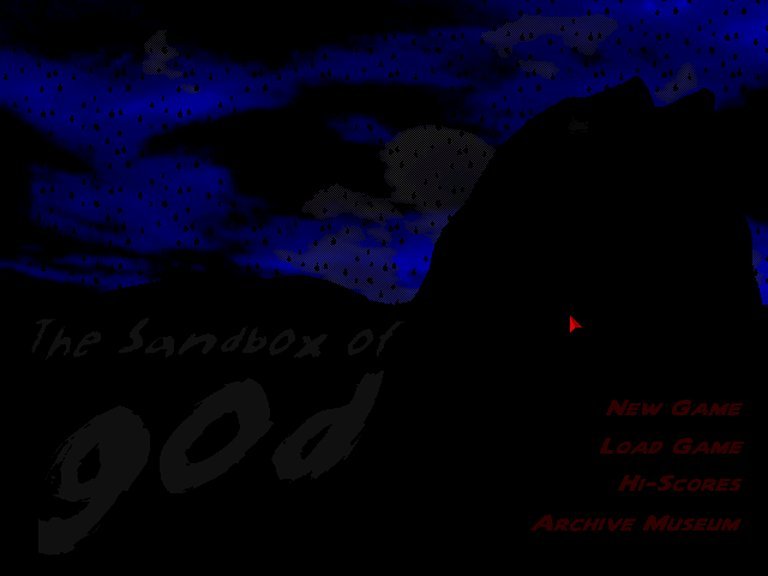
The Sandbox of God is a god simulator that begins with an empty Earth where players wield divine powers—such as creating trees, animals, or weather—in a specific order to shape the world, with outcomes like rabbits eating seedlings or trees growing after rain depending on the sequence used. Gameplay unfolds across six eras, each with its own set of powers, culminating in an achievement tally that reflects the player’s divine interventions and consequences.
Where to Buy The Sandbox of God
PC
The Sandbox of God Free Download
The Sandbox of God Guides & Walkthroughs
The Sandbox of God Reviews & Reception
myabandonware.com (96/100): a fun, light-hearted, and creative take on playing god.
The Sandbox of God: Review
Introduction
In the annals of indie gaming history, few titles embody the raw, unfiltered joy of creative discovery quite like The Sandbox of God. Released in 2004 by Vertigo Games under the enigmatic pseudonym Mr. Chubigans, this freeware god-simulator stands as a testament to how minimalist design and emergent storytelling could birth a cult classic. Decades later, its influence permeates puzzle games and sandbox simulations alike, yet its original brilliance remains criminally underexamined. This review dissects The Sandbox of God not merely as a relic, but as a profound exploration of causality, consequence, and the intoxicating power of creation. Its thesis: a game stripped to its barest mechanics—clicking buttons in sequence—unlocks a universe of philosophical depth, making it an enduring masterpiece of interactive design.
Development History & Context
Emerging from the fertile grounds of the 2004 indie scene, The Sandbox of God was a product of its era’s technical constraints and artistic ambitions. Developed by Vertigo Games—a studio synonymous with experimental freeware—and powered by GameMaker 5 (a then-nascent engine for solo developers), the game was a triumph of resourcefulness. Mr. Chubigans, whose identity remains deliberately obscure, crafted this jewel against a backdrop where web-based Flash games like Grow (by Japanese group EYEZMAZE) were dominating puzzle design. Though Grow’s influence is undeniable (the core mechanic of sequential power application mirrors Sandbox’s DNA), Chubigans omitted direct credits in the README—a curious omission hinting at a desire for originality.
The 2004 gaming landscape was preoccupied with AAA spectacle, making The Sandbox of God a radical counterpoint. As freeware, it bypassed commercial pressures, aligning with the burgeoning “art game” movement championed by titles like Katamari Damacy. Chubigans’ vision was clear: distill the god-game genre to its purest form—stripping away real-time combat, complex economies, or narratives to focus solely on the ripple effects of divine intervention. This minimalist ethos, coupled with the accessibility of GameMaker, birthed a title that ran on low-end hardware yet offered staggering replay value. The result was a game that felt both ancient and futuristic—a digital sandcastle built by a lone architect with a dream.
Narrative & Thematic Deep Dive
Sandbox of God rejects traditional narrative in favor of emergent storytelling, where the player’s actions script the plot. The game presents no characters, dialogue, or explicit plot—only a barren Earth and a divine toolkit. Yet, this absence births a richer, player-driven narrative. Each playthrough becomes a parable: one might chronicle the rise and fall of civilizations through droughts and floods; another, an ecological disaster where rabbits overrun forests. The six eras—each unlocking new powers—form a loose arc of creation, from primordial chaos to sentient life.
Thematic resonance permeates every click. Stewardship is central: the player must balance nurturing life (rain, seedlings) against entropy (drought, comets). The game poses Sisyphean questions: Can a god create harmony? Or are all interventions inherently destructive? The achievement checklist, tallying successes like “Seedling Savior” or “Famine Bringer,” becomes a moral ledger, forcing players to confront the ethics of omnipotence. Critically, the narrative is non-linear; the “story” exists in the consequences, not the causes. When rabbits devour seedlings, or rain fills a comet’s crater to form a lake, these micro-events accumulate into a player-authored epic of creation and ruin. It’s a silent opera, conducted by the mouse.
Gameplay Mechanics & Systems
At its core, Sandbox of God is a puzzle of permutations. The player receives a finite set of divine powers per era (e.g., rain, rabbits, comets), usable only once each. The order of activation dictates outcomes: rain after seedlings grows forests; rain before comets creates lakes. This simple loop—>click power > observe consequence—hides staggering depth.
- Era-Based Progression: Six distinct eras (e.g., “Creation,” “Animals”) introduce escalating complexity. Early eras teach basics; later ones demand strategic foresight (e.g., using lightning to ignite drought-ravaged land).
- Achievement System: A post-game checklist rewards optimized play, incentivizing replay. Beating the game randomly is trivial; mastering it requires understanding synergies (e.g., growing trees before spawning birds for nests).
- Interface & Controls: A point-and-click system with a diagonal-down view ensures clarity. Powers are icon-driven (e.g., a cloud for rain), with tooltips for newcomers. Yet, the UI’s simplicity belies its brilliance—it never obscures the emergent chaos below.
The combat? There is none. Instead, “conflict” arises from ecological tension: rabbits vs. seedlings, man vs. drought. As one critic noted, “The gameplay is clicking buttons, but the mastery is in the chaos they create” (GameHippo.com). This absence of traditional mechanics forces players to engage with cause and effect on a meta level.
World-Building, Art & Sound
Sandbox of God’s world is a canvas, painted with minimalist strokes. The setting evolves from a monochrome wasteland into a vibrant ecosystem as players intervene. Rain falls in rippling blue torrents, trees sprout pixelated leaves, and rabbits hop with endearing simplicity. The art style—hand-drawn and earth-toned—evokes a children’s book, making even disasters feel whimsical.
Sound design is equally sparse but effective. Ambient chirps, distant thunder, and rustling leaves ground the fantasy, while a subtle, looping soundtrack shifts mood with each era. No voiceovers exist; instead, visual feedback narrates: a comet’s impact crater fills with water, a sign from god boosts human IQ. The lack of polish becomes part of the charm—animations are functional but not flashy, reinforcing the game’s “toy” aesthetic. This synergy of art and sound creates a living diorama where every change feels significant.
Reception & Legacy
Upon release, Sandbox of God was a quiet phenomenon. Critics praised its creativity but noted flaws:
– Critic Scores: MobyGames aggregates a 68% (based on 2 reviews), with GameHippo.com (70%) calling it “an entertaining, humorous take on creation,” while Curly’s World of Freeware (67%) warned: “Everything you do has consequences.”
– Player Sentiment: A single MobyGames player rated it 4.2/5, with nostalgic comments like, “Great little game” (MyAbandonware).
Its legacy, however, transcended scores. The game inspired modding communities and spurred Chubigans to create a trilogy: Remastered (2009) added “Warfare” and “Boardgame” modes, while 2018’s Remastered Edition expanded resolution and save systems. Steam reviews for the remaster (75% positive) underscore its enduring appeal, with players noting its “contemplative joy” (Steambase.io).
Influentially, Sandbox popularized the sequential puzzle subgenre, paving the way for titles like Universe Sandbox. Its freeware model became a blueprint for indie success, proving that creativity could outscale budget. As one retrospective noted, “It’s a god game for atheists—no wrath, just cause” (Retro Replay).
Conclusion
The Sandbox of God is not merely a game; it’s a digital ecosystem of ideas. By reducing godhood to button presses, Mr. Chubigans crafted a profound meditation on power and responsibility. Its minimalist design—6 eras, 6 powers per era—belies infinite replayability, while its emergent narratives ensure no two creations are alike. Critics’ lukewarm reception at launch now reads as a failure of imagination: this isn’t a strategy game but a sandbox for philosophy.
In the canon of indie history, Sandbox of God occupies a sacred space. It predates Minecraft’s sandbox ethos and influences modern narrative-driven puzzlers, yet its uniqueness endures. For players seeking a game where every click writes a story, where failure is as revelatory as success, Sandbox remains indispensable. It is, in the truest sense, a work of playable poetry—a testament to the fact that in an empty world, the first click is everything. Verdict: Timeless.