
- Release Year: 2001
- Platforms: Windows
- Publisher: Electronic Arts, Inc.
- Developer: Maxis
- Genre: Compilation
- Game Mode: Single-player
- Average Score: 95/100
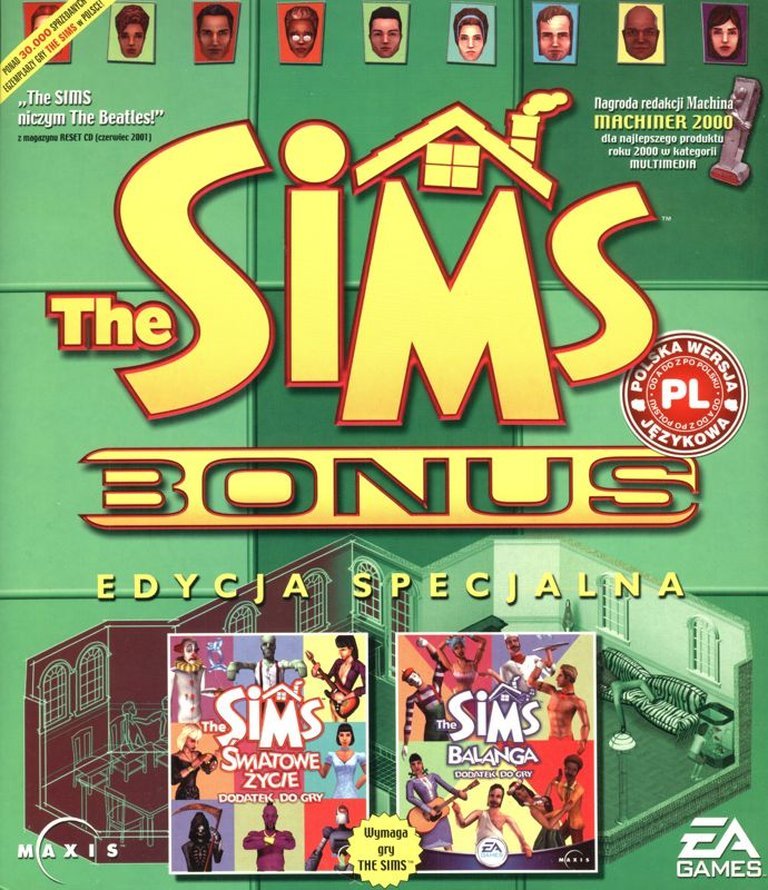
Description
The Sims Bonus is a compilation package that bundles the Livin’ Large and House Party expansion packs for the social simulation game The Sims. It enhances the core suburban life gameplay by adding new careers, items, and social events, allowing players to create and control virtual Sims in an expanded, open-ended environment where they manage daily activities, relationships, and home customization.
The Sims Bonus Reviews & Reception
ign.com (95/100): Play god, fix toilets.
The Sims Bonus: A Comprehensive Review of a Foundational Compilation
Introduction: The Domestic Revolution, Packaged
In the pantheon of video game history, few titles have reshaped the cultural landscape as profoundly as The Sims. Its genius lay not in fantastical combat or intricate puzzles, but in the mundane, relatable, and endlessly customizable drama of everyday life. Released in 2000, Will Wright’s seminal life simulation shattered expectations, becoming a best-selling phenomenon that appealed universally. Yet the game’s true, enduring power was unlocked not by its initial release alone, but through a steady cadence of expansion packs that deepened its systems and broadened its possibilities. Enter The Sims Bonus, a compilation released on July 17, 2001, for Windows. This package, bundling the first two major expansions—The Sims: Livin’ Large and The Sims: House Party—is more than a simple repackaging. It represents a critical juncture, a curated snapshot of Maxis and Electronic Arts’ early strategy to evolve their groundbreaking toy into a perpetually engaging platform. This review argues that The Sims Bonus is a historically significant artifact that crystallized the franchise’s core expansion philosophy: augmenting the player’s agency over social dynamics, domestic aesthetics, and narrative creation, thereby transforming The Sims from a curious novelty into a sustained cultural force.
Development History & Context: From “Toilet Game” to Cultural Touchstone
The story of The Sims Bonus cannot be told without first understanding the tumultuous origins of its parent game. Will Wright, co-founder of Maxis, was famously inspired by two disparate events: his study of Christopher Alexander’s architectural treatise A Pattern Language and the devastating loss of his own home in the 1991 Oakland firestorm. The latter experience, recounted in numerous sources, shifted his focus from building structures to understanding the human relationships that give those structures meaning. His initial concept, Doll House, was met with profound internal skepticism at Maxis. As detailed in the Mentalfloss and ClassX histories, executives derided it as “the toilet game,” worried its focus on domestic chores and social simulacra would alienate the perceived core gaming audience and tarnish the SimCity brand. Development was covert for years, with Wright working on it alongside other projects like SimCity 2000.
The acquisition of Maxis by Electronic Arts in 1997 proved pivotal. EA, while known for action titles, recognized the potential in Wright’s vision and provided the necessary backing. The development team, led by programmer Jamie Doornbos, built an ambitious agent-based AI system where Sims’ needs—hunger, hygiene, bladder, energy, social, and fun—dictated their autonomous behaviors, though player intervention remained key. The game’s aesthetic was a clever hybrid: 3D character models against pre-rendered, dimetric-projection backgrounds, a practical solution to the technological constraints of 1999/2000 that gave the game its distinctive, charmingly blocky look.
The groundbreaking moment at the 1999 E3 convention, where an unscripted AI-driven same-sex kiss between two female Sims stole the show, as described in the New Yorker and Mentalfloss, was a decisive turning point. It announced the game’s inclusive ethos and effectively killed any internal talk of cancellation. Released in February 2000, The Sims became an unprecedented stratospheric success, selling millions and defying genre expectations. The strategy from the outset was an aggressive expansion schedule. Livin’ Large arrived in August 2000, followed by House Party in April 2001. By July 2001, the The Sims Bonus compilation was released, strategically bundling these two expansions for players who had purchased the base game later or desired a more complete initial experience. This was the era of the “Platinum” or “Deluxe” edition—a common retail practice to capture renewed market interest and provide value.
Narrative & Thematic Deep Dive: The Unscripted Saga of Suburban Life
The Sims, and by extension The Sims Bonus, possesses no traditional narrative. There is no linear story, no final boss, no scripted campaign. Its “narrative” is entirely emergent, generated through the complex interplay of player intent and Sims’ AI-driven desires. This design philosophy, influenced by Wright’s love of Understanding Comics and its concept of “closure” (where the reader fills in gaps), places the player in the role of author, director, and god. The expansions in The Sims Bonus dramatically amplify this narrative potential.
Livin’ Large introduces not just new careers but entire new archetypes and the thematic tensions they embody. The addition of careers like Musician (creative, sporadic income), Journalist (investigative, social), Hacker (solitary, morally ambiguous), and Paranormal (bizarre, involving alien abductions and clairvoyance) expands the Sims’ professional horizons far beyond the corporate ladder of the base game. These careers satirize and explore American dreams and subcultures. The “Paranormal” career track, in particular, injects a layer of surreal humor and supernatural possibility, with encounters with UFOs and the iconic, grimly humorous figure of “Sunny the Tragic Clown” (a nod to the game’s dark comedy). Thematically, Livin’ Large deepens Wright’s original satirical take on consumerism. The new items—125 in total, from luxury hot tubs to cheesy velvet paintings—aren’t just decorative; they become props in the ongoing story of aspiration, status, and the often-futile pursuit of happiness through material goods.
House Party, conversely, is a pure expansion of social narrative. Its core mechanic—the ability to throw and attend parties—creates entirely new social scenarios. The dynamics of hosting (preparing food, mingling, managing guest needs) versus attending (networking, flirting, causing chaos) generate countless micro-stories. The introduction of themed party outfits ( formalwear, 70s disco, Hawaiian) and a plethora of new social interactions (from passionate kissing to playful insults) provides a richer vocabulary for Sims to express themselves and conflict. The cameo by comedian Drew Carey, triggered by throwing an exceptional party, is a brilliant meta-commentary: it acknowledges the player’s skill as a director by rewarding them with a celebrity “character” from outside the Sim universe. House Party’s theme is the collective, the communal experience, turning the private domestic sphere into a stage for public social theater.
Together, these expansions move the thematic core of The Sims beyond the base game’s focus on individual need-fulfillment and career climb. Livin’ Large explores identity and subversion through career and style, while House Party explores community, reputation, and social performance. They cement the game’s status as a sandbox for sociological experimentation, where players can stage anything from a quiet dinner party to a rave haunted by a clown ghost.
Gameplay Mechanics & Systems: Deepening the Domestic Sandbox
The genius of The Sims is its deceptively simple gameplay loop: manage needs, develop skills, pursue career, build relationships, and shape an environment. This loop is supported by three key modes: Live Mode (direct control), Build Mode (architectural construction), and Buy Mode (furnishing and object placement). The Sims Bonus expansions masterfully expand each without breaking the elegant, tile-based system.
Core Loop Enhancement: The base game’s needs meter and skill system (Mechanical, Cooking, Cleaning, etc.) are the foundation. Livin’ Large adds new skills like Charisma (crucial for the Paranormal and Journalist careers) and Creativity (for Musicians), and new needs-interacting objects like the Massage Chair (relieves stress) or Funeral Urn (adds a layer of dealing with death). House Party introduces the Party Meter, a new goal-oriented system that tracks the success of an event based on guest enjoyment, adding clear, short-term objectives to the open-ended sandbox.
Career & Progression Systems: Livin’ Large‘s five new careers are not merely reskins. They come with unique workplaces (50 new ones), distinct career tracks with different reward objects (e.g., a musician gets a high-end guitar), and new aspiration-related benefits. The Hacker career, for instance, involves suspicious late-night activities and can bring in sudden, large sums of money (or trouble), introducing risk-reward dynamics absent from the more stable corporate jobs. This diversifies the economic gameplay and story potential.
Social & Relationship Mechanics: House Party is a monumental addition here. It introduces group socials—interactions that involve multiple Sims simultaneously, like group dancing or telling group jokes. This changes social dynamics from one-on-one bonding to managing a crowd’s mood. The Party Guest NPC type adds unpredictability, as uninvited strangers can show up. The expansion also refines the existing relationship system, making it easier to build multiple connections at a single event, a crucial change for generating complex family and friend webs.
Build/Buy Mode & Object Interaction: Both expansions significantly pad the catalog. Livin’ Large adds quirky, style-defining objects like the Love Tester (a fun social tool), Clown Painting (which can induce the “Clowning Around” moodlet), and Hypnotizer (a direct interaction tied to the Paranormal career). House Party adds essential party infrastructure: buffet tables, dance floors, kegs, DJ booths, and themed decorations. Critically, all objects adhere to the original game’s square-tile placement rules, ensuring seamless integration into existing houses. This systemic consistency is a hallmark of Maxis design—new content expands possibilities without requiring players to learn new construction paradigms.
Innovations and Flaws: The most significant innovation is the AI-driven scenario demonstrated at E3. The expansions leverage this by adding more autonomous, context-sensitive behaviors (e.g., a Sim with high Charisma will autonomously work the room at a party). A notable flaw, inherited from the base game, is the sometimes-brittle pathfinding and the infamous “object stuck in wall” bug, which was rarely fully fixed. The tile-based construction, while intuitive, can lead to frustrating architectural limitations. Furthermore, the lack of true multiplayer (a persistent myth for the series) is a missing feature, though the social systems create a compelling simulation of multiplayer dynamics.
World-Building, Art & Sound: Crafting a Simlish Suburbia
The Sims world is not a photorealistic place but a stylized, approachable suburbia rendered in a warm, saturated palette. The art direction, led by Charles London, employs a “low-fidelity” aesthetic that prevents the uncanny valley. Sims are 3D polygonal models with exaggerated, expressive animations (the signature “flailing arms” of anger, the waddle of a pregnant Sim). The environments are 2D hand-drawn bitmaps mapped onto 3D surfaces, a technical compromise that resulted in a timeless, storybook-like visual language. The Sims Bonus expansions adhere strictly to this aesthetic. Livin’ Large introduces garish, punk-rock and goth-themed clothing and furniture, visually clashing with the base game’s neutral tones to represent subcultural identity. House Party brings disco balls, streamers, and catering trays, visually signaling the shift to a social event space.
The sound design is equally iconic and thematically integral. Composer Jerry Martin’s score for the base game is a collection of smooth, new-age and light jazz tracks that create a calming, affluent suburban vibe. Build Mode features more upbeat, creative jazz. The expansions wisely reuse and slightly remix this core soundtrack, adding new, context-specific tunes (e.g., a more frenetic track for a successful party). The sound effects are wonderfully precise: the clack of a keyboard, the sizzle of a stove, the pop of a champagne cork. This audio feedback is crucial for gameplay literacy.
However, the most legendary auditory element is Simlish. Conceived when voice actors struggled with real languages, this improvised gibberish—blowing raspberries, chewing syllables—became a stroke of genius. It communicates emotion and intent through tone and cadence without the barrier of specific dialogue, making the Sims feel universally relatable. The expansions add new Simlish voice lines for new interactions (e.g., a “WooHoo!” variant for the hot tub). This linguistic choice reinforces the game’s themes: it’s about universal human behaviors, not specific cultural stories.
The world itself, the original “Neighborhood,” is a single-screen diorama of lots. Livin’ Large and House Party do not expand this geographic space (that comes later with Hot Date and Vacation); instead, they densify the content of each lot. The world feels bigger because each Sim’s home can now host a concert, a seance, or a kegger, vastly increasing the potential for activity and visual variety within the same constrained space.
Reception & Legacy: Codifying the Expansion Model
The Sims upon its 2000 release garnered “universal acclaim” (Metacritic 92%) and became a commercial juggernaut. It was the best-selling PC game in the US for four consecutive years (2000-2003), selling over 6.3 million copies by 2002 and eventually over 41 million with expansions by 2004. It won countless Game of the Year awards and is regularly listed among the greatest games of all time (Time’s #31, MoMA collection). Its success was unprecedented for a non-violent, open-ended simulation.
The individual expansions received strong praise. Livin’ Large was noted for its creative new careers and items, though some reviewers felt its “weird” themes were less cohesive than the base game. House Party was celebrated for finally fulfilling the long-desired ability to host social gatherings, a core fantasy of the dollhouse concept. Both scored highly on contemporary reviews.
The Sims Bonus compilation itself, however, occupies a quieter space in the historical record. MobyGames shows only two user ratings for the compilation, averaging 4.5/5, with no critic reviews. This is common for compilation releases, which are often seen as value propositions rather than new creative statements. Its primary legacy is operational: it served as an important entry point. In 2001, a new player buying The Sims would likely encounter either a barebones base game or a compilation like this. The Sims Bonus offered a more complete, immediately rich experience, showcasing the game’s expanded potential and likely hooking players who might have otherwise found the base game too sparse. It established the “double expansion” bundle as a standard retail SKU, paving the way for the later “Deluxe” and “Complete Collection” editions.
The true legacy of Livin’ Large and House Party is how they defined the expansion pack paradigm for the entire franchise. They proved that expansions could successfully venture into distinct thematic territories (consumerist excess/social ritual) while remaining integral to the core simulation. The career and social systems they introduced became templates for all future packs. Furthermore, this era cements the modding scene’s infancy. The Sims was designed from the ground up for moddability, with Maxis releasing tools before launch. The new objects, skins, and behaviors from these expansions provided fresh assets and inspiration for the burgeoning community of custom content creators, a symbiotic relationship that remains the franchise’s lifeblood.
Culturally, these expansions amplified the game’s inclusivity. While the base game’s AI allowed for same-sex relationships (the infamous E3 kiss), Livin’ Large and House Party added clothing and social interactions that could be used to express LGBTQ+ identities more visibly within the game’s logic, albeit unofficially through player interpretation. This laid the groundwork for the more explicit and celebrated inclusivity of later sequels.
Conclusion: An Indispensable Bundle in the Simscape
The Sims Bonus is not a revolutionary game in its own right; it is a strategic compilation of two revolutionary expansions. Released at the zenith of the original The Sims‘ cultural penetration, it functioned as both a bridge and a beacon. For Maxis and EA, it was a calculated move to monetize the game’s headlong success and package its growing complexity for newcomers. For players, it was the definitive version of the Sims experience circa 2001—the point where the domestic dollhouse fully blossomed into a society simulator capable of hosting rock concerts, paranormal investigations, and chaotic house parties.
Its place in video game history is therefore as a foundational artifact. It captures the moment when The Sims transitioned from a brilliant, if slightly niche, curiosity into a sprawling, content-rich platform. The systems added by Livin’ Large (alternative careers, skills, satire) and House Party (structured social events, group dynamics) are not mere add-ons; they are pillars of the Sims identity that persist in altered forms throughout the sequels. The compilation’s greatest achievement is in its demonstration of modular potential—the proof that a life simulation game could be endlessly extended in thematic and mechanical directions without fracturing its core appeal.
In the vast Sims franchise, which has sold over 200 million copies and spawned dozens of expansions across four main games, The Sims Bonus may be overshadowed by later, more technically advanced entries. But to understand the franchise’s DNA, one must return to this bundle. It represents the consolidation of Will Wright’s radical vision: a game about the meaningful poetics of everyday life, where washing dishes, climbing the corporate ladder, and kissing a neighbor at a party are all equally valid, player-driven stories. It is a testament to the idea that the most powerful simulations are not of wars or galaxies, but of the fragile, beautiful, and ridiculous business of being human. The Sims Bonus is not just a collection of features; it is the package that helped teach the world to Sim.