
- Release Year: 1998
- Platforms: Macintosh, Windows
- Publisher: Purple Moon Media
- Developer: Purple Moon Media
- Genre: Adventure, Sports
- Perspective: 3rd-person
- Game Mode: Single-player
- Gameplay: Mini-games, Puzzle elements, Visual novel
- Setting: Middle school, Soccer team
- Average Score: 40/100
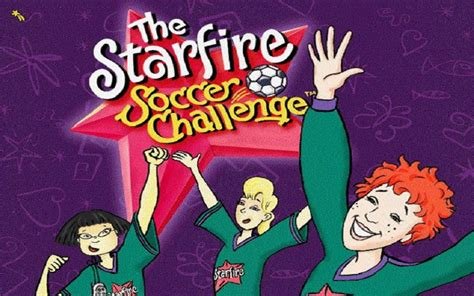
Description
The Starfire Soccer Challenge is a soccer-themed visual novel game designed for girls aged 8-12, set in the same universe as the Rockett and Secret Paths series. Players follow middle school student Ginger Baskin and her friends as they navigate personal challenges to earn spots on the Starfires soccer team. The game blends storytelling with decision-making, puzzle-solving through collected items, and mini-games that allow players to practice soccer skills like dribbling and shooting. It stands out as one of the first sports CD-ROMs specifically created for young girls, featuring relatable characters and a focus on emotional development.
Gameplay Videos
The Starfire Soccer Challenge Free Download
The Starfire Soccer Challenge Reviews & Reception
mobygames.com (40/100): A soccer-themed visual novel game targeted towards girls aged 8-12.
en.wikipedia.org : The game received a more positive reception from feminists than Purple Moon’s other games.
The Starfire Soccer Challenge Cheats & Codes
PC
At the startup screen, press [F4]. You will get a password prompt.
| Code | Effect |
|---|---|
| DONTKILLME | Unknown effect (described as ‘Guess what it does’) |
| JRBIFKKEAU | Unlocks level 2 |
| MFHRISLSOR | Unlocks level 4 |
| KSDURMOSEE | Unlocks level 6 |
| HSOURMOSEE | Unlocks level 7 |
| LOFUTRNFGI | Unlocks level 9 |
The Starfire Soccer Challenge: A Pioneering Experiment in Gender-Inclusive Game Design
Introduction: The Game That Dared to Be Different
In the late 1990s, the video game industry was a landscape dominated by hyper-masculine power fantasies, where female characters were often relegated to damsels in distress or hyper-sexualized sidekicks. Into this environment stepped The Starfire Soccer Challenge (1998), a bold experiment by Purple Moon that sought to redefine what a sports game—and indeed, what a game for girls—could be. More than just a soccer simulation, it was a narrative-driven visual novel that wove together personal growth, teamwork, and athletic competition into a tapestry aimed squarely at an underserved audience: girls aged 8–12.
This review will explore how Starfire Soccer Challenge emerged from a unique confluence of feminist game design, market research, and cultural timing to create something rare—a game that was both commercially ambitious and socially progressive. We’ll dissect its mechanics, its narrative ambitions, its reception, and its lasting (if often overlooked) legacy in the evolution of gender-inclusive gaming.
Development History & Context: The Purple Moon Revolution
The Studio Behind the Vision
Purple Moon was not just another game developer. Founded in 1996 by Brenda Laurel—a pioneer in human-computer interaction and a vocal advocate for gender-inclusive design—the studio was built on a radical premise: that games could (and should) be designed for girls, not just about them. Laurel’s work, including her seminal book Utopian Entrepreneur, argued that the gaming industry’s male-centric focus was not just exclusionary but economically shortsighted. Purple Moon’s mission was to prove that games for girls could be both critically acclaimed and commercially viable.
Starfire Soccer Challenge was the studio’s third major release, following Rockett’s New School (1997) and Secret Paths (1997). Unlike its predecessors, which were adventure games with strong narrative and puzzle elements, Starfire ventured into the sports genre—a domain almost entirely dominated by male-oriented titles like FIFA and Madden. The choice of soccer was deliberate: in 1998, women’s soccer was on the cusp of a cultural moment, with the U.S. Women’s National Team poised to win the World Cup the following year. The sport’s rising popularity among young girls made it the perfect vehicle for Purple Moon’s ambitions.
Research-Driven Design
What set Purple Moon apart was its commitment to research. The studio conducted extensive focus groups and interviews with girls aged 8–12, studying their play patterns, social dynamics, and emotional needs. This research informed every aspect of Starfire Soccer Challenge, from its character designs to its user interface.
Key findings included:
– Relatability Over Fantasy: Girls preferred characters who felt like “the girl next door” rather than unrealistic superstars. This led to the creation of protagonists like Ginger Baskin, an everyday middle-schooler with relatable insecurities.
– Narrative Depth: Unlike traditional sports games, which focused solely on competition, girls wanted stories about friendship, personal growth, and overcoming challenges.
– Puzzle and Exploration: The research showed that girls enjoyed games that rewarded curiosity and problem-solving, leading to the inclusion of item-based puzzles and interactive storytelling.
Technological Constraints and Innovations
Released in November 1998 for Windows and Macintosh, Starfire Soccer Challenge was a CD-ROM title, a format that allowed for rich multimedia experiences but also came with limitations. The game’s visuals were 2D, with pre-rendered backgrounds and sprite-based characters—a far cry from the 3D acceleration of contemporary sports games. However, Purple Moon leveraged these constraints creatively, focusing on expressive character animations and a vibrant, cartoonish art style that appealed to its target audience.
The UI was another area of innovation. Traditional sports games of the era were often cluttered with stats, menus, and complex controls. Starfire, by contrast, featured a streamlined, intuitive interface designed to be accessible to younger players. The game’s decision-based narrative system was similarly simplified, using a point-and-click mechanism that avoided the overwhelm of text-heavy visual novels.
The Gaming Landscape of 1998
To understand Starfire Soccer Challenge’s significance, one must consider the gaming ecosystem of 1998. The industry was in the midst of a 3D revolution, with titles like Half-Life, The Legend of Zelda: Ocarina of Time, and Metal Gear Solid pushing the boundaries of immersion and realism. Sports games, too, were evolving, with FIFA: Road to World Cup 98 and NBA Live 98 offering increasingly sophisticated simulations.
Yet, amidst this technological arms race, games for girls remained a niche. The few titles that existed—like Barbie Fashion Designer (1996)—were often dismissed as “pinkwashing,” offering little more than superficial gender swaps of existing genres. Purple Moon’s approach was different: it sought to create games that resonated with girls’ experiences, not just their perceived interests.
Narrative & Thematic Deep Dive: More Than Just a Game
Plot and Characters: The Starfires’ Journey
Starfire Soccer Challenge follows Ginger Baskin, a middle-school student and aspiring soccer player, as she and her friends navigate the trials of trying out for the Starfires, an elite all-girls soccer team. The narrative is structured as a visual novel, with the player making choices that influence Ginger’s relationships, her personal growth, and ultimately, her success on the team.
The game’s cast is a deliberate departure from the “lone hero” trope common in sports games. Instead of a single superstar, the story focuses on a diverse group of girls, each with their own strengths, insecurities, and backstories. Key characters include:
– Ginger Baskin: The protagonist, whose journey is as much about self-confidence as it is about soccer.
– Rockett: A returning character from Rockett’s New School, serving as a mentor figure.
– The Starfires Team: A mix of personalities, from the overly competitive to the shy and unsure, reflecting the social dynamics of real-life youth sports.
Themes: Empowerment, Friendship, and Resilience
At its core, Starfire Soccer Challenge is a story about resilience. The game’s themes are woven into its mechanics:
– Overcoming Personal Hardships: Each character faces challenges—whether it’s stage fright, self-doubt, or social anxiety—that mirror the real-life struggles of its target audience.
– Teamwork Over Individualism: Unlike traditional sports games, where the player controls a single athlete, Starfire emphasizes collaboration. Success depends on how well Ginger and her teammates support each other.
– Emotional Intelligence: The game’s puzzles and dialogue choices often revolve around understanding and empathizing with other characters, reinforcing the idea that emotional growth is as important as athletic skill.
Dialogue and Player Agency
The game’s narrative is driven by a branching dialogue system, where players make choices that affect Ginger’s relationships and the story’s outcome. These choices are not merely binary (e.g., “be nice” or “be mean”) but nuanced, reflecting the complexities of middle-school social dynamics.
For example:
– A teammate might be struggling with performance anxiety. The player can choose to offer encouragement, share their own insecurities, or even suggest a break to practice together.
– Conflicts arise not just on the field but off it, with subplots involving friendship dramas, school pressures, and family expectations.
This emphasis on agency was groundbreaking. While many games of the era treated narrative as a secondary concern, Starfire Soccer Challenge made it central, using soccer as a backdrop for a deeper exploration of adolescence.
Gameplay Mechanics & Systems: A Hybrid Experience
Core Gameplay Loop: Story, Puzzles, and Soccer
Starfire Soccer Challenge is a hybrid of several genres:
1. Visual Novel: The primary mode of play, where the story unfolds through dialogue and cutscenes.
2. Adventure/Puzzle Game: Ginger collects items throughout the game, which can be interacted with to solve puzzles. These puzzles often reveal character backstories or unlock new narrative paths.
3. Sports Mini-Games: At any point, the player can pause the story to engage in soccer drills, practicing dribbling, shooting, heading, and passing.
This hybrid structure was designed to keep players engaged across different play styles. The mini-games, while simple, were a clever way to tie the narrative themes (e.g., practice makes perfect) to the gameplay.
Combat? No. Competition? Yes.
Unlike traditional sports games, Starfire Soccer Challenge does not feature full matches or competitive gameplay. Instead, the soccer elements are abstracted into skill-based mini-games that reinforce the narrative’s focus on personal improvement. For example:
– Dribbling: A timing-based challenge where Ginger must navigate around cones.
– Shooting: A precision game where the player aims for different targets in the goal.
– Passing: A rhythm-based mechanic that emphasizes teamwork.
These mini-games are not just filler; they are tied to the story. Improving Ginger’s skills in these drills can unlock new dialogue options or narrative branches, creating a feedback loop between gameplay and storytelling.
Character Progression: Growth Beyond Stats
Progression in Starfire Soccer Challenge is not measured in traditional RPG stats (e.g., +1 to speed) but in emotional and social growth. As Ginger overcomes challenges, she gains confidence, which in turn affects how other characters perceive and interact with her. This system was a deliberate rejection of the “grind for power” mechanics common in other games, instead rewarding players for empathy and perseverance.
UI and Accessibility
The game’s UI was a masterclass in accessibility. Recognizing that its target audience might be less experienced with complex game controls, Purple Moon designed a system that was:
– Intuitive: Point-and-click navigation with clear visual feedback.
– Minimalist: Avoiding the clutter of stats and menus that dominated sports games.
– Encouraging: Positive reinforcement through sound effects, animations, and dialogue.
This approach was not just about simplicity; it was about respecting the player’s intelligence and emotional needs.
World-Building, Art & Sound: Crafting a Safe Space
Setting and Atmosphere
Starfire Soccer Challenge is set in a fictional middle school and its surrounding neighborhood, a world that feels both familiar and aspirational. The environments—classrooms, soccer fields, parks—are designed to be inviting, with warm colors and soft edges that contrast sharply with the gritty, hyper-masculine aesthetics of other sports games.
The game’s world is also notably safe. Unlike many games of the era, which thrived on conflict and danger, Starfire presents a space where failure is not punitive but educational. This was a deliberate choice, reflecting Purple Moon’s research into the emotional needs of young girls.
Visual Direction: Cartoons Over Realism
The art style of Starfire Soccer Challenge is deliberately cartoonish, with exaggerated expressions and bright, cheerful colors. This was not just an aesthetic choice but a thematic one:
– Expressive Characters: The exaggerated animations made it easier for players to read emotions, reinforcing the game’s focus on empathy.
– Inclusivity: The diverse character designs—varying in body type, skin tone, and hairstyle—were a rare sight in 1998, offering representation to a broad audience.
– Approachability: The soft, rounded visuals made the game feel less intimidating to newcomers.
Sound Design: The Power of Positivity
The game’s sound design is subtle but effective. The soundtrack is upbeat and motivational, with a mix of light rock and synth tunes that evoke the energy of youth sports without overwhelming the player. Sound effects are used sparingly but purposefully—for example, the cheerful “ding” of a successful puzzle solve or the encouraging cheers of teammates.
Voice acting, while limited by the technology of the era, is warm and expressive, further humanizing the characters. The absence of aggressive or competitive audio cues (e.g., booing crowds, taunts) reinforces the game’s focus on positivity and growth.
Reception & Legacy: A Mixed but Meaningful Impact
Critical Reception: Praise from Feminists, Skepticism from Gamers
Starfire Soccer Challenge received a mixed reception upon release. While it was lauded by feminists and educators for its progressive design, it struggled to gain traction among mainstream gamers and critics.
-
Positive Reception:
- Feminist scholars and advocates, including Brenda Laurel herself, praised the game for its fresh take on the sports genre. In Brenda Laurel: Pioneering Games for Girls, Carly A. Kocurek noted that Starfire “took a fresh take on the sports game” by focusing on personal growth over competition.
- The game was nominated for “PC Children’s Entertainment Title of the Year” at the 2nd Annual Interactive Achievement Awards, a testament to its innovative approach.
- A 2011 journal article in the Journal of the Canadian Academy of Child and Adolescent Psychiatry described it as an “outstanding example of digital technology supporting positive emotional development.”
-
Negative Reception:
- The game’s MobyGames score (2.0/5, based on a single rating) suggests that it failed to resonate with the broader gaming community. Many players, accustomed to the fast-paced action of traditional sports games, found Starfire’s narrative focus and mini-games underwhelming.
- The lack of full soccer matches or competitive multiplayer modes was a common criticism, with some dismissing it as “not a real sports game.”
Commercial Performance and the Fate of Purple Moon
Despite its critical acclaim in feminist circles, Starfire Soccer Challenge did not achieve commercial success. Purple Moon, despite its ambitious vision, struggled to compete in an industry that remained skeptical of games for girls. The studio was acquired by Mattel in 1999 and eventually shuttered, marking the end of its pioneering work.
Influence and Legacy
While Starfire Soccer Challenge may not have been a commercial hit, its influence can be seen in the slow but steady evolution of gender-inclusive game design:
– Narrative-Driven Sports Games: Later titles like FIFA Street (2012) and NBA 2K’s story modes owe a debt to Starfire’s emphasis on character and story.
– Games for Girls Movement: Purple Moon’s work paved the way for studios like Her Interactive (Nancy Drew series) and later indie developers who sought to create games that resonated with female audiences.
– Emotional Intelligence in Games: The game’s focus on empathy and personal growth foreshadowed later titles like Life is Strange (2015) and Night in the Woods (2017), which prioritize emotional storytelling over traditional gameplay mechanics.
Conclusion: A Flawed but Essential Experiment
The Starfire Soccer Challenge was not a perfect game. Its mini-games were simplistic, its narrative branches were limited, and its visuals were constrained by the technology of its time. Yet, to judge it solely by these metrics is to miss the point. This was a game that dared to ask: What if a sports game wasn’t about winning, but about growing? What if it wasn’t about being the best, but about being your best?
In an industry that often equates innovation with technological prowess, Starfire Soccer Challenge stands as a reminder that true progress can also come from empathy, inclusivity, and a willingness to challenge the status quo. It may not have been a commercial triumph, but it was—and remains—a cultural one.
Final Verdict: The Starfire Soccer Challenge is a flawed but essential artifact of video game history. It is a game that mattered not for what it achieved in sales or scores, but for what it represented: a bold, unapologetic step toward a more inclusive future for gaming. For historians, feminists, and designers, it remains a touchstone—a proof of concept that games can be more than just escapism; they can be mirrors, teachers, and friends.
Rating: ★★★★☆ (4/5) – A pioneering work that transcends its technical limitations through its heart and vision.