
- Release Year: 2003
- Platforms: Windows
- Developer: Chris Jones, Dylan Downing, ROTN community
- Genre: Adventure
- Perspective: Side view
- Game Mode: Single-player
- Gameplay: Graphic adventure, Icon-based, Point and click
- Setting: Futuristic, Sci-fi
Description
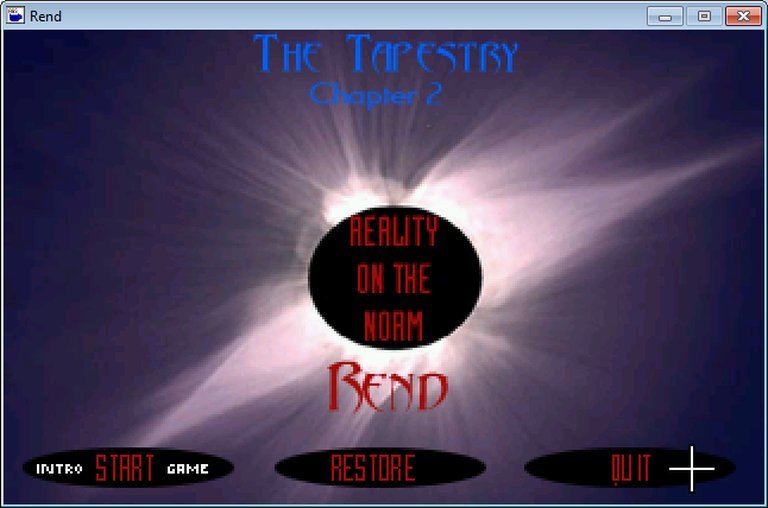
Set in the shared Reality-on-the-Norm universe, The Tapestry – Chapter 2: Rend is a sci-fi comedy graphic adventure created with Adventure Game Studio. Taking place five weeks after the events of the first chapter, the story follows the protagonist Greyson as he maintains a human form to monitor the town. When mysterious shadow entities known as adumbrations begin to appear again, the player must guide Greyson through a classic point-and-click interface, exploring the town, collecting items, and solving puzzles to defeat these threats.
The Tapestry – Chapter 2: Rend Free Download
The Tapestry – Chapter 2: Rend Cheats & Codes
PC
Admin console commands require setup in ‘Otherlands\Saved\WindowsServer\Config\Server.ini’ to enable admin rights.
| Code | Effect |
|---|---|
| /beastmaster | makes AI ignore you |
| /port | 1/2/3, for quick teleports |
| /addtocollection 210 0 5 | Summons Wolf howeltooth |
| /addtocollection 206 0 5 | Summons Wolf prowlfang |
| /addtocollection 199 0 5 | Summons Boar T1 |
| /addtocollection 200 0 5 | Summons Boar T2 |
| /addtocollection 203 0 5 | Summons Frabbit |
| /addtocollection 221 0 5 | Summons yxen (baby) |
| /addtocollection 222 0 5 | Summons yxen (adult) |
| /addtocollection 223 0 5 | Summons yxen (adult male) |
| /addtocollection 225 0 5 | Summons Roc (bby) |
| /addtocollection 226 0 5 | Summons Roc (bby big) |
| /addtocollection 233 0 5 | Summons waspray |
| /addtocollection 335 0 5 | Summons Frostfang |
| /setfaction 1 | Sets faction to Revenant |
| /setfaction 2 | Sets faction to Conclave |
| /setfaction 3 | Sets faction to Order |
| /setlevel (number of level you want) | Adjusts player level |
| /setskilllevel 1-16 1-100 | Adjusts skill level |
| /mob 1 | God Mode On |
| /mob 0 | God Mode Off |
| /createloot 201 1 0 5 | Creates Basic Gear |
| /createloot 202 1 0 5 | Creates Better Gear |
| /createitem (id of item) (quantity of item) | Creates an item by ID and quantity |
The Tapestry – Chapter 2: Rend: Review
In an era dominated by hyper-realistic shooters and sprawling open-world epics, The Tapestry – Chapter 2: Rend (2003) emerges as a poignant relic of a bygone gaming landscape—a lovingly crafted, self-contained point-and-click adventure that embodies the spirit of amateur game development in the early 2000s. As the second chapter in Dylan Downing’s Reality-on-the-Norm series, this obscure Windows title may lack the polish of commercial giants, but it compensates with infectious humor, a uniquely surreal sci-fi narrative, and a dedication to the adventure genre’s core tenets. This review delves into the game’s development, narrative depth, mechanical design, artistic merits, and enduring legacy, arguing that despite its technical constraints, Rend remains a charming time capsule of indie creativity and a testament to the power of community-driven storytelling.
Development History & Context
The Tapestry – Chapter 2: Rend was developed primarily by Dylan Downing, whose passion for interactive fiction shines through in every pixel. Released on September 20, 2003, it was built atop the Adventure Game Studio (AGS) engine—a freeware toolkit that democratized game development for non-programmers. AGS was the backbone of countless fan-made adventures in the 2000s, offering a robust framework for 2D point-and-click gameplay while imposing strict limitations on graphics, sound, and system flexibility. Downing leveraged this engine to craft a cohesive experience, but the constraints are palpable: backgrounds are static, animations are rudimentary, and the interface adheres to the era’s standard verb-based icons (walk, look, use, talk, etc.).
The game’s genesis lies in the Reality-on-the-Norm series, which began with The Tapestry: Prologue – The First Stitch (2002) and Chapter 1: The Unraveling (2003). Downing’s vision was to create a serialized sci-fi comedy where reality itself is a fragile tapestry threatened by “adumbrations” (reality-warping entities). Set in the titular town, the series blended absurdist humor with cosmic stakes—a niche ambition for a solo developer. Remarkably, Downing collaborated with the ROTN community for art assets, while the soundtrack cobbled together licensed tracks from classical (Beethoven’s Moonlight Sonata), orchestral (Holst’s Mars), and even pop (ABBA’s Gimmie, Gimmie, Gimmie) sources. Playtesting was handled by AGS veterans like Phorbin and David L. Gilbert (of Blackwell fame), underscoring the interconnected web of indie creators of the era.
Released into the gaming landscape of 2003—a year marked by the rise of 3D action games like Star Wars: Knights of the Old Republic and Prince of Persia: The Sands of Time—Rend felt like a deliberate anachronism. It harked back to the golden age of LucasArts and Sierra adventures but lacked the budget or polish to compete. Yet, its niche appeal was undeniable, targeting a dedicated audience of adventure game purists and fans of the burgeoning indie scene. The game’s cliffhanger ending, promising a sequel that never fully materialized, reflects the precarious nature of passion projects in an industry dominated by AAA studios.
Narrative & Thematic Deep Dive
The Tapestry – Chapter 2: Rend excels as a narrative-driven experience, weaving a tale of cosmic absurdity with grounded, character-driven humor. Set five weeks after the events of Chapter 1, the game opens with Greyson—an agent tasked with protecting reality—ordered to remain in human form and monitor the town of Reality-on-the-Norm. His respite is short-lived, as new adumbrations emerge, threatening to unravel the fabric of existence. The plot unfolds through a series of whimsical yet urgent quests: Greyson must explore the town, interrogate quirky locals, and confront manifestations of chaos, culminating in a battle against the First Adumbration. The narrative’s strength lies in its balance of high-concept sci-fi and low-brow comedy, a signature of the ROTN series.
Characters are the heart of Rend. Greyson, the weary-yet-capable protagonist, is joined by a recurring ensemble: the enigmatic Death, the cryptic Elandra, and the bumbling duo Davy and Frank Jones. New faces add fresh dynamics: Albert Waeks, a mysterious newcomer; Jennifer Barns, a perpetually jogging fitness enthusiast; and Hank Dolby, a sarcastic waiter whose dialogue injects levity into tense moments. The dialogue is sharp and character-driven, with NPCs delivering deadpan one-liners and non-sequiturs that amplify the game’s comedic tone. For instance, Hank Dolby’s retorts about “the absurdity of interdimensional threats” while serving coffee highlight the game’s theme of normalcy coexisting with the bizarre.
Thematically, Rend explores the fragility of reality and the burden of responsibility. The adumbrations serve as metaphors for life’s unexpected disruptions—mundane anxieties amplified to cosmic proportions. Greyson’s struggle mirrors the player’s own: navigating a world where logic is optional and chaos is just around the corner. The game’s use of humor as a counterweight to existential dread mirrors the works of Douglas Adams or Futurama, making weighty themes accessible. Yet, the narrative is not without flaws. Pacing falters in the middle act, with fetch quests slowing momentum, and the cliffhanger ending feels abrupt, leaving threads unresolved—a common pitfall of serialized indie projects. Still, the ingenuity of blending sci-fi lore with small-town charm makes Rend a standout in its niche.
Gameplay Mechanics & Systems
As a classic point-and-click adventure, Rend prioritizes exploration, puzzle-solving, and dialogue over action. Gameplay revolves around guiding Greyson through Reality-on-the-Norm’s side-scrolling environments, interacting with objects and NPCs to uncover clues and progress the story. The core loop is admirably straightforward: talk to inhabitants to gather information, collect items from the inventory, and combine them to solve environmental puzzles. Combat, when it appears, is abstract and puzzle-based—e.g., defeating adumbrations requires specific item combinations rather than reflexes, aligning with the genre’s tradition of cerebral challenges over brawn.
Character progression is non-traditional; there are no experience points or skill trees. Instead, advancement is tied to narrative milestones: solving a puzzle unlocks new areas, and key items grant access to previously blocked locations. This design reinforces the story-driven focus but can feel restrictive for players seeking agency. The AGS engine’s limitations are evident in the UI: a bottom-of-screen inventory bar and icon-based actions are functional but dated. Pixel-hunting is occasionally frustrating, with hotspots that are small or illogically placed—a common pain point for adventures of this era. Innovation is minimal; Rend adheres to genre conventions without reinventing them. However, its integration of the ROTN lore into gameplay—e.g., using “reality-stabilizing” items to manipulate the environment—adds a layer of thematic cohesion.
Systems-wise, the game excels in integration. Dialogue choices, though limited, influence NPC reactions, hinting at a branching narrative that never fully materializes. The inventory management is streamlined, with a logical “use on” mechanic for combining objects. Yet, flaws persist: some puzzles lack clear signposts, leading to trial-and-error frustration, and the lack of a hint system exacerbates this. Combat, while infrequent, feels tacked-on—a concession to genre expectations rather than a natural extension of the story. Despite these issues, Rend’s gameplay is a faithful homage to LucasArts classics, prioritizing player satisfaction through clever design over complexity.
World-Building, Art & Sound
The Tapestry – Chapter 2: Rend’s world-building is its greatest strength, transforming a generic small-town setting into a living, breathing testament to mundane weirdness. Reality-on-the-Norm is a masterclass in environmental storytelling: its streets are lined with anachronistic tech and surreal phenomena, from floating mailboxes to buildings that flicker in and out of existence. The sci-fi elements are grounded in human experience—coffee shops, parks, and high schools become stages for cosmic drama. This juxtaposition creates a unique atmosphere: lighthearted and whimsical, yet tinged with underlying tension. The adumbrations, as manifestations of reality decay, are visually inventive, manifesting as glitching sprites or warping geometry, though AGS’ technical limits prevent truly spectacular effects.
Artistically, the game reflects its engine’s constraints. Pre-rendered backgrounds are detailed but static, with a limited color palette dominated by earthy tones and neon accents. Character sprites are expressive but simplistic, with animations that are stiff and repetitive. The community-contributed art shines in minor details—e.g., the TARDIS cameo (courtesy of the BBC), a loving nod to Doctor Who, or the caricatured likenesses of NPCs like Jennifer Barns. While not groundbreaking, the art captures the game’s tone, using exaggerated features and vibrant contrasts to amplify its humor.
Sound design is where Rend surprises. The soundtrack is a curated playlist of eclectic tracks, ranging from Beethoven’s brooding Moonlight Sonata during tense moments to ABBA’s upbeat Gimmie, Gimmie, Gimmie during lighthearted sequences. This anachronistic blend underscores the game’s themes of normalcy and chaos. Sound effects are functional but unremarkable—footsteps, door creaks, and item pickups are standard fare. Voice acting, absent in the released version, would have elevated the experience, but the reliance on text dialogue allows players to imagine the characters’ voices, adding a personal touch. Together, the art and sound craft a cohesive atmosphere: a place where the mundane and the magical collide, inviting players to savor its offbeat charm.
Reception & Legacy
Upon release in September 2003, The Tapestry – Chapter 2: Rend passed through the gaming world with little fanfare. No critical reviews are documented in archives like MobyGames, and its niche status meant it was overshadowed by mainstream titles. Commercially, it was likely a modest success, appealing to a dedicated audience of adventure game enthusiasts and fans of the ROTN series. Its legacy, however, is one of quiet reverence among indie game historians. The game was preserved by the Internet Archive in 2014, ensuring its survival for future generations. It stands as a snapshot of early-2000s amateur development—proof that passion and creativity could rival (if not surpass) AAA polish in storytelling depth.
Influence is hard to quantify, as Rend did not spawn imitators or subgenres. Yet, it embodies the spirit of the AGS community, which prioritized narrative innovation over technical prowess. Its emphasis on character-driven humor and surreal sci-fi foreshadowed later indie darlings like Night in the Woods. The ROTN series, though incomplete, remains a cult favorite, with Rend often cited as its most cohesive chapter. Its legacy is also cautionary: the unfulfilled sequel and reliance on licensed music highlight the vulnerabilities of passion projects. Nonetheless, Rend’s preservation and occasional rediscovery by adventure game fans underscore its value as a cultural artifact—a reminder that gaming’s history is not just defined by blockbusters, but by the bold experiments of underdog creators.
Conclusion
The Tapestry – Chapter 2: Rend is a flawed but fascinating time capsule. As a product of Dylan Downing and the ROTN community’s ingenuity, it delivers a compelling narrative, memorable characters, and a uniquely charming atmosphere, all hampered by the technical limitations of its era. Its gameplay adheres to adventure game traditions without innovating, and its puzzles and pacing stumble at times. Yet, its strengths—whimsical humor, a grounded-yet-surreal world, and a killer soundtrack—elevate it above mere nostalgia.
In the pantheon of video game history, Rend may never be a household name, but it deserves recognition as a labor of love that exemplifies the creativity of indie development. For fans of classic adventures or those seeking a dose of absurdist sci-fi, it remains a hidden gem. As a chapter in the unfinished ROTN saga, it leaves players yearning for more—proof that even a fragmented story can leave an indelible mark. Verdict: A charming, if imperfect, adventure that stands as a testament to the enduring appeal of point-and-click storytelling and the boundless imagination of its creators.