
- Release Year: 2012
- Platforms: Nintendo Switch, PlayStation 3, Windows, Xbox 360
- Publisher: Focus Home Interactive SAS, Frogwares Game Development Studio, Frogwares Ireland Ltd.
- Developer: Frogwares Game Development Studio
- Genre: Adventure
- Perspective: 1st-person, 3rd-person (Other)
- Game Mode: Single-player
- Gameplay: Investigation, Point-and-click, Puzzle
- Setting: 1890s, Belle Époque, City – London
- Average Score: 60/100
Description
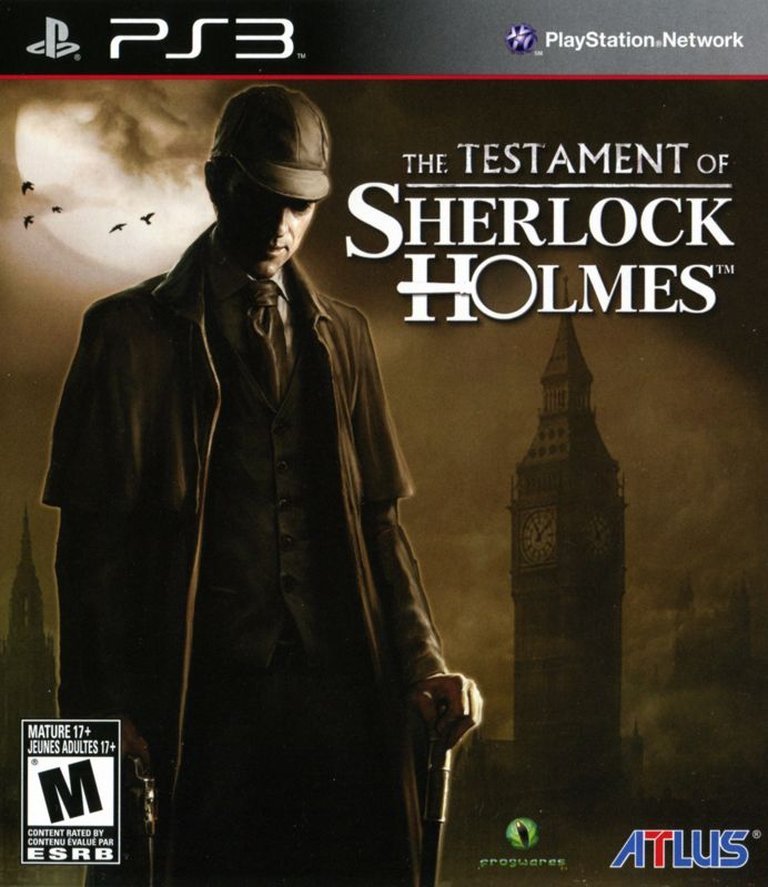
The Testament of Sherlock Holmes is an adventure game set in London, 1898, where the iconic detective is framed after a stolen jewel case reveals a fake necklace and the Bishop of Knightsbridge is discovered tied up and mutilated. Players initially control Holmes but soon switch to Dr. Watson, who must investigate his partner’s alleged guilt through open-world exploration, puzzles, and deductions in this narrative-driven mystery.
Gameplay Videos
Where to Buy The Testament of Sherlock Holmes
The Testament of Sherlock Holmes Cracks & Fixes
The Testament of Sherlock Holmes Patches & Updates
The Testament of Sherlock Holmes Guides & Walkthroughs
The Testament of Sherlock Holmes Reviews & Reception
slantmagazine.com (60/100): Frogwares still hasn’t quite cracked the case of the genius avatar.
reviewed.com : A perfect choice for the cerebral gamer.
The Testament of Sherlock Holmes: A Definitive Analysis of a Darkened Canon
Introduction: The Detective’s Shadow
In the pantheon of licensed adventure games, Frogwares’ long-running Sherlock Holmes series has always held a distinguished, if niche, place. With The Testament of Sherlock Holmes (2012), the Ukrainian studio attempted not just another casefile, but a profound narrative gamble: to permanently tarnish the impeccable reputation of literature’s greatest detective. This review will argue that Testament stands as the most narratively ambitious and thematically mature entry in the Frogwares canon, successfully using the interactive medium to explore the corrosive nature of genius and the fragility of trust. However, this artistic peak is achieved at the cost of mechanical refinement, with clunky controls and repetitive puzzle design creating a persistent friction against its darkly compelling story. It is a game of two halves: a masterclass in atmospheric, character-driven mystery, undermined by the very gameplay meant to deliver it.
1. Development History & Context: A Console Leap and a Darker Vision
From PC Roots to Console Primacy
Prior to Testament, Frogwares had built its reputation on PC-exclusive point-and-click adventures, with titles like The Mystery of the Mummy (2007) and Sherlock Holmes Versus Jack the Ripper (2009). As CEO Waël Amr stated, the team was “limited in reaching the PC market by trying to aim for a middle ground” with lower specs. With the then-current generation of consoles (Xbox 360, PlayStation 3) offering a robust installed base, Frogwares made a strategic pivot. Testament was developed from the ground up for consoles first, a first for the series, necessitating a new in-house graphic engine. This “Sherlock Holmes 6” engine was a significant technical upgrade, enabling fully rendered 3D environments, dynamic lighting, and more detailed character models compared to the 2D backgrounds and pre-rendered art of previous titles.
This console-first approach had direct gameplay consequences. The development team implemented a versatile camera system allowing seamless switching between first-person, over-the-shoulder third-person, and a classic point-and-click static view—a clear attempt to cater to both console players using gamepads and traditional PC adventure fans. The ability for characters to “run” was added to “travel faster” across the larger, more open-ended 3D environments, a nod to the scale expected on consoles. However, this technical leap came with a prolonged development cycle. Announced in early 2011 with a projected 2010 release, the game was delayed by nearly two years, finally launching in September 2012.
Aesthetic and Thematic Maturation
The move to a custom engine also allowed Frogwares to pursue a darker, more mature tone. Unlike Jack the Ripper, which used stylistic drawings to obscure the horror of its historical victims, Testament features fully modeled, gruesome crime scenes with mutilated bodies and graphic violence, as the victims are purely fictional. This aligned with a conscious narrative shift. Amr explicitly stated the goal was to show “Holmes’ darker side,” where he employs blackmail, forgery, and ruthless manipulation—a “cat-and-mouse style plot” reminiscent of Splinter Cell: Conviction or The Bourne Conspiracy. This philosophical departure was the game’s core design pillar: to challenge the player’s, and Watson’s, unwavering faith in the detective.
Publishing and Distribution
Focus Home Interactive served as the primary European publisher and distributor, handling physical retail copies for all platforms. In North America, Atlus acquired publishing rights, ensuring a dedicated release. The game saw a standard physical and digital release on Steam in September 2012. Its legacy was extended with surprise ports to Nintendo Switch (March 2023) and PlayStation 4 (June 2023), often bundled in collections like the “Frogwares Ultimate Collection,” introducing the title to a new generation of players.
2. Narrative & Thematic Deep Dive: The Fall of the Great Detective
Plot Architecture and Structural Genius
The narrative is framed by a contemporary book club of children (later implied to be Holmes and Watson’s grandchildren) discovering Watson’s journals, a device that softens the story’s grimness for a modern audience while establishing its historical weight. The plot, set in 1898 London, begins with Holmes seemingly at the height of his powers, recovering the stolen Samoan Necklace. The immediate reversal—the jewels are fakes, and Holmes is publicly accused—sets up the central conflict. The subsequent horrific mutilation of the Bishop of Knightsbridge provides the first tangible, brutal crime, but the true mystery is Holmes himself.
The story is masterfully structured in escalating stages of suspicion:
1. The Accused: Holmes is framed for theft and fraud by journalist Oliver Farley and an opportunistic Judge Beckett.
2. The Fugitive: After a bombing (for which Holmes is blamed) and the death of Inspector Baynes, Holmes fakes his suicide and operates in the shadows.
3. The Revelation: The conspiracy’s true scale is unveiled: a Hatred Plague poison, mass-produced by Hans Schielman (“the Rat Killer”), is to be distributed via Prince Woodville’s soup carts to the poor of Whitechapel, inciting riots that will topple the government. Professor Moriarty is the political mastermind, but Schielman is the scientific engine.
4. The Resolution: The finale at Moriarty’s carnival hideout sees the bombs defused, the factory destroyed, and the ironic, poetic justice of Schielman’s poison-fueled attack on Moriarty. The denouement—Holmes adopting Moriarty’s infant daughter, Katelyn—provides a devastatingly redemptive coda, granting the lonely genius a family.
Character Deconstruction: Holmes, Watson, and the Weight of Trust
Testament’s core drama is the erosion of the Holmes-Watson partnership. Holmes, voiced with chilling precision by Kerry Shale, exhibits his canonical arrogance to a villainous extreme. He Withholds evidence, destroys property, engineers a prison break, and bombs a judge’s house (accidentally killing a maid). His actions are juxtaposed with Watson’s (David Riley) dawning horror. Watson becomes the player’s avatar of moral outrage, delivering potent “What the Hell, Hero?” speeches. The genius of the writing is that Holmes’ stated motive—protecting Watson from Moriarty’s wrath—is partially true but insufficient. As TV Tropes notes, he is a “Jerk with a Heart of Gold” who tones down only after Watson forces a dénouement. The final, profuse apology, where Holmes admits his “necessary” extremism was also driven by his own nature (“I am a prick”), is one of the most nuanced character moments in gaming adaptations of the character.
Professor Moriarty, while the “Big Bad,” is given unexpected depth. His dying request for Holmes to raise his daughter frames him not as a mere sociopath, but as a man with a vestige of love, respecting his rival enough to entrust his child to him. This relationship is later expanded in The Devil’s Daughter, but Testament plants the seed: Moriarty’s final act is one of trust, a quality his own scheme utterly lacked.
Themes: Genius, Corruption, and Legacy
The game explores three intertwined themes:
* The Cost of Genius: Holmes’ intellectual superiority isolates him, breeding a contempt for procedure and a willingness to operate outside all moral law. His “solution” is often as destructive as the crime.
* Systemic Corruption: The conspiracy reaches into the highest echelons: a judge, an inspector (Baynes, a mole), a prince, and a peer of the realm. Moriarty’s plan is to poison the poor to create chaos and install a puppet monarch—a plot that weaponizes societal neglect.
* Found Family: The ending subverts the lone genius trope. Holmes, having lost his reputation and friends, gains a daughter. It’s a redemption not through solving a case, but through embracing human connection, directly countering Moriarty’s manipulative legacy.
3. Gameplay Mechanics & Systems: The Deduction Board and Its Discontents
Core Loop and Investigation
Gameplay is a three-part loop: Explore (in 3D environments), Examine (find clues via the “Sixth Sense” mechanic), and Deduce (use the Deduction Board). The “open world” promise is limited; while players can choose the order of some locations (e.g., prison vs. cemetery first), the narrative path is largely linear. Running is available but feels sluggish, and the open environments (Whitechapel streets) are sparsely populated with interactive NPCs.
The “Sixth Sense” is a crucial Anti-Frustration Feature. Pressing a button highlights all interactive objects with a magnifying glass and an audio cue. On higher difficulties, it has a cooldown, encouraging careful observation. This system replaced tedious pixel-hunting, a significant quality-of-life improvement for the genre.
The Deduction Board: Mind Palace in a Menu
This is the game’s conceptual centerpiece and its most successful innovation. Discovered clues (documents, items, testimonies) are stored on a board where players must link them and select a logical conclusion from a list (e.g., “The Poison Was Administered Via…” with options like “Opium” or “Food”). Correct connections turn green; incorrect ones simply don’t progress, with no penalty. This mimics Holmes’ associative thinking and turns evidence assembly into a satisfying mini-game. However, as noted by reviewers, these boards appear too infrequently in the mid-game, with long stretches of simple item-hunting between major deduction sequences.
Puzzles: A Mixed Bag of Logic and Levers
Puzzles fall into two categories:
1. Environmental/Logic Puzzles: Often tied to locks—chests, gates, doors—featuring tilting tiles, matching symbols, rotating gears, or sequence-based challenges. Some are clever (a chess knight’s tour puzzle), others are frustratingly obscure.
2. “Examination” Puzzles: Using tools like a UV lamp, chemical kit, or microscope on a clue to answer specific questions. The answers aren’t always intuitive and can gate progression.
The major flaw is consistency and integration. As 4Players.de criticized, “Why is nearly every simple door locked with a peculiar special mechanism?” The puzzles often feel like arbitrary barriers inserted to stretch playtime, breaking narrative immersion. The skippable puzzle option after repeated failures is a necessary concession to this design problem, but it feels like an admission of failure. A dedicated hint system for the puzzles themselves is absent; “Sixth Sense” only highlights objects, not solutions.
Controls and Perspectives
The triple-camera system (first-person, third-person, point-and-click) is ambitiously executed. Each perspective is fully functional, and players can switch on the fly. First-person is excellent for immersion and precise clue inspection. Third-person is better for navigating cluttered spaces and seeing character animations. The classic point-and-click mode is the most familiar to adventure veterans. However, all modes suffer from character movement that is either too slow (walk) or unwieldy (run), and collision detection issues (Watson famously getting stuck in doorways, a “Game-Breaking Bug” noted on TV Tropes). The game was designed for console gamepads, and the keyboard/mouse controls, while functional, lack the fine-tuned responsiveness of a pure PC point-and-click title.
4. World-Building, Art & Sound: A Gritty, Immersive London
Art Direction and Technical Achievement
For its time, Testament‘s graphics were a standout. The new engine delivered richly detailed Victorian environments with a stark, moody color palette. The contrast between the grim, rain-slicked streets of Whitechapel (opium dens, squalid apartments, filthy cemeteries) and the opulent, warmly lit interiors of the aristocracy (the Bishop’s palace, Judge Beckett’s library) is powerful and thematically resonant. Character models are expressive, and crime scenes are rendered with unflinching, harrowing detail—the mutilated bishop, the corpse in the smelting vat, the poisoned victims. While dated by 2025 standards (textures can be blurry, animations stiff), the art direction’s intent—to create a dirty, dangerous, and believable 1898 London—is completely successful. It avoids romanticized “steampunk” gloss for a version of London that feels authentically perilous.
Sound Design and Musical Score
The orchestral soundtrack is effective, predominantly somber and tense, underscoring the game’s dark tone. However, as the Gamepressure guide notes and several reviews imply, it is “underused” and can become repetitive during exploration. The true audio stars are the voice performances. Kerry Shale’s Holmes is a masterclass in cold, clipped, intellectually arrogant delivery. David Riley’s Watson provides the essential humanity and moral anchor; his moments of exasperation and betrayal are profoundly effective. The supporting cast is generally strong, though non-native English accents can occasionally slip. Sound effects—the clink of glassware, the gurgle of the poison, the crash of the explosion—are crisp and add to the realism.
Atmosphere as Narrative Partner
The world-building does heavy narrative lifting. Exploring Watson’s Baker Street apartment reveals trinkets from past cases (a nod to Versus Jack the Ripper and The Awakened), creating a sense of history. The shift from the familiar, cozy 221B to the ransacked, police-trashed apartment after Holmes’ fall is a powerful visual storytelling moment. The oppressive atmosphere of Whitechapel—the fog, the乞丐 (beggars), the lurking threats—makes the player feel the social decay at the heart of Moriarty’s plan. The game’s setting is not a backdrop; it is an antagonist and a clue.
5. Reception & Legacy: A Cult Classic’s Journey
Critical Reception at Launch
Testament received generally favorable reviews but with notable platform disparities and recurring critiques.
* Aggregates: Metacritic scores reflect this: PC 73/100 (18 reviews), PS3 65/100 (25 reviews), Xbox 360 64/100 (24 reviews). The MobyGames average is 79% from 21 critics.
* Praise: Universally acclaimed for its story, atmosphere, and voice acting. Adventure Gamers awarded it “Best of the Rest” in 2012, calling it “Frogwares at their finest” for its “surprising story of Sherlock’s apparent fall from grace.” GameSpot (8/10) highlighted its effective twists. Rock, Paper, Shotgun noted it as “a strong story, mostly well told.”
* Criticism: The harshest critiques centered on controls (clunky movement, camera issues), linearity (funneling players through scripted sequences with little agency), and puzzle inconsistency (too many arbitrary lock puzzles, frustrating difficulty spikes). PC Games (Germany) lamented “the unbalance of the puzzles.” 4Players.de specifically called out the excessive “minigame stretching.” The ending was divisive; GameBoomers noted Holmes’ behavior might bother “Sherlock purists.”
Commercial Performance and Player Legacy
Commercially, it was a solid success within the niche adventure genre, contributing to Frogwares’ overall franchise sales of over 7 million units by 2017. Its player reception has been warmer than some critical scores suggest. On Steam, it holds a “Mostly Positive” rating (77% from nearly 3,000 reviews as of 2025), with players frequently praising the story and deduction mechanics despite dated controls. The 2023 ports to Switch and PS4, often bundled, have revitalized interest. Community efforts on PCGamingWiki and ModDB provide essential patches for modern systems, indicating a dedicated, enduring fanbase.
Influence and Place in History
Testament is a pivotal title in two trajectories:
1. In the Frogwares Series: It directly precedes Crimes & Punishments (2014), which expanded the deduction board into a full moral-choice system. The darker tone and focus on Holmes’ psychology paved the way for The Devil’s Daughter (2016), which directly continues the Katelyn Moriarty storyline. It represents the peak of the “classic” Frogwares adventure formula before they transitioned to the more action-oriented, Unreal Engine 4-powered Sherlock Holmes Chapter One (2021).
2. In the Adventure Genre: It demonstrated that a licensed adventure game could tackle serious, mature themes and character deconstruction without sacrificing the core puzzle-solving appeal. Its “Deduction Board” system influenced later detective games by making evidence assembly a tangible, gameified process. While not a mainstream blockbuster, it is a cult classic and a benchmark for narrative ambition in the point-and-click space. It proved that Sherlock Holmes could be portrayed as morally compromised in an interactive format, a risk that largely paid off.
6. Conclusion: A Flawed Masterpiece of叙事的野心
The Testament of Sherlock Holmes is not a perfect game. Its controls are often cumbersome, its puzzle design inconsistently applied, and its structure defiantly linear in an era increasingly embracing player agency. To play it is to wrestle with its mechanical limitations.
However, to dismiss it on those grounds is to miss its extraordinary achievement. Frogwares crafted a story that does what few Sherlock Holmes adaptations dare: it dismantles the hero to examine what remains. It asks if genius without conscience is merely a different kind of madness, and if the man who deduces every sin is himself incapable of morality. The dynamic between a descending Holmes and a ascending, disillusioned Watson is the poignant, beating heart of the experience. The deduction board remains a brilliant translation of literary detection into game mechanics. The atmosphere of a grim, rain-soaked London is palpable and oppressive.
Its legacy is secure. It is the dramatic and thematic high point of the Frogwares series, a game willing to break its iconic protagonist to see if he could be rebuilt. For enthusiasts of narrative-driven games, it remains an essential, if frustrating, case study in how story can elevate flawed mechanics. For Sherlockians, it is a bold, canonical-adjacent “what if” that respects the spirit of Doyle’s creation while fearlessly exploring its shadow. Verdict: A narratively groundbreaking but mechanically uneven adventure. Its triumphs in writing, voice acting, and atmospheric world-building outweigh its gameplay stumbles, securing its place as a cult classic and the most daring entry in the Frogwares Holmes saga.