
- Release Year: 1997
- Platforms: Windows
- Publisher: Funsoft GmbH, Virgin Interactive Entertainment, Inc.
- Developer: Logic Factory, Inc., The
- Genre: Strategy, Tactics
- Perspective: Diagonal-down
- Game Mode: LAN, Online PVP, Single-player
- Gameplay: Base building, Puzzle elements, Real-time strategy, Resource Management, RPG elements, Spell casting
- Setting: Fantasy, Futuristic, Sci-fi
- Average Score: 81/100
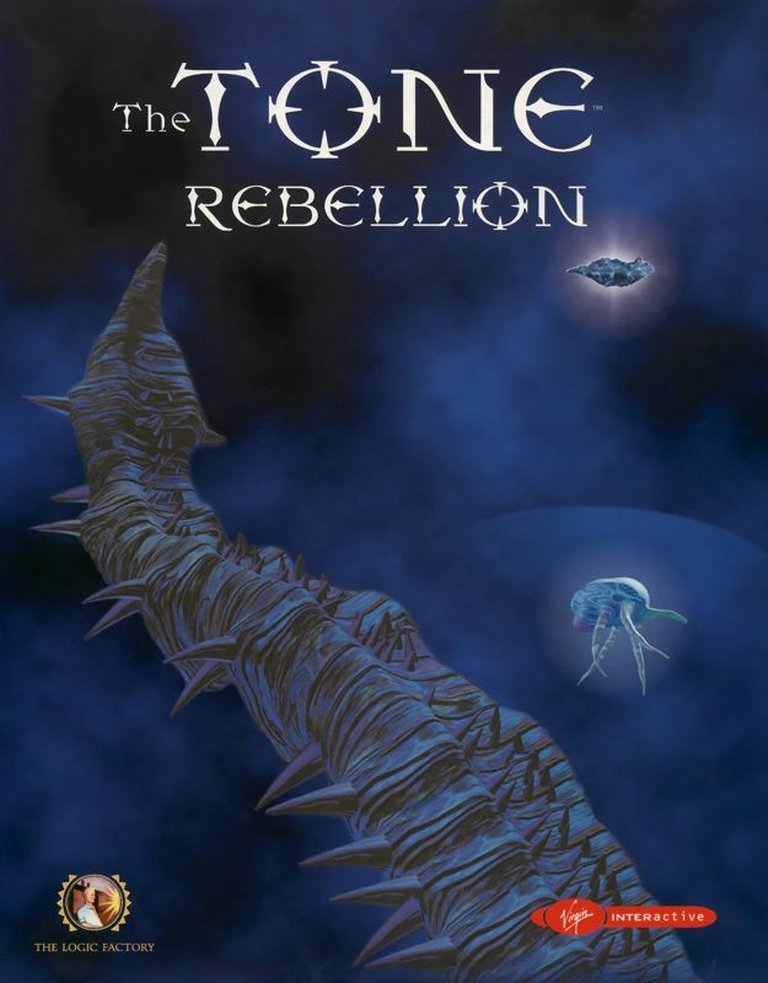
Description
In a fantasy-sci-fi world, the peaceful Floaters draw power from a mystical liquid called the Tone until the evil Leviathan destroys their civilization, scatters their world into fragmented islands, and forces the survivors to evolve into four distinct tribes. Players choose one tribe—Tarks, Zygons, Cepheans, or Dyla—to lead, harvesting Tone to build structures, train units, and develop RPG-style spells, while solving artifact-based puzzles to bridge islands and unite against the Leviathan in this real-time strategy game.
Gameplay Videos
The Tone Rebellion Free Download
The Tone Rebellion Patches & Updates
The Tone Rebellion Reviews & Reception
en.wikipedia.org (80/100): Maybe if Logic Factory had spent less time on metaphysical trappings and more on gameplay, this would have been an interesting game.
oldpcgaming.net : The Tone Rebellion shines as an unparalleled artistic achievement.
obscuritory.com : If you try to play this like a conventional 4X game, you’ll hit a wall quickly.
myabandonware.com (90/100): Although it doesn’t ship with any major bug, The Tone Rebellion is still plagued with the same weaknesses as its predecessor, most notably the very weak AI that does a lot of stupid things. Nonetheless, the game’s very unique premise and several innovations help set it apart from other 4X games, and qualify it for our Top Dog award.
The Tone Rebellion: A Flawed Masterpiece of Surreal Strategy
Introduction
In the crucible of 1997, when real-time strategy (RTS) games like StarCraft and Total Annihilation defined the genre through militaristic conquest and streamlined mechanics, The Tone Rebellion emerged as a defiantly anomalous vision. Developed by The Logic Factory, the studio behind the cult space strategy game Ascendancy, this title dared to reimagine the RTS not as a war simulator but as a meditative odyssey of restoration and myth. Its premise—jellyfish-like aliens called Floaters battling the cosmic evil of the Leviathan to reunite their shattered world—was as surreal as it was ambitious. Yet, while its legacy as a cult classic is secure, The Tone Rebellion remains a game defined by its contradictions: a breathtaking fusion of artistry and gameplay flaws, a philosophical treatise disguised as a strategy game, and a title that rewards patience even as it frustrates. This review will dissect its historical context, narrative depth, innovative mechanics, and enduring legacy to argue that, despite its technical shortcomings, The Tone Rebellion stands as a landmark in experimental game design—a flawed masterpiece that redefined the boundaries of what an RTS could be.
Development History & Context
Created by The Logic Factory over an intense 18-month development cycle, The Tone Rebellion was a product of both creative ambition and industry turbulence. Announced in March 1997 as a spiritual successor to Ascendancy, the game initially partnered with Broderbund before a dramatic last-minute shift saw it published under Virgin Interactive Entertainment in August 1997. This upheaval, while chaotic, underscored the studio’s commitment to a singular vision: crafting a game that prioritized atmospheric storytelling and introspection over genre conventions. Technically constrained by the era’s hardware, the team leveraged pseudo-3D graphics and CD-ROM capabilities to weave a richly layered world, with composer Nenad Vugrinec’s “baroque and bizarre” soundtrack acting as a narrative anchor. Released amid the RTS boom of 1997—a year dominated by titles like Age of Empires and Dark Reign—The Tone Rebellion arrived as a counterpoint. While peers focused on resource extraction and combat escalation, The Logic Factory sought to build a game around emotional resonance and environmental storytelling, a gamble that alienated mainstream audiences but cemented its reputation among critics and players who valued innovation over polish.
Narrative & Thematic Deep Dive
The narrative of The Tone Rebellion unfolds like a cosmic fable, blending science fiction with mythological grandeur. The backstory, revealed through artifacts and environmental storytelling, posits a world once unified by the “Tone,” a life-sustaining liquid corrupted by the malevolent Leviathan. This cataclysm shattered the world into floating islands, scattering the peaceful Floaters into four isolated tribes: the red Physical-affiliated Tarks, the yellow Supernatural Zygons, the blue Ethereal Cepheans, and the green Natural Dyla. Each tribe’s evolution is a study in divergence—shaped by their realms and isolation—yet united by a shared quest to restore the world’s wholeness. The Leviathan itself, a Biblical-inspired force of greed and hatred, serves as an antagonist not through overt malice but through insidious corruption, infecting Tone pools with spores and spawning increasingly monstrous minions. This duality of innocence versus corruption permeates the narrative, with players embodying the role of a reluctant messiah guiding their tribe through a shattered Eden. The game’s dialogue, sparse yet poetic, leans heavily on symbolism—artifacts like the “Octojen” or “Shrine of the Storm” are puzzle pieces and mythic keys, their descriptions hinting at virtues (courage, wisdom) and vices (fury, apathy) that mirror the Leviathan’s corruption. This thematic depth elevates The Tone Rebellion beyond mere strategy, framing its gameplay as a metaphor for spiritual renewal and collective healing.
Gameplay Mechanics & Systems
At its core, The Tone Rebellion is a 4X game (eXplore, eXpand, eXploit, eXterminate) reimagined through a lens of restoration rather than conquest. Players begin on a single island, harvesting Tone—the game’s lifeblood—to build structures (e.g., dojos for fighters, tone spreaders for expansion) and train units. Unlike traditional RTS titles, expansion is horizontal: players deploy “Spreaders” to reveal new island segments, creating a nomadic, map-unfolding experience. Each island harbors artifacts, collected like puzzle pieces to unlock bridges to new territories, blending strategy with adventure-game problem-solving. Combat, though real-time, is tactically minimalist. Units gain experience and learn spells, but encounters often devolve into simple attrition, with the Leviathan’s minions exhibiting “zero intelligence.” The game’s most innovative system is the realm dynamic, where elemental forces (Physical, Supernatural, Ethereal, Natural) fluctuate in power like tides, dictating unit strengths via rock-paper-scissors mechanics. This adds a layer of temporal strategy, as players must time attacks based on shifting dominances. However, the interface and AI reveal the game’s flaws. Point-and-select controls are unintuitive, with no clear feedback for unit status or building locations, while the AI’s “weak” decision-making—failing to prioritize threats or exploit weaknesses—undermines challenge. Multiplayer, supporting up to four players via LAN or internet, offered cooperative potential but rarely matched the single-player narrative cohesion. Ultimately, The Tone Rebellion excels in concept but falters in execution, its systems feeling more like “Simon says” puzzles than dynamic strategy.
World-Building, Art & Sound
The world of The Tone Rebellion is a masterpiece of surreal world-building, realized through a unique fusion of art and sound. The shattered islands—crystalline caves, ethereal seas, and petrified forests—are rendered in a hand-drawn, pseudo-3D style that evokes watercolor paintings and aquatic dioramas. Each landscape is a self-contained vignette, with environments like the “Cephean Sea” or “Broont Swamp” reflecting their dominant realm through color palettes and creature designs. Floaters, resembling airborne jellyfish with one eye and five tentacles, drift across these vistas with an otherworldly grace, while Leviathan structures—corrupted spores, pulsating spawners—loom as organic horrors. This aesthetic choice, described as “surreal” and “hypnotic,” was divisive yet undeniably bold, with critics praising its “awesome art style” even as some found it too abstract. Sound design is equally integral, with Vugrinec’s score shifting between Debussy-esque piano melodies and dissonant ambient textures that underscore the game’s mystical tone. The audio acts as a narrative guide, with musical “acts” signaling transitions between islands and moods. Together, the art and sound create an atmosphere of melancholic wonder, transforming routine gameplay loops into a meditative experience. As one reviewer noted, it feels less like playing a game and more like “progressing through a grand work of art based on an underlying text you have never read.”
Reception & Legacy
At launch, The Tone Rebellion received a polarized reception, mirroring its dual nature as a technical curiosity and artistic triumph. Critically, it averaged 77% on MobyGames, with publications like Mega Score (91%) and Jeuxvideo.com (90%) hailing its “unique premise” and “surreal environment.” PC Games (Germany) called it “a rare original in the RTS genre,” while Computer Gaming World awarded it 4/5, praising its “absorbing diversion” for patient players. Yet, significant detractors included PC Gamer, which lambasted it with a scathing 35%, arguing that “metaphysical trappings” overshadowed gameplay. Player reviews were equally divided, with some lauding it as “the most innovative and surreal game of its time” while others dismissed it as “unique, ambitious, original, not fun.” Commercially, it failed to find an audience, overshadowed by genre titans and hampered by its steep learning curve. Over time, however, The Tone Rebellion evolved into a cult classic. Retrospectives from sites like The Obscuritory highlight its influence on experimental titles, praising its “conservationist” resource model and “rebellion against militaristic RTS conventions.” It anticipated games like Stardew Valley in its focus on renewal over conquest and inspired a niche appreciation for narrative-driven strategy. Though its legacy is one of “what could have been”—crippled by AI flaws and interface issues—it remains a testament to The Logic Factory’s audacity, remembered not for perfection but for its unflinching commitment to a singular, haunting vision.
Conclusion
The Tone Rebellion is a paradox: a game that is simultaneously its time’s most radical strategy experiment and its most frustrating technical compromise. Its narrative of restoration and its elemental realm system remain unparalleled in their ambition, while its art and sound design create a world of haunting beauty. Yet, these triumphs are inextricably linked to its failures—the unintuitive UI, the simplistic combat, the weak AI—ensuring it never achieves the mainstream resonance of its contemporaries. In the end, The Tone Rebellion is less a game to be “won” than to be experienced. It challenges players to find meaning not in victory, but in the act of piecing together a shattered world, one artifact at a time. For historians and genre enthusiasts, it stands as a vital artifact of 1990s experimental gaming—a flawed, fascinating glimpse into a future where RTS might have been less about war and more about wonder. As a cult classic, it endures not despite its flaws, but because of them: a monument to the courage of creators who dared to build bridges between art and interactivity, even if the path across was treacherous.