
- Release Year: 1997
- Platforms: Windows 16-bit, Windows
- Publisher: Virtual Entertainment, Inc.
- Developer: Virtual Entertainment, Inc.
- Genre: Educational
- Perspective: Fixed / flip-screen
- Game Mode: Single-player
- Gameplay: Game show, Mental training, quiz, trivia
- Setting: Contemporary
- Average Score: 88/100
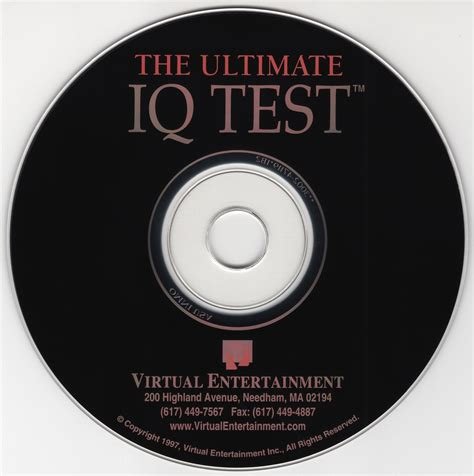
Description
The Ultimate IQ Test is an educational game released in 1997 for Windows, designed to measure a player’s IQ through a variety of engaging activities. These include identifying the odd-one-out, answering general knowledge questions, recognizing patterns, and solving shape puzzles. Despite its straightforward premise, the game offers a surprisingly entertaining experience, blending mental training with a contemporary setting and direct control interface.
The Ultimate IQ Test Free Download
The Ultimate IQ Test Reviews & Reception
mobygames.com (88/100): Designed to measure a player’s IQ, this game has a number of activities, which include finding the odd-one-out, answering some general knowledge questions, pattern recognition, and solving shape puzzles.
The Ultimate IQ Test: A Deep Dive into a Forgotten Edutainment Classic
Introduction
In the late 1990s, as the video game industry hurtled toward the 3D revolution, a quiet little CD-ROM title emerged, promising to measure the very essence of human intellect. The Ultimate IQ Test, developed and published by Virtual Entertainment, Inc. in 1997, was a product of its time—a curious blend of educational software and interactive entertainment, designed to quantify intelligence through a series of digital challenges. While it may not have left an indelible mark on gaming history, its existence speaks volumes about the era’s fascination with edutainment, the commercialization of psychological testing, and the evolving relationship between technology and self-improvement.
This review will dissect The Ultimate IQ Test from every conceivable angle, exploring its development, gameplay, cultural context, and legacy. Was it a legitimate tool for measuring intelligence, or merely a gimmicky parlor trick masquerading as science? And why, despite its obscurity, does it warrant our attention today?
Development History & Context
The Studio Behind the Test
Virtual Entertainment, Inc. was a small, relatively unknown developer and publisher that operated during the mid-to-late 1990s. Little is known about the company’s broader catalog, but its focus appeared to be on educational and utility software, with The Ultimate IQ Test standing as one of its few notable releases. The studio’s obscurity is telling—it was one of countless small firms that sprung up during the CD-ROM boom, hoping to capitalize on the burgeoning market for multimedia software.
The game’s development coincided with a period of rapid technological advancement. By 1997, CD-ROM drives had become standard in most PCs, allowing for richer multimedia experiences than the floppy disks of yesteryear. Windows 95, released in 1995, had already revolutionized personal computing, and its successor, Windows 98, was on the horizon. The Ultimate IQ Test was designed to run on these platforms, as well as the aging Windows 3.1, ensuring broad compatibility.
The IQ Test Craze of the 1990s
To understand The Ultimate IQ Test, one must first grasp the cultural obsession with IQ testing that permeated the late 20th century. The concept of the Intelligence Quotient (IQ) had been around since the early 1900s, thanks to the work of psychologists like Alfred Binet and Lewis Terman. By the 1990s, however, IQ tests had transcended their academic origins, becoming a mainstream phenomenon.
Books like The Bell Curve (1994) sparked heated debates about intelligence, genetics, and social policy, while magazines and talk shows frequently featured IQ-related segments. The rise of personal computing made it possible to digitize these tests, leading to a surge in IQ-testing software. Titles like IQ Test Pro (1996) and Multimedia! IQ Test (1995) flooded the market, each promising to deliver an accurate measure of one’s cognitive abilities.
The Ultimate IQ Test entered this crowded field with a bold claim: it wasn’t just another IQ test—it was the ultimate one. Whether it lived up to that promise is a question we’ll explore in depth.
Technological Constraints and Design Choices
Given the hardware limitations of the era, The Ultimate IQ Test was a relatively modest affair. The game required a mere 5 MB of hard drive space—a pittance even by 1997 standards—and ran on systems as old as Windows 3.1. Its visuals were sparse, relying on simple 2D graphics and text-based interfaces. There were no flashy animations, no voice acting, and no complex simulations. Instead, the game’s strength lay in its structure: a series of timed challenges designed to assess various cognitive skills.
The decision to forgo elaborate presentation was likely a practical one. CD-ROMs could hold up to 700 MB of data, but The Ultimate IQ Test was a lean 144.5 MB, suggesting that Virtual Entertainment prioritized functionality over frills. This minimalist approach was common in educational software, where the emphasis was on utility rather than spectacle.
Narrative & Thematic Deep Dive
The Illusion of Narrative
Unlike traditional video games, The Ultimate IQ Test had no plot, no characters, and no dialogue. There was no protagonist embarking on a heroic quest, no villain to defeat, and no world to save. Instead, the game positioned the player as both the subject and the scientist—a participant in a self-administered experiment.
The lack of narrative was not a flaw but a deliberate choice. The game’s “story,” such as it was, revolved around the player’s journey of self-discovery. Each question answered, each puzzle solved, was a step toward uncovering one’s intellectual strengths and weaknesses. In this sense, the game’s narrative was meta—it was the story of the player’s engagement with the test itself.
Themes: Intelligence, Self-Improvement, and the Quantified Self
The Ultimate IQ Test tapped into several themes that resonated deeply with the late 20th-century zeitgeist:
-
The Quantified Self: The game was part of a broader cultural shift toward self-measurement. As personal computers became household staples, people grew increasingly interested in using technology to quantify aspects of their lives, from fitness to finances. IQ tests offered a way to measure something far more abstract: intelligence.
-
The Promise of Self-Improvement: The 1990s saw the rise of the self-help industry, with books, tapes, and software promising to unlock human potential. The Ultimate IQ Test fit neatly into this ecosystem, offering users not just a score but a roadmap for cognitive enhancement. By identifying areas of weakness, players could theoretically target those skills for improvement.
-
The Democratization of Psychology: Once the domain of academics and clinicians, psychological testing was becoming accessible to the masses. The Ultimate IQ Test was a symptom of this trend, allowing anyone with a PC to engage in a practice that had previously required a trained professional.
-
The Gamification of Learning: Even in 1997, there was a growing recognition that games could be powerful educational tools. The Ultimate IQ Test blurred the line between assessment and entertainment, framing cognitive challenges as a form of play. This was edutainment in its purest form.
The Ethics of Digital IQ Testing
While The Ultimate IQ Test was marketed as a fun, interactive experience, it also raised ethical questions. IQ tests have long been criticized for their potential to reinforce stereotypes, justify discrimination, and oversimplify the complexities of human intelligence. By packaging these tests as a game, Virtual Entertainment risked trivializing their serious implications.
Moreover, the game’s claim to measure IQ was dubious at best. Legitimate IQ tests, such as the Stanford-Binet or the Wechsler Adult Intelligence Scale, are administered under controlled conditions by trained professionals. The Ultimate IQ Test, by contrast, was a self-administered, unstandardized assessment. Its results were likely more reflective of the player’s familiarity with the test’s format than their actual cognitive abilities.
Gameplay Mechanics & Systems
Core Gameplay Loop
The Ultimate IQ Test was structured as a series of timed challenges, each designed to assess a different cognitive skill. The game’s activities included:
- Odd-One-Out: Players were presented with a group of items and tasked with identifying the one that didn’t belong.
- General Knowledge Questions: A mix of trivia questions covering topics like history, science, and pop culture.
- Pattern Recognition: Players had to identify sequences or relationships between shapes, numbers, or symbols.
- Shape Puzzles: Spatial reasoning challenges that required players to manipulate or assemble geometric forms.
Each activity was presented in a straightforward, no-frills interface. Players selected their answers using a mouse, and the game provided immediate feedback, along with a running tally of their score. The experience was akin to taking a digital standardized test, with all the pressure and none of the proctor.
Combat? No. Challenge? Yes.
While The Ultimate IQ Test lacked traditional video game mechanics like combat or exploration, it was not without its own form of conflict. The player’s adversary was not a pixelated villain but the ticking clock and their own cognitive limitations. The game’s difficulty stemmed from the time constraints and the abstract nature of the challenges, which required quick thinking and mental agility.
In this sense, The Ultimate IQ Test was a puzzle game in the purest sense. Like Tetris or Portal, it tested the player’s ability to recognize patterns, solve problems, and adapt to new challenges. The difference, of course, was that The Ultimate IQ Test framed these puzzles as a measure of intelligence rather than mere entertainment.
Character Progression: The Illusion of Growth
Traditional video games often feature character progression systems, where players unlock new abilities or upgrade their stats. The Ultimate IQ Test offered a different kind of progression: the accumulation of knowledge about one’s own mind.
As players completed each section of the test, they received feedback on their performance, highlighting strengths and weaknesses. This information could theoretically be used to guide future learning, making the game a tool for self-improvement. However, the lack of follow-up resources or personalized recommendations limited the game’s utility in this regard. Players were left to interpret their results on their own, with no guidance on how to act on them.
UI and UX: Functional but Uninspired
The game’s user interface was functional but unremarkable. Menus were text-heavy, with minimal graphical flourishes. Navigation was straightforward, with players clicking through screens to select their answers. The lack of visual polish was likely a concession to the game’s educational purpose—form followed function, and the focus was on clarity rather than aesthetics.
One notable feature was the game’s use of a “direct control” interface, meaning players interacted with the test directly rather than through an avatar or intermediary. This design choice reinforced the game’s serious tone, positioning the player as a test-taker rather than a gamer.
Innovations and Flaws
The Ultimate IQ Test was not a trailblazer in terms of gameplay innovation. Its mechanics were borrowed from established IQ testing methodologies, and its presentation was standard for educational software of the era. However, it did stand out in one regard: its attempt to bridge the gap between psychology and entertainment.
The game’s most significant flaw was its lack of scientific rigor. While it mimicked the structure of legitimate IQ tests, it lacked the standardization and validation that make such tests reliable. The absence of normative data—comparisons to a representative sample of the population—meant that players’ scores were meaningless in an absolute sense. A high score on The Ultimate IQ Test did not necessarily correlate with a high IQ in the real world.
Moreover, the game’s fixed difficulty level meant that it could not adapt to the player’s ability. Unlike modern adaptive tests, which adjust their questions based on the test-taker’s performance, The Ultimate IQ Test presented the same challenges to everyone, regardless of skill level. This one-size-fits-all approach limited its effectiveness as a measuring tool.
World-Building, Art & Sound
The Setting: A Digital Testing Lab
The Ultimate IQ Test took place in a contemporary setting, but not in the traditional sense. There were no virtual worlds to explore, no characters to interact with, and no environments to navigate. Instead, the game’s “world” was the digital testing lab—a sterile, abstract space where the player’s mind was the only landscape.
This minimalist approach was consistent with the game’s educational goals. By stripping away distractions, the developers ensured that the player’s focus remained on the test itself. The absence of a traditional setting also reinforced the game’s serious tone, distinguishing it from more frivolous edutainment titles.
Visual Design: The Aesthetics of Utility
The game’s visual design was spartan, reflecting its utilitarian purpose. The interface consisted primarily of text and simple geometric shapes, with occasional use of basic illustrations. Colors were muted, and animations were nonexistent. The overall aesthetic was reminiscent of early Windows applications, with a focus on functionality over form.
This design philosophy was not unique to The Ultimate IQ Test. Many educational software titles of the era adopted a similar approach, prioritizing clarity and ease of use over visual appeal. The assumption was that users—whether students, professionals, or casual learners—were more interested in the content than the presentation.
Sound Design: Silence as a Design Choice
The Ultimate IQ Test was a remarkably quiet game. There was no background music, no sound effects, and no voice acting. The only audio cues were the occasional beeps or chimes that signaled correct or incorrect answers. This minimalist sound design was likely intended to minimize distractions, allowing players to focus entirely on the test.
The absence of sound also contributed to the game’s serious, almost clinical atmosphere. Unlike action games, which use sound to heighten excitement, or adventure games, which use it to build immersion, The Ultimate IQ Test treated sound as an unnecessary embellishment. The result was an experience that felt more like a real IQ test than a video game.
Reception & Legacy
Critical Reception: A Surprising Endorsement
Given its obscurity, The Ultimate IQ Test received surprisingly little critical attention. The only known review came from Computer Gaming World (CGW), which awarded the game an 88% score—a remarkably high rating for what was essentially an educational tool.
The CGW review, published in September 1998, praised the game for being “considerably more entertaining than its name suggests.” The critic acknowledged the inherent skepticism surrounding IQ tests but argued that The Ultimate IQ Test managed to make the experience engaging. This endorsement, while modest, suggests that the game succeeded in its primary goal: to make the process of IQ testing palatable to a broader audience.
Commercial Performance: A Niche Product
The Ultimate IQ Test was never a commercial juggernaut. It was a niche product, targeted at a specific audience: individuals interested in self-assessment, students preparing for standardized tests, or parents looking for educational software for their children. Its sales figures are unknown, but its obscurity today suggests that it did not achieve widespread popularity.
The game’s commercial fate was likely sealed by its limited appeal. Unlike mainstream titles, which could rely on word-of-mouth or marketing hype, The Ultimate IQ Test had to compete in a crowded field of educational software. Its lack of brand recognition and its unremarkable presentation made it easy to overlook.
Legacy: A Footnote in Edutainment History
The Ultimate IQ Test has had little lasting impact on the video game industry. It was not a trendsetter, nor did it inspire a wave of imitators. Instead, it remains a footnote in the history of edutainment—a curious artifact of a time when developers were still experimenting with the intersection of education and entertainment.
That said, the game’s existence is noteworthy for what it reveals about the cultural moment in which it was created. It reflects the late 1990s’ fascination with self-measurement, the commercialization of psychological testing, and the belief that technology could be harnessed for self-improvement. In this sense, The Ultimate IQ Test is a time capsule, offering a glimpse into the aspirations and anxieties of its era.
Influence on Subsequent Games
While The Ultimate IQ Test did not directly influence later games, it was part of a broader trend that continues to this day: the gamification of cognitive assessment. Modern titles like Brain Age (2005) and Lumosity (2007) owe a debt to early edutainment software, including The Ultimate IQ Test. These games refined the formula, incorporating more sophisticated mechanics, better visuals, and adaptive difficulty. However, the core idea—that cognitive challenges can be both educational and entertaining—remains the same.
Conclusion: The Ultimate IQ Test in the Pantheon of Gaming History
The Ultimate IQ Test is not a game that will be remembered alongside the classics of 1997, such as Final Fantasy VII, GoldenEye 007, or Fallout. It lacks the narrative depth, the visual spectacle, and the mechanical innovation that define those titles. Instead, it occupies a humble place in gaming history as a relic of the edutainment boom—a well-intentioned but flawed attempt to merge psychology with play.
And yet, there is something fascinating about The Ultimate IQ Test. It represents a moment when developers believed that video games could be more than just entertainment—that they could be tools for self-discovery, instruments of measurement, and catalysts for personal growth. In this sense, the game was ahead of its time, anticipating the rise of brain-training apps and the broader trend of gamified self-improvement.
Ultimately, The Ultimate IQ Test is a reminder that not all games need to be masterpieces to be meaningful. Sometimes, the most interesting titles are the ones that dare to ask questions—even if they don’t always provide the answers. In a medium often obsessed with spectacle, The Ultimate IQ Test stands as a quiet testament to the power of curiosity, the allure of self-knowledge, and the enduring human desire to understand the workings of the mind.
Final Verdict: 6.5/10 – A fascinating historical artifact and a noble experiment in edutainment, but ultimately more interesting as a cultural artifact than as a game.