
- Release Year: 2006
- Platforms: PlayStation 2, Windows
- Publisher: Liquid Games
- Developer: Mere Mortals Ltd.
- Genre: Board game, Sports
- Game Mode: Hotseat, Single-player
- Gameplay: Jokers, Multiple-choice questions, trivia
- Setting: FIFA World Cup, Football (European), Soccer
- Average Score: 40/100
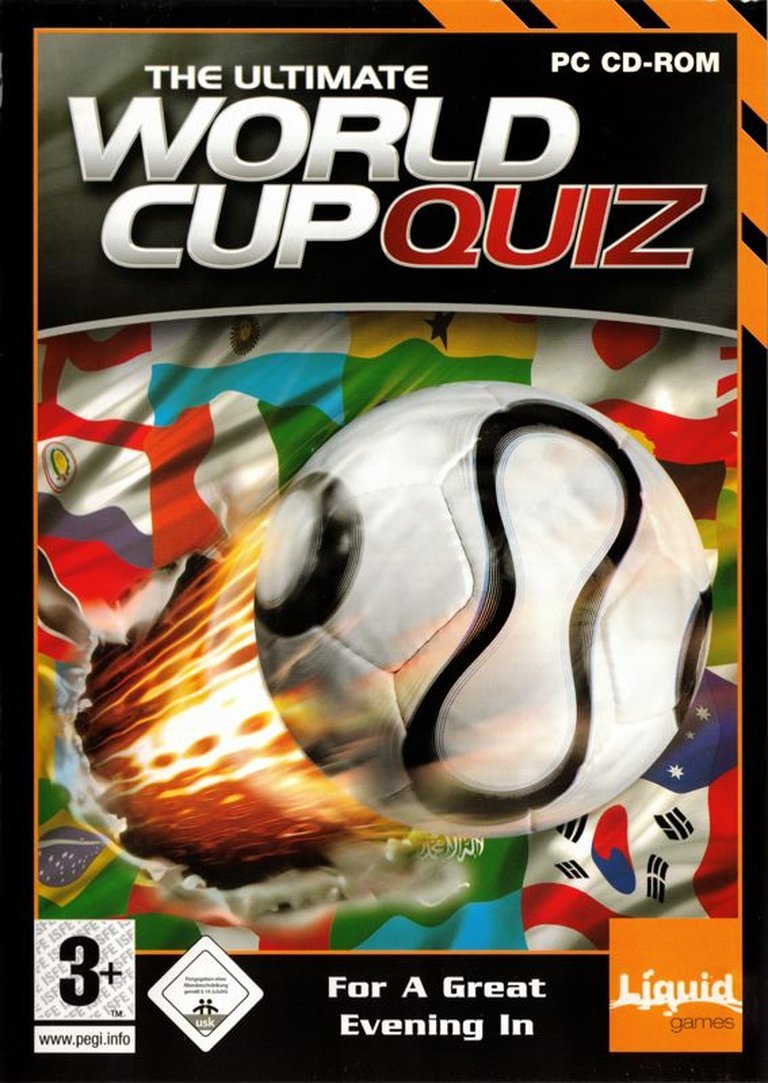
Description
The Ultimate World Cup Quiz is a multiplayer football trivia game focusing exclusively on FIFA World Cup history from its 1930 inception in Uruguay to modern tournaments. Designed for 1-4 players, it features four distinct modes: Top of the League (solo or competitive play), cooperative Play or Pass, tactical Shootout with forced-answer jokers, and Football Crazy’s mixed challenges. Players answer multiple-choice questions across multiple rounds, using strategic power-ups to eliminate wrong answers or challenge opponents’ knowledge of iconic World Cup moments.
The Ultimate World Cup Quiz Reviews & Reception
eurogamer.net : Festival of ultimate shame and disappointment
The Ultimate World Cup Quiz Cheats & Codes
Nintendo GameCube
Use Action Replay cheat device. Enable code must be on.
| Code | Effect |
|---|---|
| ZBCW-BQ09-W0KZ7 + J1P0-6RE2-5796U | Unlimited Store Points |
| PTYW-ZAWH-1C7NY + DPYQ-W3VU-BCMEX + D1MA-3for Player 2G-6KBJE + 6U2M-33RW-94F59 | Press X+D-Pad Left to make Home team win |
| 9HQQ-2WF2-0QNNK + PM9Z-M5YV-87NKA + YHE1-TV9P-FU7FV + YG8H-AZYE-WNMM0 | Press X+D-Pad Right to make your team win |
| KD5H-EV5D-Q8QPA + ZXDP-QFWM-V4Y25 + YTJN-CUR9-JNZ29 | Press X+D-Pad Up for more time |
| P20F-TZQN-Z2U96 + F67C-5YZ6-6NPGE + AN87-8DZV-ZGGGX | Press X+D-Pad Down to make period end quickly |
The Ultimate World Cup Quiz: Review
Introduction
In the crowded arena of sports video games, The Ultimate World Cup Quiz (2006) emerges as a niche contender—a digital pub trivia night laser-focused on soccer’s most storied tournament. Developed by Mere Mortals Ltd. and published by Liquid Games during the feverish buildup to the 2006 FIFA World Cup, this PlayStation 2 and Windows title aimed to capitalize on global football mania. Yet beneath its straightforward premise lies a game grappling with the limitations of its format, technological constraints, and the Sisyphean challenge of translating World Cup history into compelling interactivity. This review dissects its legacy as a curious artifact of mid-2000s sports trivia games—one that scores occasional goals but ultimately misses the mark as a lasting interactive experience.
Development History & Context
A Studio’s Trivia Ambitions
Mere Mortals Ltd., a UK-based developer known for budget-friendly titles, teamed with Liquid Games—a publisher specializing in quiz and casual games—to create The Ultimate World Cup Quiz. Released in May 2006, just weeks before the World Cup kicked off in Germany, the game was part of Liquid’s “Quiz Series,” slotted between The Ultimate Sports Quiz (2005) and The Ultimate Trivia Quiz (2006). The timing was strategic: FIFA’s flagship event promised a surge of interest in soccer-themed content.
Technological Constraints and the Mid-2000s Landscape
Built for PlayStation 2 and PC, the game operated within the hardware limitations of the era. The PS2 version utilized DVD storage, allowing for minimal video clips and static images lifted from World Cup archives—many of which, as noted in Eurogamer’s contemporaneous review of a similar title, suffered from muddy, VHS-era quality. In a gaming landscape dominated by EA Sports’ FIFA juggernaut and Sony’s Buzz! quiz franchise, The Ultimate World Cup Quiz sought to carve a niche with pure trivia gameplay. However, its lack of graphical ambition and reliance on text-based questions reflected a budget-conscious approach, prioritizing accessibility over innovation.
Narrative & Thematic Deep Dive
The “Story” of Football History
As a trivia game, The Ultimate World Cup Quiz lacks a traditional narrative. Instead, its “story” is the 76-year tapestry of the FIFA World Cup itself—from Uruguay 1930 to Germany 2006. The game frames itself as an encyclopedic tribute, with questions spanning iconic moments (Maradona’s “Hand of God”), obscure statistics, and cultural ephemera. This thematic focus positions players as custodians of football heritage, testing their mastery of the sport’s global folklore.
Characters and Dialogue: Minimalist Engagement
There are no characters here—unless one counts the disembodied quizmaster (voiced by Jonathan Pearce in similar titles, though unconfirmed here) whose repetitive phrases likely echoed the Eurogamer-reviewed 2006 FIFA World Cup Interactive Quiz Game’s critique of grating commentary. Dialogue is functional: questions, answers, and sparse feedback (“Correct!”). The absence of narrative scaffolding or charismatic hosts (à la Buzz!) renders the experience austere, relying solely on the player’s intrinsic motivation to conquer football trivia.
Gameplay Mechanics & Systems
Core Modes and Loops
The game offers four modes, each tweaking the quiz formula:
1. Top of the League: A solo or multiplayer mode with three rounds of eight questions. Players use “jokers” to eliminate two wrong answers.
2. Play or Pass: Cooperative multiplayer with no jokers, emphasizing teamwork.
3. Shootout: A competitive duel where jokers force opponents to answer.
4. Football Crazy: A hybrid mode cycling through the previous three.
Each question presents four multiple-choice options, spanning text-based queries, “spot the ball” photo challenges, and rare video clips (e.g., “What happened next?”). Correct answers award points, with jokers and substitutions adding tactical depth.
Flaws and Repetition
The gameplay’s Achilles’ heel is repetition. With approximately 1,000 questions (per official descriptions), recycled clips and images rapidly surface—a flaw Eurogamer highlighted in similar titles, noting, “If we see that Emmanuel Petit sliding tackle once more we’ll scream.” Solo play feels especially monotonous, with only Top of the League available for single players. The lack of adaptive difficulty or question randomization further undermines replayability, turning sessions into memorization drills.
UI and Progression
The interface is utilitarian: a minimal HUD with score trackers and joker counters. Navigation relies on simple menus, consistent with budget titles of the era. Progression is nonexistent beyond high scores—no unlockables, career modes, or online leaderboards—reflecting its origins as a quick-play party game.
World-Building, Art & Sound
Visuals: A Slide Show of History
The Ultimate World Cup Quiz’s art direction is functional at best. Static images dominate, featuring grainy player photos, team badges, and tournament logos. Video clips, though sparingly used, suffer from low resolution, akin to the “captured-from-VHS” quality Eurogamer lamented. The isometric pitch view in Tournament mode adds a kitschy sports aesthetic, but it’s more nostalgic slideshow than immersive world-building.
Sound Design: Crowd Noise and Commentary
Ambient crowd noises and generic stadium chants form the audio backbone, evoking a muted matchday atmosphere. Voice acting is limited to question narration and sparse feedback, lacking the charisma of contemporaries like Buzz!. Jonathan Pearce’s presence in similar titles suggests energetic commentary might have existed here, but repetition would have dulled its impact.
Reception & Legacy
Launch and Critical Reception
Upon release, The Ultimate World Cup Quiz garnered little critical attention. MobyGames records a solitary user rating of 2/5, citing underwhelming content. Eurogamer’s review of the analogous 2006 FIFA World Cup Interactive Quiz Game (scoring 5/10) contextualizes its flaws: “Repetition quickly gets on your nerves… short on content.” Commercial performance remains undocumented, suggesting it faded into obscurity post-tournament.
Legacy: A Footnote in Quiz Game History
The game’s legacy is negligible. It arrived as Sony’s Buzz! franchise dominated the quiz genre and EA’s FIFA series reigned over football simulations. Unlike Buzz!, which embraced bombast and variety, The Ultimate World Cup Quiz offered a bare-bones experience. Its sole innovation—World Cup exclusivity—proved insufficient to endure beyond 2006’s hype cycle. Today, it persists only as a collector’s curio, emblematic of mid-2000s budget titles chasing event-based relevance.
Conclusion
The Ultimate World Cup Quiz is a time capsule of football fandom and mid-2000s gaming pragmatism. Its earnest celebration of World Cup history is admirable, and its multiplayer modes occasionally spark competitive trivia fun. Yet technological constraints, repetitive content, and a lack of polish relegate it to the sidelines of gaming history. For devout football historians, it might offer fleeting nostalgia—but like a tournament underdog, it never truly contends for greatness. In the pantheon of sports games, this is less a classic and more a qualifying-round footnote: earnest, ephemeral, and eminently skippable.
Final Verdict: A 2/5 relic—a passion project hamstrung by execution, best left to completists and nostalgia-hunting superfans.