
- Release Year: 1999
- Platforms: Windows
- Publisher: Strategic Simulations, Inc.
- Genre: Compilation
- Setting: 000, Warhammer 40, Warhammer Fantasy
Description
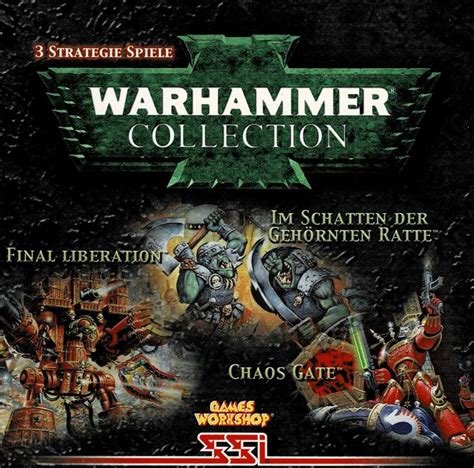
The Warhammer Universe Strategy Game Collection is a 1999 compilation that brings together four classic strategy games based on Games Workshop’s iconic Warhammer franchises. It includes two titles from the grimdark fantasy setting—Warhammer: Shadow of the Horned Rat and Warhammer: Dark Omen—and two from the sci-fi universe of Warhammer 40,000—Warhammer 40,000: Chaos Gate and Final Liberation: Warhammer Epic 40,000. All games are patched to their final versions and come with PDF documentation, offering tactical gameplay in richly detailed, war-torn worlds.
The Warhammer Universe Strategy Game Collection Reviews & Reception
retro-replay.com : The Warhammer Universe Strategy Game Collection brings together four distinct tactical experiences, each tapping into a different facet of the Games Workshop universe.
The Warhammer Universe Strategy Game Collection: Review
Introduction
In the closing years of the 20th century, the PC gaming landscape was a fertile ground for strategy titles, with real-time giants like StarCraft and Age of Empires dominating the conversation. Yet, nestled within this era was a compilation that offered a starkly different, more methodical breed of warfare: The Warhammer Universe Strategy Game Collection. Released in 1999 by Strategic Simulations, Inc. (SSI), this four-CD set gathered the earliest digital adaptations of Games Workshop’s legendary tabletop franchises—two from the grimdark fantasy of Warhammer and two from the dystopian sci-fi of Warhammer 40,000. While contemporary titles rushed toward faster-paced action, this collection reveled in the slow burn of tactical deliberation, the crunch of miniature-like units on hexagonal grids, and the gothic tapestry of a universe defined by perpetual war. My thesis is this: The Warhammer Universe Strategy Game Collection is not merely a retro curiosity but a crucial historical artifact that encapsulates the fraught but passionate early days of translating tabletop wargaming to the digital realm. It showcases both the ambitious vision and the technical limitations of its time, offering a window into how the strategies and lore of Warhammer were first interpreted for a new medium—a legacy that would eventually blossom into today’s robust lineup of Warhammer video games.
Development History & Context
The genesis of this collection lies in the fragmented efforts of several studios during the mid-to-late 1990s, each tackling a slice of the Warhammer mythos under the licensing purview of Games Workshop. The individual games—Warhammer: Shadow of the Horned Rat (1995), Warhammer: Dark Omen (1998), Warhammer 40,000: Chaos Gate (1998), and Final Liberation: Warhammer Epic 40,000 (1997)—were developed by distinct teams with varying levels of fidelity to their tabletop sources. Shadow of the Horned Rat and Dark Omen emerged from Mindscape and Electronic Arts, respectively, focusing on real-time tactics. Meanwhile, Chaos Gate (by Random Games Inc.) and Final Liberation (by Holistic Design, Inc.) adopted turn-based, hex-grid systems more reminiscent of traditional wargaming. SSI, a veteran publisher known for licensed strategy titles (notably Panzer General), bundled these disparate projects into a single compilation in 1999, likely to capitalize on the growing Warhammer fandom and the burgeoning PC strategy market.
The creators’ vision was clear: translate the granular, unit-centric tactics of the tabletop into engaging digital experiences. However, they operated under significant technological constraints. The late 1990s saw the rise of 3D acceleration (with cards like 3dfx’s Voodoo), but many strategy games still relied on 2D sprites or early 3D engines due to performance limitations. These titles were no exception—Shadow of the Horned Rat and Dark Omen used isometric 3D environments with limited texture detail, while the 40K games employed top-down, tile-based visuals that prioritized clarity over spectacle. CD-ROM storage allowed for richer asset libraries than floppies, but it also introduced installation headaches and compatibility issues that modern patches later addressed. The gaming landscape was dominated by the real-time strategy boom, but turn-based and tactical games still held a dedicated niche. Warhammer’s entry into this space was thus a balancing act: appealing to tabletop veterans while attracting digital newcomers, all while wrestling with the hardware of the day. This context explains the collection’s mixed bag of mechanics and aesthetics—a product of its time, yet ambitiously scaled across two universes.
Narrative & Thematic Deep Dive
The narrative strength of the Warhammer universes has always been their grim, operatic scope, and this collection, despite its technical simplicity, manages to harness that thematic weight through concise storytelling and abundant lore. Each game’s campaign is a self-contained saga that weaves into the broader tapestry of Games Workshop’s worlds.
Warhammer: Shadow of the Horned Rat thrusts players into the Old World, a fantasy realm beset by the insidious Skaven—rat-men whose treacherous plots threaten the kingdoms of men. The plot is a classic tale of survival against a relentless foe, punctuated by twists of betrayal and the discovery of ancient evils. Its sequel, Dark Omen, expands the canvas, introducing new factions like the Beastmen and delving into prophecies of apocalypse. Both games use mission briefings, in-game dialogue, and contextual unit descriptions to build a world where honor is fragile and corruption is ever-present. The narrative leans heavily on the “gritty fantasy” tone that defines Warhammer: heroes are flawed, victories are pyrrhic, and the line between savior and destroyer blurs.
Switching to the 40K titles, the themes intensify into the franchise’s signature grimdark. Chaos Gate follows a Rogue Trader—a privateer operating under the fringe of the Imperium of Man—tasked with quelling a Chaos incursion. The story unfolds through branching mission objectives and character interactions that highlight the moral ambiguities of the 41st millennium: orders may conflict with survival, and the enemy often wears the guise of corrupted imperial forces. Final Liberation ups the ante to a planetary-scale conflict, where resource management and corporate politics intersect with mechanized warfare. Here, the narrative emphasizes the vast, impersonal machinery of war—the sheer scale of Titan-sized engines and the futility of individual agency against the backdrop of galactic conquest.
What binds these stories is not just their shared universe but their exploration of core Warhammer themes: the corruption of power, the futility of heroism in a eternal war, and the visceral horror of alien or chaotic threats. The PDF documentation included in the collection is essential here, providing lore summaries, unit profiles, and background art that deepen the narrative context. For instance, the codex-style entries for Space Marine chapters or fantasy regiments flesh out the histories behind the units, transforming tactical decisions into meaningful engagements with the fiction. While the in-game storytelling is sparse by modern standards (limited voice acting or cinematic cutscenes), the written lore and atmospheric mission design create an immersive experience that rewards patient engagement. The collection thus serves as a narrative bridge—from the tabletop’s reliance on player imagination to the digital medium’s potential for curated storytelling.
Gameplay Mechanics & Systems
At its core, the collection is a study in contrasts: two games favor real-time action, while the other two embrace deliberate, turn-based strategy. This duality offers a comprehensive look at how Warhammer’s tactical essence was being interpreted in the late ‘90s.
Warhammer: Shadow of the Horned Rat and Dark Omen employ a real-time tactics system with isometric camera control. Players command warbands or regiments in battles that demand constant micro-management. Units have defined roles (archers, cavalry, infantry), morale states, and formation bonuses, requiring players to position troops, issue on-the-fly orders, and exploit enemy weaknesses. The upgrade system allows veteran squads to gain heroes and equipment, adding a light RPG layer to campaign progression. However, the real-time nature can be unforgiving—pausing is limited, and the AI often relies on swarming tactics that test player reflexes as much as strategy. Dark Omen refines this with more varied mission objectives and larger-scale battles, but both share a common flaw: a clunky interface that struggles with unit selection and pathfinding, a frustration mitigated somewhat by the final patches included in the collection.
On the 40K side, Chaos Gate and Final Liberation utilize a hex-based, turn-based paradigm. Chaos Gate focuses on squad-level tactics, with missions that incorporate risk-reward elements like timed objectives and psychic power management (e.g., using Null Zones to counter enemy psykers). The hex grid emphasizes positional advantage, cover, and unit special abilities. Final Liberation scales up to company-level commands, introducing resource gathering, unit production, and logistics across larger campaign maps. Here, players manage entire mechanized detachments—from infantry to Titans—balancing offense with supply lines. The turn-based system allows for deeper planning but can lead to protracted sessions as each side deliberates moves.
Both pairs of games share common threads: a reliance on careful unit preservation (veteran units are invaluable), terrain exploitation, and faction-specific asymmetries (e.g., Chaos forces might have powerful but unstable units). The patches included in the collection are crucial, fixing bugs, improving compatibility with modern systems, and smoothing out some UI quirks. Yet, by contemporary standards, the interfaces feel archaic—minimaps are rudimentary, tooltips sparse, and hotkey customization limited. The learning curve is steep for newcomers, as mechanics assume familiarity with Warhammer tabletop rules. Still, for those who persevere, the gameplay loops are deeply rewarding, offering a tactical complexity that few modern titles replicate. The collection’s innovation lies in its early attempt to digitize tabletop wargaming’s granularity, even if the execution betrays its era’s constraints.
World-Building, Art & Sound
The visual and auditory presentation of The Warhammer Universe Strategy Game Collection is a testament to the Warhammer aesthetic’s resilience, even when filtered through late-‘90s technology. The fantasy titles, Shadow of the Horned Rat and Dark Omen, use an isometric 3D engine that, while primitive by today’s standards, captures the gritty, brown-and-blood palette of the Old World. Battlefields are populated with animated units—rank-and-file soldiers with distinct silhouettes, siege engines like catapults and cannons, and spell effects that burst with chaotic color. The camera perspective offers clear visibility, though zooming is limited. Textures are low-resolution, but the art direction nails the franchise’s grimdark tone: armor is dented, banners tattered, and creatures monstrous.
The 40K games, Chaos Gate and Final Liberation, opt for a top-down, hex-based view with bold, colorful terrain tiles that ensure tactical clarity. Futuristic settings—ruined hive cities, volcanic forges, and alien deserts—are rendered with atmospheric backdrops and dramatic lighting. Explosions and particle effects, though simple, add visceral feedback. Unit icons are detailed enough to distinguish Space Marines from Orks or Eldar, and the color coding (e.g., red for Chaos, green for Orks) reinforces faction identity.
Sound design follows the era’s conventions: MIDI-based music that oscillates between stirring marches and ominous ambient tracks, and sound effects that are functional but thin—clashing swords, laser blasts, and creature roars that lack the punch of modern audio. Voice acting is minimal, relegated to brief mission briefings. Yet, the overall atmosphere is immersive precisely because it leans into the raw, unpolished feel of its time. The included PDF documentation elevates the experience further, providing high-resolution unit cards, lore illustrations, and cinematic storyboards that enrich the world-building. These manuals are not mere afterthoughts but integral to the collection’s identity, offering a tactile link to the tabletop hobby that birthed Warhammer. In concert, the art and sound craft a cohesive, if dated, universe that remains faithful to Games Workshop’s vision—dark, epic, and unforgiving.
Reception & Legacy
At launch, The Warhammer Universe Strategy Game Collection met with muted critical reception. The lone critic review from GameStar (Germany) awarded it 74%, praising the “thoughtful gameplay principles” that still function “brilliantly” but noting the visuals were “double outdated” even in 1999. This encapsulates the contemporary sentiment: the games were appreciated for their tactical depth but seen as technically behind the curve compared to flashier RTS contemporaries. Commercially, the compilation was a niche product, targeting dedicated Warhammer fans and strategy enthusiasts rather than the mass market. Its four-CD format was cumbersome, and the games’ steep learning curves likely limited broader appeal.
However, the collection’s legacy has evolved in retrospective analysis. It stands as a foundational text in the history of Warhammer video games, predating the landmark Dawn of War series by several years. These early titles demonstrated that Warhammer’s tabletop mechanics could be translated to digital formats—albeit with compromises. They influenced later developers by highlighting what worked (deep tactical systems, rich lore integration) and what didn’t (clunky interfaces, dated graphics). For instance, Relic Entertainment’s Dawn of War (2004) built upon the 40K tactical foundation while embracing real-time action and improved presentation, learning from the limitations of games like Chaos Gate.
In the broader industry context, the collection represents a transitional period where licensed games were often experimental, prioritizing fidelity to source material over mainstream accessibility. Its compilation model—bundling multiple titles with patches and documentation—was relatively innovative for its time, offering a curated experience that respected the player’s investment. Today, among collectors and Warhammer historians, the set is revered as a time capsule. It captures an era when the franchise was still finding its digital voice, balancing the demands of tabletop purists with the possibilities of interactive media. While later titles like Total War: Warhammer or Vermintide have achieved critical and commercial heights, this collection remains a crucial stepping stone—a reminder of the humble, pixelated beginnings of a multimedia empire.
Conclusion
The Warhammer Universe Strategy Game Collection is a paradox: a package of games that feel archaic yet remain compelling, a commercial afterthought that now feels indispensable. As a professional historian, I see it as a vital document of the late-1990s strategy gaming scene—a period when developers were scrambling to adapt complex tabletop systems to the PC, often with mixed results. The collection’s strengths lie in its unwavering commitment to Warhammer’s tactical depth and grimdark atmosphere, preserved through patches and PDF lore that outlast the graphical shortcomings. Its weaknesses—clunky UIs, steep learning curves, and visual datedness—are products of their time but do not overshadow the strategic ingenuity on display.
For modern players, this is a niche recommendation: essential for Warhammer completists, strategy aficionados willing to overlook age, and scholars of game design. For the broader audience, it may feel like a museum piece. Yet, its place in video game history is secure. It was among the first to bridge Games Workshop’s tabletop worlds with digital interactivity, paving the way for the sophisticated Warhammer experiences we enjoy today. In the grand narrative of Warhammer’s digital evolution, this collection is the rugged, battlescarred veteran—not the most polished, but undeniably foundational. To play it is to witness the raw, unfiltered ambition of an era where the only law was “in the grim darkness of the far future, there is only war”—and in the fantasy realms, there was only tactical perseverance.