
- Release Year: 2000
- Platforms: Windows
- Publisher: THQ Inc.
- Developer: Human Code, Inc.
- Genre: Action, Puzzle
- Perspective: Side view
- Game Mode: Single-player
- Gameplay: Action, Mini-games, Platformer, Puzzle, Shooter
- Setting: Africa, Arctic, Asia, Australia, Europe, South America
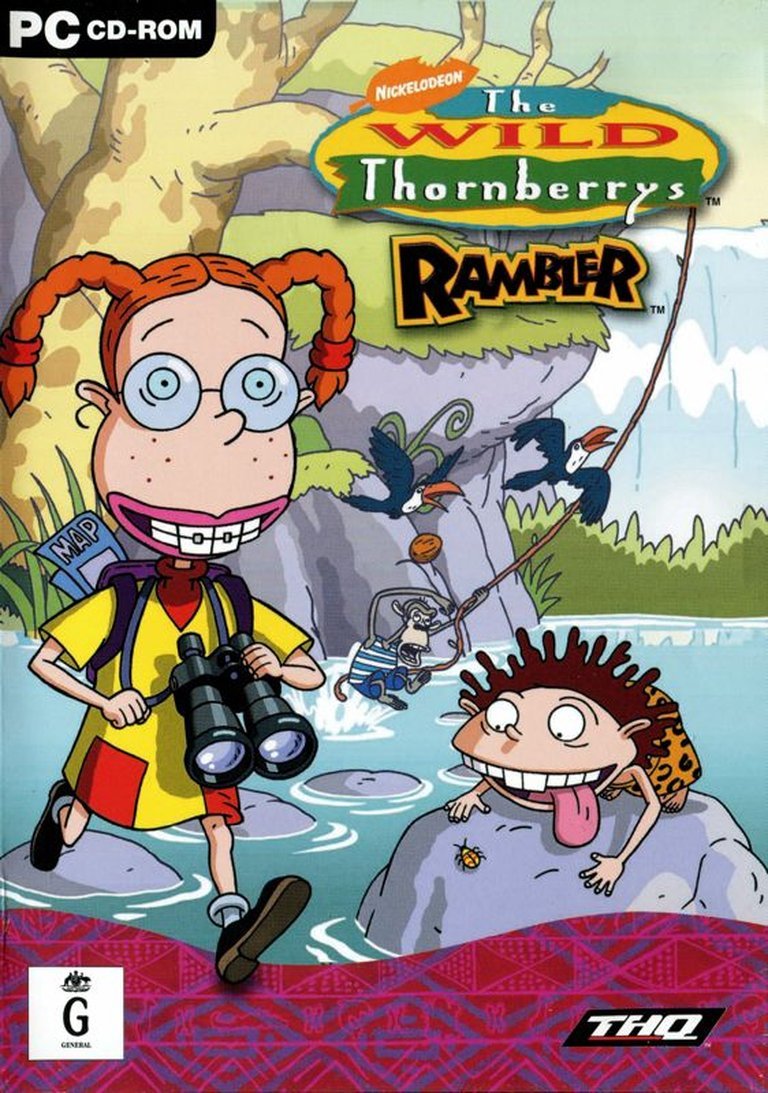
Description
The Wild Thornberrys: Rambler is a collection of themed mini-games based on the Nickelodeon cartoon, taking players on a journey across various continents. Each mini-game features a different character from the Thornberry family: Eliza navigates Arctic ice floes to rescue baby animals, Darwin swings through South American jungles to retrieve stolen shirts, Donnie collects bugs in the African savannah, Debbie chases monkeys in Asia to recover her CDs, and Nigel uses boomerangs to stop poachers. The games offer diverse gameplay mechanics, from platforming and puzzle-solving to shooting, and are controlled primarily with arrow keys, with one game using the mouse and another combining mouse and keyboard. Players start with three lives and can earn extras by collecting bonus items like film canisters and parkas.
Gameplay Videos
The Wild Thornberrys: Rambler Free Download
The Wild Thornberrys: Rambler Guides & Walkthroughs
The Wild Thornberrys: Rambler Cheats & Codes
Game Boy Color
GameShark codes: Enter the hexadecimal code in the GameShark device. Xploder codes: Enter the hexadecimal code with $ prefix in the Xploder device. Level passwords: Enter the symbol sequence at the password screen.
| Code | Effect |
|---|---|
| 0106A9DD | All Animals Collected (GameShark) |
| 010FB3DD | Full Battery Power (GameShark) |
| 0164A2DD | Full Stomach (GameShark) |
| 010AA5DD | Infinite Health Meter (GameShark) |
| 0109A7DD | Infinite Nuts (GameShark) |
| 011CABDD | Stop Timer (GameShark) |
| $0D276F71 | All Animals (Xploder) |
| $0D2BAF71 | Infinite Energy (Xploder) |
| $0D2BC271 | Infinite Energy (Xploder) |
| $0D3CC871 | Infinite Time (Xploder) |
| Heart, Heart, Timer, Diamond | Level 02 Password |
| Heart, Circle, Square, Diamond | Level 03 Password |
| Heart, Circle, Circle, Timer | Level 04 Password |
| Heart, Equals, Equals, Timer | Level 05 Password |
| Heart, Heart, Circle, Square | Level 06 Password |
The Wild Thornberrys: Rambler: A Dual-Platform Odyssey of Mini-Games and Missed Opportunities
Introduction: A World of Licensed Promise
In the golden age of Nickelodeon adaptations—a period when nearly every animated series spawned a video game counterpart—The Wild Thornberrys: Rambler stands as a fascinating case study in divergent design. Released in August 2000 for Windows and November 2000 for Game Boy Color, this dual-platform entry tasked players with aiding the Thornberry family’s quest for the Golden Schweitzer Award, the pinnacle of nature documentary excellence. While the PC version, developed by Human Code, Inc., offered a charming, continent-hopping collection of character-driven mini-games, the Game Boy Color port by Vicarious Visions faltered into repetitive platforming. This review examines how the same franchise license birthed two distinct experiences: one a flawed yet faithful tribute to the show’s spirit, the other a cautionary tale of handheld adaptation. Through meticulous analysis of gameplay, narrative, and reception, we uncover how technological constraints, creative vision, and market pressures shaped this relic of licensed gaming history.
Development History & Context: Studios, Visions, and Technological Tensions
The bifurcated development of Rambler reflects the late-1990s gaming landscape’s fractured ecosystem. For the PC version, Human Code, Inc.—a studio with a history of edutainment titles—leveraged the Open Media Toolkit from Pacific Media Worx to build a mouse-centric mini-game framework. Their vision was to distill the show’s globe-trotting ethos into accessible, character-specific challenges, each reflecting a continent’s ecology. Conversely, Vicarious Visions (then rising handheld specialists) approached the Game Boy Color as a platformer, using its 2D scrolling capabilities to craft six interconnected levels. Both studios faced constraints: Human Code relied on pre-licensed audio samples from Spectrasonics’ Supreme Beats library, while Vicarious Visions grappled with the GBC’s 8-bit color palette and limited RAM.
The 2000 gaming climate amplified these challenges. Licensed games were ubiquitous but often criticized for formulaic design, and Mattel Interactive—publisher for both versions—prioritized speed-to-market over innovation. PC gamers, however, were experiencing a boom in casual gaming, making the mini-game format viable. Meanwhile, handheld users demanded portability, but Vicarious Visions’ platformer shift betrayed the PC’s character-centric focus. This divergence created a fractured identity: one version embraced the show’s ensemble cast, the other forced them into disjointed cameos.
Narrative & Thematic Deep Dive: Documenting Family and Frontier
Rambler’s narrative is a straightforward extension of the Wild Thornberrys TV series: the family films exotic wildlife to win the Golden Schweitzer Award, with each mini-game/level representing a chapter in their global journey. The PC version excels in thematic cohesion, using continent-specific challenges to spotlight character traits:
– Eliza’s Ice Hopper (Arctic): Embodies her empathy as she rescues seal pups, with cracking ice floes symbolizing nature’s fragility.
– Darwin’s Another Vine Mess (South America): Highlights his mischievousness through vine-swinging thefts, with toucan attacks mirroring environmental hazards.
– Debbie’s Monkey Chaser (Asia): Satirizes teen rebellion via shampoo-wielding CD retrieval, blending humor with resource management.
– Nigel’s Boomerang Tango (Australia): Channels his documentary ethos through poacher combat, framing conservation as action.
Dialogue, voiced by the TV cast (including Michael Peter Balzary as Donnie), maintains the show’s witty, educational tone. The GBC version, however, dilutes this cohesion. Its six levels—ranging from Yeti photography to bus driving—lack narrative flow, reducing characters to avatars for disconnected challenges. Password-based saves and unique endings (per difficulty tier) add replay value but sacrifice thematic depth. Ultimately, the PC version’s narrative succeeds by mirroring the show’s core theme: family bonding through shared environmental stewardship.
Gameplay Mechanics & Systems: Mini-Games Mastered and Mishandled
The PC version’s strength lies in its varied, character-centric mechanics:
– Eliza’s Ice Hopper: Mouse-controlled precision jumping, with bonus items (film canisters, parkas) adding risk-reward depth.
– Darwin’s Vine Mess: Arrow-key swinging, where slippery vines and monkey collisions create tension.
– Donnie’s Bug Quest: Puzzle-solving via rock-moving, warthog avoidance, and canteen collection.
– Debbie’s Monkey Chaser: Shampoo-spraying strategy, with bananas as bribes or extra lives.
– Nigel’s Boomerang Tango: Mouse-aimed boomerang duels, blending skill and timing.
Each game offers 10 escalating levels, with lives earned via bonuses. Controls are intuitive (mouse for Ice Hopper, arrow keys for others), though Boomerang Tango’s hybrid input feels clunky. The GBC version, however, suffers from systemic flaws. Its six levels—Beetle Mania, Commvee Rally, You Ain’t Seen Nothin’ Yeti, etc.—employ generic platforming (jumping, collecting) with poor collision detection. IGN’s “wonky control” critique stems from unresponsive inputs and “aimless level design,” while the board-game multiplayer via Game Link Cable feels tacked on. Difficulty tiers (“Wild/Wilder/Wildest”) alter enemy counts and endings but fail to mask repetitive gameplay. Verdict: The PC version’s varied loops offer “good, clean fun” (Review Corner), while the GBC’s platforming is “disappointingly tame” (Nintendo Power).
World-Building, Art & Sound: From Arctic Savannahs to Handheld Limitations
Human Code’s PC version excels in environmental storytelling. Each mini-game’s art captures the show’s Klasky Csupo aesthetic: jagged ice floes in the Arctic, lush Amazon canopies, and dusty African savannahs. Character designs are faithfully cartoonish, with Darwin’s expressive posture and Debbie’s sarcastic smirk resonating. Sound design, sourced from Supreme Beats, uses upbeat, location-specific tracks and sampled dialogue to immerse players. The GBC version, constrained by 8-bit hardware, simplifies environments into monochromatic backdrops. Gabriel Valles’ art retains character likenesses but sacrifices detail, making levels feel generic. Audio, too, suffers from repetitive chiptunes and muffled voice samples. Both versions, however, leverage the show’s educational ethos—Eliza’s narration teaches animal facts, and Nigel’s commentary underscores conservation.
Reception & Legacy: A Tale of Two Platforms
Rambler’s reception was a study in contrast. The PC version earned a lukewarm 70% average (MobyGames), with Review Corner praising its “enjoyable” mini-games but noting limited replay (“only 10 levels”). PCMag echoed the “uneven” praise, calling it a “good, clean fun” diversion. The GBC version fared far worse. IGN’s brutal 4/10 lamented its “uninspired and simplistic” design, criticizing “bad collision detection,” while Nintendo Power’s 2/5 deemed it “actionless.” Commercially, both versions struggled to stand out amid licensed game saturation.
Legacy-wise, Rambler is a footnote. It didn’t influence subsequent Wild Thornberrys titles (e.g., Animal Adventures), and Vicarious Visions never revisited the mini-game model. Yet, it exemplifies licensed game development’s pitfalls: the PC version’s faithfulness to source material offered charm, while the GBC’s rushed port exposed hardware limitations. Today, it’s remembered nostalgically by fans but critically as a mediocre adaptation.
Conclusion: A Divided Legacy
The Wild Thornberrys: Rambler is a game of two halves: the PC version, a polished if shallow mini-game collection that channels the show’s heart; the GBC version, a flawed platformer that epitomizes handheld licensed-game struggles. Its historical significance lies in this duality—a reminder that even a strong license can yield experiences as varied as the Arctic and the Outback. For players, the PC version remains a quirky, low-stakes adventure, while the GBC iteration serves as a cautionary relic. Verdict: 6.5/10. The PC iteration captures the Thornberrys’ spirit with charm, but the GBC port’s technical flaws prevent it from rising above mediocrity. In the annals of licensed gaming, Rambler is neither a masterpiece nor a disaster—it is simply a product of its time, a snapshot of ambition tempered by industry realities.