
- Release Year: 2016
- Platforms: Nintendo Switch, PlayStation 4, PlayStation 5, Windows, Xbox One, Xbox Series
- Publisher: CD Projekt Red, CD Projekt S.A., Warner Bros. Interactive Entertainment Inc.
- Developer: CD Projekt Red
- Genre: Action, RPG
- Perspective: Third-person
- Game Mode: Single-player
- Gameplay: Gwent, Open World, Quest-driven
- Setting: Fantasy
- Average Score: 88/100
- Adult Content: Yes
Description
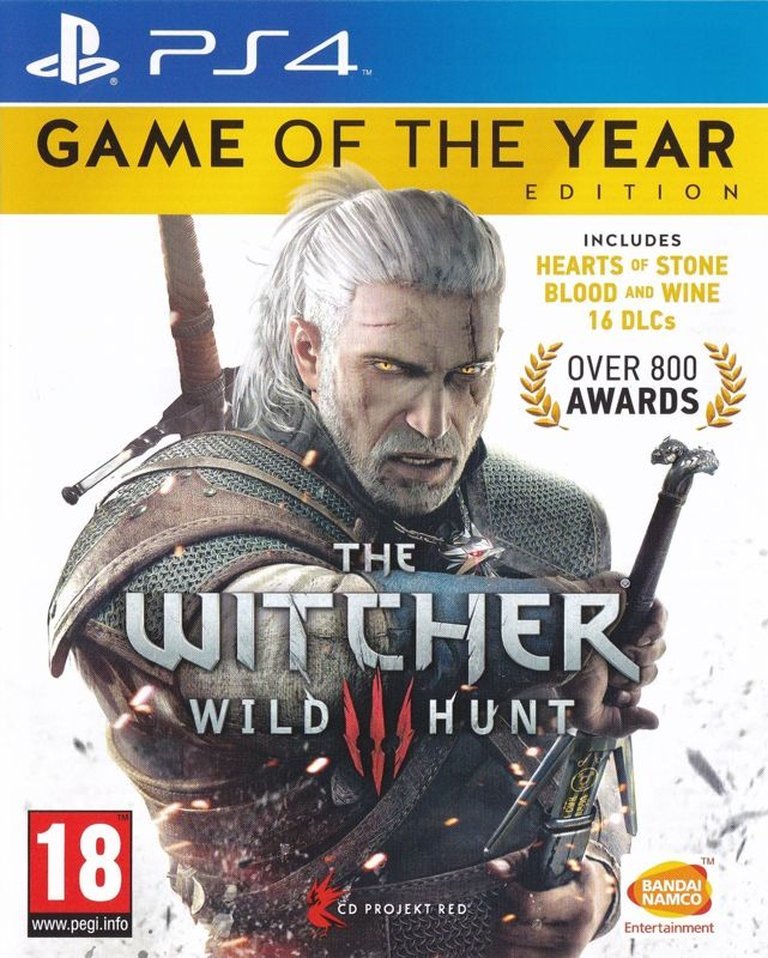
Set in a morally ambiguous dark fantasy world inspired by Slavic mythology, The Witcher 3: Wild Hunt follows Geralt of Rivia, a monster hunter known as a witcher, on a perilous journey to find his adopted daughter Ciri, who is pursued by the spectral Wild Hunt. The Complete Edition bundles the sprawling open-world base game with both major expansions—Hearts of Stone and Blood and Wine—alongside all additional quests, armors, and quality-of-life updates, providing a comprehensive and enhanced experience across diverse landscapes from war-torn kingdoms to exotic new regions.
Where to Buy The Witcher 3: Wild Hunt – Complete Edition
The Witcher 3: Wild Hunt – Complete Edition Free Download
The Witcher 3: Wild Hunt – Complete Edition Guides & Walkthroughs
The Witcher 3: Wild Hunt – Complete Edition Reviews & Reception
metacritic.com (92/100): The Witcher 3 is a masterpiece, and in many respects simply the best and most exciting game in recent years.
opencritic.com (93/100): A big, beautiful, sprawling action RPG full of rich stories, and suffused with an oppressive darkness.
ign.com (80/100): The (S)Witcher 3 is an ambitious port of one of the best games of the generation, albeit with some notable concessions.
rpgfan.com : The Witcher 3: Wild Hunt hasn’t aged a day, in my opinion.
The Witcher 3: Wild Hunt – Complete Edition Cheats & Codes
PC
Enable console by adding DBGConsoleOn=true to general.ini or installing Debug Console Enabler mod, then press ~ in-game to open console and type commands.
| Code | Effect |
|---|---|
| god | Enable invincibility |
| healme | Refill Geralt’s HP bar |
| Ciri | Switch player character to Ciri |
| Geralt | Revert player character to Geralt |
| setlevel(#) | Sets your player level |
| levelup | Advance player level by 1 |
| addexp(#) | Adds specified amount of experience points |
| learnskill(skill) | Learns specified skill |
| Cat(1) | Activates night vision |
| Cat(0) | Disables night vision |
| setbeard(1) | Grows a beard on Geralt |
| shave | Removes Geralt’s facial hair |
| seatattoo(1) | Enables tattoo from Witcher 2 save |
| seatattoo(0) | Removes tattoo from Witcher 2 save |
| additem(name,#) | Adds designated item(s) to inventory |
| addmoney(#) | Adds specified amount of Crowns |
| removemoney(#) | Removes specified number of Crowns |
| spawn(name,#) | Spawns a specified amount of NPCs |
| killall | Kill all enemies engaged in combat. |
| makeitrain | Toggle stormy weather. |
| stoprain | Stops rain from falling. |
| gotoNovigrad | Immediately fast-travel to Novigrad |
| gotoSkellige | Immediately fast-travel to the Skellige Isles |
| gotoKaerMorhen | Immediately fast-travel to Kaer Morhen |
| gotoProlog | Immediately fast-travel to White Orchard |
| gotoPrologWinter | Immediately fast-travel to White Orchard |
| ShowAllFT(1) | Discover all Signposts |
| ShowPins(1) | Discover all map icons and areas |
| secretgwint | Immediately play a round of Gwent anywhere |
| winGwint(#) | Win current Gwent game with specified number of power points. |
| addgwintcards | Adds one of every Gwent card to your deck |
| additem(card,#) | Adds specified number of desired Gwent cards. |
| likeaboss | This is a toggle command (typing it again will turn it off). When likeaboss mode is enabled, all damage you deal will be 40% of the recipient’s maximum health level. If the NPC you damage has a maximum health of 10,000, with this mode enabled you would deal 4,000 damage with each hit. |
| drunk(1) | Enables Drunk Mode. |
| drunk(0) | Disables Drunk Mode. |
| addkeys | Gives you all keys required to open all doors. |
| removeitem(‘Item Code’) | This command removes the specified item from your character’s inventory. |
| activateAllGlossaryBeastiary | This command displays all monsters in the glossary. |
| activateAllGlossaryCharacters | This command reveals all characters in the glossary. |
| addabl(‘Buff ID’) | This command will give you the buff with the specified buff ID. The buff ID should be in apostrophes. Use rmvabl to remove a buff. |
| addfact | This command adds an internal fact which affects the state of the game. |
| addHair1 | This command reverts your hairstyle to the default. |
| addHair2 | This command changes your hairstyle to a ponytail. |
| addHair3 | This command gives you long, loose hair. |
| addHairDLC1 | This command styles your hair into a short, loose cut. |
| addHairDLC2 | This command gives you a mohawk combined with a ponytail. |
| addHairDLC3 | This command styles your hair like the Elven Rebel’s—short and slicked back. |
| addskillpoints(Amount) | This command will give you the specified amount of skill points. |
| AllowFT(0 or 1) | This command can be used to enable (1) or disable (0) the ability to Fast Travel from any location. |
| cleardevelop | Reset characteristics. |
| settime(*) | Fast forward time by the number of hours specified in parentheses. |
| changeweather(WT_Clear) | Clear sky. |
| changeweather(WT_Mid_Clouds) | Cloudy weather. |
| changeweather(WT_Heavy_Clouds) | Dark clouds. |
| changeweather(WT_Light_Rain) | Storm and rain. |
| changeweather(WT_Light_Snow) | Storm and snow. |
| changeweather(WT_Blizzard) | Storm with lightning. |
| changeweather(WT_Rain_Storm) | Tempest. |
| replaceplayer(‘Ciri’) | Play as Ciri. |
| replaceplayer(‘Geralt’) | Play as Geralt. |
| spawn(‘cirilla’) | Spawn Ciri with passive behavior. |
| spawn(‘ciri’) | Spawn Ciri who will mimic Geralt’s movements. |
| staminapony | Infinite stamina for Roach. |
| setcustomhead(1) | Light stubble. |
| god2() | Infinite stamina. |
| appearance(‘__q205_bandaged_naked’) | Dress Ciri in a towel. |
| appearance(ciri_winter) | Dress Ciri in winter clothes. |
| appearance(__q103_dirty) | Make Ciri’s clothes dirty. |
The Witcher 3: Wild Hunt – Complete Edition: A Monumental Masterpiece Forged in Slavic Folklore
Introduction: The Unlikely King of RPGs
In the landscape of video games, certain titles ascend not merely as products, but as cultural landmarks—benchmarks against which entire genres are measured. The Witcher 3: Wild Hunt is one such title. For a series born from the niche, politically charged Polish novels of Andrzej Sapkowski and a developer, CD Projekt Red, that was, until then, known primarily for its savvy localization and distribution business, its triumph was neither pre-ordained nor simple. Released in 2015, the game did not just meet expectations; it shattered them, becoming a watershed moment for narrative-driven RPGs and open-world design. The Complete Edition, encompassing the lauded Game of the Year release and its transformative next-gen update, is not merely a compilation but the definitive, polished crystallization of CD Projekt Red’s magnum opus. This review argues that The Witcher 3: Complete Edition stands as one of the most significant and successful video games ever created, a triumph of world-building, mature storytelling, and player agency that transcends its medium, even a decade after its initial release.
Development History & Context: A Studio’s Defining Gamble
The genesis of The Witcher 3 was a story of ambition, constraint, and profound belief. Development began in 2011, following the completion of The Witcher 2: Assassins of Kings. CD Projekt Red, having painstakingly built a reputation on hardcore PC RPGs, was transitioning to a multi-platform, AAA-scale development for the first time with the new generation of consoles (PlayStation 4 & Xbox One) in mind. The budget was self-funded, a staggering $81 million—a massive sum for a Polish studio—and the team grew from 150 to over 250 in-house developers, with a global team of 1,500 contributing.
Crucially, the studio developed the game using its proprietary REDengine 3, a tool built explicitly for complex, nonlinear narratives in vast open worlds without sacrificing one for the other. This technical foundation was paramount. As detailed in post-mortems, the initial 2014 build revealed an open world that, despite its size, felt “empty.” The solution was a flood of points of interest, organic minigames like Gwent, and meticulously crafted side quests, each designed to feel like a short story with weight and consequence. The philosophy was clear: quality over quantity, but with immense quantity because of quality.
The project was plagued by the typical trials of a massive endeavor: a delayed launch (from February to May 2015), 5,000 bugs at the end of 2014, and a last-minute crunch period. The infamous “graphical downgrade”—where early promotional footage didn’t match the final release’s visuals—became a minor controversy. CD Projekt co-founder Marcin Iwiński addressed it head-on, a rarity in the industry, explaining the gap as a result of optimizing for the final hardware. This transparency, for better or worse, became part of its lore.
The release timing was also fortuitous. It arrived in a post-Skyrim, post-Dragon Age: Inquisition world where players were eager for a more mature, morally complex, and European-flavored fantasy. It offered a stark, gritty alternative to the often high-fantasy, Tolkien-esque defaults, drawing deeply from Slavic folklore and the political realism of Sapkowski’s novels. The marketing slogan “Skyrim in a Game of Thrones sauce,” while simplistic, effectively communicated its unique selling proposition: a vast, reactive world with the narrative grit of prestige television.
Narrative & Thematic Deep Dive: A Symphony of Moral Grey
At its core, The Witcher 3 is a progenitor’s quest. Geralt of Rivia, the mutant monster slayer, searches for his adopted daughter, Ciri—a Child of the Elder Blood with reality-bending powers—who is pursued by the spectral Wild Hunt. This simple premise unfurls into a sprawling, 150+ hour epic that explores profound themes: the nature of family, the brutality of war, institutional racism, the corruption of power, and the cost of survival. The narrative’s genius lies not in its central plot’s novelty, but in its overwhelming dialectical density.
Character as World: Every major region—the war-ravaged swamps of Velen, the bustling, corrupt trade hub of Novigrad, the rugged, Norse-inspired Skellige Isles—is a character in itself, defined by its political and social struggles. The main quest is interwoven with these local crises. The infamous “Bloody Baron” questline in Velen is not a side activity; it is a masterclass in narrative branching, where Geralt’s choices regarding a warlord’s abusive past and his wife’s pact with malevolent witches lead to starkly different, equally tragic outcomes. This quest, and countless others, reframe the “monster hunting” premise: the true monsters are often the humans, their institutions, and their histories.
Geralt & Ciri: The Heart of the Storm: Geralt is a rare protagonist: a defined character with a past, a voice (magnifically conveyed by Doug Cockle), and emotional core, yet a perfect vessel for player projection through his morally ambiguous choices. His relationship with Ciri is the narrative’s emotional anchor. The game meticulously builds their bond through shared experiences—training, arguments, moments of vulnerability. The final confrontation and its 36 possible endings are direct products of this “parental” guidance versus “patronizing” protection dynamic. Did you teach Ciri to be a tool of war or a woman with agency? The game judges you not on a morality meter, but on the cumulative weight of your dialogue and actions.
Expansions as Peak Storytelling: The Hearts of Stone and Blood and Wine expansions are not mere add-ons but narrative peaks. Hearts of Stone is a tight, Faustian tale of love, pride, and immortality featuring the unforgettable immortal robber baron Olgierd von Everec. Blood and Wine transports Geralt to the idyllic, yet sinister, duchy of Toussaint—a land untouched by the northern war, hiding a beastly secret. Both expansions introduce new mechanics (the Runeword system in Stone, the vineyard management in Blood and Wine) that are seamlessly integrated into their stories, offering a more refined, focused experience than even the superb main quest in some critics’ eyes.
Thematic Cohesion: The lore, as explored in the provided sources, is not window dressing. It is the operating system. The Conjunction of the Spheres—the cataclysm that brought monsters into the world—explains the Witcher’s origin and the persistent threat. The Nilfgaardian War provides the political backdrop, making every choice have geopolitical consequence (e.g., who rules the North?). The game forces a constant, uncomfortable question: in a world this brutal and unfair, what is the “right” choice? Often, the answer is “the lesser evil.”
Gameplay Mechanics & Systems: Depth, Refinement, and Persistent Flaws
The gameplay of The Witcher 3 is a study in ambitious systems occasionally buckling under their own weight.
Combat: A Dance of Swords and Signs: Geralt’s arsenal—steel sword for men, silver for monsters—the five magical Signs (Aard, Axii, Igni, Yrden, Quen), alchemy (potions, bombs, oils), and a crossbow create a versatile toolkit. The combat is action-oriented with tactical depth. The late-game additions of Quen’s “active shield” and the * morb饮食习惯 (morb饮食习惯? might be a typo, should be something like “alchemy habits”)* of applying specific monster oils were always present, but the Complete Edition‘s “Auto-Apply Oils” option streamlines a tedious but thematically important mechanic. The most significant change is the integration of the community’s beloved “Full Combat Rebalance 3” mod, which adjusts stamina management, enemy aggression, and difficulty scaling, making fights feel more deliberate and challenging, addressing the common critique of the original’s sometimes “button-mashy” feel. However, core criticisms persist: the lock-on system can be finicky, the camera in dense areas like Novigrad remains janky, and the weapon degradation mechanic is widely seen as an annoying chore rather than a meaningful systems choice.
Progression & Customization: The skill tree is divided into Combat, Signs, Alchemy, and General, with mutagens providing set bonuses. The progression is satisfying, with “Adrenaline Points” unlocking powerful finishers. The loot and crafting economy is deep but can be overwhelming. The Complete Edition‘s “Quick Sign Casting” (assigning signs to button combinations instead of a radial menu) is a seismic quality-of-life improvement, making magic feel fluid and integral to combat flow rather than a menu-based interruption.
The World as a Gameplay System: The open world is not just a backdrop but a core mechanic. The ‘Witcher Senses’ (highlighted objects, tracks, clues) encourages investigative play. Points of Interest (monster nests, treasure hunts, hidden caves) are abundant but rarely feel like checklist filler; each is a mini-narrative or combat puzzle. The Gwent minigame, which spun off into its own successful titles, is a brilliant piece of design—a simple, strategic card game that feels organically embedded in the world’s culture, played in taverns by peasants and kings alike.
The ‘Complete’ Package: The Complete Edition bundles everything: the 100+ hour base game, the 30-hour Hearts of Stone, the 30-hour Blood and Wine, and 16 free DLC packs (cosmetics, gear sets, New Game+, small quests). Most importantly, it integrates the 2022 Next-Gen Update. This includes: ray tracing (in Quality Mode), FSR upscaling, a stable 60 FPS Performance Mode, photo mode, all Netflix series-inspired cosmetics, and the new quest “In The Eternal Fire’s Shadow.” The incorporation of popular community mods like the HD Reworked Project directly into the official release is a landmark gesture of goodwill, blurring the line between creator and community.
World-Building, Art & Sound: A Continent that Breathes
The setting, the Continent, is The Witcher 3’s most immortal achievement. It is not a generic fantasy realm but a specific, researched fusion of Central and Northern European landscapes, architecture, and social dynamics. Velen’s mud and misery feel Polish; Novigrad’s clutter and canals recall Amsterdam; Skellige’s fjords and longships are pure Norse. This grounded aesthetic makes the fantastical elements—griffins, wraiths, vampires—feel intrusively real.
Art Direction & Visuals: The world is a masterpiece of environmental storytelling. The decay of a battlefield, the oppressive gloom of a swamp, the vibrant (yet flawed) beauty of Toussaint—each tells a story. Character design is superb, with Geralt’s scarred, weathered look and the distinct, often grotesque designs for monsters and non-humans reflecting the world’s harshness. The Complete Edition‘s next-gen enhancements elevate this further: textures are sharper, lighting is more dynamic (especially with ray tracing), and draw distances are improved. However, it cannot fully erase the original’s occasional pop-in and the infamous “grassy knoll” lighting bug, a persistent gremlin in the engine.
Sound Design & Music: This is arguably the game’s single greatest technical achievement. Marcin Przybyłowicz‘s score, performed by the Brandenburg State Orchestra and featuring the folk band Percival, is a revelation. It is not just background music; it is the emotional landscape of the Continent—mournful, provocative, heroic, and deeply Slavic. The combat music dynamically swells, the exploration tracks are melancholic and inviting, and the region-specific town themes (like Novigrad’s bustling, accordion-driven theme) are instantly iconic. The voice acting is, across the board, some of the best in any medium. The Polish and English casts are phenomenal, with Doug Cockle’s weary, gravelly Geralt and Denise Gough’s fiercely intelligent Yennefer forming a magnetic core. The localization effort (15 languages, 500+ voice actors, a 450,000-word script) was monumental and pays off in every interaction.
Reception & Legacy: The Benchmark That Endured
The Witcher 3 received universal acclaim at launch. It holds 93/100 on Metacritic (PC) and won a historic 260+ Game of the Year awards in 2015-2016, a record at the time. Critics universally praised its narrative depth, world-building, side content, and voice acting, while its combat and technical hiccups were consistent, if minor, points of critique. The Complete Edition and its next-gen update have been met with similarly high praise (94/100 on Metacritic for PS5/XSX), with reviewers celebrating the visual upgrades, QoL changes, and the mod integration as a loving curation of the game’s legacy.
Commercial Phenomenon: The sales story is stratospheric. It sold 4 million copies in its first two weeks, 6 million in six weeks, and by 2025, it has surpassed 60 million units across all platforms. This makes it one of the best-selling video games of all time. The Netflix series The Witcher (2019) triggered a 554% sales spike, demonstrating the powerful synergy between mediums. The Complete Edition‘s strategy—offering the entire saga with all DLC and next-gen enhancements—has ensured its longevity as the version to own.
Industry Influence: Its impact is immeasurable. It raised the bar for open-world RPG storytelling, proving that dense, reactive, morally complex quests could coexist with a vast landscape. It demonstrated the commercial viability of single-player, narrative-focused games in an increasingly multiplayer-dominated market. Its success validated the “games as a service” model done right: releasing substantial, high-quality paid and free DLC for years after launch. It directly inspired a generation of developers to prioritize player agency and world consistency. Most tellingly, its own developer, CD Projekt Red, struggled to meet the standard it set with the troubled launch of Cyberpunk 2077, a testament to how high The Witcher 3 set the bar.
The Nintendo Switch port is a fascinating footnote. Developed by Saber Interactive, it is a technical miracle—the entire massive game runs on a hybrid handheld. Critics acknowledged the severe graphical downgrades (lower resolution, reduced effects, pop-in) but were universally awestruck by the achievement. Scores ranged from 70-90%, with the consensus: “It’s a lesser version, but the fact it exists at all is a triumph.” It introduced the game to an entirely new, mobile audience.
Conclusion: The Definitive Fantasy Epic
The Witcher 3: Wild Hunt – Complete Edition is more than a game; it is a complete artistic statement. It represents the apex of CD Projekt Red’s original vision, refined over seven years with expansions, fixes, and a breathtaking next-gen overhaul that respects its community. Its flaws—the occasionally clunky combat, the persistent minor bugs, the uneven frame rate in crowded cities—are faint cracks in an otherwise magnificent edifice.
The Complete Edition is the essential package. It delivers three monumental campaigns (the base game and two expansions) of unparalleled narrative depth, set in one of gaming’s most alive, textured, and morally complex worlds. It features voice acting and a musical score of Oscar-worthy caliber. It provides hundreds of hours of meaningful content where even a “simple” monster contract tells a human story of fear, greed, or loss.
In the canon of video game history, The Witcher 3 has earned its place alongside Chrono Trigger, Final Fantasy VII, The Elder Scrolls V: Skyrim, and Red Dead Redemption 2. It is a monument to the power of choice, the weight of consequence, and the enduring allure of a well-told story. It is a game that does not just occupy your time but enriches your imagination and challenges your perspective. For any student of the medium, any lover of narrative, or any seeker of escape into a world more real than our own, the Complete Edition of The Witcher 3: Wild Hunt is not merely recommended—it is required. It is the definitive fantasy epic of the modern era.
Final Verdict: 96/100 — A Timeless Masterpiece.